A boiler feed pump is a small piece of the plant carrying a big consequence. Lose it, and drum level cannot be maintained, and the unit trips — behind boiler tube leaks, BFP-related events are among the most cited forced outage causes in thermal power plants. And the failure rarely comes out of nowhere. Bearings account for over 70% of rotating equipment failures, and by the time an operator hears the pump, the P-F interval has already been running for weeks. In one well-documented power plant case, a BFP inlet bearing vibration moved from 32 µm to 37 µm — a five-micrometer shift most walkaround rounds would never catch — and that early signal is what allowed the maintenance team to plan the outage instead of taking one. iFactory BFP condition monitoring correlates vibration against ISO 20816 thresholds, thrust pad wear, motor current signature, and process parameters into a single reliability picture — on-prem, live in 6 to 12 weeks.
iFactory Rotating Equipment Reliability
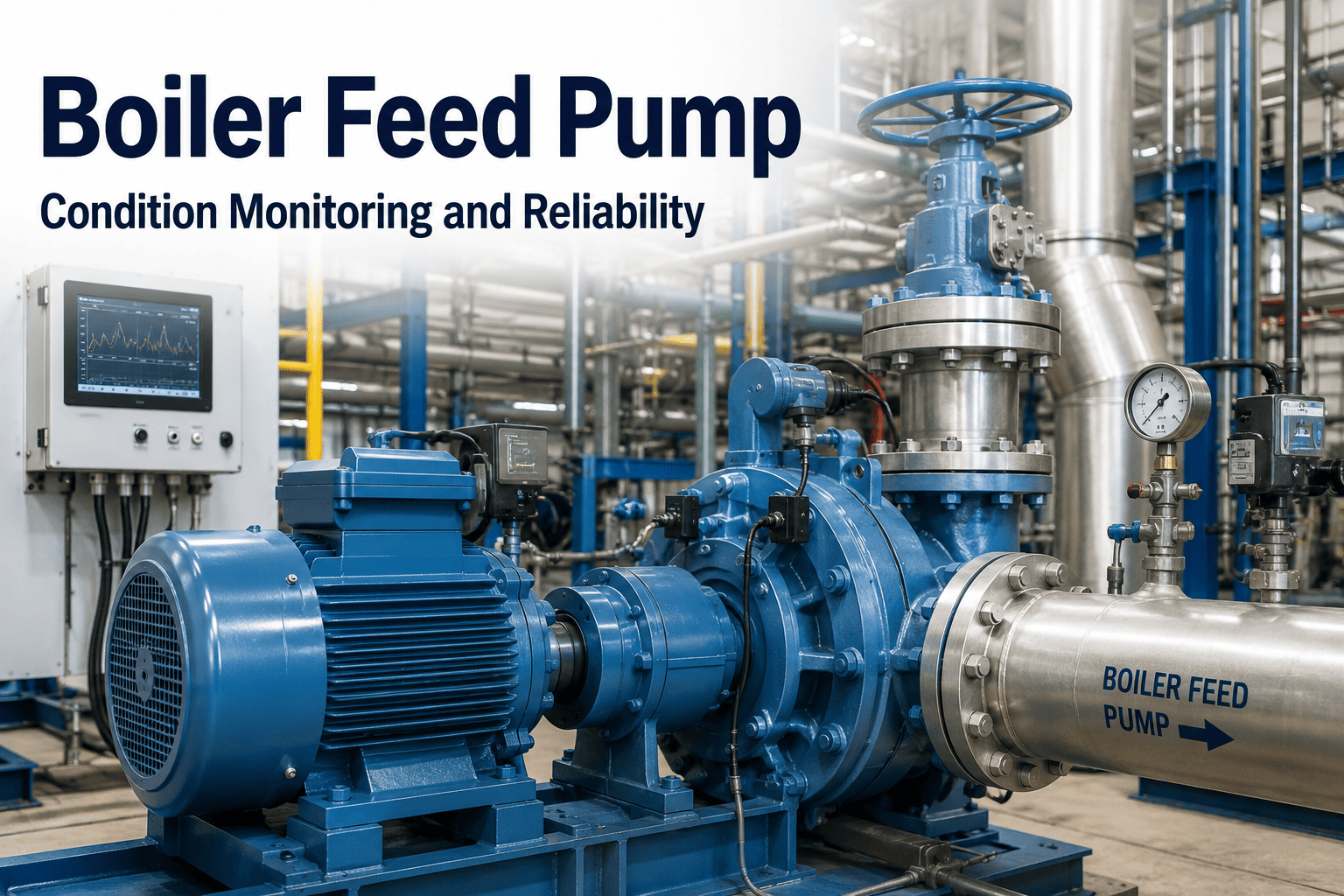
Boiler Feed Pump Condition Monitoring and Reliability
Correlate vibration, thrust pad wear, and motor current against ISO 20816 thresholds. Catch bearing degradation, cavitation, and misalignment before they become a unit trip — on a single on-prem edge server.
2nd
most cited forced outage cause
70%+
rotating failures start at bearings
4.5mm/s
ISO 20816 vibration threshold
6-12wk
to go-live, on-prem
The Failure Modes That Trip Units
A BFP fails along two lines — hydraulic and mechanical — and the underlying causes interact. Cavitation damages the impeller and induces vibration; vibration accelerates bearing wear; bearing wear shifts alignment; misalignment amplifies vibration. Understanding which mode is developing early is what separates a planned outage from a forced one.
Hydraulic
Fluid-Driven Failures
Cavitation
Suction pressure falls below vapor pressure, vapor bubbles form and collapse violently on the impeller — pitting damage, noise, vibration, and efficiency drops of up to 20%. Root cause is usually inadequate NPSH margin.
Flow Instability
Running outside the pump's rated flow range produces turbulent forces and radial thrust — leading to seal problems, packing failure, and eventually shaft damage. Common at low-load partial-flow operation.
Recirculation
Internal recirculation at off-BEP operating points creates pressure pulsations that shuttle the rotor axially — a leading cause of thrust bearing damage and shaft fatigue in variable-load service.
Mechanical
Rotating Element Failures
Bearing Wear
Inadequate lubrication, contamination, or misalignment progressively degrades bearing clearance. Bearings alone account for more than 70% of rotating equipment failures — this is the single biggest failure population to monitor.
Thrust Pad Wear
Balance drum wear or lubrication issues load the thrust bearing beyond design. Excessive axial shaft movement is the direct precursor to thrust bearing failure and catastrophic rotor damage.
Coupling Misalignment
Pump-to-motor misalignment induces cyclic vibration and premature seal failure. Detectable as axial vibration and 1x/2x running-speed spectral peaks well before it damages the coupling.
The P-F Interval Is Your Warning Window
Every BFP failure develops along a P-F curve — from the potential failure point where degradation first becomes detectable, to the functional failure where the pump can no longer do its job. Different indicators reveal themselves at different points on that curve. Watching only the last two means you get the shortest lead time to act.
Weeks to months
Vibration Signature Change
The earliest reliable indicator. Small shifts in vibration amplitude or spectrum — a 5 µm change on a bearing — reveal emerging imbalance, misalignment, or bearing degradation long before anything is audible.
Days to weeks
Thrust and Temperature Rise
Bearing temperature climbs, thrust pad wear accelerates, motor current signature shifts. The degradation is now measurable at multiple points and the intervention window is narrowing.
Hours to days
Audible Noise, Particles in Oil
A walkaround inspector can hear something now. Wear particles show up in lube oil samples. The pump is close to functional failure and the operating window is small.
Zero warning
Functional Failure — Unit Trip
Drum level cannot be maintained, the boiler cannot follow load, the unit trips. Forced outage, MW lost, and the cost of the failure now includes market exposure and startup fuel.
Where the Sensors Go, Per ISO 20816
Vibration monitoring is not "put a sensor somewhere." ISO 20816 lays out sensor placement for rotating machinery, and BFPs benefit from a defined layout: two radial sensors on the pump bearing housing, two on the motor, and an axial sensor to catch misalignment early. Add thrust and motor current, and the failure modes above become observable end-to-end.
01
Vibration — Pump and Motor Bearings
Radial sensors on both pump and motor bearing housings measure amplitude and spectrum. The primary condition indicator; 4.5 mm/s RMS is the common ISO alert threshold for BFP-class machinery. An axial sensor detects misalignment before coupling damage.
02
Thrust Pad Wear
Axial shaft position monitored against thrust pad thickness. Progressive wear indicates lubrication issues or balance drum degradation — one power plant case caught rising thrust in time to safely shut down a BFP on a 350 MW set before bearing damage occurred.
03
Motor Current Signature
MCSA reveals rotor bar defects, air gap eccentricity, and load anomalies that vibration alone can miss. Motor current also correlates directly with hydraulic performance — a shift here often points to cavitation or off-BEP operation.
04
Process Correlation
Suction and discharge pressure, NPSH margin, bearing temperature, seal flush flow, and lube oil pressure — the hydraulic and lubrication context that turns a raw vibration alert into a specific failure hypothesis.
Want to see how iFactory correlates all four streams on your BFPs? Book a demo and we'll walk your unit through live condition monitoring.
The 32 µm Story: Why Trending Beats Threshold
A well-documented power plant case shows what early trending looks like in practice. At one coal-fired plant, an AI-powered condition monitoring system flagged BFP-2 when the inlet bearing vibration moved from 32 µm to 37 µm — a five-micrometer shift outside the expected operational range. The absolute number was still low by any static threshold. The deviation from baseline was the signal.
Power plant case
Small Signal, Big Save
The 5 µm shift guided the team to focus on the mechanical seal and related components — a targeted inspection rather than a full pump strip-down. The alert bought the outage-planning window the plant needed. In high-speed rotating machinery, even small deviations signal serious underlying issues, which is why baseline-relative trending catches failures that fixed thresholds do not.
From Anomaly to Action
Detection alone is not reliability. The value is the closed loop — anomaly detected, failure mode diagnosed, corrective work order created, and outage planned before the pump forces one. iFactory closes that loop against the same signal set that gave you the early warning.
1
Detect the Deviation
Vibration, thrust, current, and temperature compared continuously to baseline — deviations flagged the shift they appear, not on next month's inspection.
2
Classify the Failure Mode
Spectrum analysis, thrust behavior, and current signature narrow the diagnosis — bearing wear vs cavitation vs misalignment — before the maintenance team steps into the boiler house.
3
Estimate Time to Failure
Trend rate against P-F curve models the intervention window — days, weeks, or months — so the outage is planned to load and market conditions, not forced by the pump.
4
Trigger the Work Order
Corrective work order raised to the CMMS with the specific component, part list, and diagnostic detail — reliability team hits the pump with a plan, not a hunch.
Why Walkarounds Miss the Early Signal
Walkaround inspections still catch failures — the loud, late, obvious ones. The problem is that the earliest, cheapest window to act closes weeks before anything is audible. Continuous condition monitoring changes what "early" means for a maintenance team.
Walkaround inspection
Late by Design
Rounds run weekly or monthly, so weeks of P-F interval are invisible
Catches audible noise and heat — the last two stages of the curve
A 5 µm shift on a bearing is below the sensitivity of a hand meter
Diagnosis depends on the memory of whoever is on shift
iFactory continuous monitoring
Early and Repeatable
Vibration, thrust, current sampled continuously with baseline comparison
Small baseline-relative shifts flagged before absolute limits are hit
Failure-mode classification, not just an over-threshold alarm
Learning retained in the system across shifts and personnel
What a Forced BFP Outage Actually Costs
The cost of BFP failure is not the pump. It's the lost megawatt-hours, the startup fuel, the market exposure of missed dispatch, and the compressed repair schedule that turns a planned outage into a nights-and-weekends job. That is why the P-F interval is worth so much.
2nd
forced outage cause
BFP events cited behind boiler tube leaks in industry reliability studies
70%+
start at bearings
bearings alone account for the majority of rotating equipment failures
20%
efficiency drop
cavitation alone can cost this much in pump efficiency before failure
50-70%
lifecycle cost is energy
a degraded BFP eats power long before it forces an outage
On-Prem AI, Live in 6 to 12 Weeks
Vibration signatures, thrust histories, and process telemetry are core plant operating IP. The iFactory condition monitoring platform runs on a pre-configured edge server on-premise, with all processing inside your firewall and no external egress required to operate. It ships racked and ready with the reliability models pre-loaded — and a structured deployment puts it live in a single quarter.
1
Rack the edge server
A pre-configured edge AI server slots into the plant, shipped pre-validated with the BFP condition monitoring and reliability analytics pre-loaded.
2
Connect sensors and DCS
Read-only links to existing vibration monitors, thrust probes, motor CTs, and DCS process tags let the AI learn each pump's normal operating envelope.
3
Reliability board goes live
Vibration, thrust, current, and process correlation run on-prem inside your firewall — with anomaly alerts, failure mode classification, and CMMS work-order integration.
What Live BFP Monitoring Delivers
Continuous, multi-parameter condition monitoring converts directly into fewer forced outages, longer intervention windows, and a shift from reactive to planned maintenance. These reflect outcomes reliability teams report after moving from walkaround-and-threshold to correlated AI monitoring.
Earlier
P-F detection
baseline-relative alerts trigger weeks before threshold alarms
Fewer
Forced outages
BFP failures converted to planned outages within scheduled windows
Ranked
Failure modes
bearing vs cavitation vs misalignment diagnosed before strip-down
Auto
CMMS work orders
corrective jobs raised with specific component, not generic tickets
Curious what a P-F trend looks like on your own BFPs? Talk to our reliability team and benchmark your fleet against live AI condition monitoring.
Frequently Asked Questions
Are BFP failures really that common a forced outage cause?
In industry reliability studies of thermal power plants, boiler feed pump and boiler feed system events consistently sit near the top of forced outage causes — behind boiler tube leaks, which are typically the single largest category. The exact ranking varies by fleet type, but BFP-related events are widely acknowledged as one of the most impactful BOP reliability categories. And unlike tube leaks, BFP failures develop along a P-F curve that continuous monitoring can catch weeks in advance.
Which parameter matters most — vibration, thrust, or current?
Vibration is the primary condition monitoring tool for BFPs and gives the earliest warning for bearing wear, misalignment, imbalance, and cavitation. Thrust monitoring is essential because thrust bearing failure is one of the fastest paths to catastrophic damage and it is not always visible in vibration alone. Motor current signature analysis catches rotor and electrical issues, and correlates with hydraulic problems that pure mechanical monitoring can miss. The value comes from correlating all three against process context — no single parameter tells the whole story.
Why isn't a fixed 4.5 mm/s alarm threshold enough?
Static thresholds catch late-stage failures reliably — they are excellent trip protection. What they miss is early-stage degradation where the absolute value is still well within limits but the trend from baseline has shifted. The 32-to-37 µm case is the canonical example: neither reading would fail an ISO 20816 zone-A/zone-B check, but the deviation from baseline was the actionable signal. Baseline-relative trending catches failures weeks before static thresholds do.
Can we use our existing vibration and DCS instrumentation?
Yes, in most cases. iFactory integrates read-only with existing online vibration monitors, thrust probes, motor CTs, and DCS process tags. If a pump has ISO 20816-compliant sensor coverage, the AI learns its baseline envelope from the existing signal set. Where a pump lacks sensor coverage, we recommend the minimum instrumentation to reach reliable monitoring — typically the radial and axial sensor layout on the pump and motor called out in the standard.
Does our vibration and process data leave the plant, and how long to deploy?
No data leaves. The AI runs on a pre-configured edge server on-premise, with all processing inside your firewall and no external egress. The server ships racked and ready with software pre-loaded, and a structured deployment puts the live BFP reliability board and CMMS integration in service in 6 to 12 weeks. The fastest way to see fit is a demo on your own pump data — book one and bring a recent vibration trend and a forced outage report.
Convert Forced Outages Into Planned Ones.
See Your BFPs Trended Against P-F
Bring a recent vibration trend and a forced outage report. We'll show live correlation of vibration, thrust, and motor current on your pumps, failure-mode classification, and CMMS work orders raised from AI alerts — all on an on-prem server, live in 6 to 12 weeks.
ISO 20816
threshold aware