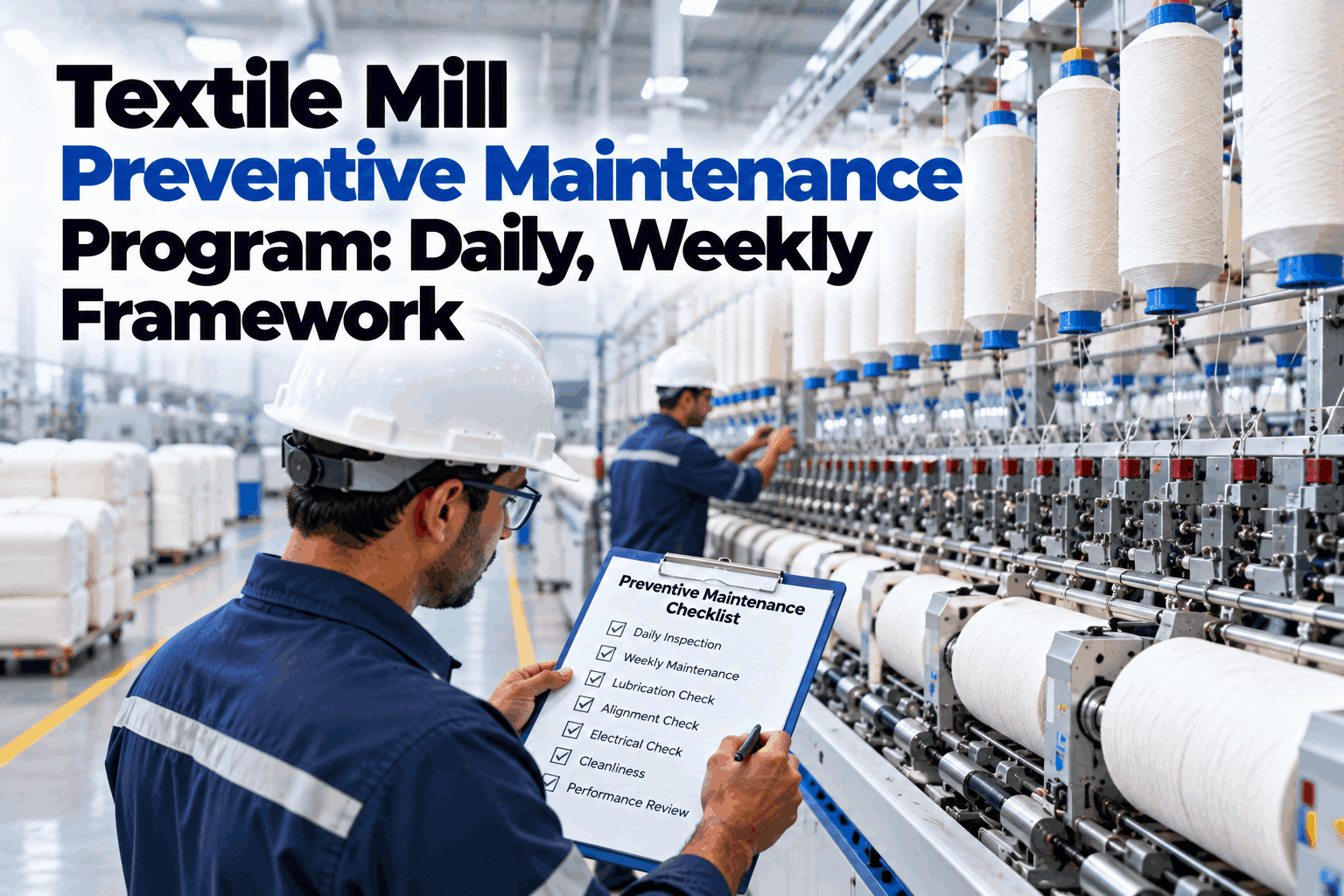
A spinning frame stops mid-shift. The operator tells the shift fitter, the fitter jots the fault on a slip and the slip is still on the desk when the next shift arrives. The machine sits idle, the part is ordered twice and nobody can say how often this frame has failed this quarter. Paper requests and verbal hand-offs hide the very information a textile mill needs to cut breakdowns, backlog and defects. Digital maintenance work orders put every job on one record that follows it from request to close, on the phone in the technician's pocket. This guide shows what a useful work order contains, where jobs come from, which KPIs to track and how to avoid the mistakes that keep paper habits alive on a screen. To apply it to your own mill, book a work order walkthrough.
Digital Textile Maintenance Work Orders for Textile Manufacturing
A practical guide for maintenance teams: how a work order moves from request to close on a mobile phone, which fields make it useful and how to cut backlog, repeat failures and defects.
- How a job moves from request to close on a phone
- Which fields make a work order useful for analysis
- How to cut backlog and repeat failures
Four causes explain more than 80% of the lost hours, and none of them is the repair itself. The dashed line marks where the cumulative share passes 80%.
What a Digital Work Order Really Is
A digital work order is one record that follows a job from request to close.
An operator or a machine alert raises the request. The system routes it to the right technician, who sees the machine, the symptom and the instructions on a phone. The technician records the cause, the parts used and the time, then closes the job with a check that the machine runs properly. Every step is time-stamped and stays in the machine's history. Our maintenance analytics team can show how this looks on your own machines and departments.
Raise it at once
From a phone or a machine alert, with the asset named.
Route by rule
To the right skill and shift, by priority.
Work from the phone
Checklist, parts, time and cause recorded on the job.
Verify and learn
Checked, closed and added to the machine history.
Every closed job adds a cause, a time and a list of parts to the machine's history. That history is what makes preventive and predictive maintenance possible. A job closed with "done" adds nothing.
What a Useful Work Order Contains
The fields decide whether the history can be analysed later.
A work order that records only a machine and a date tells you little. A few well-chosen fields turn each job into data that shows which machines fail, why and at what cost. To see which fields your mill already captures, book a work order data review.
A list of ten to twenty failure codes per machine type is easier to use than a long one. If technicians have to scroll to find a code, they will pick the first one and the data will mislead.
Where Textile Work Orders Come From
Jobs should be raised from more than one source.
A mill that waits for breakdowns raises work orders only after the damage is done. Digital work orders can also be raised from the maintenance plan, from machine condition and from quality findings, so problems are handled earlier and with less lost production.
Repeating yarn and fabric defects often start with machine condition. When a defect is tied to a machine and a position, the work order for the fix can be raised from the quality finding, not from the next breakdown.
What a Faster Work Order Cycle Is Worth
Minutes lost between a fault and a technician can look small on a shift report. Multiplied across a year of breakdown jobs and the contribution of a running machine, they become a number worth acting on.
From Request to Close
A good work order flow leaves no job without an owner.
Each step should be visible to the maintenance team and to production. A digital flow shows which jobs are open, who holds them and what each one is waiting for, so the team can clear blocks instead of chasing updates.
Request
Raised from the floor or an alert.
Assign
Routed by skill, shift and priority.
Diagnose
Cause found and recorded.
Repair
Parts and time logged on the job.
Verify
Test run and quality check.
Close
History updated for next time.
KPIs a Work Order System Should Feed
Good work order data makes the maintenance KPIs reliable.
Textile maintenance KPIs are only as good as the records behind them. When every job carries an asset, a cause, a time and parts, the KPIs follow without extra spreadsheets.
Sort open jobs by age and priority and ask what each is waiting for. A short weekly review keeps old jobs from becoming permanent and shows whether the cause is parts, access or people.
Common Work Order Mistakes
Most weak data comes from jobs that are closed too quickly.
A digital system can still end up recording very little. A few simple habits keep the work order history useful and keep the technicians on side.
Good practice
- Raise requests from the floor, on a phone
- Use short failure codes with a clear meaning
- Close each job with parts, time and a check
Common mistakes
- Verbal requests that never reach the system
- Closing jobs as "done" with no cause
- Letting the backlog grow with no priority rule
If raising a request on a phone takes longer than telling the fitter, people will go back to telling the fitter. Keep the form to a few taps: machine, symptom, priority and a photo.
How iFactory Digital Work Orders Work
Requests and alerts in, closed jobs and clean history out.
iFactory's maintenance management raises work orders from phone requests, preventive schedules and condition alerts, then routes them by skill, shift and priority. Technicians work from a phone, record cause, parts and time, and close each job with a check. Parts link to your spare parts stock, and dashboards show backlog, planned work, repeat failures and the other KPIs above. It runs on an on-prem server inside your network, with one view across departments and sites. Questions on fit go to our support desk.
From the floor
Phone requests, schedules and condition alerts.
By rule
Skill, shift and priority decide who gets the job.
With data
Cause, parts and time recorded before closing.
Find repeat failures
History shows which machines and causes recur.
Results depend on your machines, how consistently jobs are recorded and how quickly causes are acted on. We measure assignment time, backlog and repeat failures on your own data during the pilot, rather than promising a general figure.
Turnkey AI: Delivered, Connected and Live in 6–12 Weeks
You do not build this. It arrives ready.
iFactory ships as a pre-configured NVIDIA AI server with the software pre-loaded. Rack it, plug in power and Ethernet, and the AI is live on your network. Our team handles cabling, network setup, asset list, spare parts and machine data integration, team training and 24×7 remote monitoring. Data stays on your own network. For a scope matched to your mill, request a turnkey quote.
Ship, network and asset data
Server installed. Asset list and spare parts data loaded for the pilot departments.
Codes, schedules and rules
Failure codes, preventive schedules and priority rules set with your maintenance team.
Go-live and training
Mobile work orders live. Technicians trained. 24×7 remote monitoring begins.
Frequently Asked Questions
What is a digital maintenance work order?
It is an electronic record of a maintenance job, from request to close, holding the machine, the symptom, the cause, the parts used, the time spent and the verification. It replaces paper slips and verbal requests.
How is it different from a paper work order?
It reaches the right technician at once, shows the machine history, links to spare parts and creates data that can be searched and analysed. A paper order is hard to track and rarely feeds any analysis.
Do all technicians need their own smartphone?
Not necessarily. Many mills use shared tablets or a few rugged phones per shift. Plan device numbers, charging and floor connectivity before go-live so the system is easy to use in practice.
How do work orders support predictive maintenance?
Condition alerts can raise jobs automatically, and closed jobs with failure codes build the history that predictive models and reliability reviews need. Without that history, alerts have no context.
How do work orders connect to spare parts management?
Each job records the parts used, which updates stock and shows which parts cause waiting. That gives better reorder levels for items such as bearings, cots and belts.
How do we start?
With one department that has frequent breakdowns, such as spinning or weaving. A 6-week pilot connects the asset list, sets failure codes and shows the first live backlog view. To plan it, contact our team.
See How Your Work Orders Flow Today
In thirty minutes we look at how requests reach your technicians, how jobs are closed and what your records show. You keep the notes whether or not you go further with iFactory.
- 1Recent paper work orders or request slips
- 2The asset list for one department
- 3Your common failure types and spare parts
- 4Your current backlog and preventive schedule
- 5The department with the most repeat breakdowns