A loom that breaks down mid-run doesn't just lose the hours it sits idle — it loses the warp tension history, forces a restart sequence, and often produces a metre of off-spec fabric on both sides of the stoppage. A ring frame whose spindle bearings are replaced on the day they fail costs three times what they cost when replaced at the scheduled interval, and leaves the operator running reduced production for two shifts while parts are sourced. A sizing machine whose pressure rolls go unserviced until they show visible wear has been producing inconsistently sized yarn for weeks before the defect shows up in a weaving shed complaint. Preventive maintenance in a textile mill is not a cost — it is the mechanism by which production quality and machine efficiency are controlled. The mills that achieve the lowest defect rates and the highest machine efficiency are not running better equipment. They are running the same equipment on a structured daily and weekly maintenance framework that catches degradation before it becomes a breakdown. iFactory Maintenance Management is built to run that framework — every machine, every department, every task, tracked live.
iFactory Maintenance Management — Textile Manufacturing
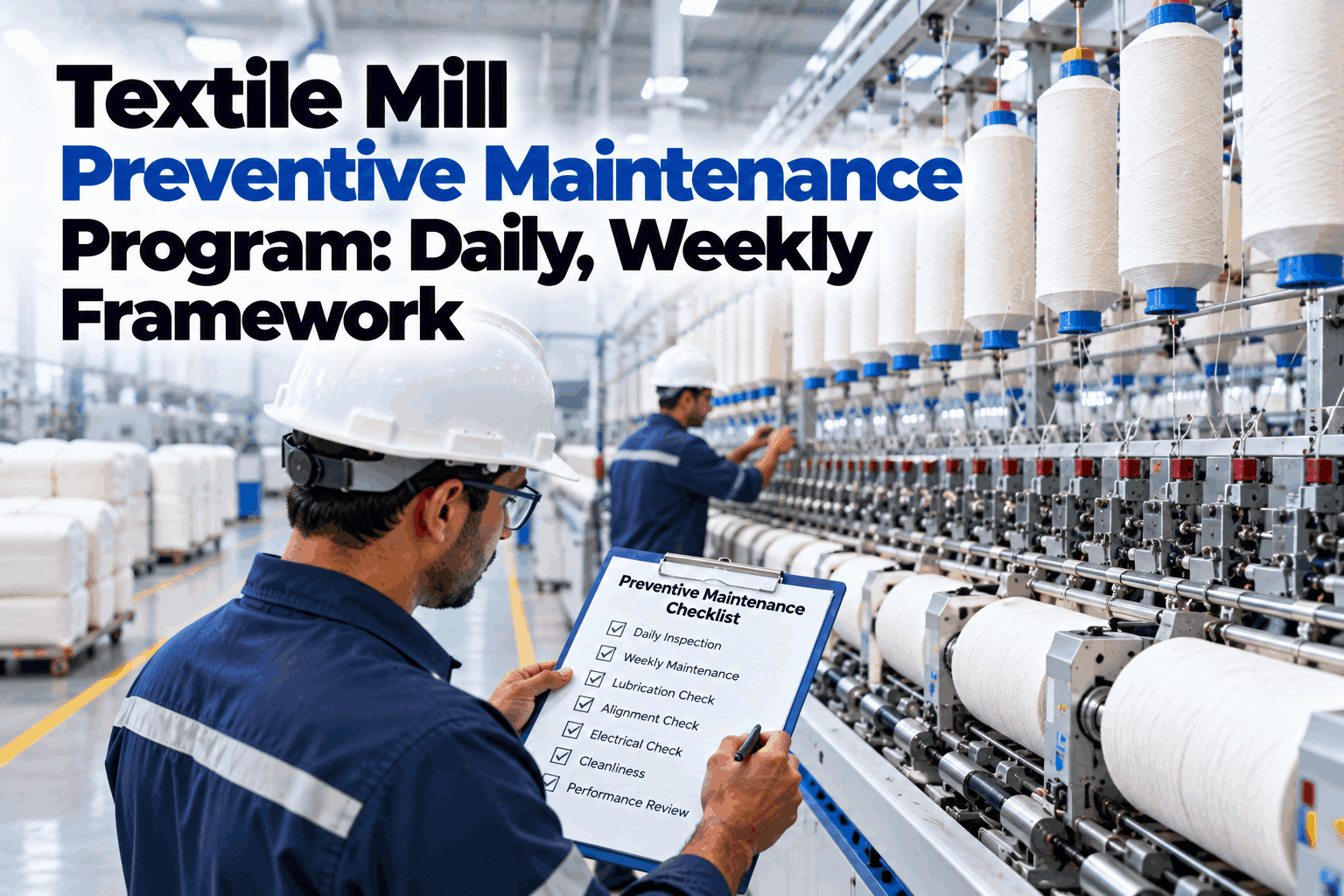
Textile Mill Preventive Maintenance: Daily & Weekly Framework
Structured PM schedules for spinning, weaving, sizing, and finishing — with work order tracking, spare parts visibility, and maintenance KPIs that show whether the programme is actually running or just planned.
3× higher
repair cost when bearings fail vs scheduled replacement
15–25%
reduction in machine downtime within 6 months of structured PM
Daily + weekly
framework covering every machine class across spinning to finishing
Live backlog
PM compliance tracked per shift, per department, per machine
Why Textile Mills Stay Reactive — Even When They Know Better
Most textile maintenance managers understand preventive maintenance. Most have a PM schedule somewhere — in a spreadsheet, a binder, or a legacy system. The problem is not the plan. It is the six reasons the plan does not run the way it was written, and why breakdown maintenance fills the gap every time.
01
Production pressure overrides PM
When a loom is running on order, stopping it for a scheduled lubrication check requires a deliberate decision. Without a system that makes the PM task visible and overdue, the production supervisor always wins the argument.
02
Tasks not assigned to anyone specific
A PM checklist on a wall assigns a task to a shift, not to a person. At shift end, if the check wasn't done, no one knows — because no one was named on it and no one has to close it out in a system.
03
No visibility of what was actually done
A paper checklist signed at the end of a shift proves the paper was signed. It does not prove the check was done. Without digital work order closure with technician ID and timestamp, compliance is an estimate.
04
Spare parts not available at task time
A weekly bearing replacement schedule breaks down immediately if the bearings aren't in the store when the task is due. Without parts-linked work orders, the technician defers the task and the deferral is never tracked.
05
Backlog not measured or managed
Every PM task that is deferred but not rescheduled becomes invisible backlog. Without a backlog KPI, maintenance managers don't know how far behind the programme is until a wave of breakdowns makes it obvious.
06
No link between PM gaps and defect rates
When a loom section produces broken-end defects, the investigation starts at the yarn — not at the last time the temple mechanism was serviced. PM records and quality data live in separate systems and never meet.
The Daily PM Framework — What Every Shift Should Complete
Daily preventive maintenance in a textile mill is not a deep inspection — it is a structured set of quick checks that catch the early signals of degradation before they become a stoppage. These are the tasks that run every shift, across every major machine class, in a well-run textile PM programme.
Spinning — Daily
Ring frame, open-end, speed frame
OperatorCheck spindle speed and vibration — flag any irregular sound
OperatorInspect bobbin holders and traveller condition — replace worn travellers
TechnicianLubricate top-roller saddles — check for flat spots and cradle wear
TechnicianCheck suction system — clear lint buildup at filter and duct entry
TechnicianInspect drafting zone aprons — replace any cracked or glazed aprons
OperatorLog end breakage count per frame — compare to previous shift baseline
Weaving — Daily
Rapier, air-jet, projectile, shuttleless
OperatorCheck warp tension consistency across the width — flag any loose or tight sections
TechnicianInspect and clean shed-forming mechanism — check cam timing marks
TechnicianLubricate rapier band and gripper heads per OEM interval schedule
OperatorCheck weft insertion quality — inspect for missing picks, double picks
TechnicianClean temple inserts and check for thread-count-appropriate sizing
OperatorLog picks per minute and warp-break count — compare to loom baseline
Sizing & Prep — Daily
Sizing machine, warping, beaming
TechnicianCheck size box temperature and viscosity — log against recipe specification
TechnicianInspect squeeze roll pressure — confirm nip gap is within spec per yarn count
OperatorCheck yarn breakage count on warping creel — inspect for package tangle sources
TechnicianClean drying cylinder surface — check for size buildup and surface condition
TechnicianInspect leasing rods and drop wire guide alignment on beaming headstock
OperatorLog beam weight and ends-per-beam vs target — flag any deviations
The Weekly PM Framework — Deeper Inspections by Department
Weekly preventive maintenance tasks are the deeper inspection layer — the checks that take a machine out of production for 30 to 90 minutes, require a trained technician, and address the subsystems that daily checks don't reach. These are the tasks that prevent the major failures. Missed weekly PMs are where most unplanned breakdown events in textile mills originate.
Spinning
Weekly — per frame
Full spindle vibration check — replace any spindle running above threshold
Top-arm spring tension measurement — recalibrate to spec per count
Bottom-roller bearing condition — listen for roughness, check temperature
Ring and traveller gauge — check ring condition, replace travellers to schedule
Suction duct deep clean — full lint clear through all drops and main trunk
Gear box oil level check — inspect for oil discolouration or metallic content
Weaving
Weekly — per loom
Shedding mechanism full inspection — check cam followers, springs, and timing
Beat-up reed condition — inspect for bent dents, replace if count requires
Warp stop-motion contact inspection — clean and test all drop-wire contacts
Selvedge cutter blade condition — replace worn blades, check actuation timing
Main shaft bearing temperature — check against baseline during production run
Lubrication system function — verify all lube points receiving correct oil flow
Sizing & Warping
Weekly — per machine
Full size box cleanout — remove all solidified size, inspect box condition
Squeeze roll rubber condition — measure shore hardness, log degradation
Drying cylinder steam trap function — check for bypass or waterlogging
Warping tension disc inspection — replace worn or pitted discs by creel position
Drive chain and sprocket inspection — check elongation, lubricate to schedule
Beam flange face condition — check for dents or damage before next set
Finishing
Weekly — per line
Stenter chain and clip condition — inspect for bent clips, stretched chain
Burner efficiency check — measure temperature profile across stenter width
Mangle roll nip pressure — measure and recalibrate to fabric specification
Sanforizing blanket thickness — measure at five points across width, log wear
Chemical dosing pump calibration — verify flow rate matches recipe demand
Exhaust fan belt condition — inspect tension, check bearing temperature
The Live PM Dashboard — Compliance Visibility Across Every Department
A PM schedule without compliance tracking is a list of good intentions. Live PM dashboard visibility means every department showing its task completion rate, overdue count, and backlog against the schedule — in real time, not in a Monday morning report that covers last week's failures.
Spinning — Hall A
48 ring frames
On schedule
Daily PM compliance96%this shift
Weekly tasks due128 completed, 4 open
Overdue tasks0backlog clear
End breakage rate2.1/100within target
Weaving — Shed 2
120 rapier looms
Backlog growing
Daily PM compliance71%−18% vs last week
Overdue tasks2311 weekly, 12 daily
Weekly tasks due3419 completed
Warp break rate4.8/100above 4.0 target
Sizing — Prep Area
4 sizing machines
On schedule
Daily PM compliance100%all tasks closed
Weekly tasks due88 completed
Overdue tasks0backlog clear
Size viscosityOn specall 4 machines
Finishing — Line 1
Stenter + sanforize
Critical overdue
Overdue tasks7stenter chain — 9 days late
Breakdown riskHighchain skip detected
Daily PM compliance68%technician shortage
Alert sent08:14maintenance manager
Preventive vs Reactive — The Cost Difference in a Textile Mill
The argument for preventive maintenance in a textile mill is not just operational — it is financial. Reactive maintenance costs more in every category, and the production loss it causes is the largest cost that never appears in the maintenance budget.
Reactive Maintenance
"We fix it when it breaks."
Emergency spare parts at 2–3× catalogue price — if available at all
Repair labour at overtime rates — breakdown happens at shift end
Secondary damage — failed bearing takes out the shaft, spindle, or housing
Production loss — looms down until repair complete, order delayed
Quality loss — defect fabric produced in the period before the failure was obvious
No data captured — failure mode unknown, same failure recurs in 6 months
Preventive Maintenance
"We replace it before it fails."
Planned spare parts at standard cost — ordered on schedule, in stock
Planned labour at standard rates — scheduled into the shift pattern
Controlled replacement — only the worn part, no secondary damage
Planned downtime — 30-minute PM slot vs 4-hour emergency repair
Quality protected — machine running within spec throughout PM interval
Data captured — failure modes logged, PM interval refined over time
Maintenance KPIs That Tell You Whether the Programme Is Working
A preventive maintenance programme that runs on paper but is not measured produces no reliable results. These are the maintenance KPIs that should be tracked per department, per machine class, and per technician — the numbers that tell a reliability manager whether the PM framework is performing or just scheduled.
PM Compliance KPIs
PM task completion rate — daily tasks closed vs scheduled
Weekly PM compliance % — per department and per machine
PM backlog — overdue tasks by age and priority
Mean time between PM deferrals — how often tasks slip
Technician task close rate — individual accountability
Machine Reliability KPIs
MTBF — mean time between failures per machine class
MTTR — mean time to repair per failure type
Unplanned downtime % — per shift and per department
Breakdown frequency — events per 1,000 machine hours
Machine efficiency % — actual vs rated production speed
Quality-Linked KPIs
End / warp break rate per frame or loom
Defects per 100 metres — by machine and by maintenance state
Defect-to-PM correlation — quality events linked to missed tasks
Second-quality fabric % — produced in breakdown recovery periods
Customer complaints linked to machine condition
Cost & Spares KPIs
Maintenance cost per kg of yarn or metre of fabric
Reactive vs planned maintenance spend ratio
Spare parts consumption vs PM schedule forecast
Emergency purchase cost — unplanned parts at premium price
Spares stockout rate — parts not available at task time
Want to see your PM compliance and backlog by department? Book a demo — bring your current PM schedule and we'll show you how iFactory tracks it live against completion.
How iFactory Runs Your PM Programme — From Schedule to Closed Work Order
The gap between a PM schedule that exists and a PM programme that runs reliably is five operational steps. Each one is where iFactory replaces a paper-based assumption with a tracked, assigned, and verified activity.
01
Schedule Build
Daily and weekly PM tasks built per machine class — operator checks, technician inspections, lubrication routes, and replacement intervals — mapped to your specific equipment list and department structure.
02
Work Order Issue
Tasks auto-generated as work orders at the start of each shift — assigned to named technicians or operators, with parts pre-listed, tools specified, and estimated duration set. No task starts without an owner.
03
Mobile Completion
Technicians close work orders on mobile devices at the machine — with checklist confirmation, reading entry where required, and photo attachment for any finding that needs escalation. Timestamp and ID recorded automatically.
04
Backlog & Alert
Any task not closed by its due time becomes visible overdue backlog — flagged by machine, department, and age. Alerts sent to maintenance supervisor when overdue tasks reach a threshold or when a critical task is missed.
05
KPI & Trend
PM compliance, backlog age, MTBF, and quality-linked maintenance data reported per department and per machine — trended over time so the reliability manager can see whether the programme is improving or drifting.
Machine Types Covered — Spinning Through Finishing
Textile manufacturing is one of the most equipment-diverse production environments in any industry. A vertically integrated mill may run ring frames, open-end machines, sizing ranges, rapier looms, and stenter finishing lines under the same roof — each with entirely different PM requirements, spare parts, and failure modes. iFactory covers every machine class on one maintenance platform.
Spinning
Ring frame
Open-end / rotor
Speed frame / roving
Draw frame
Comber
Carding machine
Weaving Preparation
Warping machine
Sizing / slashing machine
Beaming / sectional warper
Twisting machine
Winding machine
Leasing / drawing-in frame
Weaving
Rapier loom
Air-jet loom
Projectile loom
Water-jet loom
Dobby loom
Jacquard loom
Dyeing & Finishing
Stenter / tenter frame
Sanforizing machine
Jigger / winch dyeing
Continuous dyeing range
Mangle / padding machine
Raising / shearing machine
Want to see how the PM framework maps to your specific machine list? Talk to our textile maintenance team — we'll build a sample schedule from your equipment register before any commitment.
What a Structured PM Programme Delivers in a Textile Mill
The return on a structured preventive maintenance programme in a textile mill compounds across three dimensions simultaneously: lower maintenance cost, higher machine efficiency, and better fabric quality. These are the outcomes mills see within 6 to 12 months of moving from reactive to structured PM with live compliance tracking.
15–25%
Downtime reduction
unplanned stoppages within 6 months of structured PM
3× lower
Repair cost
planned replacement vs reactive emergency repair per event
Linked
PM to quality data
defect rate and machine maintenance state on one view
Live backlog
Compliance visibility
overdue tasks by department, machine, and age — not a weekly report
Frequently Asked Questions
How long does it take to build the PM schedule for a textile mill?
For a mill with a defined equipment register — machine types, counts, and OEM documentation available — a working daily and weekly PM schedule can be built in 2 to 4 weeks. This covers task definition, interval setting, assignment rules, and spare parts linkage for each machine class. Where OEM documentation is incomplete, we work from industry-standard intervals for each machine type and adjust based on the mill's own breakdown history from the first 60 to 90 days of operation. The schedule is a live document — intervals tighten or extend as MTBF data accumulates.
How do technicians access and close their work orders on the shop floor?
Through iFactory's mobile interface on a phone or tablet — or through a shared terminal at the department entry if mobile devices are not permitted on the floor. Work orders are presented as a task list per shift: machine ID, task description, required tools and parts, and estimated duration. The technician confirms each checklist item, enters any reading (bearing temperature, oil level, spindle vibration count), attaches a photo if there is a finding, and closes the work order. The system timestamps every action and records the technician ID — no paper signature required.
What happens when a technician finds a defect during a PM task?
The PM task is closed as a "finding" rather than a "pass" — the defect description, severity, and photo are logged against the machine. The system auto-generates a corrective maintenance work order with the finding linked as context, assigns it to the appropriate technician or supervisor based on severity, and flags it in the maintenance backlog with the PM task as its root cause. This is the data chain that transforms PM from a compliance activity into a reliability improvement programme — every finding feeds back into the failure history for that machine.
Can the system manage spare parts stock against the PM schedule?
Yes. Spare parts are linked to specific PM tasks — bearings to weekly ring frame inspections, aprons to daily drafting zone checks, travellers to shift replacement schedules. The system tracks consumption against forecast, flags when stock is approaching reorder level based on upcoming PM demand, and generates purchase alerts before a stockout occurs. Emergency purchases driven by reactive breakdowns are tracked separately — giving the reliability manager a clear view of how much of the parts budget is going to planned maintenance vs unplanned failure.
How quickly can we see the impact of the PM programme on breakdown rates?
Most mills see a measurable reduction in unplanned stoppages within 8 to 12 weeks of running a structured PM programme with live compliance tracking — not because PM prevents all failures immediately, but because the backlog of deferred maintenance starts to close and the highest-risk machines get attended to first. MTBF data becomes reliable enough to trend within 90 days. The quality impact — reduced end breakage rates, lower warp breaks, more consistent sizing — typically becomes visible in fabric defect reports within the same period, as the link between maintenance state and quality output becomes measurable for the first time.
Stop finding out about failures after the loom stops.
See a Live PM Programme Running Across Your Textile Mill
Bring your equipment register, your current PM schedule (or what remains of one), and three months of breakdown records. We'll build a sample daily and weekly task framework for your machine types, map it to your department structure, and show you what live compliance tracking looks like on your operation.
Daily+Weekly
PM framework