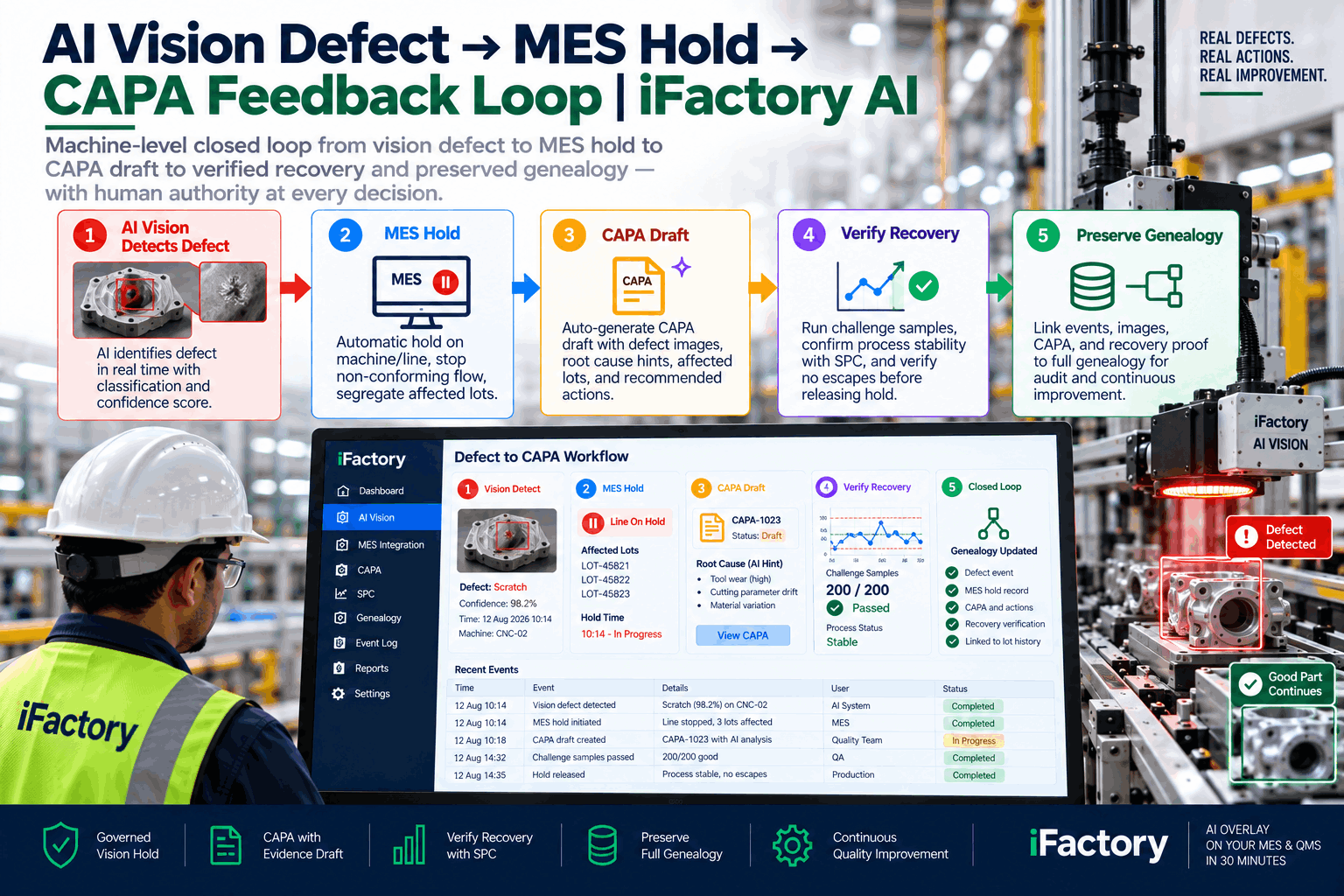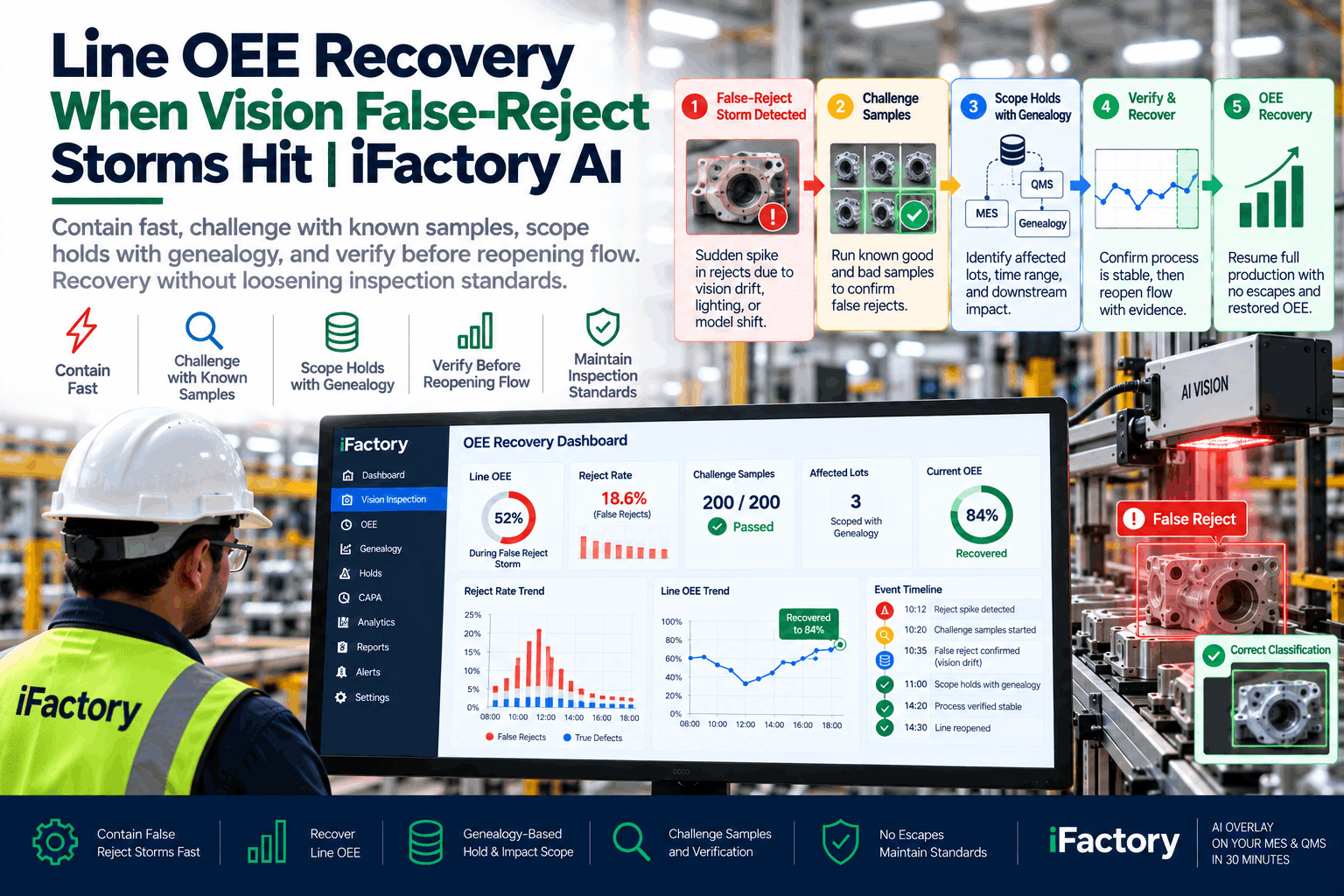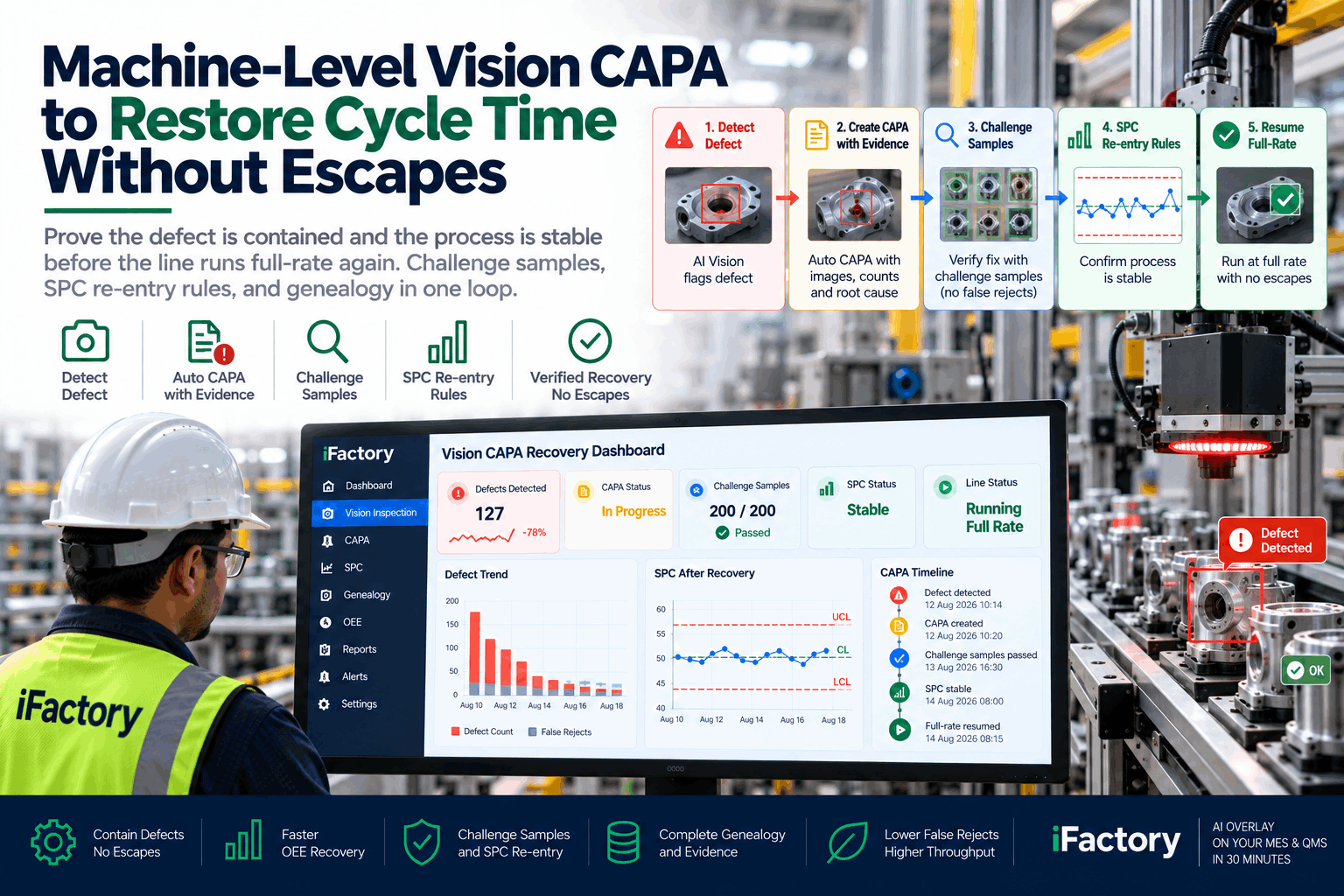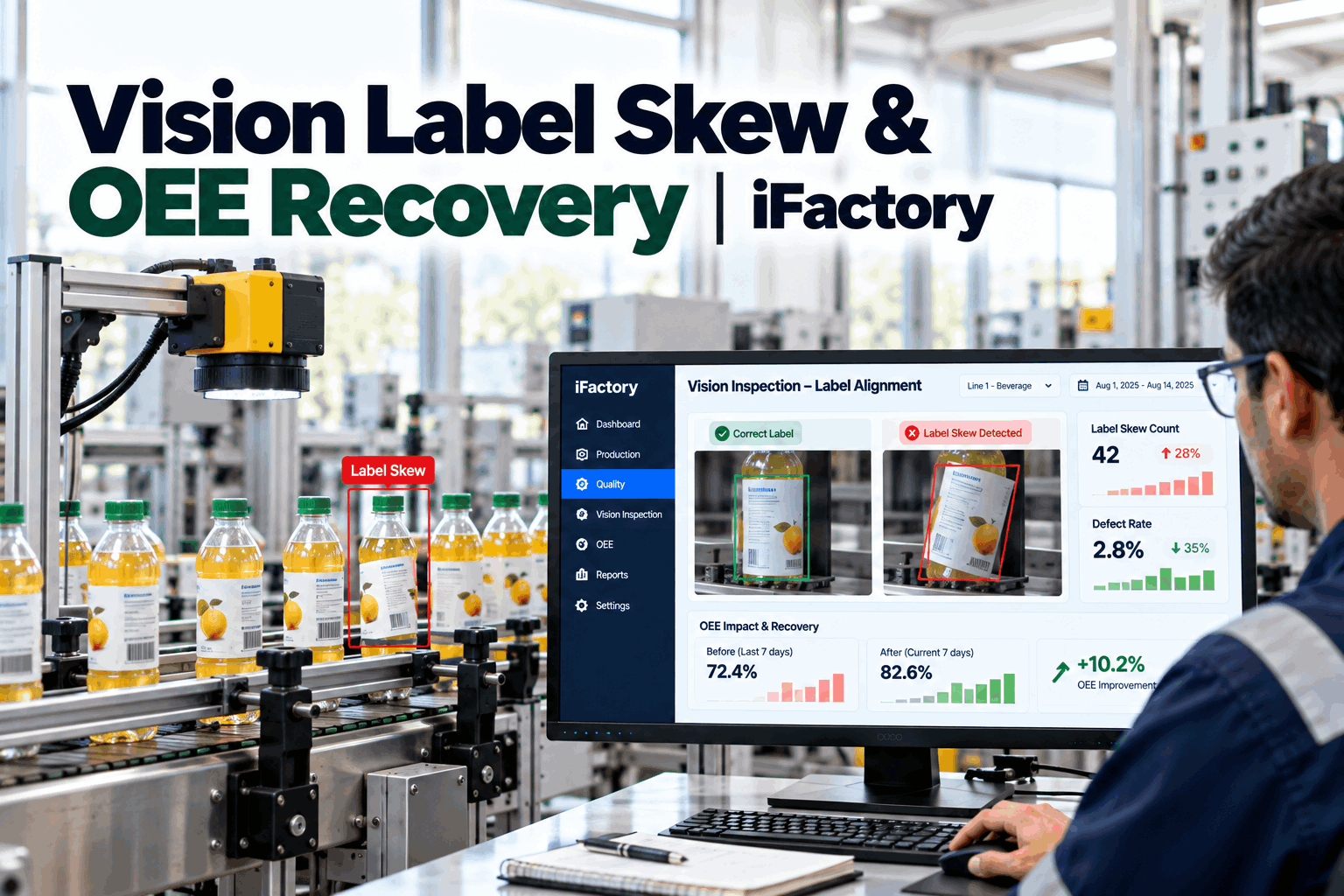
A packaging line supervisor sees skew rejects climbing on a fill-and-label run, and the operator has already adjusted the guide once without effect. In that moment, the OEE meter is ticking down and the containment scope is unclear. iFactory AI overlays your MES, QMS, historian, and vision stack so label skew events arrive with the line, bay, product family, and vision context needed for a fast containment and an evidence-based recovery — not a guess at the adjustment, but a review the operator and supervisor can act on together. Book a 30-minute walkthrough of a label-skew recovery reviewed end to end.
Fast recovery from skew events depends on knowing which bay, which product, which lot, and which adjustment stopped the pattern before OEE loss compounds.
At a Glance
Why Skew Events Punish OEE Disproportionately
Label skew is rarely one big event. It is a cluster of small rejects that stack up across a run. Each reject may take only a few seconds to eject and log, but the underlying condition is often still active, so the next unit fails too, and the next. The result is a run that looks superficially fine on the aggregate — no big downtime block, no dramatic alarm — but that is quietly leaking availability and performance loss through repeated micro-stops and the rework loop that follows.
Recovering from a skew cluster is not just about getting the current unit right. It is about identifying which bay or applicator is producing the skew, whether the pattern is product-specific, lot-specific, or shift-specific, and what adjustment is likely to hold. A guess at the guide adjustment may resolve the current cluster and leave the underlying condition in place for the next shift. A reviewed recovery based on the vision and process context has a much better chance of holding, and the recovery record is what lets the next shift pick up where this one left off rather than starting from scratch.
Context Fields That Sharpen a Skew Recovery
Which applicator, bay, or nozzle produced the skewed units — often the pattern is concentrated on one.
Which product or SKU is running and whether the skew is specific to that geometry or label design.
Which label roll or adhesive lot is in use and whether it was recently changed.
The specific skew angle, position offset, or label edge signature that the inspection flagged.
What the operator or maintenance team recently changed and whether the change is holding.
Whether the pattern coincides with a shift change, operator handoff, or maintenance window.
What iFactory Delivers
iFactory gives the operator and supervisor the bay, product and lot context they need to stop a skew cluster and keep it stopped.
Which applicator or bay is producing the skew, with angle and offset from vision.
Product, label roll, adhesive lot, recent adjustments and shift in one place.
The operator asks which bay is skewing and what changed, and hears it at the line.
The adjustment the crew chose, who approved it and why.
Next-run comparison showing whether the skew cluster stayed resolved.
Skew-driven micro-stops and rework tracked back into your OEE record.
Bring one recent skew cluster. We walk through bay identification, product context, vision inspection review, and the adjustment plan — beside your existing MES and vision system.
A Recovery Workflow That Preserves the Evidence Trail
The strongest recovery workflow does not stop at "issue resolved". It preserves the evidence trail so the recovery can be reviewed, verified, and re-referenced. That trail includes the initial skew cluster with timestamps and bay identification, the vision inspection evidence that triggered the review, the process context reviewed alongside the vision evidence, the adjustment proposed and confirmed by the operator and supervisor, the verification on the next run showing the pattern resolved, and the record stored back against the line, bay, and product family for future reference.
Recurring skew clusters — the same bay, the same product family, the same shift boundary — become visible in that record over time. Those recurring patterns are natural inputs to the CI cadence, and they surface not because a dashboard highlighted them, but because the recovery discipline preserved the trail across many events.
Where Spoken Analytics Fits in Skew Recovery
Spoken analytics does not adjust the applicator. It helps the operator and supervisor review the evidence together — often at the line, headset in place — so the adjustment decision is made with context. The workflow preserves human sign-off on every adjustment and every release-to-run decision. The layer speeds the review, records the outcome, and preserves the trail. The crew still owns the decision that stops the pattern.
The practical benefit shows up in two places. First, on the shift itself: the operator does not have to leave the line to hunt for prior recovery records, the supervisor does not have to piece together the story from memory, and the reviewed adjustment stands a better chance of holding through the run. Second, over time: the archive of recovery records builds a knowledge base that new operators can learn from, and CI leads can review to spot structural fixes worth investing in — better guides, better lighting, better fixture design. Neither benefit requires replacing the vision system or the MES. Both come from adding a review discipline on top of them.
Frequently Asked Questions
Because skew events are usually clusters of micro-stops that repeat until the underlying condition is corrected — the aggregate loss is bigger than any single reject.
Bay identification, product family, material lot, vision inspection result, recent adjustment history, and shift context together sharpen the recovery scope.
No. The operator and supervisor make the adjustment. The agent organizes the evidence so the review is faster and better informed.
By checking the next run against the same bay and product family, confirming the skew pattern did not return, and preserving the outcome in the recovery record.
By preserving the recovery trail across many events so the recurring bay, product, or shift patterns become visible over time.
A guess at the adjustment may resolve the current cluster and leave the condition in place. A reviewed recovery based on vision and process context has a much better chance of holding through the next shift.