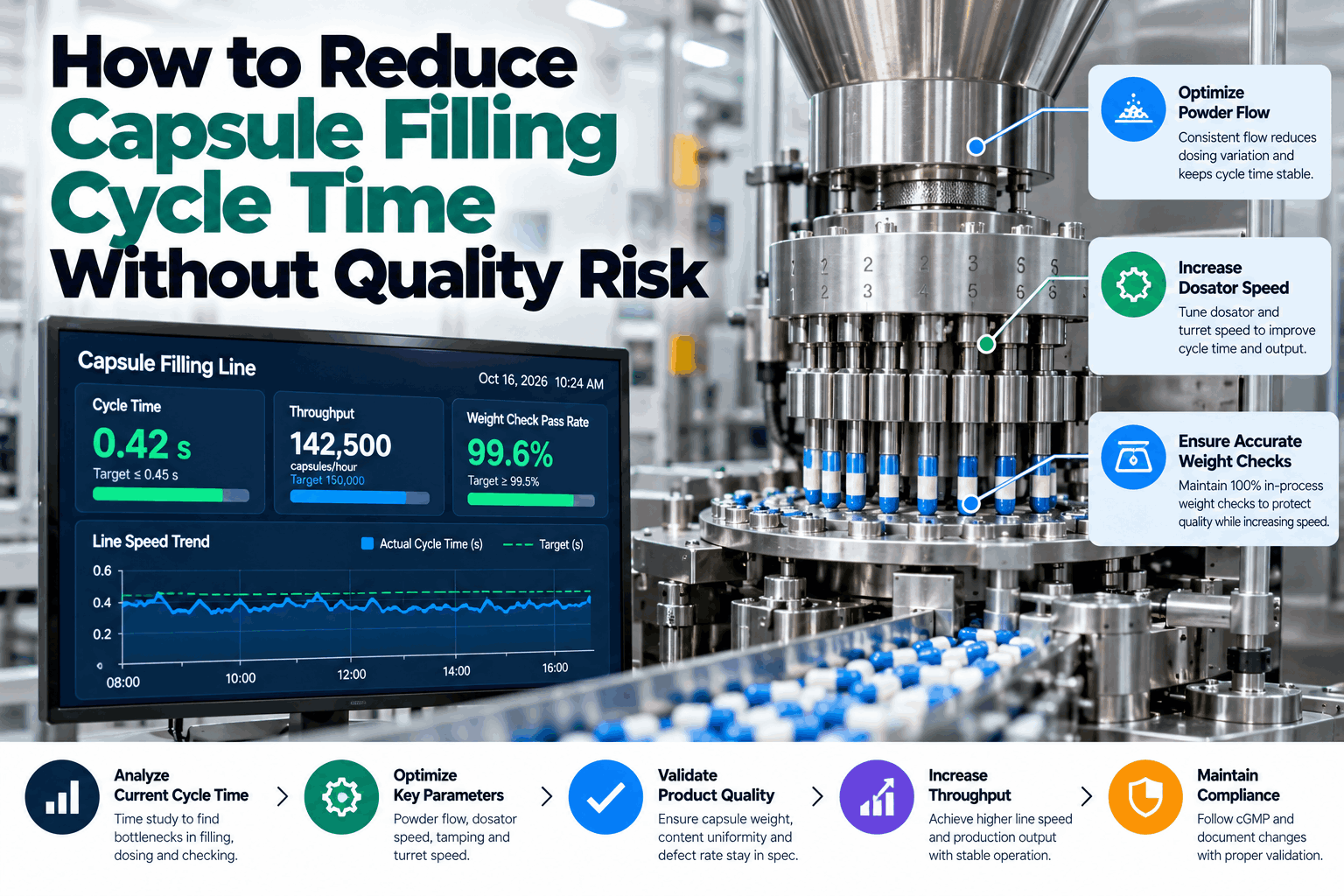
When a capsule line falls behind, the first instinct is to turn the speed up. It is also the riskiest thing you can do, and usually not where the time is. A capsule batch loses far more hours to slow start-ups, short stops, weight adjustments and cleaning than it could ever win back from a faster machine. And speed is the one change that can push capsule weights towards their limits. This guide shows where capsule filling cycle time really goes, how powder flow, dosator speed and weight checks set the pace, and five ways to shorten a batch, safest first. It also shows how iFactory tracks speed and weight together. To look at one of your own batches, book a batch review.
How to Reduce Capsule Filling Cycle Time Without Quality Risk
Find the hours a batch loses before it ever reaches full speed, and take them back without moving capsule weight any closer to its limits.
- Where a 14-hour batch really spends its time
- Five ways to go faster, ranked by quality risk
- How to test a speed increase safely
How fast the filler runs while it is running. The number on the screen.
Everything it takes to finish a batch: set-up, start-up, filling, stops and cleaning. The number that decides output.
Two different cycle times. Most plants watch the first and are paid on the second.
Where a Capsule Batch Really Spends Its Time
Filling is only about half the batch. The rest is getting ready, getting right and getting clean.
Time one batch from the moment the room is cleared to the moment it is cleared again. You will usually find that the filler ran at something close to its set speed for barely half of those hours. The rest is where cycle time hides, and none of it carries the quality risk that a speed change does. Our support team can build this picture from your own batch records.
At its rated 90,000 an hour this machine could fill the batch in 6.7 hours. It took 14.
What the timeline tells you
- Running flat out would save 50 minutes. That is the most that speed alone can give.
- Start-up and stops cost two hours. And they cost capsules too.
- Set-up and cleaning cost four hours. Every batch, whatever the speed.
The slow part of the batch is not the part where the machine is running.
Three Things That Set the Pace
Powder flow, dosing speed and weight checks. Each one can hold the line back, and each affects the others.
A capsule filler can only run as fast as powder can be fed evenly, dosed accurately and checked in time. Push one without the other two and the weights tell you. In one published study, weight variability followed the process settings, not the properties of the powder. So a speed change has to be tested, never assumed. To see how the three interact on your line, book a working session.
Powder flow
Powder has to refill the bed evenly between every dose. Bridging, uneven bed height and damp powder all show up as weight scatter.
Dosing speed
At higher speed there is less time to pick up, compress and transfer each plug. An incomplete plug is a light capsule.
Weight checks
How often you weigh, and how fast you react, decides how long a drift can run before anyone knows.
Dosator machines
A tube dips into a bed of powder, picks up a plug, compresses it lightly and places it in the capsule body. Usually continuous rotary motion.
Weight is set by the dosing chamber volume, the height of the powder layer and the compression applied.
Tamping pin machines
Powder is pressed into holes in a dosing disc over several stations, building the plug in stages. Intermittent motion.
Often preferred for powders that do not compact easily and need firmer, repeated compression.
On both kinds of machine, the dose depends on the powder it is taken from. If the bed or bowl level rises and falls, so does capsule weight. A steady level, a working stirrer and powder in good condition do more for both speed and weight than any change to the speed setting. Check these first.
Know the Weight Limits Before You Touch the Speed
Speed is only safe while there is room between where your weights sit and where they must not go.
The European Pharmacopoeia test weighs 20 capsules. For capsules under 300 mg, no more than two may differ from the average by more than 10%, and none by more than 20%. Your registered specification and in-house action limits will be tighter. The question for any speed change is simple: how much of that room does it use up? Ask our quality specialists how to chart it.
Both speeds pass. But at 90,000 the spread almost fills the action band, so the first small drift will trip it. That is less margin, more adjustments and more stops.
Sampling or every capsule?
If weights are sampled every 20 minutes, a drift that starts just after a check runs for 20 minutes unseen. At 80,000 an hour that is about 27,000 capsules.
Modern fillers can be fitted to weigh every capsule and adjust without stopping. Where that is in place, drifts are caught in seconds, and the margin needed for a given speed is smaller.
Whichever you have, trend the weights. A single result inside limits can still be the start of a drift.
One Batch, Before and After
The same 14-hour batch with four changes made. Only one of them touches the speed, and it is the smallest.
Five Ways to Cut Cycle Time, Safest First
Work down the list. Do not start at the bottom.
These five are ordered by how much quality risk they carry, from none to some. The first four make the process steadier as well as faster, which is why they come first: a steadier process is what earns you the room to try the fifth. To rank them against your own batch data, book a ranking session.
How to test a speed step safely
Stay inside the validated range
If the new speed is outside it, stop here and raise a change request.
Take a baseline first
Weight spread, rejects and stops at today's speed, over a full batch.
Step up by about 5%
One small step. Hold it long enough for several rounds of weight checks.
Compare, then decide
If spread, rejects and stops are no worse, keep it. If any is worse, go back.
A higher speed that widens the weight spread brings more adjustments, more rejects and more stops. It is quite possible to raise the speed setting by 10% and finish the batch later than before. Judge every speed change on good capsules per batch hour, never on the speed shown on the machine.
How iFactory Watches Speed and Weight Together
One timeline for the batch, with speed, stops and capsule weight on the same clock.
iFactory reads the filler's speed and stop signals and the results from your weight checks, and lines them up for every batch. It shows where the hours went, which stops repeat, and how weight spread changes with speed for each product. It advises. Your validated settings, your quality unit and your batch record stay in charge. Our integration team can confirm what your fillers already provide.
What you see for each batch
- The full timeline, from clearance to clearance
- Minutes to reach weight at start-up, against the best batch
- Every stop, timed and grouped by cause
- Weight spread at each speed the batch ran
- Good capsules per batch hour, the figure that matters
Turnkey AI: Delivered, Connected and Live in 6–12 Weeks
You do not build this. It arrives ready.
iFactory ships as a pre-configured NVIDIA AI server, racked and ready, with the software pre-loaded. Rack it, plug in power and Ethernet, and the AI is live on your network.
Our team handles cabling, network setup, PLC and SCADA integration, operator training and 24×7 remote monitoring. The server sits inside your own network, so batch and product data stay on site. For a scope matched to your lines, request a turnkey quote.
Ship, network and data
Server installed. Filler speed, stops and weight-check results connected for one line. Approach agreed with your quality unit.
Model training and pilot
Batch timelines built from live and recent batches. Stop causes named with your operators. First ranked list of losses.
Go-live and training
Batch view live for the pilot line. Operators, supervisors and quality staff trained. 24×7 remote monitoring begins.
Frequently Asked Questions
What sets cycle time on a capsule filling line?
For the machine: how evenly powder feeds, how fast it can be dosed accurately, and how quickly weights are checked. For the batch: all of that plus set-up, start-up, stops and cleaning. In most batches the time outside steady filling is as large as the filling itself.
Will running faster affect capsule weight?
It can. At higher speed there is less time to form and transfer each dose, so weights may fall or scatter more. How much depends on the product and the machine. The only way to know is to step up in small stages and compare weight spread with your baseline.
What are the weight limits for capsules?
The European Pharmacopoeia mass test allows 10% deviation for capsules under 300 mg and 7.5% for 300 mg or more, on 20 capsules. Other pharmacopoeias use different tests. What governs your product is its registered specification, and your in-house limits should sit inside that.
Can we raise speed without revalidating?
Within the speed range already validated for the product, a change is normally handled under your routine controls. Outside that range it needs change control and supporting evidence. This is a decision for your quality unit, so involve them before the trial, not after.
Is weighing every capsule worth it?
Often, yes, for more than quality. Catching a drift in seconds means fewer capsules at risk, fewer stops for adjustment, and less margin needed at a given speed. Whether it pays depends on batch value and how often your weights drift today.
Which is faster, a dosator or a tamping pin machine?
Neither as a rule. Both kinds are built for outputs of 100,000 capsules an hour and more. The choice is usually made on how the powder behaves: how well it compacts and flows. The fastest machine is the one that holds weight on your product.
How long does it take to go live?
Six to twelve weeks from delivery for a first line. We need a place for the server with power and Ethernet, read access to filler and weight-check data, and time with your production and quality teams. To check your set-up first, contact our team.
Bring One Batch Record
In thirty minutes we take one finished batch and lay out its timeline: set-up, start-up, filling, stops and cleaning. You will see where the hours went, and which of the five levers fits. You keep the timeline either way.
- 1Start and end times for one batch
- 2The filler's rated and usual speeds
- 3In-process weight results for that batch
- 4The stop log, however rough
- 5The validated speed range for the product