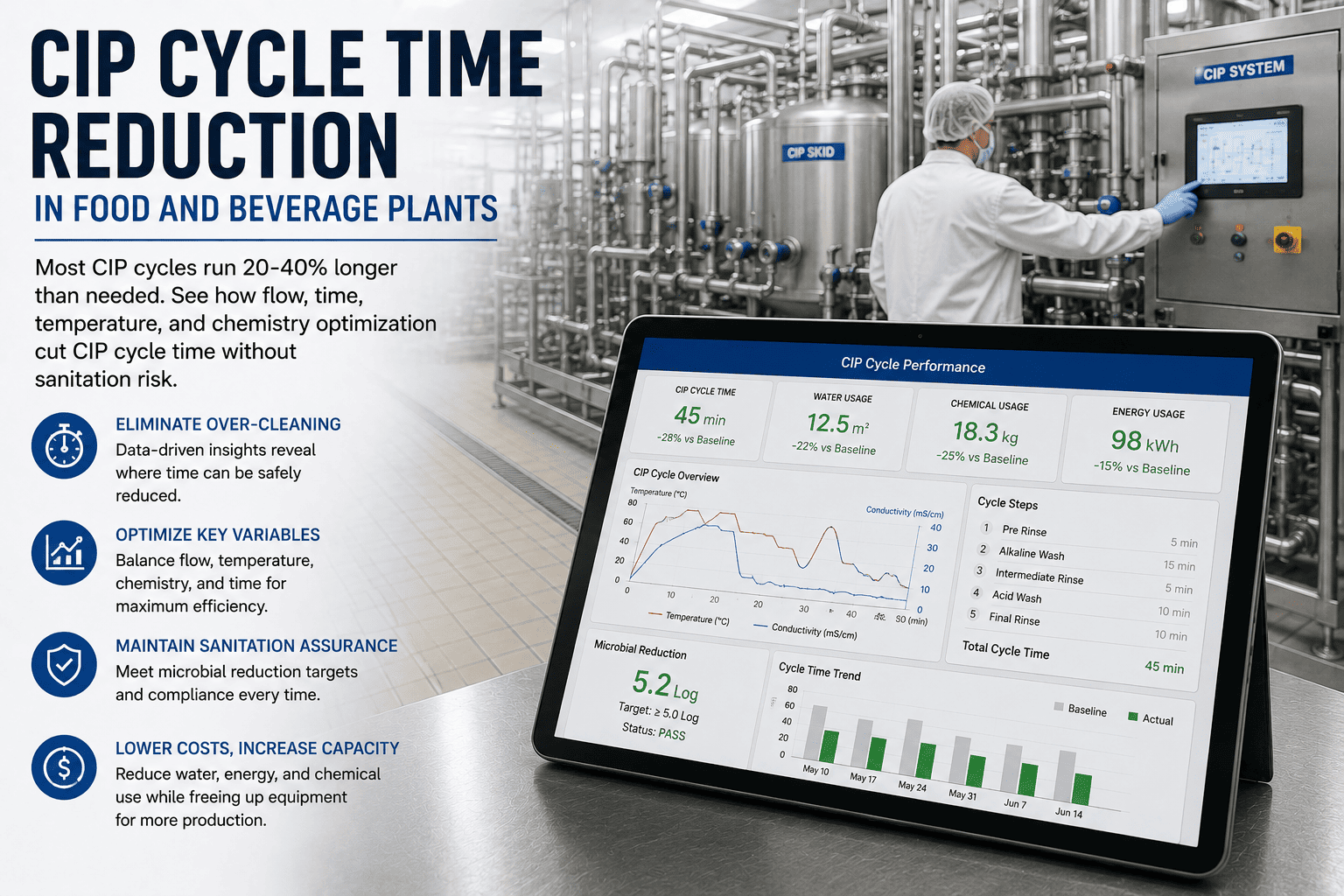
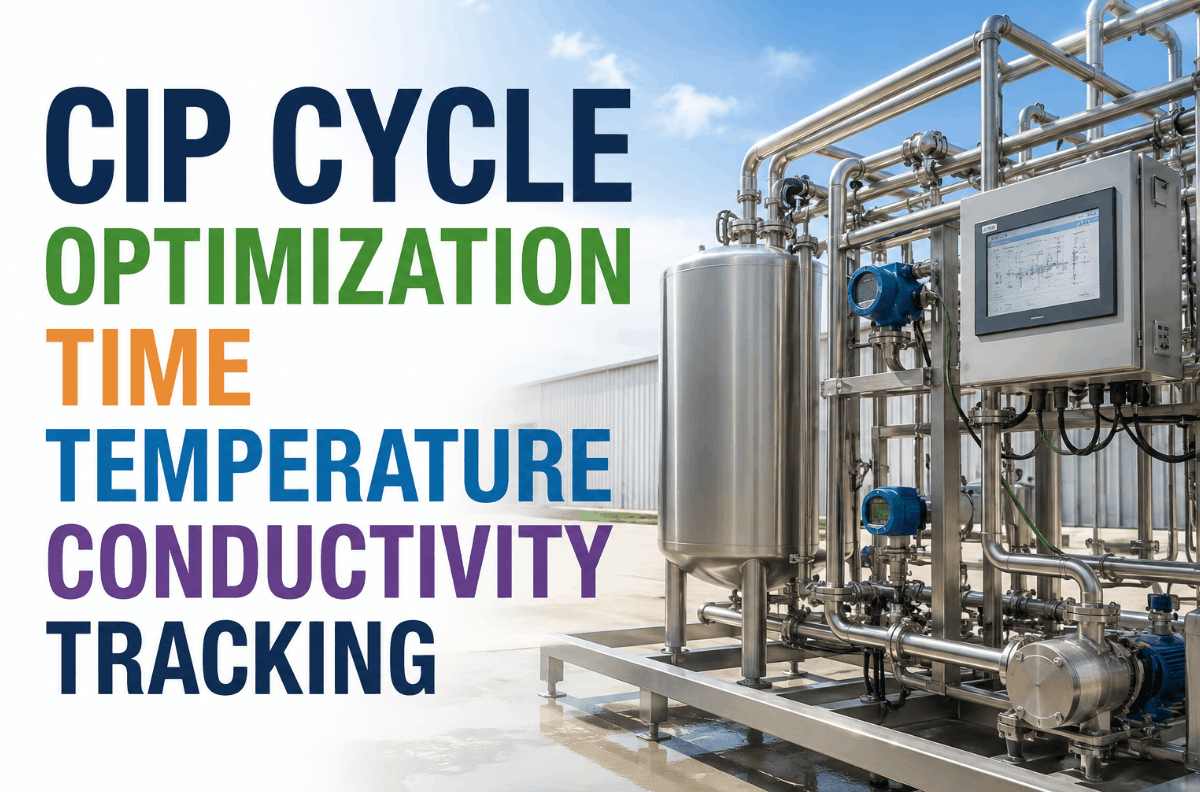
Most CIP cycles in food and beverage plants run 20 to 40 percent longer than the soil load in front of them actually requires — not because anyone chose to waste the time, but because the cycle was set once during commissioning for the worst-case soil the line would ever see, and then applied unchanged to every cycle since. A short pasteurized-milk run and an 18-hour cheese vat get the same fixed wash duration, even though one leaves a fraction of the soil the other does. Every extra minute of CIP is a minute the line is not producing, plus the water, energy, and chemistry pushed through it. The good news is that cycle time can be cut without ever touching sanitation safety — by rebalancing the four levers that actually drive cleaning, and by ending each phase when the surface is clean rather than when a timer expires. See how iFactory finds that time — book a demo.
OPERATIONS · FOOD & BEVERAGE · CIP CYCLE TIME
Your CIP Cycle Is Cleaning for the Worst Shift You Ever Had — On Every Shift
A fixed-duration cycle set for worst-case soil runs that same duration whether the equipment is barely dirty or heavily fouled. iFactory rebalances the four cleaning levers and ends each phase on the chemistry — recovering cycle time without adding sanitation risk.
THE SIZE OF THE OPPORTUNITY
What Fixed-Timer CIP Is Actually Costing You
20–40%
How much longer many CIP cycles run than the actual soil load requires
20–30%
Share of a typical dairy or beverage plant's water and chemical spend consumed by CIP
15–45 min
Time recoverable per circuit per day when phases end on cleanliness, not a fixed clock
250 days
Production days per year over which that recovered time compounds into real capacity
THE FOUR LEVERS OF EVERY CIP CYCLE
Sinner's Circle: Why You Can Cut Time Without Cutting Clean
Cleaning effectiveness is the product of four interacting factors — time, action, chemistry, and temperature, often called TACT or the Sinner's Circle. The key insight is that they trade against each other: strengthen one and you can safely reduce another. Cutting cycle time is not about cleaning less, it is about letting the other three levers carry more of the load so the clock does not have to.
T
Time
Contact duration is the lever most plants over-spend, because the SOP duration is set for worst-case soil and never revisited. It is also the lever the other three can most easily buy back.
A
Action
Mechanical flow does the physical work of removing soil, with a turbulent-flow target around 1.5 m/s in pipework. Correct flow velocity lets a wash finish in less time than a slow, under-turbulent circuit.
C
Chemistry
Detergent type and concentration break down the soil chemically. Confirming caustic strength is in validated range means the wash is working at full effect rather than being padded with extra minutes.
Te
Temperature
Heat accelerates the chemical reaction, with caustic typically run at 60–80°C. Verifying temperature at the return line, not just the supply, confirms the whole circuit is actually at cleaning temperature.
Find the time hiding in your own CIP cycles
iFactory analyzes your CIP cycle data to show exactly which phases are running longer than validated soil removal requires — and builds the re-validation plan to prove it before anything changes on the floor.
WHERE THE MINUTES ACTUALLY HIDE
The Five CIP Phases, and the Time Trapped in Each
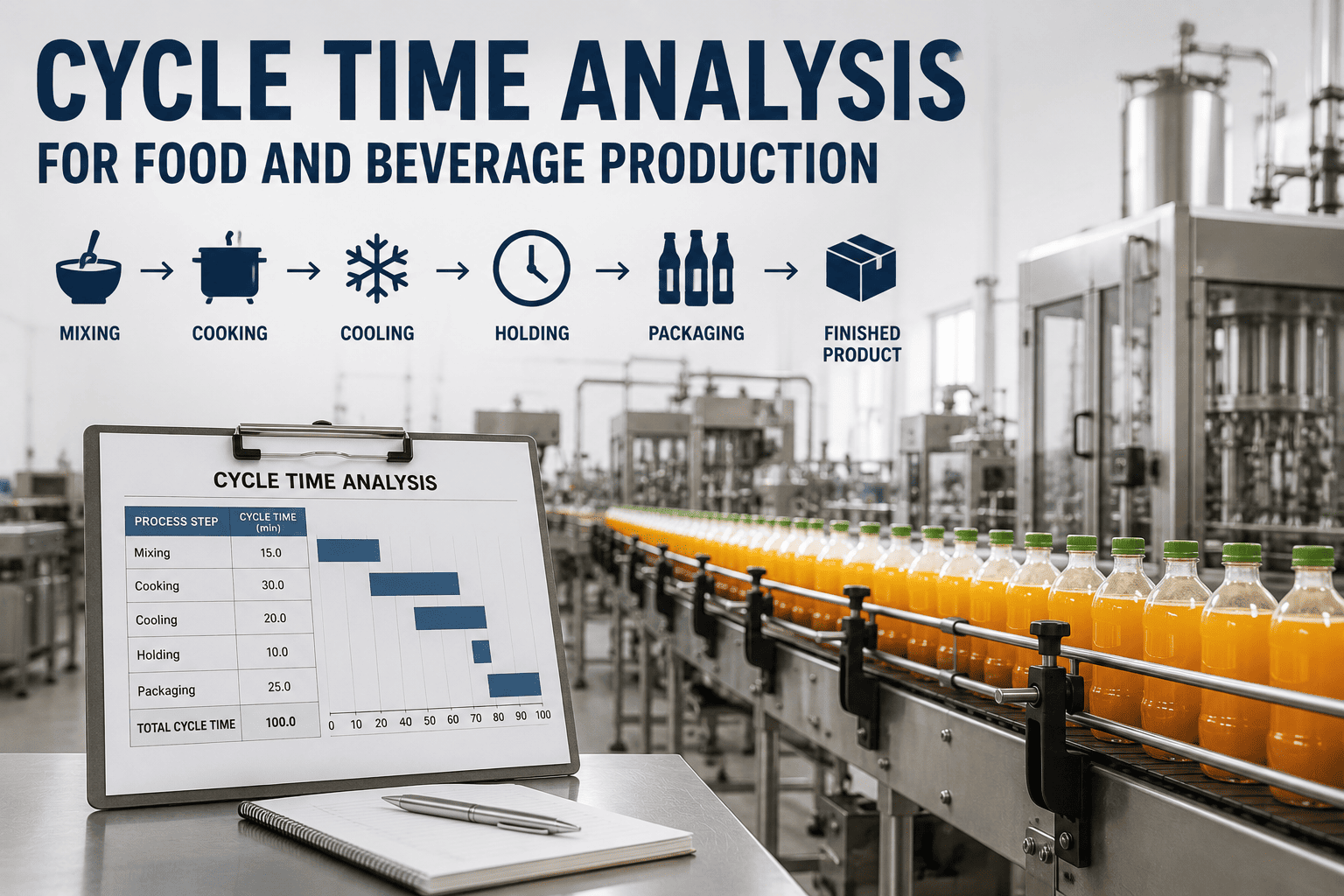
A standard dairy or beverage CIP runs five phases in sequence, and each one carries its own over-run for a different reason. Cutting total cycle time means finding the recoverable minutes phase by phase, not shaving the whole cycle by a blanket percentage.
1
Pre-Rinse Flush
Removes gross soil before chemistry. Running to a fixed time means the flush continues after the return water is already clean; ending it when return turbidity drops to target both saves time and confirms the caustic phase is set up to succeed.
2
Caustic (Alkaline) Wash
The primary cleaning phase, typically 60–80°C. Contact time should be counted from when correct temperature and concentration are confirmed at the return — not from cycle start — so the wash is not padded to cover a slow heat-up that better monitoring would expose.
3
Intermediate Rinse
Displaces caustic before the acid phase. This rinse can end the moment return conductivity drops to near-baseline water, instead of running fixed extra minutes "to be safe" — one of the most common places a cycle quietly loses time every run.
4
Acid Wash
Removes mineral scale the caustic cannot dissolve. On many lines this does not need to run every single cycle; matching acid frequency to actual scale build-up rather than habit removes an entire phase from cycles that do not need it.
5
Final Rinse
Flushes all remaining chemical to potable-water baseline before production. Ending on a conductivity reading that confirms baseline, rather than a fixed timer, lets production restart immediately once the circuit is verifiably clean.
TIMER-BASED VS. CHEMISTRY-BASED CIP
Clean on the Clock, or Clean on the Data
The safest way to cut cycle time is not to shorten every phase by a fixed amount — that risks under-cleaning and a failed swab test. It is to let each phase end the moment the data confirms the surface is clean, which on a light-soil cycle happens well before the worst-case timer would.
| Cycle Factor |
Fixed-Timer CIP |
iFactory Chemistry-Based CIP |
| Phase end trigger |
A clock set for worst-case soil |
Sensor data confirming the surface is clean |
| Response to light soil load |
Runs full worst-case duration anyway |
Ends early once cleanliness is confirmed |
| Rinse phase duration |
Fixed minutes plus a safety buffer |
Ends when conductivity returns to baseline |
| Temperature verification |
Often supply-side only |
Confirmed at the return line, whole-circuit |
| Cycle-to-cycle consistency |
Varies with operator and shift |
Same measurable standard every cycle |
| Sanitation risk when reducing time |
High if shortened without data |
Controlled — clean is proven, not assumed |
HOW A CYCLE GETS SHORTER SAFELY
From Cycle Data to a Validated Shorter Cycle
iFactory reduces cycle time as a structured, evidence-backed change — never as an informal trim of the SOP, which is exactly how plants accidentally introduce cleaning failures while trying to save time.
1
Capture Every Phase's Real Data
Return-line temperature, conductivity, and flow are logged across all five phases of each cycle, building a picture of what actually happens versus what the SOP assumes.
2
Identify Where Phases Over-Run
The data shows where a rinse hit baseline conductivity minutes before its timer ended, or where a wash was padded to cover a slow heat-up — the specific, recoverable minutes in each phase.
3
Rebalance the Four Levers
Where time is cut, flow, chemistry concentration, or temperature is confirmed sufficient to carry the load, so the Sinner's Circle stays balanced and cleaning efficacy is preserved.
4
Re-Validate Before Anything Changes
The proposed shorter cycle is proven against swab, ATP, or conductivity acceptance criteria under worst-case soil before it ever becomes the standard, so the change is documented, not assumed.
5
Lock In and Monitor the New Cycle
The validated cycle becomes the new standard, with ongoing monitoring to confirm it keeps meeting cleanliness targets and to flag drift before it becomes a sanitation problem.
Recover CIP time without touching your safety margin
Give operations shorter, validated cleaning cycles that free up production capacity while proving — not assuming — that every circuit is clean.
FREQUENTLY ASKED QUESTIONS
What Operations Teams Ask About CIP Cycle Time Reduction
Isn't cutting CIP time just asking for a failed swab test or a sanitation issue?
It would be if you simply shortened the timers by a blanket percentage — that is genuinely risky and is not what this is. The approach here is to let each phase end when sensor data confirms the surface is actually clean, which on a light-soil cycle happens well before the worst-case timer would expire. Where time is removed, the other cleaning levers are confirmed sufficient to carry the load, and every shorter cycle is re-validated against your existing acceptance criteria before it becomes the standard. Clean is proven, not assumed, which makes this lower-risk than the fixed cycle you run today.
Do we need to buy new sensors, or can this use what our CIP skid already has?
Most CIP skids already generate the three signals that matter most — return-line temperature, conductivity, and flow — because they are needed to run and log the cycle in the first place. iFactory is designed to use that existing data first, so many plants can start finding recoverable time without new instrumentation. Where a specific circuit would benefit from an added sensor, such as turbidity on the pre-rinse return, that can be added, but it is not a precondition for getting value from the data you already have.
How much cycle time can we realistically expect to recover?
It varies by line, soil type, and how long ago the cycle was last optimized, but many plants find that 15 to 45 minutes per circuit per day is recoverable once phases end on cleanliness rather than a fixed clock. The biggest gains usually come from rinse phases that hit baseline conductivity minutes before their timer ends, and from acid washes running every cycle when the actual scale build-up does not require it. Because the recovered time repeats across roughly 250 production days a year, even a modest per-cycle saving compounds into meaningful capacity.
We run dairy, brewery, and juice lines with very different soils — does one approach fit all?
The Sinner's Circle framework applies across all of them, but the specific balance of time, action, chemistry, and temperature is set per circuit and per soil type rather than as one universal recipe. A high-fat dairy soil, a brewery's beerstone, and a high-sugar juice residue each foul equipment differently and clean out on different curves, which is exactly why cycle data is captured per line before any change is proposed. The method is consistent; the validated cycle it produces is specific to each circuit's real soil profile.
How does this hold up when an auditor asks why we shortened a validated cleaning cycle?
This is where the structured approach matters most: every shorter cycle is backed by the captured data showing the surface reached the cleanliness target, the re-validation results proving it under worst-case soil, and the ongoing monitoring confirming it continues to meet standard. That is a stronger audit position than a fixed cycle whose duration nobody can justify beyond "it was set at commissioning." The documentation is built as part of the change rather than reconstructed afterward, so the answer to the auditor's question is already on file.
CLEAN ON THE CHEMISTRY, NOT THE CLOCK
Turn CIP Downtime Back Into Production Capacity
Your CIP cycles are almost certainly cleaning for a worst case that most shifts never see. iFactory finds the recoverable minutes, rebalances the levers, and proves the shorter cycle is still clean — before anything changes on the floor.