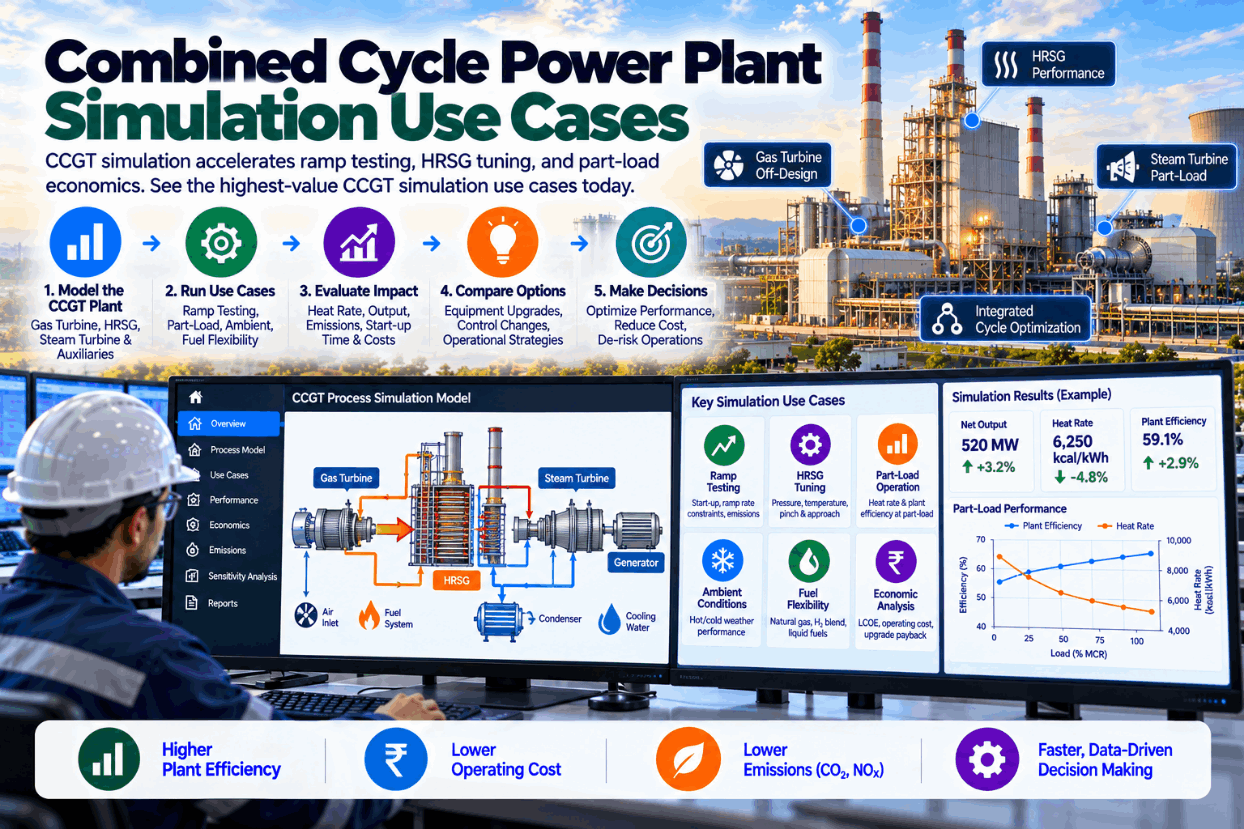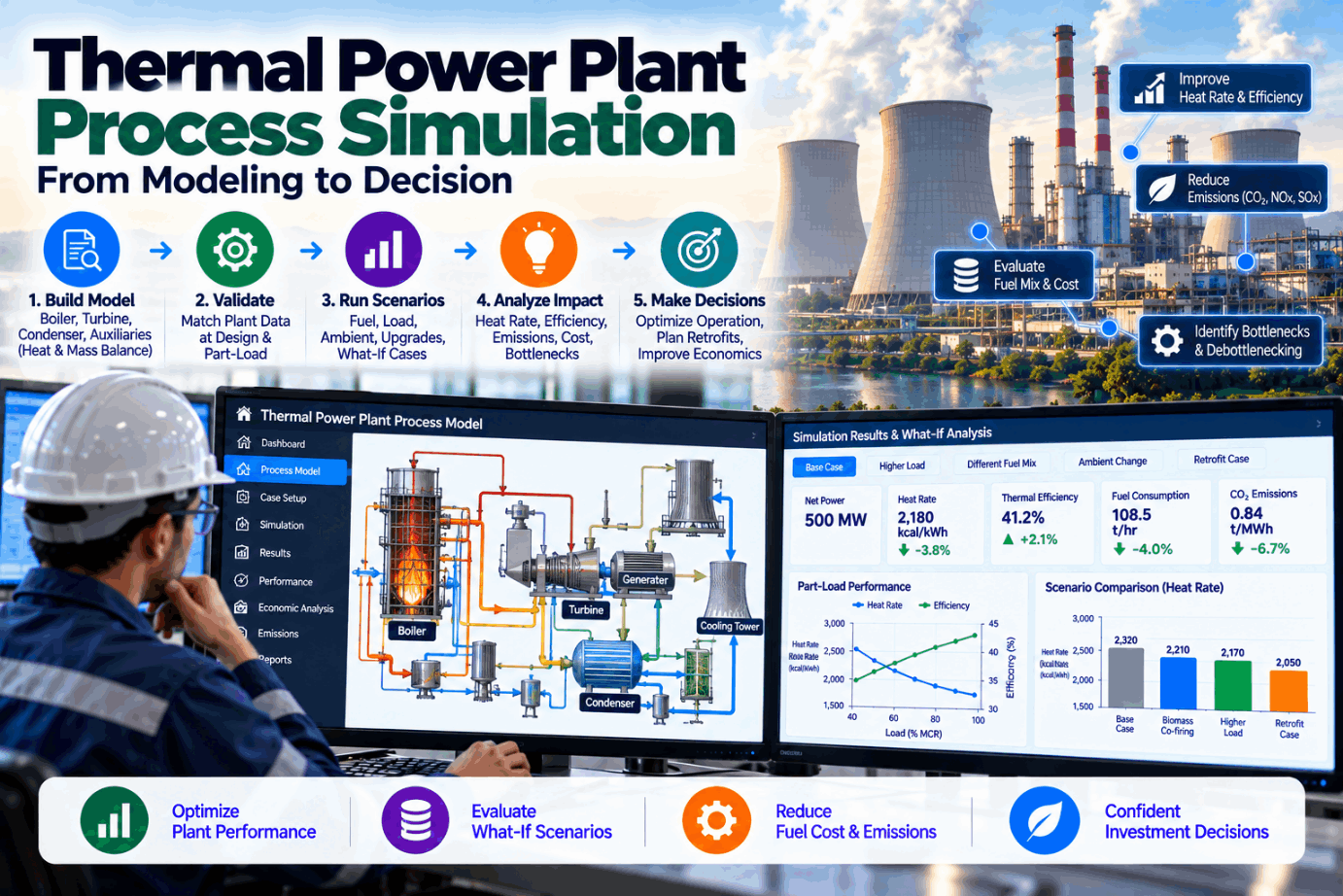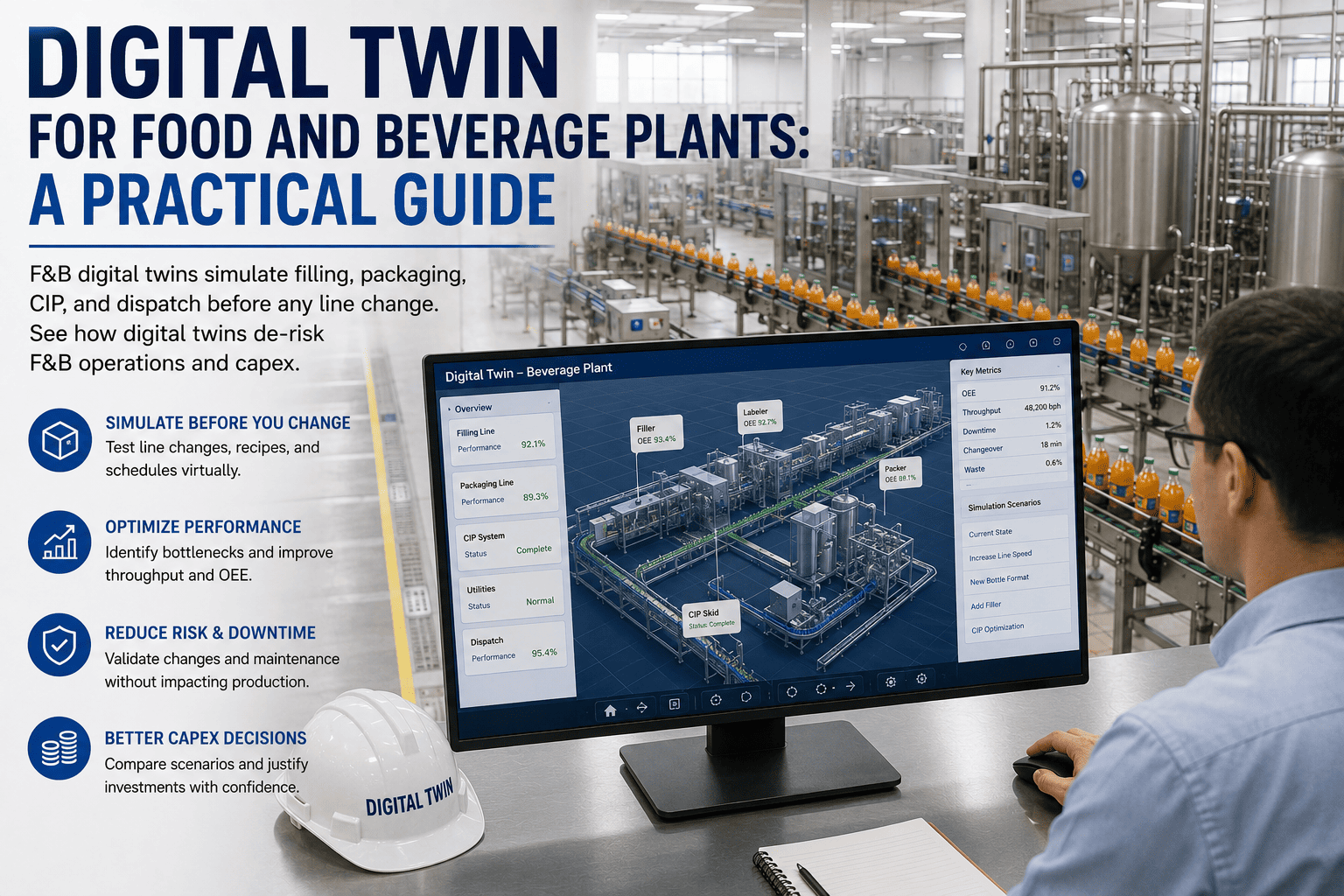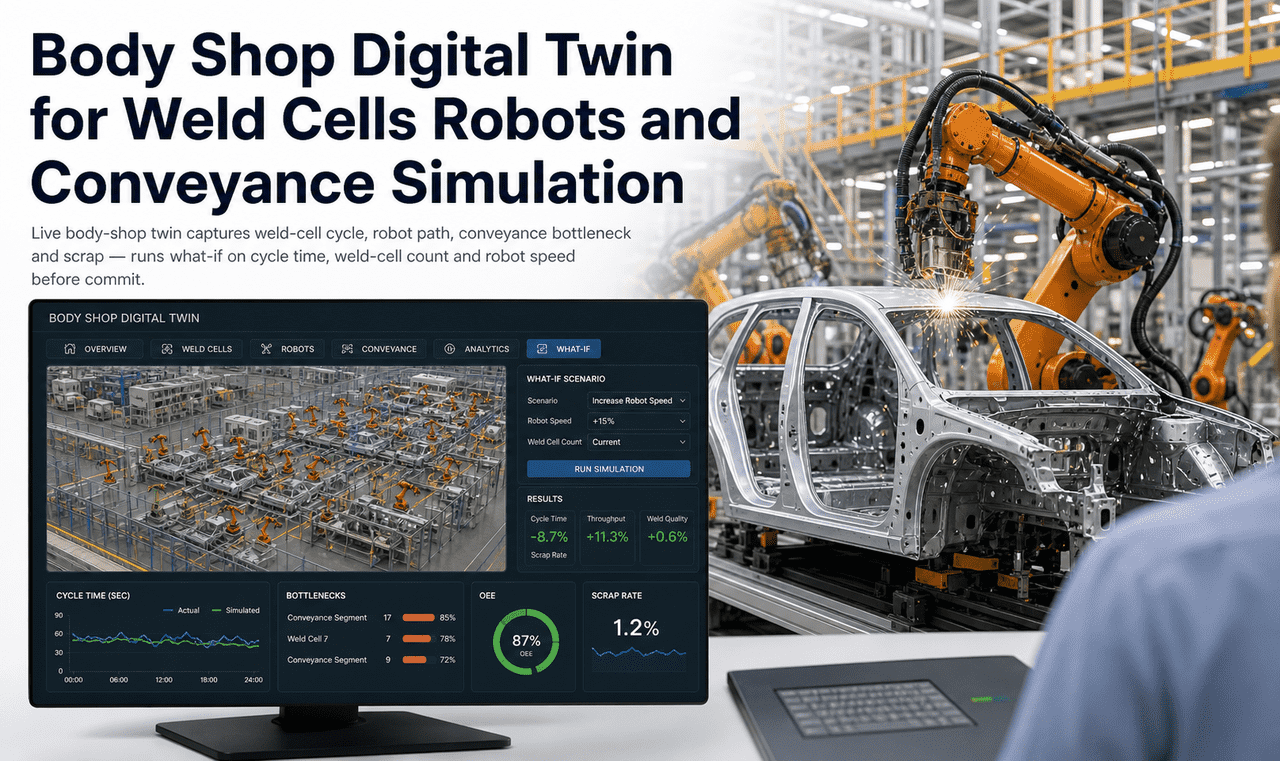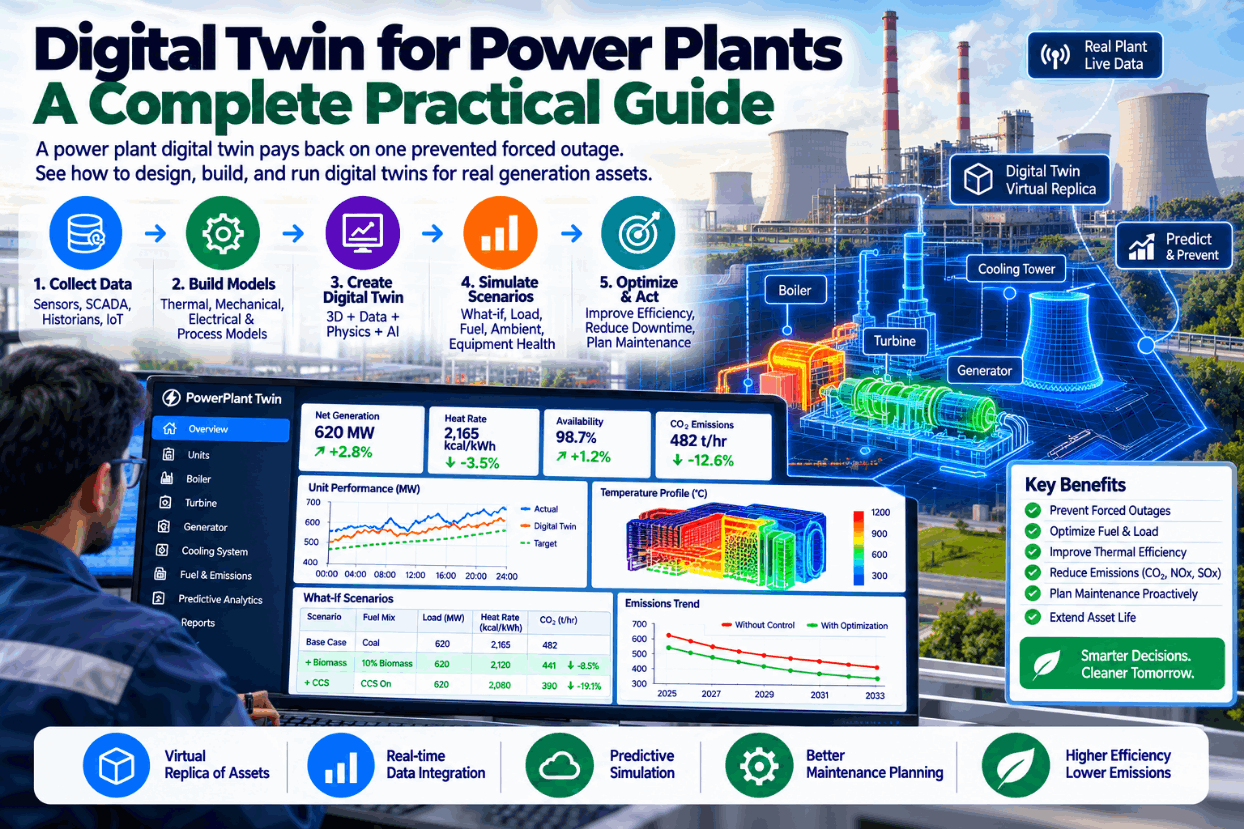
Digital twin has become one of the most used and least defined terms in power generation. For some vendors it means a 3D model; for others a dashboard; for others a full physics simulation of the plant. For a plant manager the useful definition is simpler: a model of a real asset, kept in step with that asset by live data, that answers questions about its condition and performance and what will happen next. This guide cuts through the terminology, explains the main types of twin, how they are built and kept accurate, which use cases pay back in thermal and combined cycle plants, and the pitfalls that turn twins into expensive displays. To see a working power plant twin, book a short walkthrough.
Digital Twin for Power Plants: A Complete Practical Guide to Design, Build and Run
Physics and data models of boilers, turbines, generators and auxiliaries, kept in step with the plant by live data and used for performance, health and what-if decisions.
Why So Many Digital Twins Disappoint
Many power plant twin projects start with a vision of a complete virtual plant and end with a set of screens that operators rarely open. The reasons are consistent: the twin was built to show, not to decide; its models drifted away from the real plant; and nobody owned acting on what it said.
The market is growing fast regardless. Global Market Insights values digital twins in energy and power at about US$6.6 billion in 2025, growing around 13.9% a year to 2035, with predictive maintenance and asset performance management as the most commercially proven use. The same report notes the top five vendors held only 22.3% of the market in 2025, a sign of many different approaches and definitions.
A twin earns its place when it answers specific questions that matter to money, safety or reliability, and keeps answering them correctly. We can help frame those questions on a call.
What a Digital Twin Is and Is Not
Clear definitions prevent expensive misunderstandings between engineering, IT and vendors.
Most useful power plant twins are hybrid: physics sets the structure and data keeps it honest. That combination is the basis of every twin in our platform.
How a Power Plant Twin Is Built
Whatever the vendor, a working twin has the same layers.
DCS, historian, condition monitoring and maintenance records.
Data cleaned, reconciled and checked for faulty instruments.
Physics, data or hybrid models of each system and asset.
Models tuned so they match the plant at known conditions.
Expected versus actual, health scores, forecasts and what-if runs.
Alerts, recommendations and work orders to the people who act.
Data validation is often underestimated. Power plants have hundreds of instruments that drift or fail quietly. A twin that trusts a failed flow meter will give confident but wrong answers. Reconciling measurements against mass and energy balances catches many such problems.
The action layer is the other common gap. A twin that raises alerts nobody owns delivers nothing. Linking findings to maintenance work orders and operating decisions is what turns insight into value.
Both layers are standard in our deployments and are where our engineers spend much of the set-up time.
Use Cases That Pay Back in Power Plants
These are the twin uses with the clearest value in thermal and combined cycle plants.
| Use case | What the twin does | Value |
|---|---|---|
| Heat rate deviation | Compares actual with expected performance by component | Fuel savings, faster fixes |
| Equipment health | Detects early degradation in pumps, fans, turbines and generators | Fewer forced outages |
| Outage planning | Ranks work by condition and performance impact | Shorter, better targeted outages |
| What-if studies | Tests fuel, load, ramp and configuration changes | Better decisions before changes |
| Dispatch support | Provides accurate part-load efficiency and limits | Better bids and scheduling |
| Training and commissioning | Simulates plant response for operators and control logic | Fewer trips and faster start-up |
Each use case needs a named decision owner. A health alert for a boiler feed pump is only useful if a maintenance planner is expected to act on it within a set time, and a heat rate deviation only matters if someone is accountable for recovering it.
Start with one or two use cases where value is clear and data is available. Heat rate deviation and equipment health are common starting points because they use existing data and produce measurable results within months.
Forced outages are expensive, so health use cases often justify a twin on their own; the exact value depends on your unit’s margin and market. We help estimate it in a value study.
Building a Twin Step by Step
A phased build delivers value early and reduces risk.
List the decisions the twin must support and who will act on them.
Check instruments, historian coverage and maintenance records.
Build and calibrate a twin of one system, such as boiler feed pumps or the condenser.
Run for several months and measure findings acted on and their value.
Add systems and units, reusing models and data pipelines.
Recalibrate after overhauls, modifications and instrument changes.
Maintenance of the twin is part of the plan from day one. After an overhaul, equipment behaves differently; if the twin is not recalibrated, it will see phantom improvements or losses. Assigning an owner for model upkeep avoids that drift.
A first system twin usually takes weeks, not years. See a phased plan in a demo.
Data Requirements Checklist
Twin quality depends on data quality. Check these before starting.
Gaps are normal and rarely block a first use case. The data assessment shows which to close first. Ask our support team for the assessment template.
Digital Model Versus Working Twin
The difference between a twin that helps and one that decorates a control room comes down to a few choices.
- Built to display, not to decide
- Models never recalibrated after overhauls
- Instrument faults flow straight into results
- Alerts go to a shared inbox
- Scope too large to finish
- Success measured by screens delivered
- Built around named decisions
- Recalibrated after every major change
- Data validated and reconciled first
- Findings routed to owners and work orders
- Scope grown system by system
- Success measured by actions and value
Ownership after go-live is the other difference. Someone must be responsible for keeping models calibrated, reviewing alerts that were wrong and improving them. Without that, confidence fades and the twin is quietly ignored.
Scale is the most common trap. A whole-plant twin promised in one project takes years and often stalls. A pump twin that prevents a failure in its first months builds the support that funds the next step.
Our deployments start small by design and grow as value is proven. Discuss the first step with our team.
Building the Business Case
A twin business case should rest on specific, measurable outcomes.
Use your own history: past forced outages that gave warning signs, past heat rate losses that took months to find, and past outages where work was done that turned out unnecessary. Those are the events a twin would change.
A value study using your records gives a realistic case without optimistic assumptions. Book one with our advisors.
How iFactory Delivers Power Plant Digital Twins
Physics structure corrected by your own plant data.
Instrument faults and inconsistencies caught first.
Expected versus actual heat rate by component.
Early degradation found in critical equipment.
Changes tested on the model before the plant.
Findings sent to owners and maintenance systems.
It works with your DCS, historian, condition monitoring and CMMS. Pick one system and we will show its twin in a session.
Start With One System and Prove the Value
Choose a system with clear value, such as boiler feed pumps or the condenser. We build and calibrate its twin, run it for a pilot period and report the findings acted on and their value.
Twin predicts pump efficiency 3.2 points below its model at the same flow and head. Vibration rising at vane pass frequency: impeller wear likely.
A Twin Finding Turned Into Planned Work
This exchange shows how a reliability engineer might use iFactory’s twin.
iFactory ships as a pre-configured NVIDIA AI server, racked and ready with the power plant digital twins models loaded. Rack it, plug in power and Ethernet, and the AI is live on your network. Our scope covers sensors and data connections across boilers, turbines, generators and auxiliary systems, DCS, PLC/SCADA, historian and ERP integration, cabling and network setup, operator and quality team training, and 24×7 remote monitoring.
Server installed, DCS and historian links live, historical operating, performance and maintenance data loaded.
Models calibrated on your own unit data, then run in advisory mode on one unit with your operations and performance engineers reviewing every output.
Rollout to the agreed units under your change management, operator and engineer training, and 24×7 remote monitoring in place.
Software, server and integration come as one package. For pricing on your units, contact our sales team.
Frequently Asked Questions
A model of a specific plant or asset, kept in step with it by live data, used to understand current condition and performance and to predict behaviour or test changes.
A simulation may be run once with assumed inputs. A twin is connected to the real asset, recalibrated as it changes and used continuously for decisions.
Heat rate deviation analysis and equipment health monitoring usually show value first, because they use existing data and lead to measurable fuel savings and avoided failures.
Usually hybrid. Physics provides structure and extrapolation to new conditions; data corrects the models to match real behaviour.
A first system twin typically takes weeks. A whole-plant twin is best built system by system over months, with value proven at each step.
Data validation, recalibration after overhauls and modifications, and an owner for model upkeep. Plan it with our engineers.
Build a Twin That Changes Decisions, Not Just Screens
iFactory builds hybrid twins of your equipment, keeps them calibrated and routes every finding to someone who acts, so the twin pays back in avoided outages and recovered heat rate.
Illustrative rollout. Twins are added system by system, each calibrated before use.