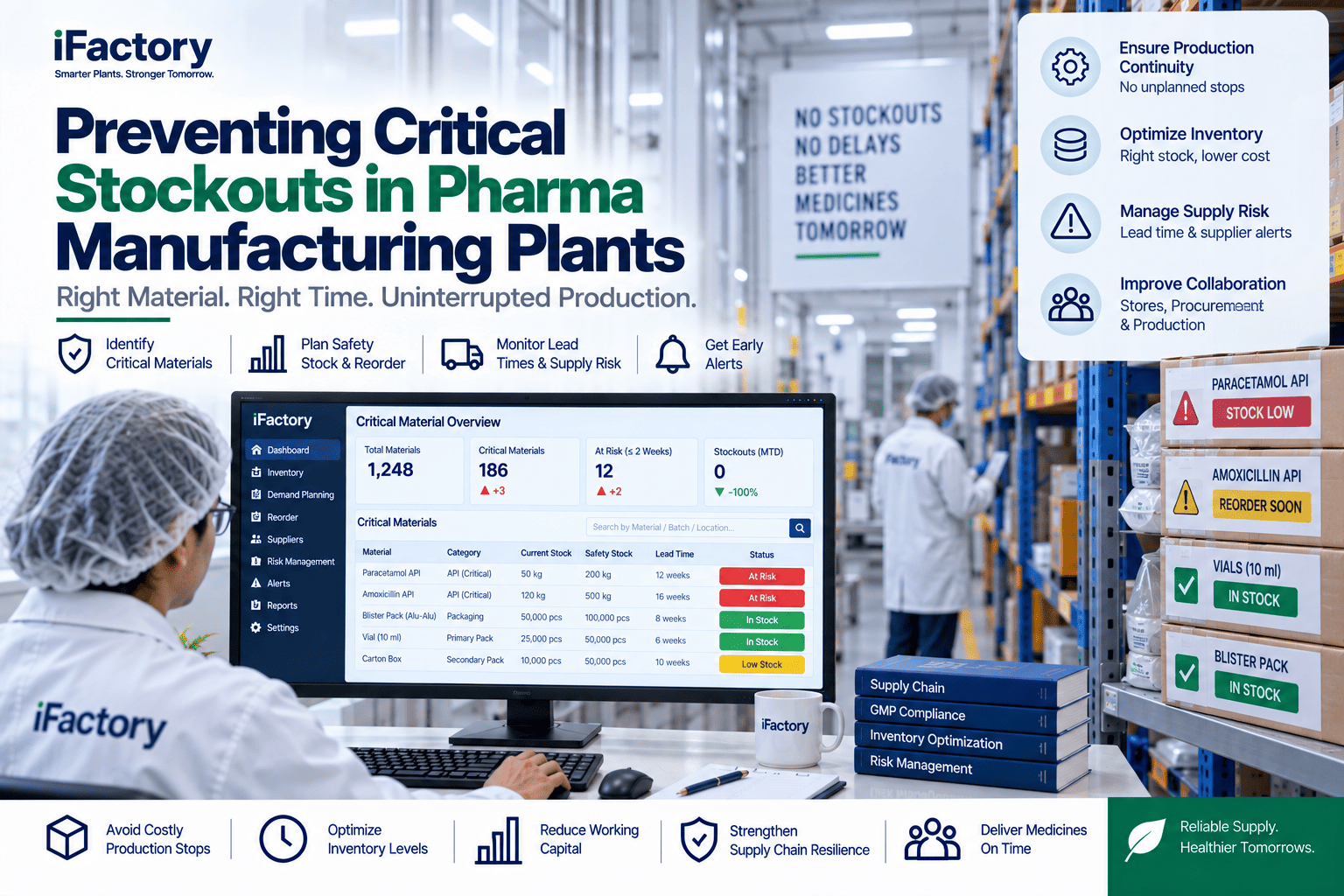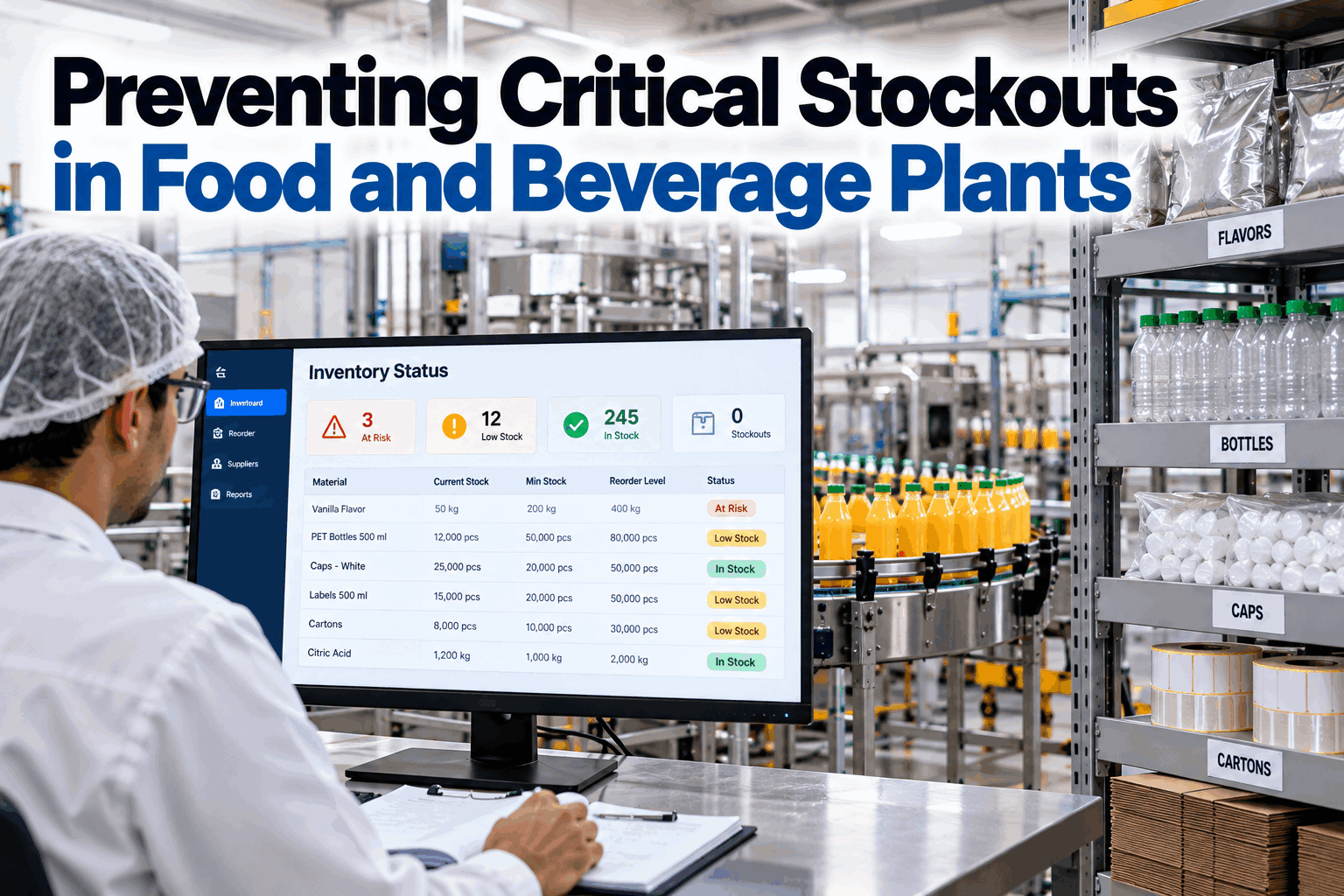
One missing flavor, cap, carton or label can stop an entire production campaign. Preventing stockouts in a food and beverage plant means knowing which materials can stop production, how much protection each needs and when to act on supplier or inventory risk. This guide outlines a practical approach using criticality scoring, min-max levels, lead-time monitoring and routine checks. To see how it could work with your own inventory and production data, book a stockout prevention walkthrough.
Preventing Critical Stockouts in Food and Beverage Plants
A practical guide for stores and supply chain teams: identify the materials that can stop production, set inventory controls that reflect real risk and spot shortages early enough to respond.
- Score inventory by production and supply risk
- Set min-max and reorder rules around actual lead times
- Track shortages, expiry and supplier changes before they stop a line
Why Stockouts Are Different in Food and Beverage Plants
A shortage can affect a campaign, a shelf-life window and the materials already staged for production.
Food and beverage plants often depend on a specific combination of ingredients, packaging and labels. A product may not be substitutable without approval, and some materials have storage, allergen, lot or expiry controls that affect whether stock is usable. When planning focuses only on total quantity, it can miss the difference between stock on hand and stock that is available for the next production order.
Protect recipe-critical inputs
Track ingredients with limited substitutes, supplier constraints or special handling requirements.
Include every campaign component
Account for caps, cartons, films, pouches, trays and other format-specific materials.
Count only usable inventory
Exclude expired, quarantined, damaged or otherwise unavailable stock from supply coverage.
Connect stock to the schedule
Compare projected material availability with planned orders and changeovers.
A warehouse balance can include reserved stock, quality holds, expired lots or inventory assigned to another campaign. Use a clear definition of usable stock in every shortage calculation.
Build a Criticality Score for Plant Materials
Not every stockout has the same operational impact.
Use a consistent scoring method to focus attention on materials that could halt production, disrupt customer orders or create a safety or quality concern. Involve planning, procurement, operations and quality when deciding the scoring factors and escalation rules.
For example, a high-criticality material may need frequent review and supplier escalation, while a lower-risk item may follow standard replenishment rules. Set tiers with your own operational, customer and quality requirements in mind.
Set Min-Max and Reorder Points That Reflect Reality
Reorder rules work only when they reflect demand, replenishment time and usable inventory.
A min-max policy can trigger replenishment when projected available stock reaches a defined minimum, then restore stock toward a maximum. For variable-demand or long-lead materials, include the demand expected during replenishment and an appropriate buffer. Review the settings when usage, supplier performance, pack size or shelf-life constraints change.
Establish actual usage
Use consumption by product, line and campaign where possible, and account for planned production changes.
Validate replenishment time
Compare quoted lead time with receipt history, including supplier delays and receiving checks.
Define min, max and triggers
Document the calculation, owner, review frequency and actions at each risk threshold.
Open purchase orders should not automatically be treated as available supply. Check confirmation status, expected arrival, quantity, quality-release needs and whether the delivery still meets the production date.
Find Shortage Risk Before Production Is Affected
A useful shortage signal combines inventory status with what the plant plans to make next.
Review critical materials against the production schedule and expected receipts. A low balance may be manageable if replenishment is confirmed before consumption; a higher balance may still be a risk if the stock is on hold, expires before use or is allocated to another order.
An alert is useful only when someone owns the next step. Define who checks the data, who contacts the supplier, who approves substitutions and who decides whether the production plan needs to change.
Stockout Prevention KPIs to Track
Measure whether the process gives teams time to act, not just how much inventory is in the warehouse.
Start with a reliable baseline and agree on definitions across stores, purchasing, planning and operations. Segment results by criticality, material class or supplier so that improvements in one group do not hide problems in another.
Make Shortage Risk Visible Earlier
When inventory, supplier updates and production requirements are reviewed separately, teams can discover a shortage only after the schedule is already at risk. A shared view can help stores and supply chain teams prioritize exceptions and follow them through to resolution.
From Inventory Data to a Reliable Prevention Routine
A repeatable review process helps turn shortage signals into timely, documented decisions.
Start with a manageable set of high-criticality materials. Validate the inventory data, confirm who owns each exception and test the process against historical shortage events before expanding it to more items or sites.
Prioritize
Score materials by impact, supply risk and recovery time.
Validate
Reconcile balances, holds, reservations and expiry dates.
Calculate
Set min-max rules using usage and replenishment history.
Monitor
Compare projected supply with the production schedule.
Escalate
Assign an owner and response for each risk level.
Improve
Review stockouts, expedites and missed alerts.
Common Stockout Prevention Mistakes
Many shortage surprises start with inventory data or assumptions that were not revisited.
Good practice
- Prioritize materials by operational and quality risk
- Use usable, lot-aware inventory in coverage calculations
- Review supplier dates and lead-time performance
- Assign an owner to each shortage alert
- Revisit min-max settings when demand or supply changes
Common mistakes
- Treating every item as equally critical
- Counting held or expired inventory as available
- Using a quoted lead time without checking delivery history
- Relying on a spreadsheet with no clear update owner
- Setting reorder levels once and never reviewing them
More inventory can increase expiry, storage and working-capital exposure. Consider supplier reliability, approved alternatives, order frequency and shelf life alongside buffer stock.
How Inventory and Supply Chain Analytics Can Help
Bring inventory status, supplier signals and production requirements into a reviewable workflow.
iFactory can connect operational data sources and provide a shared view of inventory and process signals. A deployment’s usefulness depends on the quality, availability and integration of your source data. Teams should validate inventory definitions, user permissions and escalation rules during the project, and retain purchasing, production and quality decisions with the responsible teams. For questions about fit, contact the support team.
Bring relevant signals together
Review inventory, receipts, consumption and schedule data in context.
Surface critical exceptions
Focus attention on items with low projected coverage or changing supply conditions.
Make ownership clear
Track who is checking a shortage, contacting a supplier or validating an alternative.
Learn from outcomes
Use stockouts, expedites and alert misses to improve the prevention process.
Results depend on your source systems, inventory practices and data quality. Define measures and validate them with your team using your own materials and operating history.
Frequently Asked Questions
What is stockout prevention in a food plant?
It is the process of identifying materials that may be unavailable when needed, assessing the operational risk and taking action before the shortage disrupts production.
Which materials should we prioritize?
Start with items that can stop production or have limited approved substitutes, long or unreliable replenishment times, specific quality controls or significant expiry constraints. Include ingredients and packaging components.
How do min-max inventory levels work?
A min-max approach defines a lower threshold that triggers replenishment and an upper level to restore toward. Set the levels using demand, lead time, supply variability, order constraints and usable shelf life.
How should we account for lead time?
Compare quoted lead times with actual supplier delivery history. Consider order processing, transport, receiving and any quality-release steps that affect when material can be used.
Should we increase safety stock for every critical item?
Not automatically. Balance shortage risk against expiry, storage capacity, minimum order quantities and the availability of approved alternatives. Set buffers according to material-specific risk and plant policy.
How do we get started?
Choose one product line or group of high-criticality materials, validate the inventory and lead-time data, agree on alert owners and test the review process against previous shortage cases.
Review Your Critical Material Risks
Bring a sample of your inventory and supplier data to discuss how your team identifies materials at risk, validates usable stock and responds to a potential shortage.
- 1Critical material or ingredient list
- 2Inventory balances and lot-status data
- 3Recent supplier delivery history
- 4Production schedule for a sample period
- 5A recent shortage or expedite example