Sanitation Kanban Board for Food Plants: Clean to Release

By Jackson T on October 22, 2026

sanitation-kanban-board-food-plants-clean-release

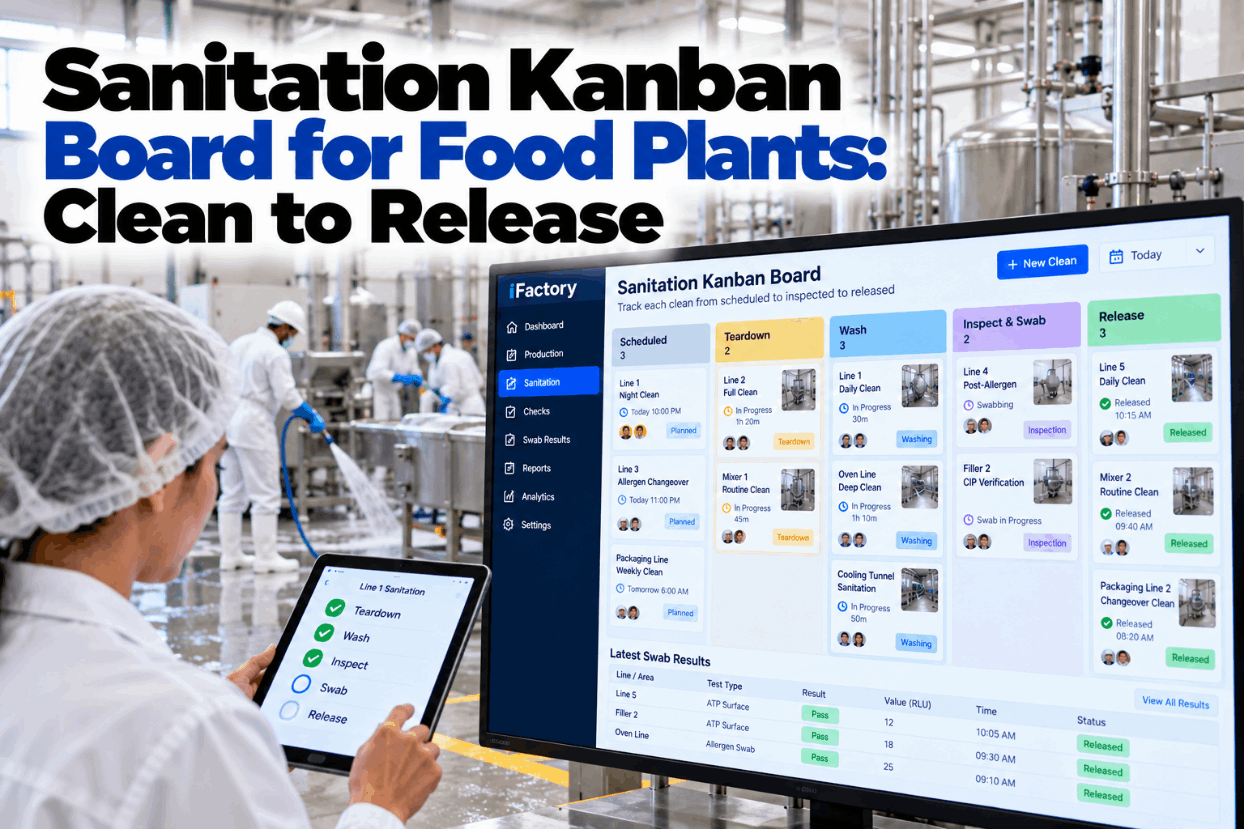
Third shift is when most food plants clean, and it is also when line status is hardest to see. Lines are torn down at different times, crews move between wash bays, and QA is swabbing one line while another waits for a pre-op check. The whiteboard by the sanitation office is out of date within the hour. A sanitation kanban board gives every line clean its own card that moves from teardown to release, with ATP swab results and sign-offs attached. See a board built from real line cards in a short sanitation board demo.

SANITATION KANBAN · CLEAN TO RELEASE

Every Line Clean on One Board, From Teardown to Release

iFactory Sanitation Kanban gives each line clean its own card, with columns for teardown, wash, inspect, swab and release. Crews move cards by voice from the wash floor, and ATP results attach to the right card automatically.

Line 4 · Deli slicingIn Swab
Allergen clean · sesame to none · teardown 23:10
✓Teardown
✓Wash
✓Inspect
4Swab
5Release
Slicer blade guard · ATPPass
Infeed belt · ATPCaution
Sesame test · lateral flowNegative
Crew lead, Line 4 · voice · 02:41"Line 4 infeed belt re-cleaned, ready for re-swab."
Re-swab requested · card held until all points pass
SANITATION WORKFLOW

Six Columns Built Around the Wet Clean

Most wet cleans follow the same seven steps: dry clean, first rinse, soap and scour, post-rinse and inspect, reassemble, pre-op, then sanitize. The board does not replace your SSOPs. It groups those steps into columns so anyone can see where each line stands, and it makes every move depend on evidence instead of a shout across the floor. A Scheduled column holds cleans from the master sanitation schedule before teardown begins. Map your own SSOP steps to columns with our sanitation specialists.

Column
Wet clean steps inside it
Card moves on when
Evidence stored on the card
Scheduled
Planned from the master sanitation schedule or a changeover order
Line stopped, product and packaging cleared, lockout applied
Line, clean type, allergen flag, crew
Teardown
Step 1: dry clean, disassembly, gross soil removed
Parts in the COP tank or wash bay, drains cleared
Lockout confirmed, parts count
Wash
Steps 2 to 4: first rinse, soap and scour, post-rinse
Surfaces free of soil, haze and water beading by sight and feel
Chemical, concentration check, contact time
Inspect
Flashlight check, chemical removal, step 5 reassembly
Parts back, guards on, no tools or chemicals left
Inspector, findings, photos
Swab
Step 6 pre-op with ATP and, where needed, allergen tests
Every swab point within its site limit
ATP reading per point, allergen result
Release
Step 7 sanitize, then final sign-off
Authorised release signed, line handed to production
Sanitizer and concentration, signer, time
Where the seven steps come from

The step names follow the widely used seven-step wet sanitation model published for the dairy industry. Your SSOP wording, order and chemistry may differ, and the columns follow your SSOP.

SANITATION KANBAN BOARD FOR PLANT MANAGERS

The Whole Night on One Screen at 02:40

A plant manager should be able to look at the board once and answer three questions: which lines are behind, where cards are waiting and which lines will be ready for first shift. Each card is one line clean. Its column shows the stage, its age shows how long it has waited, and flags mark allergen cleans and swab points that need a re-clean. The snapshot below is an illustration of a seven-line night. See the same view on your own lines in a live board walkthrough.

ScheduledNo limit
L6 · Bread wrapStarts 03:30
Teardown1 / 3
L5 · Cheese shredDry clean · 25 min
Wash2 / 2 full
L2 · Sliced hamSoap and scour · 40 min
L3 · Salad kitsPost-rinse · 15 min
Inspect1 / 1
L1 · Cooked chickenReassembly · 10 min
Swab1 / 1
L4 · Deli slicingAllergen · 1 caution
ReleaseSigned
L7 · Ready mealsReleased 02:15
Normal card Allergen or re-clean flag Column at WIP limit
ATP SWAB RESULTS

Pass, Caution and Fail Limits Belong to Your Site

ATP testing measures organic residue left on a surface and reports it in relative light units, or RLU. There is no universal pass mark. Readings depend on the luminometer brand, the surface type and its condition, so worn, pitted steel reads differently from new stainless. Instrument makers ship default limits, and at least one, Hygiena, recommends each site sets its own limits per surface. When a reading arrives, iFactory compares it with the limit for that swab point and moves or holds the card. Set up your swab points with our QA support team.

Pass
Below your lower limitPoint ticked off. When every point passes, the card can move to Release.
Caution
Between lower and upper limitPoint flagged. Re-clean and re-swab, or accept, as your SOP decides.
Fail
Above your upper limitCard returns to Wash with the point named. Re-clean, re-swab, logged.
One published way to set limits per surface
1Swab each point 5 to 10 times right after a good clean
2Average those readings. That average is the lower limit
3Upper limit is the lower limit × 3, or the lower limit plus 3 standard deviations

Swab Results That Find Their Own Card

With iFactory, a luminometer reading lands on the right line card as soon as it is taken. Passing points tick off, cautions and fails send the card back with the point named, and crew leads report re-cleans by voice.

Night sanitation lead and iFactory · 02:45
Sanitation leadWhich lines are at risk for the 05:00 start?
iFactoryLine 4 has a caution on the infeed belt and is waiting for a re-swab. Line 6 has not started teardown and is due at 03:30.
Sanitation leadSend QA to Line 4 first.
iFactoryDone. The Line 4 re-swab is top of the night QA list. I will tell you when the reading comes in.
ALLERGEN VERIFICATION

ATP Is Not an Allergen Test

A low ATP reading shows little organic residue. It does not show that an allergen protein is gone, because ATP is present in all living and once-living cells and is not a reliable marker for allergenic protein. Allergen changeover cleans need extra gates: a close visual check and an allergen-specific test, such as a lateral flow swab, for the allergen just run. Under FSMA, preventive controls cover both sanitation and allergen cross-contact. On the board, an allergen card cannot reach Release until those gates are met. Configure allergen gates in a changeover board session.

Standard clean
Inspect→ ATP swab→ Release
Allergen changeover clean
Inspect→ ATP swab→ Allergen test→ QA review→ Release
Which allergen to test for

The card carries the allergen from the product just run, taken from the production schedule, so the swab kit matches the risk. Use ELISA or your lab method for rinse water or first product where your allergen plan calls for it.

SANITATION KANBAN BOARD BEST PRACTICES

WIP Limits Set by Crews and Kit

A WIP limit caps how many cards may sit in a column at once. On a sanitation board the right limit usually comes from a physical constraint: how many crew pairs are on shift, how many foam and rinse stations can run together and how many QA techs can swab. If three lines are in Wash with two crews, one line is really waiting, and the board should say so. When a column is full, the next card waits upstream, so the bottleneck is plain to everyone. Work out limits for your shift with our support team.

TeardownCrew pairs on shiftWIP 3
WashFoam and rinse stations that can run at onceWIP 2
InspectSanitation leads free to inspectWIP 1
SwabQA techs with a luminometerWIP 1
ReleaseAuthorised signersAge flag
One card per line cleanNot one per part or task. Parts and tasks live inside the card.
Stagger teardown startsIf every line stops at once, Wash floods. Spread starts by crew capacity.
Read the full column firstAt handover, start with the column at its limit. That is where the night was lost.
SANITATION KANBAN BOARD TEMPLATE

Pre-Op and Release Sign-Off Checklist

The last move on the board, from Swab to Release, is the one that matters most. Use this checklist as a starting template for the release gate and adjust it to your SSOPs and food safety plan. Every item ticked here is stored on the card with who checked it and when. Walk through it on your own line in a release gate demo.

1Pre-op inspection
2Verification
3Release
VOICE MOVES FROM CREWS

Wet Gloves, Loud Floor, Spoken Card Moves

Sanitation crews work in wet PPE with hoses running. Stopping to wash hands and type on a handheld is the reason most boards fall behind. With voice, a crew lead speaks the line and the stage, iFactory reads the move back, and the card moves only after the lead confirms. Hear how it sounds on a noisy wash floor with our voice specialists.

"Line 2 teardown done, parts in the COP tank."
Line 2 to Wash. Correct?
Card moved · teardown 38 min
"Line 3 wash done, ready for inspect."
Line 3 to Inspect. Lead notified.
Inspector paged
"Line 4 infeed belt re-cleaned."
Re-swab requested for Line 4 infeed belt.
QA task added
"Line 1 hold, gear motor leaking oil."
Line 1 held in Inspect, work order raised. Confirm?
Card blocked · work order linked
SANITATION KANBAN BOARD IMPLEMENTATION GUIDE

From Whiteboard to Live Board in Four Steps

Start with one shift and the lines that most often miss their start time. Keep the whiteboard up while the board proves itself, then retire it once crews trust the cards. Plan the rollout with a sanitation rollout session.

1Map columnsTurn each SSOP into column moves and evidence, line by line.
2Set swab pointsName every point, take baseline readings and set limits per surface.
3Run side by sideUse board and whiteboard together for two weeks and compare.
4Review the flowEach week, look at time per column and first-time swab passes.
SANITATION KANBAN BOARD COST AND ROI

Count the Minutes Lines Wait to Be Released

The clearest value is the time between a line being clean and being released, plus re-cleans found late instead of early. Use your own figures. The worksheet below uses assumed inputs only to show the arithmetic. Our support team can help you size it with your own shift data.

Lines cleaned per night6, assumed
Nights per week5, assumed
Minutes each line waits for status, sign-off or paperwork15, assumed
Waiting time per week6 × 5 × 15 = 450 min = 7.5 hours
First-time swab pass ratePoints passing on the first swab
Time per columnWhere the night is spent
Cards sent back to WashRe-cleans by line and point
Release vs planned startMinutes early or late
TURNKEY AI DEPLOYMENT

Sanitation Board and Edge AI Server, Shipped Ready to Run

iFactory delivers Sanitation Kanban as a turnkey package. A pre-configured NVIDIA AI server ships racked and ready, with the board, voice agent and swab result import pre-loaded, so speech is handled on site and works through the noise of a wash floor. You rack it, plug in power and Ethernet, and the AI is live. Scope it for your plant with a turnkey quote.

What's Included
  • Pre-configured NVIDIA AI server, racked and ready
  • Sanitation board set up with your SSOP columns
  • Voice agent tuned for wet, noisy wash floors
  • Luminometer result import for every swab point
  • Allergen gate rules by product family
  • Headsets or rugged handhelds for crew leads
  • Training and 24×7 remote monitoring
Live in 6–12 weeks
Wk 1–4
Map and Install

SSOPs mapped to columns, swab points named, server racked and luminometers linked.

Wk 5–8
Baseline and Shadow

Baseline swabs set site limits while the board runs beside the whiteboard.

Wk 9–12
Go-Live and Review

Voice moves switched on, crews trained, weekly flow review started.

HOW iFACTORY FITS

A Sanitation Board That Keeps Pace With the Crew

iFactory is built for the night shift reality of food plants, where status changes every few minutes and nobody has dry hands. Our support team can outline a one-shift pilot.

1
A card per line clean. Each clean is one card, with its parts, crew, allergen flag and evidence inside.
2
Columns from teardown to release. Teardown, wash, inspect, swab and release follow your SSOPs, with WIP limits per column.
3
Crews move cards by voice. Spoken moves are read back and confirmed before the board changes.
4
ATP results attach automatically. Readings land on the right card and point, checked against your site limits.
1000+
Industrial clients running iFactory
99.9%
Platform uptime across round-the-clock shifts
6-12 wks
From racked server to a live sanitation board
FREQUENTLY ASKED QUESTIONS

What Sanitation and QA Leads Ask About Kanban Boards

What is a sanitation kanban board?
It is a visual board where each line clean is a card that moves through columns such as scheduled, teardown, wash, inspect, swab and release. Anyone can see where every line stands, how long it has waited and what is holding it, without walking the floor or calling the sanitation office.
What ATP reading counts as a pass?
There is no universal number. Readings vary by instrument brand, surface type and surface condition. Most sites set pass, caution and fail limits for each surface from baseline readings taken right after good cleans, and review them over time. iFactory stores the limit for each swab point and checks every reading against it.
Can an ATP pass confirm an allergen clean?
No. ATP shows general organic residue, not allergen protein. Allergen changeover cleans need a visual check and an allergen-specific test, such as a lateral flow swab for the allergen just run. On the board, allergen cards have extra gates and cannot reach Release until those results are in.
How do crews move cards without a screen?
By voice. The crew lead names the line and the stage, iFactory reads the move back and the card moves after the lead confirms. Leads can also report a re-clean, ask for a re-swab or put a line on hold for a maintenance issue in the same way.
Does the board replace our SSOPs and master sanitation schedule?
No. The SSOPs still define how each clean is done, and the master sanitation schedule still defines when. The board shows the live status of each clean against those documents and keeps the evidence, so records are complete when auditors ask.
How do we start?
Pick one shift and the lines that most often miss their start time. Map their SSOPs to columns, name the swab points, take baseline readings and run the board beside your whiteboard for two weeks. Our support team can plan that pilot with you.

Know Which Lines Are Ready Before First Shift Asks

Put every line clean on one board, move cards by voice and attach swab results automatically. The full system is delivered turnkey and goes live in 6 to 12 weeks.
Example morning handover · Night sanitation
Lines cleaned7 of 7
Released before start6
Re-swabs1, Line 4 infeed belt
Allergen cleans2, both tested negative
Every card stored with swab results and sign-offs

Share This Story, Choose Your Platform!