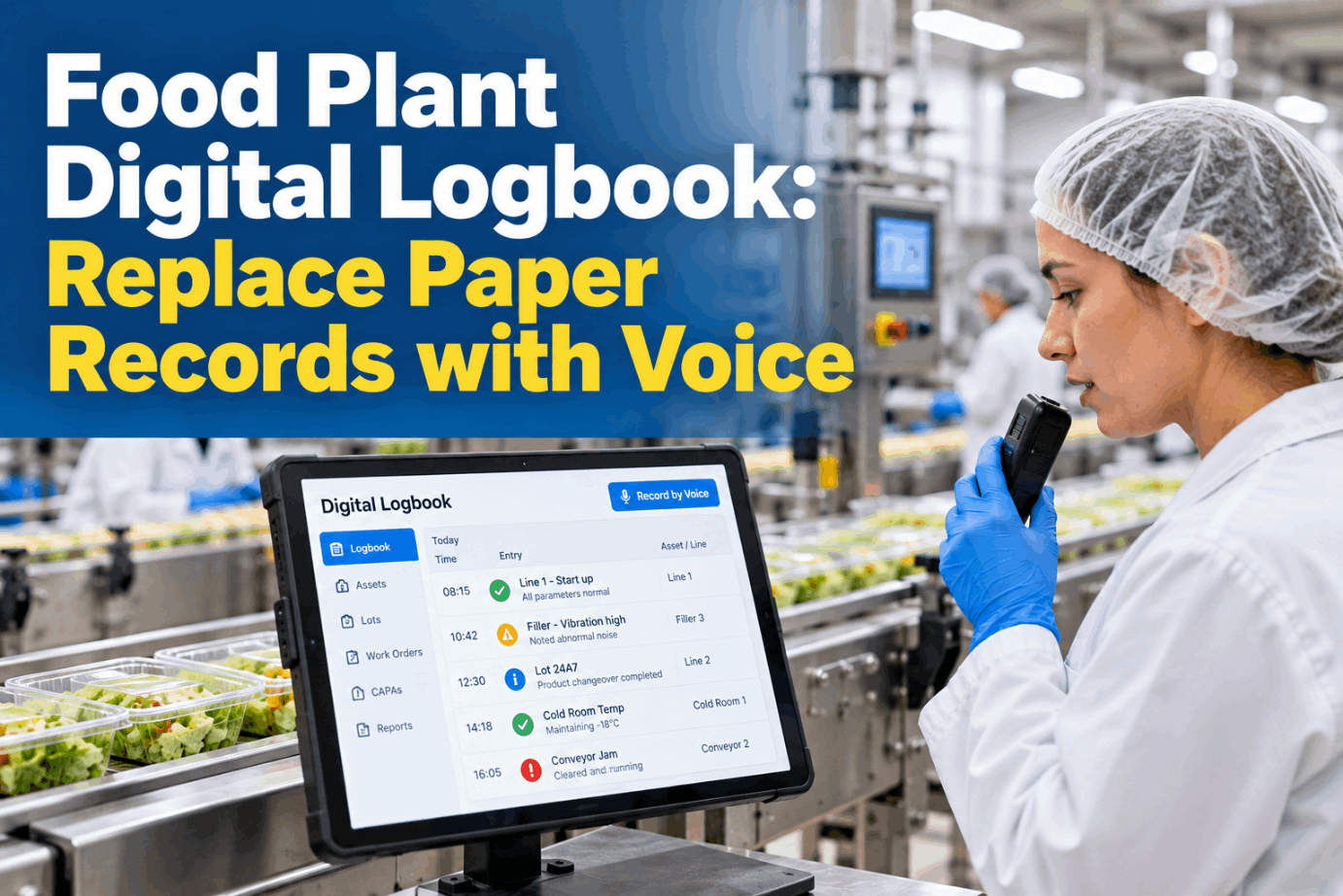
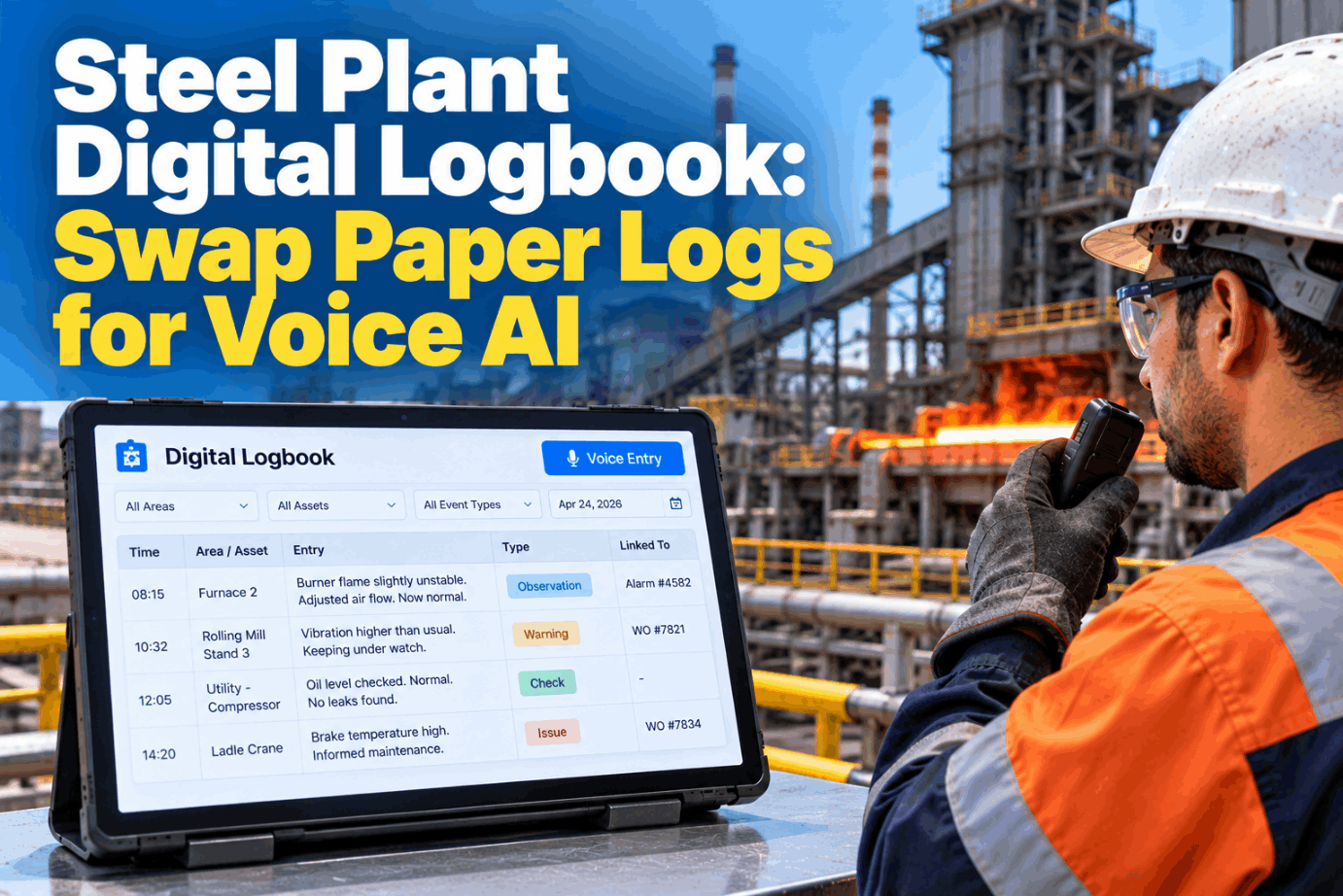
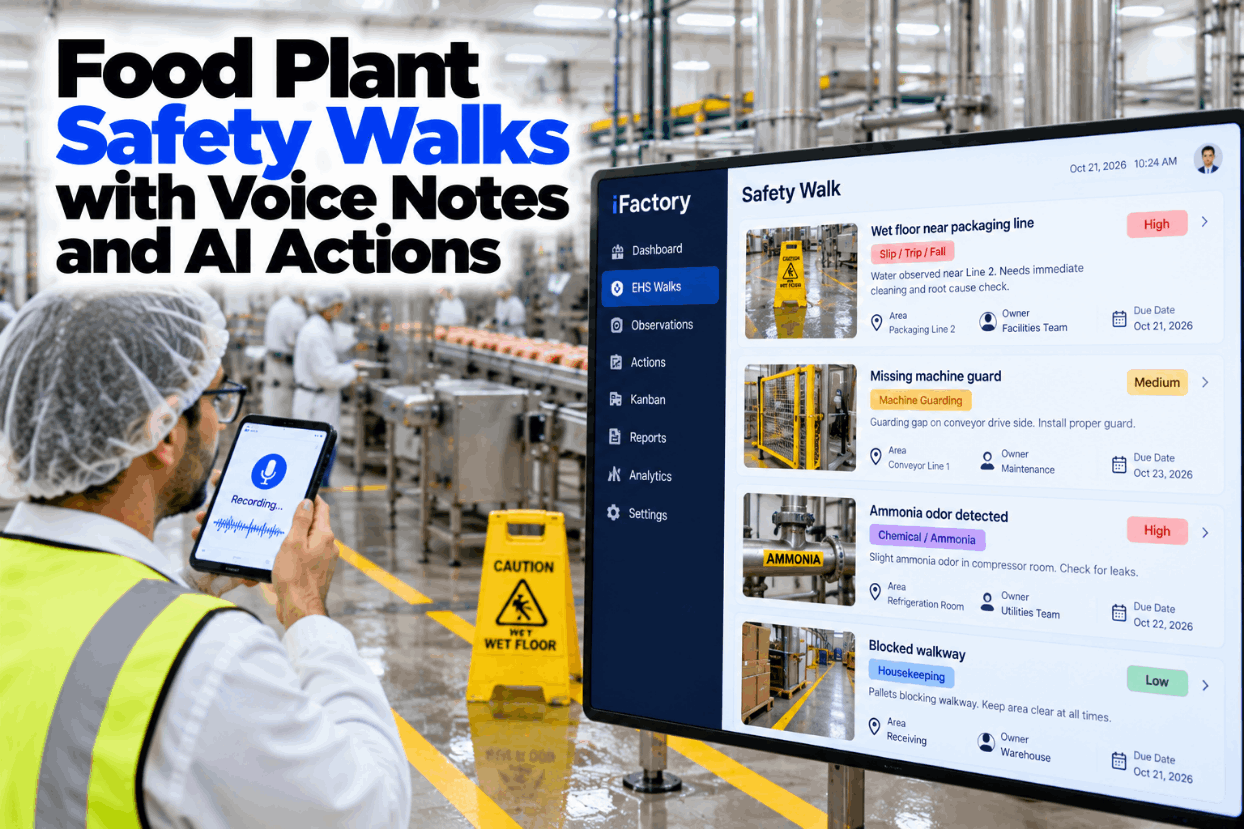
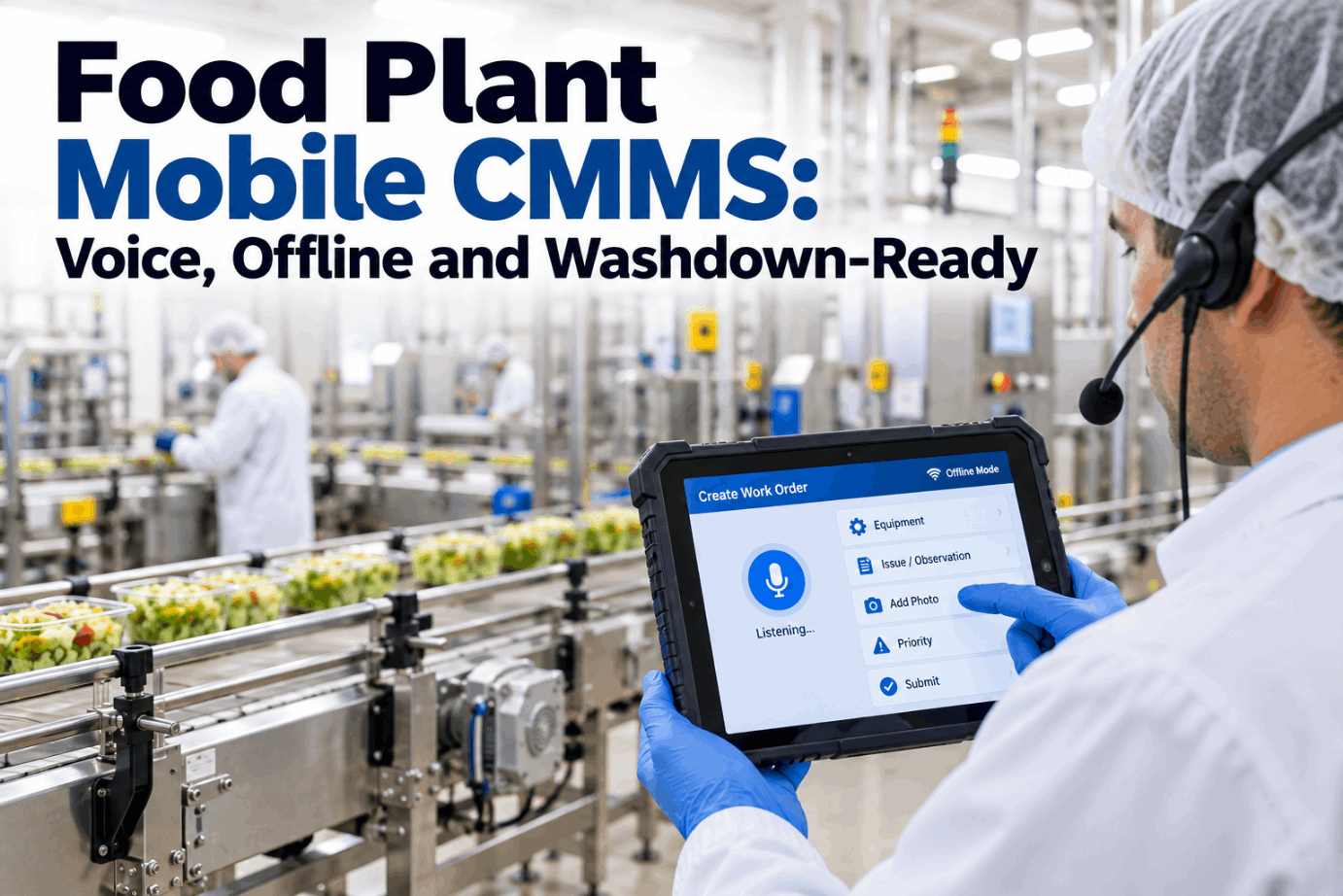
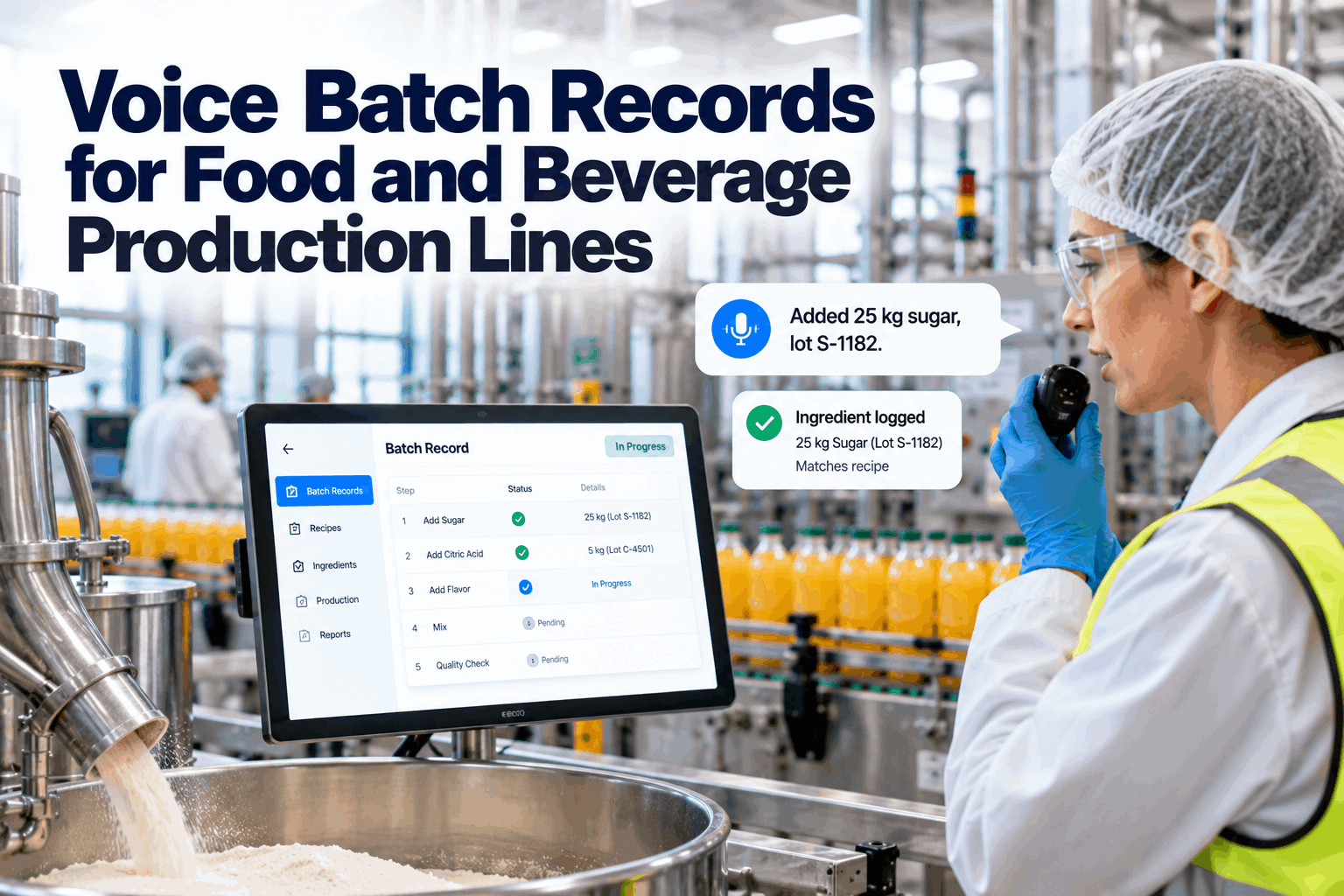
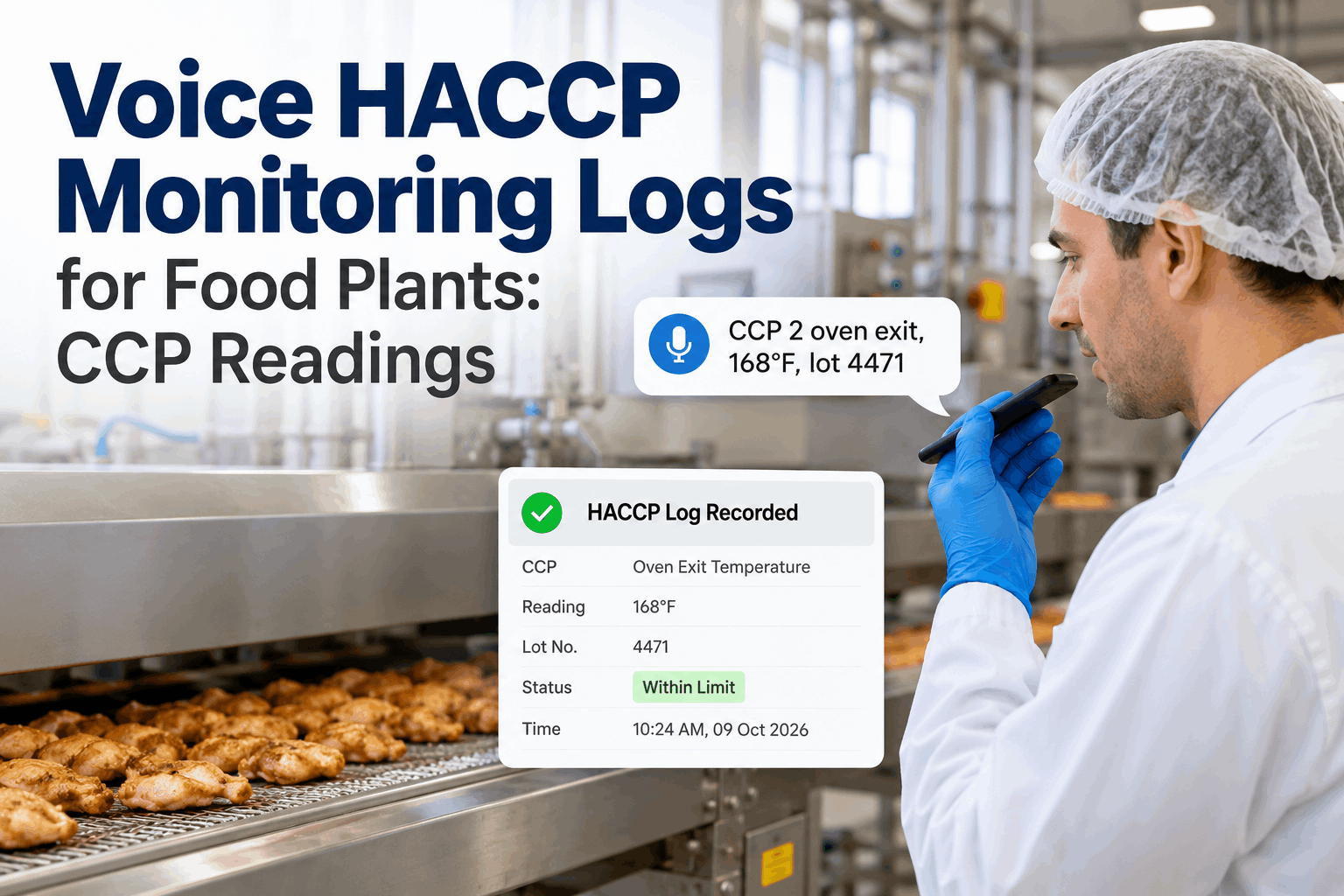
Most food plants still run on logbooks: a line log at each filler, an area log in the cold store, a maintenance book in the workshop and a handover book on the supervisor's desk. They are the first place an auditor looks and the last place anyone wants to search. Entries get written at the end of the shift, corrected with a scribble and never linked to the lot that was running. A food plant digital logbook lets crews speak each entry as it happens. Hear one filled in during a short logbook demo.
VOICE AGENT · DIGITAL LOGBOOK
Speak the Log Entry. The Lot, the Asset and the Time Fill Themselves
With iFactory Digital Logbook + Voice, area and line logs are dictated hands-free. AI tags the lot and asset, reads the entry back and links it to work orders and CAPAs, so every entry is searchable at audit time.
Line 3 log · PackingNight shift
Operator said · 02:14"Line three, case sealer jammed twice, cleared, carrying on."
Lot2611-B, from schedule
AssetCS-03 case sealer
Entered byK. Owusu
LinkedWO-4418 raised
ELECTRONIC LOGBOOK FOOD
Six Logbooks Most Food Plants Still Keep on Paper
A logbook is not a checklist. It is a running, dated record of what happened in an area, on a line or on a shift, written in the operator's own words. That free text is what makes logbooks valuable in an investigation, and what makes paper ones hard to read, search and link. Talk through your current books with our support team.
Cold store · dry store · dock
Area logEvents, door and equipment issues, visitors and anything unusualEach line
Line logStart-up, stops, product and lot changes, adjustments and rejectsEach shift
Shift handover logOpen issues, holds, jobs in progress and notes for the next crewWorkshop · lines
Maintenance logBreakdowns, fixes, parts used and who handed the area backEach clean
Sanitation logClean start and finish, chemicals, concentration checks, releasePlant floor
QA floor logHolds, checks, complaint follow-ups and release notes
21 CFR 117.305 RECORDS
What the Rule Asks of Every Log Entry
Part 117 never says "logbook", but a log entry that documents monitoring, corrective action, verification or another activity the rule requires is a record under Subpart F. Section 117.305 sets the bar paragraph by paragraph, and paragraph (a) allows original records, true copies or electronic records, so a digital logbook is a valid format. See each paragraph met in a records walkthrough.
ALCOA RECORDS
ALCOA+ Applied to a Single Logbook Line
ALCOA+ comes from pharmaceutical data integrity guidance, such as the WHO guideline on data integrity (TRS 1033, Annex 4). It is not written into Part 117, but it lines up closely with 117.305, and many food auditors use it as shorthand for records they can trust. Here is what each letter means for one log entry. Our support team can map it to your logs.
AAttributableTied to one named login and voice, never a shared account
LLegibleReadable text for the whole retention period
CContemporaneousStamped when spoken at the line, not at shift end
OOriginalThe first capture is kept, including the spoken note
AAccurateRead back and confirmed before it is saved
+CCompleteCorrections and voided entries stay visible in the history
+CConsistentSame fields, units and time source on every line and shift
+EEnduringStored on a server and backed up, not in a binder by a sink
+AAvailableRetrievable for review for as long as it is kept
Talk to the Logbook, Not the Clipboard
Operators wear gloves and stand at wet lines. They say what happened, iFactory reads it back, tags the lot and asset and files the entry to the right log. Supervisors can search it from anywhere in the plant.
Line 3 log · Operator and iFactory
OperatorLine three, metal detector test pieces passed at start-up, all three.
iFactoryRead back: Line 3 metal detector, three test pieces passed, 06:02, lot 2611-C. Save?
OperatorSave. Also, reject bin was full, I emptied it.
iFactorySaved as two entries. The reject bin note is linked to lot 2611-C for QA review.
FOOD PLANT DIGITAL LOGBOOK BEST PRACTICES
Corrections and Late Entries, Done Properly
Good documentation practice says a mistake is never hidden. On paper, that means a single line through the error so it stays readable, with the new value, initials, date and reason, and no pencil or correction fluid. The WHO data integrity guideline asks for the same. A late entry is the honest exception to "made at the time": it is marked late, shows when the event happened and when it was written, and gives the reason. A digital logbook applies both rules every time. Review your own rules in a GDP review.
Original entry
"Case sealer CS-03 jammed twice, cleared."
Written02:14, K.O.
Lot2611-B
StatusLocked when saved
Correction
"Make that three jams, not two."
Original keptjammed twice
New valuejammed three times
ReasonChecked the counter
Who, whenK.O., 02:31
Late entry
"Late entry, glue tank refilled on line three at about three."
MarkedLate entry
Event timeAbout 03:10, as stated
Written05:40, system clock
ReasonLine stop, logged after restart
LOT LINKED NOTES
How AI Tags the Lot and the Asset
An entry that says "sealer jammed" is a note. One that also names the sealer and the lot that was running is evidence. iFactory takes the line and time from the entry, finds the running lot in the production schedule or MES, and matches the equipment name to the CMMS asset register. Link your schedule and asset list with our support team.
1SpeakThe operator describes the event in plain words
2Read backThe entry is repeated and confirmed
3TagLot from the schedule, asset from the register
4LinkA WO or CAPA is raised or linked if needed
5FileSaved to the area, line or shift log
When a tag is unsure
If two lots overlap at a changeover or the equipment name is unclear, the agent asks one short question rather than guessing. The answer is saved with the entry.
SEARCHABLE LOGS AND AUDIT READY LOGS
Questions an Auditor Asks, Answered From the Log
Under 117.320, records required by Part 117 must be made promptly available to an FDA investigator on oral or written request. With paper, that means finding the right book and page and hoping the lot was written down. A digital logbook can be filtered by lot, asset, line, date, person or word. Run sample searches in a search demo.
"Every entry for lot 2611-B"Line, sanitation and QA notes for that lot, in time order
"Line 3, last Tuesday night"The night shift's line and handover entries, with linked WOs
"Everything on CS-03 this quarter"Jams, fixes and parts, linked to its work orders
"Corrections this month"Each one with the original, the reason and who made it
"Late entries by area"Counts and reasons, to show where logging slips
"Condensation, cold store log"Every mention, with date, person and photo
PAPERLESS RECORDS RULES
Retention, Retrieval and Part 11 in Plain Terms
Moving logbooks off paper does not change how long records are kept or how fast they must be produced. It changes where they live. Four points from Part 117 Subpart F answer most questions QA teams raise. Check your retention plan with our support team.
117.315(a)(1)
Keep for 2 yearsRecords are kept at least 2 years after the date they were prepared.117.315(b)
Equipment and process recordsRecords on the general adequacy of equipment or processes are kept 2 years after their use ends.117.315(c)
Offsite storageAllowed, except the food safety plan, if records can be back onsite within 24 hours. Electronic records reachable from onsite count as onsite.117.305(g)
Part 11 exemptionElectronic records kept to meet Part 117 are exempt from Part 11. Records another rule also requires stay subject to it.
Exempt is not the same as uncontrolled
Auditors still expect unique logins, a history of changes, backups and access rules. iFactory keeps all four for every log.
SHIFT HANDOVER LOG
Closing One Shift's Log and Opening the Next
The handover is where open items get lost. In a digital logbook, the outgoing lead closes the shift log, every open item carries forward on its own and the incoming lead accepts it by voice. Nothing depends on a hurried talk at the time clock. Set up handover rules in a handover session.
Close
"Close night log, Line 3."Open items are read back to the outgoing lead before the log is closed.Carry forward
Holds, open WOs, watch itemsEach one moves to the day log with its full history attached.Accept
"Day log accepted."The incoming lead's name and time are saved with the handover.
FOOD PLANT DIGITAL LOGBOOK TEMPLATE
The Fields Behind One Log Entry
Every spoken entry becomes a structured record. Most fields fill themselves, and the operator only says what happened. Ask our support team for a blank version.
LogLine 3 log, packing
PlantPlant 2, added automatically
Date and time26 Oct, 02:14, system clock
Entered byK. Owusu, login and voice
Entry"Case sealer jammed twice, cleared"
Lot2611-B, from the schedule
AssetCS-03, from the register
Links and historyWO-4418, read-back and any corrections
FOOD PLANT DIGITAL LOGBOOK EXAMPLES
Three Spoken Entries and Where They Went
These are illustrations of how short phrases become filed, linked records. They are not case studies. Try your own phrases in a phrase test.
Cold store area log
"Dock door three not closing fully, cold air leaking."Filed to the area log, door asset tagged, maintenance work order raised.Sanitation log
"Line two clean finished, test strip reads two hundred."Saved as 200 ppm, the actual value, and linked to the line release.QA floor log
"Two cases from 2611-B with smudged codes, set aside."Tagged to the lot, QA hold suggested and confirmed by the lead.
FOOD PLANT DIGITAL LOGBOOK IMPLEMENTATION GUIDE
Four Moves From Paper Books to Voice Logs
Choosing food plant digital logbook software is the easy part. The work is agreeing what each log holds and what things are called. Plan your first area with our support team.
1
List every bookEach logbook, who writes in it and who reads it.2
Agree fields and namesLines, assets and lot sources, named as crews say them.3
Run both for two weeksVoice and paper side by side in one area, then compare.4
Close the paper booksArchive them as scanned true copies and keep them for the full 2 years.
TURNKEY AI DEPLOYMENT
Digital Logbook, Voice Agent and AI Server in One Package
iFactory delivers Digital Logbook + Voice as a turnkey bundle. A pre-configured NVIDIA AI server ships racked and ready with speech models, log templates and CMMS and schedule connectors pre-loaded, so voice is processed on site. You rack it, plug in power and Ethernet, and the AI is live. Scope it for your plant with a turnkey quote.
What's Included
- Pre-configured NVIDIA AI server, racked and ready
- On-site speech models tuned for plant noise
- Area, line, shift and maintenance log templates
- Lot tagging from your schedule or MES
- Asset tagging from your CMMS register
- Work order and CAPA links from any entry
- 24×7 remote monitoring of models and hardware
Live in 6–12 weeks
Wk 1–4
Install and Connect
Server racked, logbooks mapped, schedule and asset register linked.
Wk 5–8
Pilot One Area
Voice logs run beside paper, names and prompts tuned to your crews.
Wk 9–12
Go-Live and Training
All areas switched over, crews trained, paper books archived.
HOW iFACTORY FITS
Food Plant Digital Logbook Software Built for the Floor
iFactory turns every logbook into records that are timed, attributed and linked as they are made. Our support team can walk you through a pilot plan.
1
Dictated hands-free. Area and line logs are spoken at the line and read back before saving.
2
Lot and asset tagged by AI. Every entry knows what was running and on which machine.
3
Searchable for audits. Filter by lot, asset, line, date, person or word.
4
Linked to WOs and CAPAs. An entry can raise or join a work order or corrective action.
1000+
Industrial clients running iFactory
99.9%
Platform uptime for round-the-clock food plants
6-12 wks
From racked server to paperless logbooks
FREQUENTLY ASKED QUESTIONS
What Plant Managers Ask About Food Plant Digital Logbooks
What is a food plant digital logbook?
An electronic version of the area, line, shift and maintenance logs a plant keeps on paper. Each entry is stamped with the time and the person, stored as the original record and searchable. With voice, operators dictate entries hands-free and AI adds the lot and asset.
Does FDA accept electronic logbook records?
Yes. 21 CFR 117.305(a) allows records to be kept as originals, true copies or electronic records. Under 117.305(g), electronic records kept to meet Part 117 are exempt from Part 11, unless another rule also requires them.
How long must food plant logbooks be kept?
Records required by Part 117 must be kept at least 2 years after they were prepared, under 117.315(a)(1). Customers, certification schemes or other rules may ask for longer, so set retention per log.
How are mistakes corrected in a digital logbook?
The original entry is never overwritten. A correction is saved as a new version with the new value, the reason, the person and the time, and the original stays visible. It is the digital form of the single-line cross-out.
What if an operator forgets to log something?
They make a late entry. It is marked late, shows when the event happened and when it was written, and gives a reason. Late entries can be reported by area, so supervisors see where logging slips.
How do we start?
Pick one area with a busy paper log, such as a packing line, and run voice and paper side by side for two weeks. Our
support team can help plan it.
Every Entry Legible, Timed and Linked to Its Lot
Replace paper logbooks with voice entries that are read back, tagged to lots and assets, and searchable for audits. Delivered turnkey and live in 6 to 12 weeks.
Example night shift · Line 3 log
EntriesDictated at the line
LotsTagged from the schedule
CorrectionsOriginal kept, reason shown
HandoverAccepted by the day lead
Every entry searchable for audit