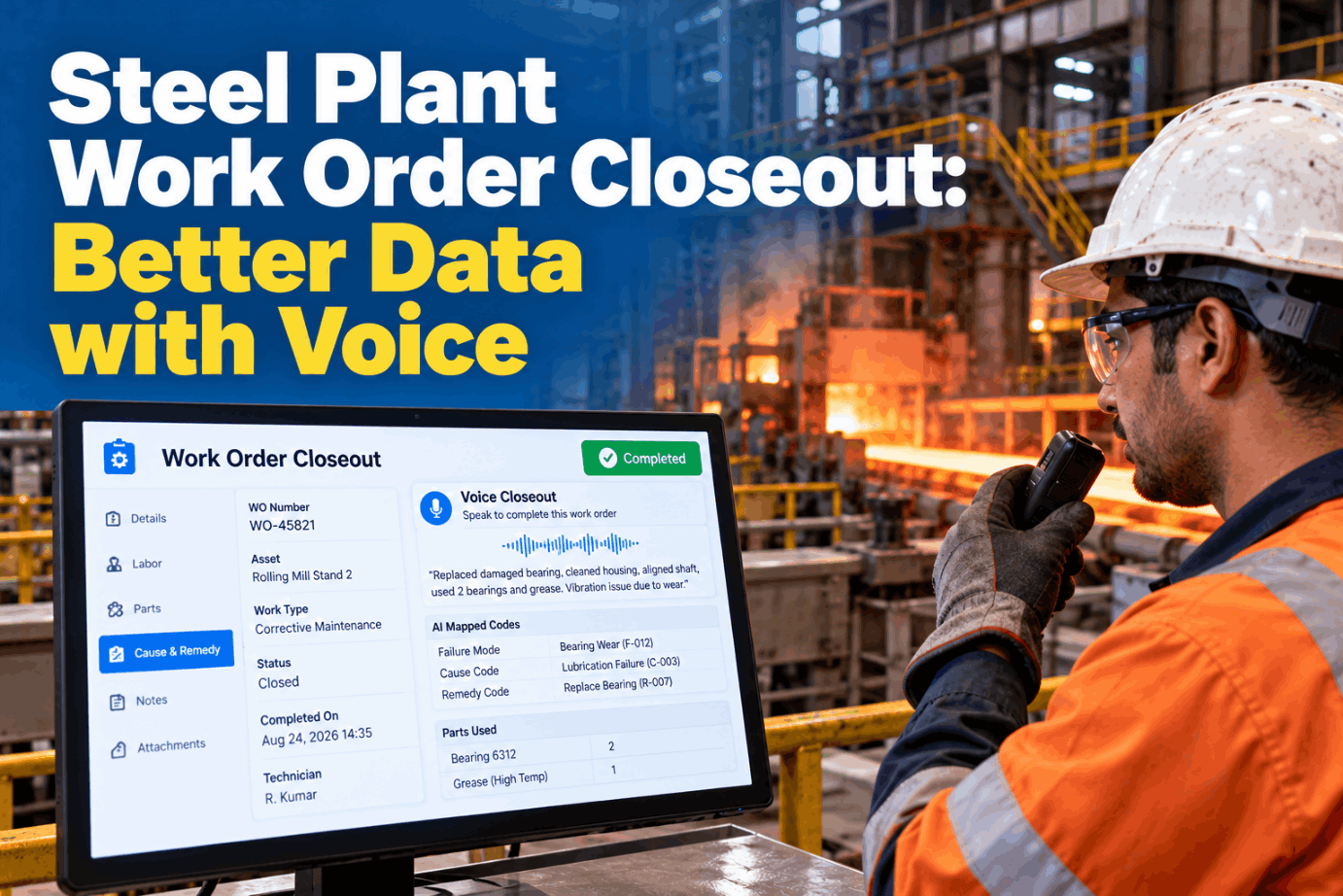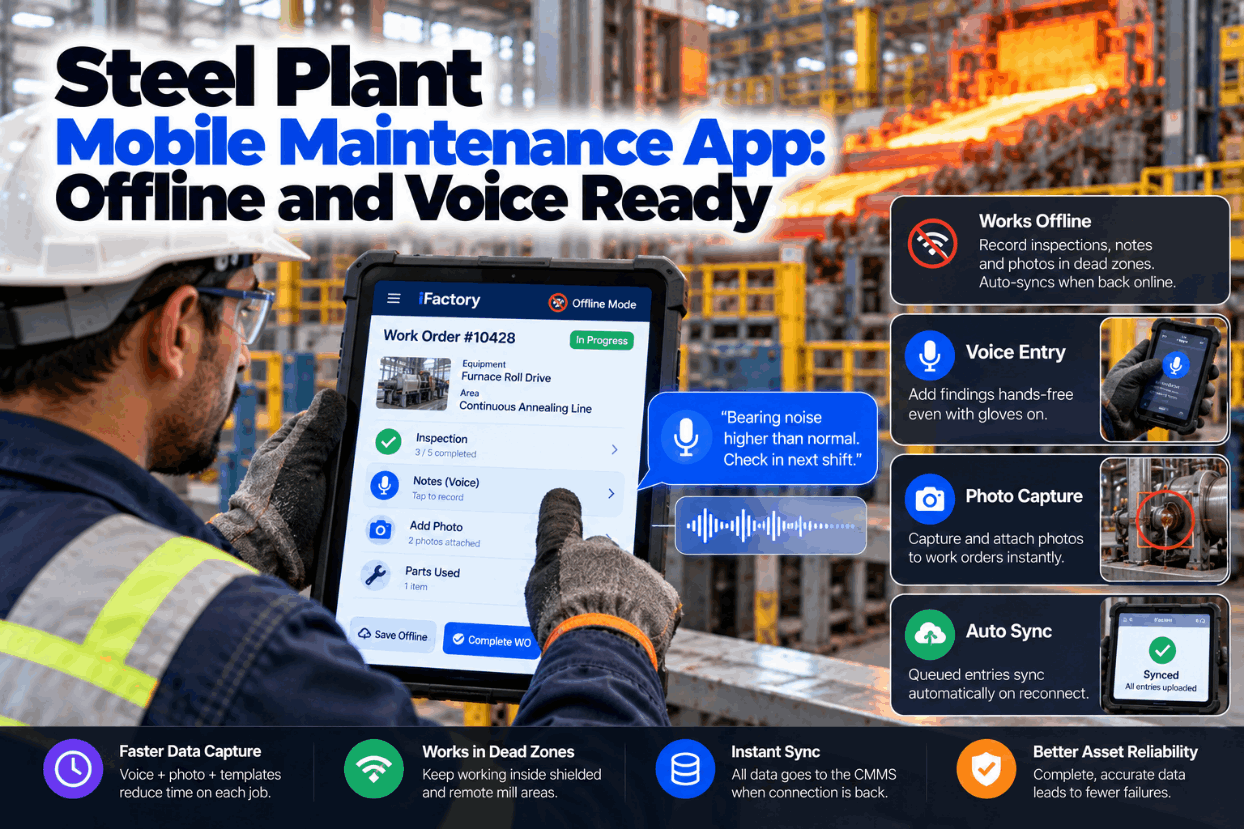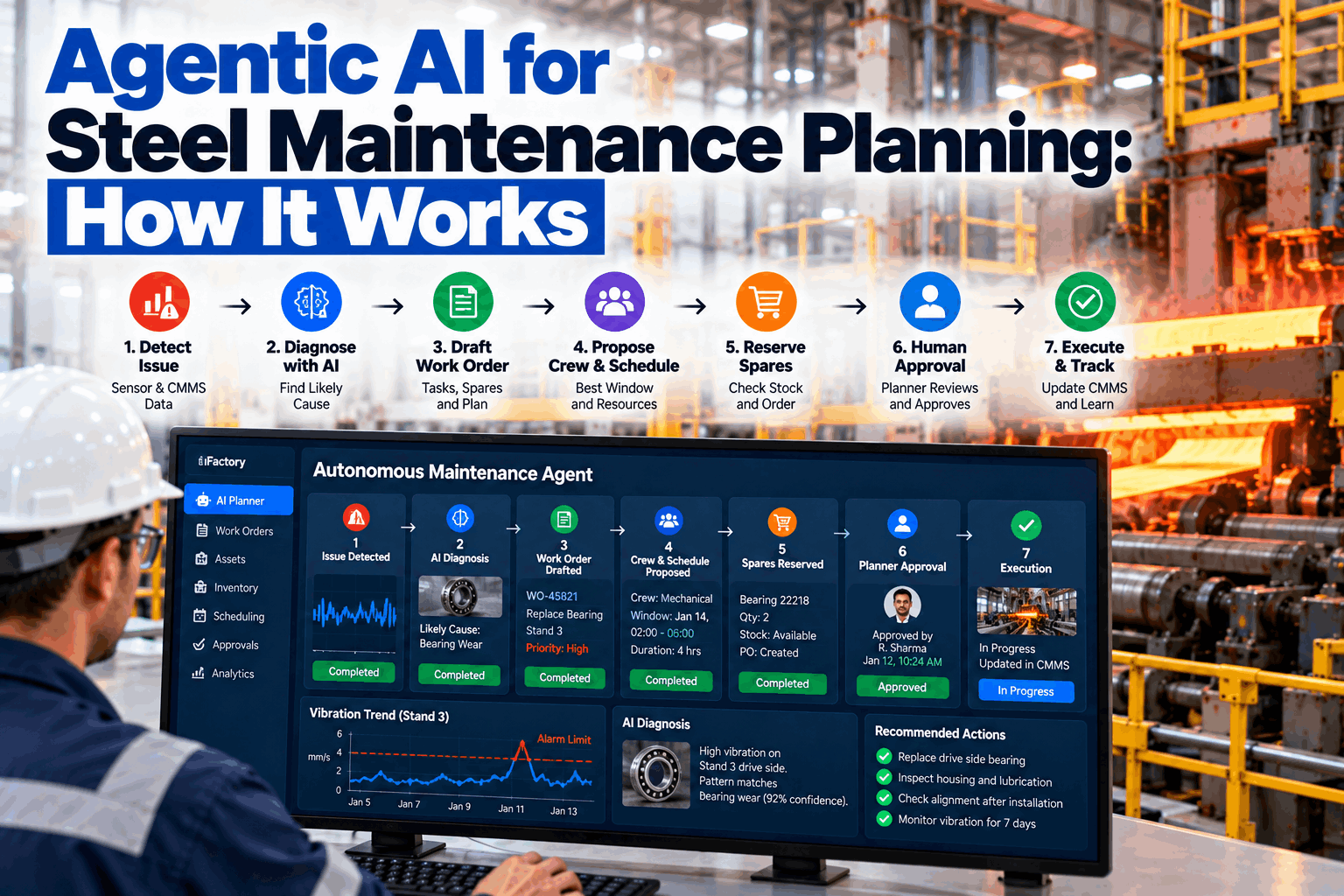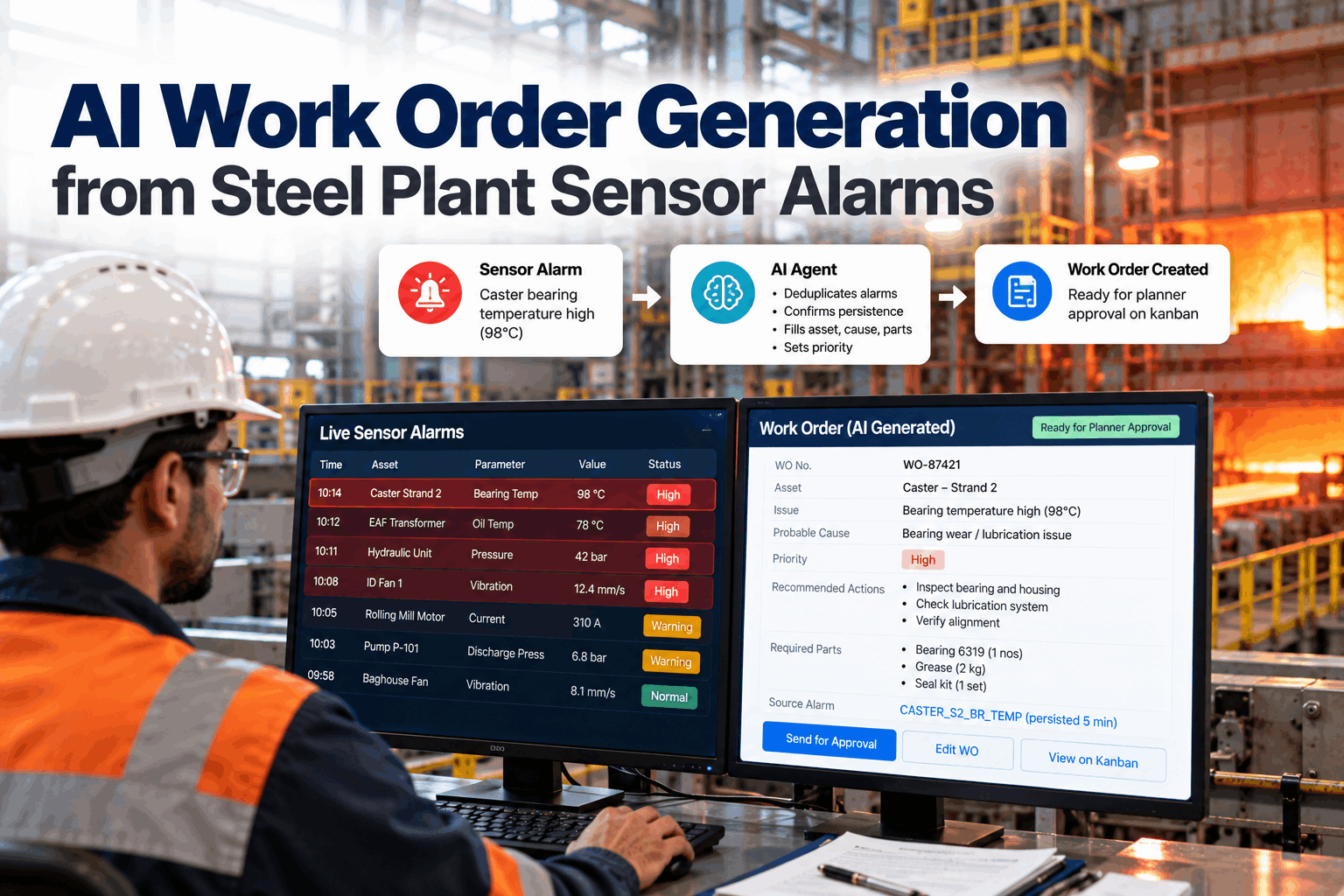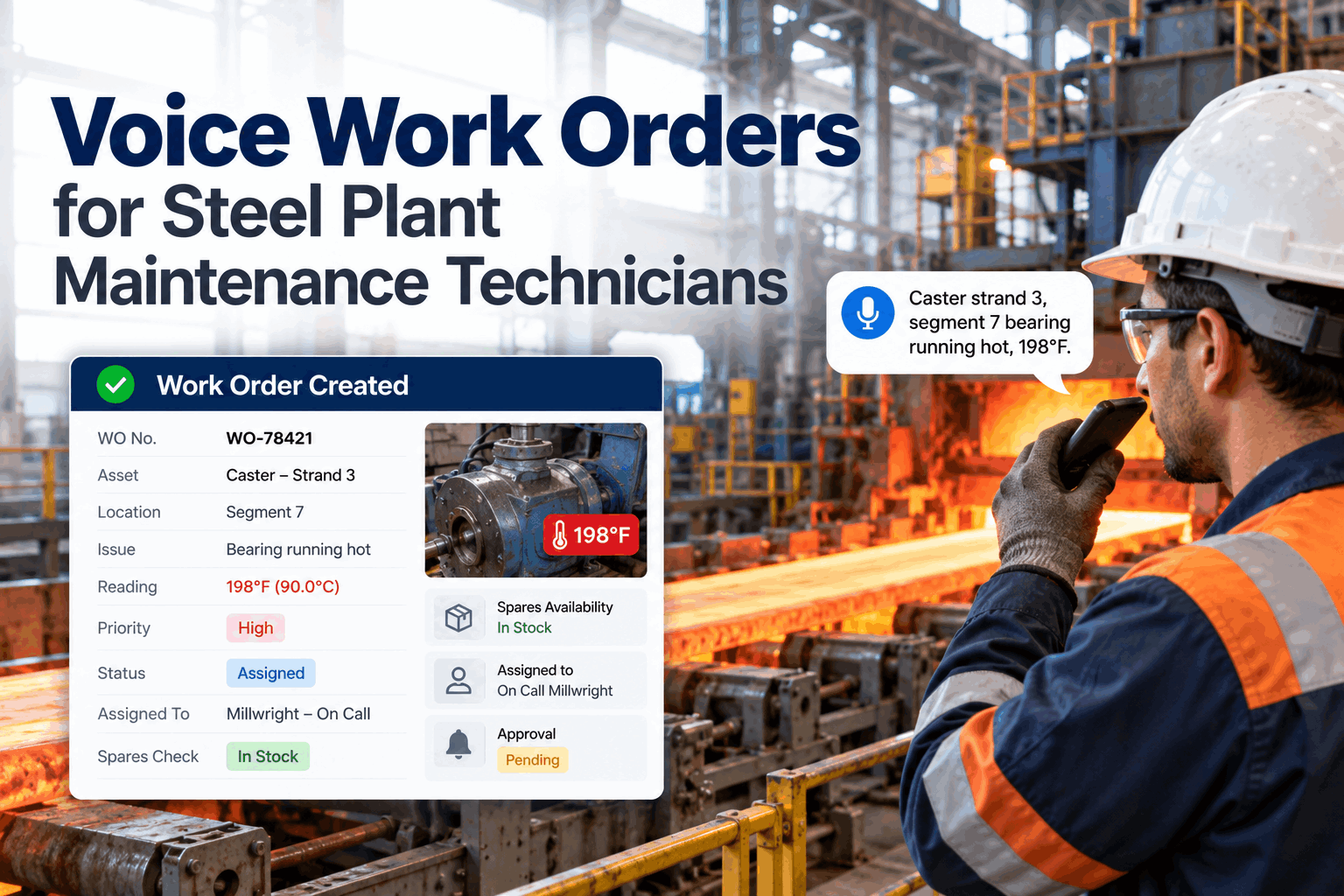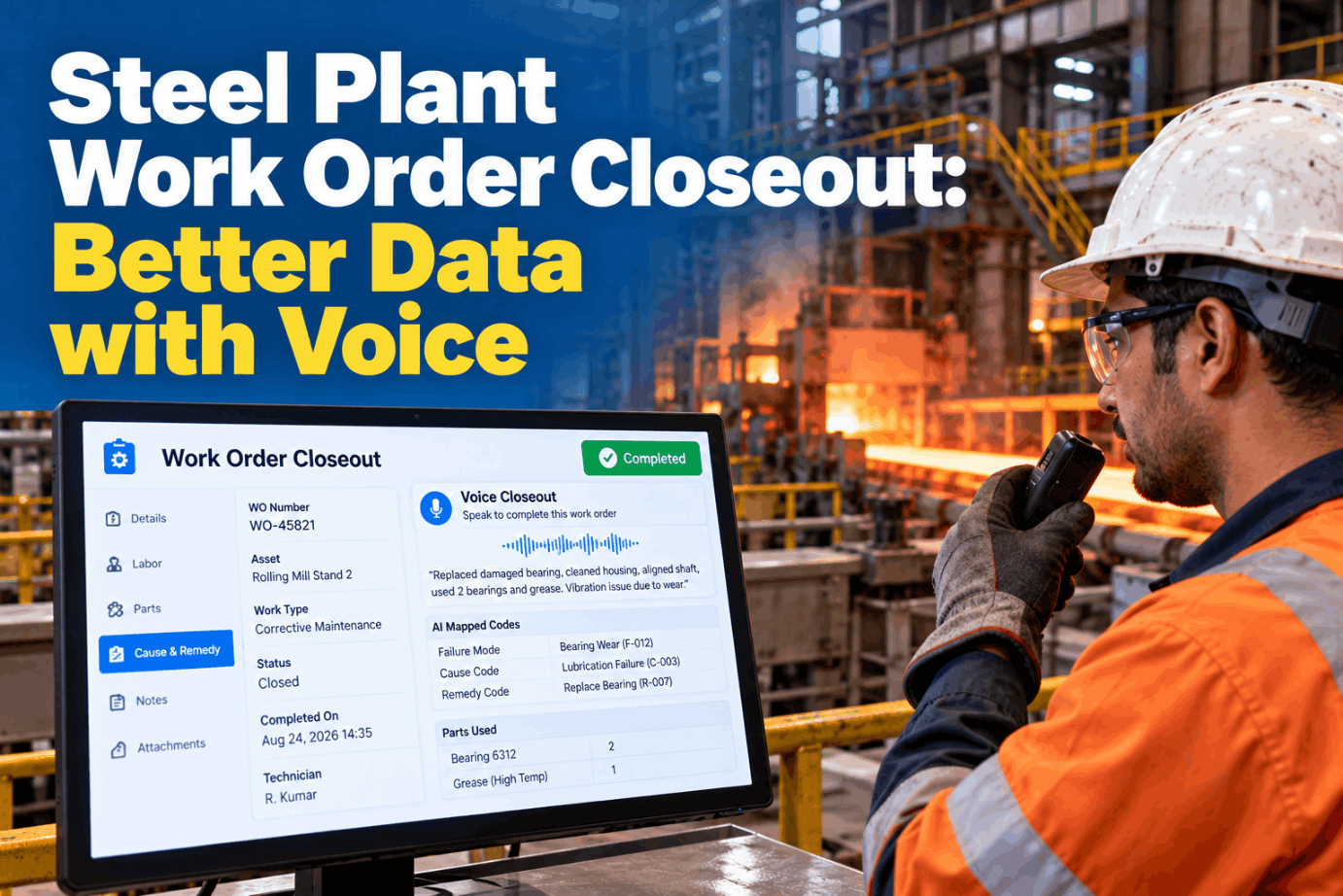
In most steel plants the job gets done well and then written up badly. A fitter comes off a caster segment after three hours in the heat, the terminal is two floors away, and the closeout reads "bearing changed, OK". Without the cause, parts and hours, the next failure looks like the first. Hear a voice closeout completed at the machine in a short closeout demo.
Close the Job by Voice and Keep the Cause, the Parts and the Hours
The iFactory Voice Closeout Agent asks for cause, remedy and parts used. It maps the technician's own words to your failure codes, books the parts used against the order and closes the kanban card with the full history attached.
Why Closeout Notes Say So Little
Closeout is the last step of a job and the first one to be rushed. A good closeout records the completion date, detailed comments, labour hours, parts and a reason-for-outage code, so failures can be traced later. Reliability writers warn that free text alone becomes meaningless for failure reporting, and that too many codes confuse the craft. Most poor notes come from the same four habits. Compare your own notes with our support team.
One Job, Two Closeout Records
The same bearing change on a continuous caster, written up two ways. The record on the left is typical of a closeout typed at shift end. The one on the right is what the voice agent builds from a short conversation at the segment. Both are illustrative, not taken from a real plant. Hear the right-hand one built live in a voice walkthrough.
Problem, Cause and Remedy in Two Common Code Sets
ISO 14224 splits a failure into the mode you observe, the mechanism behind it and the cause. Its cause groups are design, fabrication or installation, operation or maintenance, and management. SAP PM uses catalogs instead: B for object parts, C for damage, 5 for causes, A for activities and 2 for tasks. Most plants use one set or a blend. The voice agent maps speech to whichever list your CMMS holds. Share your catalog with our support team.
How Free Speech Becomes Failure Codes
The agent asks short questions in a fixed order, the way a good supervisor would. It listens for the part, the damage, the cause and the action, then matches each phrase to your code list. It reads the result back before anything is saved, so the technician agrees with the codes, not just the words. Try your own phrases in a phrase test.
Technicians shouldn't guess. The agent saves "cause to be confirmed", keeps the spoken words and flags the order for the reliability engineer. A wrong cause code is worse than an honest open one.
Ninety Seconds at the Machine, Not Ten at the Terminal
The fitter answers four or five questions with gloves on and hands free. iFactory maps the answers to your codes, books the parts used, logs the hours and closes the card on the kanban board.
Parts Drawn, Parts Used and Parts Returned
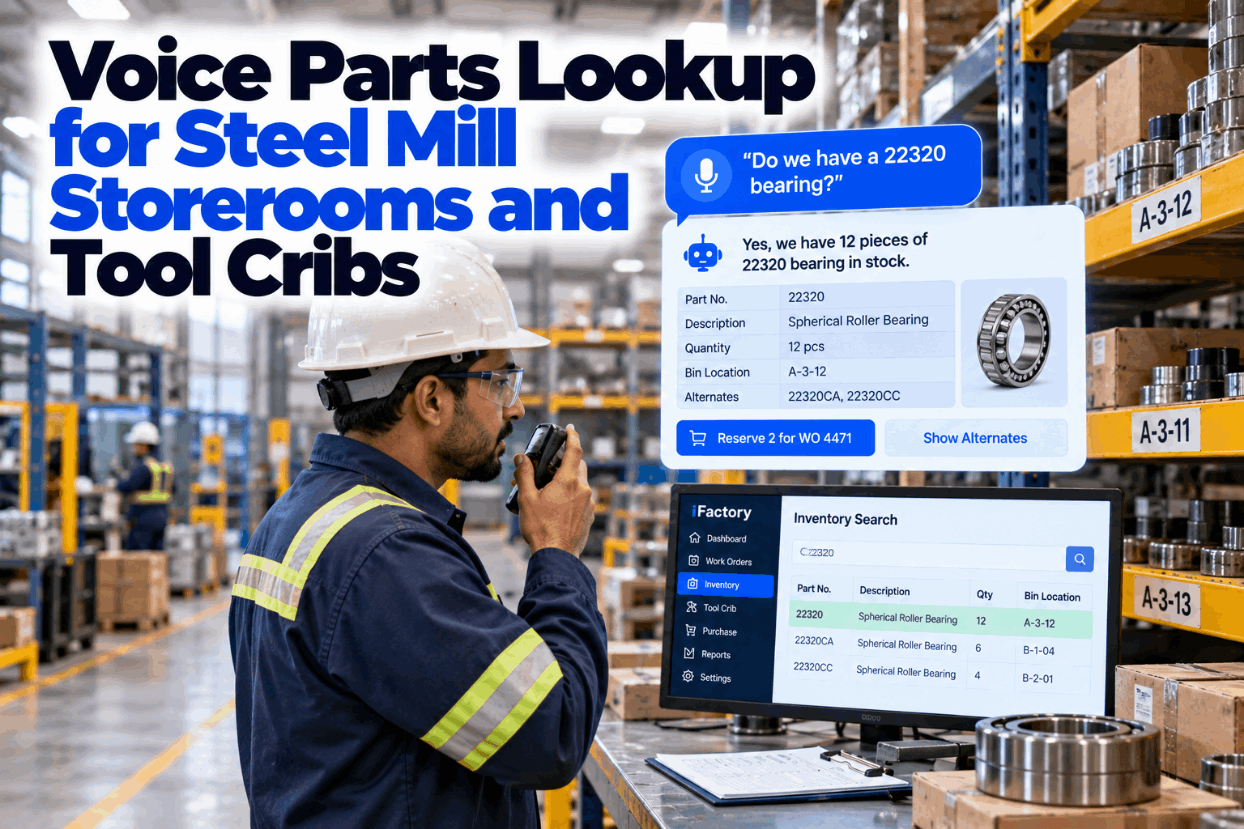
MRO stock is only as accurate as the closeouts behind it. Parts drawn for a job are not always the parts used, and a spare seal left in a toolbox is stock the storeroom can't see. In SAP, parts are issued to the order with a goods issue (movement type 261), and unused items need a return. The agent asks for all three numbers and keeps rotable spares apart. Check your stores flow with our MRO team.
Hours Split the Way Planners Can Use Them
A single total of "4 hours" can't show where a job lost time. Actual hours compared with the estimate show when job plans need revising or crews need support. The agent asks for hours per person and notes any waiting, such as crane time, permits or a missing part, as its own line. Set up delay reasons in a planning session.
Back in Service Closeout Checklist
A job is not finished when the last bolt is tight. It is finished when operations accept the asset back. Under OSHA 1910.147(e), before locks come off, the work area is checked for tools and spare parts, people are clear and affected employees are told, and each lock is removed by the person who applied it. Use the checklist below, or ask our support team for a copy you can edit.
Closeout Data Is the Raw Material for Bad Actor and RCA Work
Bad actor lists, Pareto charts and root cause studies all start from closed work orders. When half the history says "other", the ranking is guesswork. Coded closeouts let a reliability engineer see in minutes that one failure keeps returning on one asset. Codes don't replace root cause analysis, but they show where it is needed. The example is illustrative. See history views in a reliability demo.
Six Measures of Maintenance Data Quality
Record a baseline from the last three months of closed orders before go-live, then review monthly with planning, stores and reliability. These measures show whether closeouts are getting better, not just faster. Our support team can help pull the baseline.
Size the Follow-Up Time With Your Own Numbers
Every vague closeout costs someone a follow-up: a planner chasing hours, a storeman chasing parts, an engineer chasing a cause. The worksheet uses assumed inputs only, so replace each with your own figures. Build a full case with a planning specialist.
Multiply by your loaded hourly rate. Then add what is harder to price: stock counts that match the shelf, job plans with real hours and failure history good enough to rank. Leave avoided downtime out unless your own data supports it.
Four Steps Before the First Voice Closeout
The voice agent is only as good as the code list and asset names it maps to. Most of the work is cleaning those up first. Plan the first area with our support team.
Voice Agent, CMMS Links and AI Server in One Package
iFactory delivers the Voice Closeout Agent as a turnkey bundle. A pre-configured NVIDIA AI server ships racked and ready with speech models, your code catalogs and CMMS and stores connectors pre-loaded, so voice is processed on site. You rack it, plug in power and Ethernet, and the AI is live. Scope it for your plant with a turnkey quote.
- Pre-configured NVIDIA AI server, racked and ready
- Speech models tuned for mill noise and accents
- Your damage, cause and activity codes loaded
- Asset names and crew slang mapped to the register
- Parts booking linked to stores and the CMMS
- Kanban board with voice close and full history
- 24×7 remote monitoring of models and hardware
Server racked, CMMS and stores linked, code lists trimmed.
Voice closeouts run in one area, codes reviewed weekly with reliability.
All crews trained, data quality measures reviewed against the baseline.
Voice Closeout Built for Steel Plant Crews
iFactory turns the last five minutes of a job into history your planners and engineers can use. Our support team can walk you through a pilot plan.
What Plant Managers Ask About Work Order Closeout
Every Closed Job Leaves a Record Worth Keeping
Cause, remedy, parts and hours captured by voice at the machine, coded for analysis and closed on the kanban board. Delivered turnkey and live in 6 to 12 weeks.