Steel Plant Knowledge Capture from Retiring Experts by Voice

By Jackson T on October 21, 2026

steel-plant-knowledge-capture-retiring-experts-voice

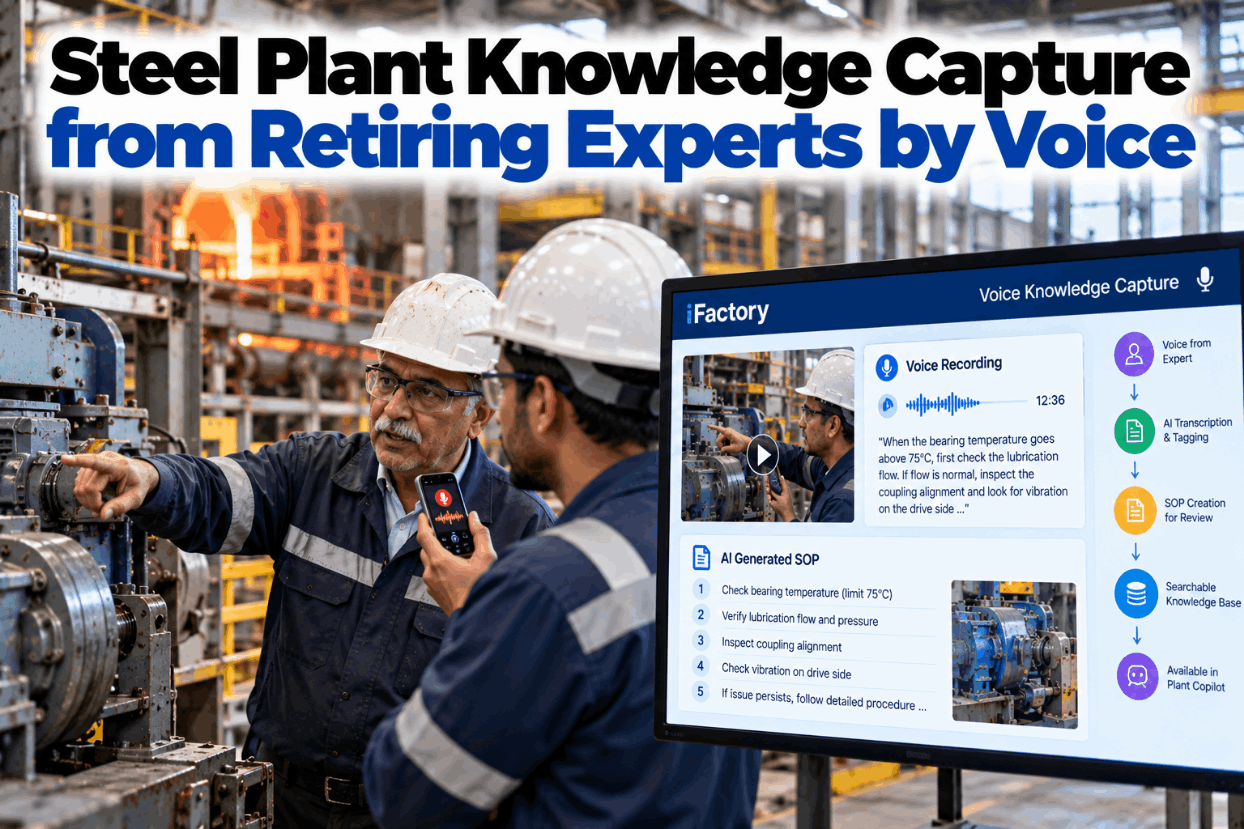
Every steel plant has a few people who can tell a failing roll bearing by its sound, or know which shim pack the F3 chock really needs. Much of that know-how was never written down, and when those people retire it leaves with them. Steel plant knowledge capture by voice lets experts explain their work while they do it, and turns what they say into reviewed procedures newer technicians can search. Hear how a recorded repair becomes an approved SOP in a short knowledge capture demo.

VOICE AGENT · KNOWLEDGE CAPTURE

Record What Your Best Fitters Know While They Work, Before They Retire

The iFactory Voice Knowledge Agent listens while experts narrate a repair. It transcribes, tags the recording by asset and failure mode, drafts an SOP for human review and feeds the copilot, so new technicians can ask the same questions later.

Capture · Senior roll shop fitterRec 18:42
Expert said"Starting the F3 work roll chock change. Recording."
iFactory read back"Recording. Tagged hot strip mill, stand F3, work roll chock. Go ahead."
Asset · HSM F3 chockMode · bearing overheatingTask · chock change
Transcript, 14:06"If the chock runs hot on the drive side, check the shim pack first, not the bearing."
Draft SOP: 7 steps · waiting for review
RETIRING WORKFORCE

The Skills Gap Is a Knowledge Gap Too

Hiring is only half the problem. A 2024 study by Deloitte and The Manufacturing Institute estimates that US manufacturing could need as many as 3.8 million new employees between 2024 and 2033, and that 1.9 million of those jobs could go unfilled. Even when roles are filled, new people arrive without the years of judgment the leavers carry. Talk through your own retirement list in a short planning call.

3.8MUS manufacturing jobs that could need filling, 2024 to 2033
1.9MOf those that could go unfilled if skills gaps persist
65%Of manufacturers in a 2024 NAM survey naming talent their top challenge
Source: Deloitte and The Manufacturing Institute, April 2024. These are US manufacturing figures, not steel-specific. Use your own retirement-eligible list for plant planning.
TACIT VS EXPLICIT KNOWLEDGE

What Is Already Written Down, and What Never Was

The philosopher Michael Polanyi summed up tacit knowledge as "we can know more than we can tell." Explicit knowledge, such as torque values and PM intervals, is already in manuals and the CMMS. Tacit knowledge, such as how a bearing sounds before it fails, is learned by doing and rarely written down. Voice capture works best on the middle of this range, where experts can explain what they notice if someone asks at the right moment. Map your own gaps with our knowledge team.

ExplicitTacit
Already documented
  • Bolt torque values
  • PM intervals and checklists
  • Lubricant grades
  • Lockout steps
Best for voice capture
  • Which check to do first on a hot chock
  • Shortcuts that are safe, and ones that are not
  • Known quirks of one specific crane or pump
  • Why a fix was done a certain way
Hard to put in words
  • The sound of a failing bearing
  • The feel of a correctly seated seal
  • Reading a caster mould by eye
  • Needs video and mentoring too
STEEL PLANT KNOWLEDGE CAPTURE FOR PLANT MANAGERS

Who to Capture First: Retirement Window Against Knowledge Risk

You cannot record everyone at once, so rank people by two things: how soon they leave, and how many others know what they know. Someone retiring next year who is the only person able to set up the coiler mandrel comes first. Fill in this grid with HR and area managers, then book sessions from the darkest cells outward. Fill it in together in a prioritisation session.

Who knows it
Leaves within 12 months
Leaves in 1–3 years
Leaves in 3+ years
Only this person
Capture nowWeekly sessions
This quarterMonthly sessions
Plan this yearNarrated jobs
Two or three people
This quarterPair capture
Plan this yearNarrated jobs
MonitorReview yearly
Documented elsewhere
Check the gapsOne review session
MonitorReview yearly
No actionKeep docs current
EXPERT KNOWLEDGE TRANSFER METHODS

Two Ways to Get Knowledge Out of an Expert's Head

Both methods come from established practice. Structured interviews draw on techniques such as the critical decision method, where an expert walks back through a real event and is asked what they noticed and why they chose what they did. On-the-job narration is a think-aloud method: the expert simply says what they are doing and why while they work. Most plants need both. Ask our support team which suits each expert.

AStructured interview
WhereQuiet room or control pulpit, 45 minutes
Best forRare failures, past incidents, judgement calls
Prompt"Tell me about the worst coiler failure you handled."
Watch forMemory gaps; confirm details against work order history
BOn-the-job narration
WhereAt the asset, during a real planned job
Best forStep order, checks, tricks, tools and parts
Prompt"Say what you check and why, as you go."
Watch forNoise; use a headset mic and never narrate hazardous steps at the cost of attention

New Technicians Ask, Experts Answer, Even After They Leave

Every approved SOP and tagged recording feeds the iFactory copilot. A new technician asks out loud, hears the answer and sees exactly which recording and procedure it came from.

Roll shop · New technician and iFactory
TechnicianF3 drive side chock is running hot again. Where do I start?
iFactoryCheck the shim pack before the bearing. Steps 2 to 4 of SOP RS-114, revision 2. Source: senior fitter recording, chock change, 14:06.
TechnicianPlay that part of the recording.
iFactoryPlaying 40 seconds from 14:06. The approved SOP is open on your handheld.
STEEL PLANT KNOWLEDGE CAPTURE IMPLEMENTATION GUIDE

From a Spoken Repair to an Approved SOP in Six Steps

SOP generation AI does the slow parts: transcribing, tagging and drafting. People do the parts that need judgement. ISO 9001 asks for documents to be reviewed and approved for suitability and adequacy before use, and an AI draft is no exception. Nothing reaches the copilot as an SOP until an engineer has signed it off. See the review gates in a workflow demo.

1RecordExpert narrates on a headset micAI
2TranscribeSpeech to text with plant vocabularyAI
3TagAsset, failure mode, task, hazardsAI
4DraftSteps, checks, tools and warningsAI
5ReviewExpert and engineer correct and approvePeople
6PublishSOP issued, copilot cites itBoth
SEARCHABLE REPAIR NOTES

Tags That Make a Recording Findable Years Later

An untagged recording is just another file nobody opens. Each clip gets tags from your own asset register and failure mode list, so a search for "F3 chock overheating" finds it alongside the work orders for the same asset. Tags are suggested by AI and confirmed in review. Set up your tag lists with our support team.

Recording KC-0317F3 work roll chock change, drive side
Reviewed
Transcript excerpt, 14:06"Drive side running hot usually isn't the bearing on this stand. More often than not the shim pack has shifted after the last roll change. Pull the cover, check the shims with a feeler gauge, and only then decide on the bearing."
AssetHSMStand F3Work roll chock DS
Failure modeBearing overheating
TaskPlanned chock change
HazardsSuspended loadHydraulic pressure
ToolsShim setFeeler gauges
Linked SOPRS-114, revision 2
EXPERT CAPTURE SESSION TEMPLATE

A 45-Minute Session Plan You Can Reuse

A good session feels like a conversation, not a test. Keep it short, focus on one asset or one failure, and always end by checking what was said. Use the plan below for structured interviews; for narrated jobs, use only the first and last blocks. Run a sample session with us in a capture demo.

0–5 min
Set up and consentExplain the purpose, how the recording is used and who reviews it. Confirm the expert agrees to be recorded.
5–10 min
Name the asset and the failureSay the asset tag and failure aloud so the agent can tag the session.
10–30 min
Walk through a real event"What did you notice first? What did you check, and in what order? What would a newer tech miss?"
30–40 min
Probe the edges"When would you not do it that way? What has gone wrong before? What is never safe to skip?"
40–45 min
Read back and closeAgent reads back the key points. Expert corrects them, and a review date for the draft SOP is agreed.
COPILOT ANSWERS WITH SOURCES

How a Copilot Answer Shows Its Sources

An answer nobody can check will not be trusted on a mill floor. The copilot answers only from approved SOPs and reviewed recordings, names its sources, and says plainly when it has no answer instead of guessing. Ask our support team how sources are shown.

Question, by voice"What torque for the F3 chock cover bolts?"
AnswerUse the torque value in SOP RS-114, step 6. The senior fitter adds: tighten in a cross pattern and recheck after the first coil.
SOP RS-114, rev 2Approved by area engineer
Recording KC-0317At 14:19, reviewed
No match ruleIf no approved source, it says so
STEEL PLANT KNOWLEDGE CAPTURE COST AND ROI

Size the Effort and the Time Saved in Hours

The real cost of capture is people's time, so count it honestly. The worksheet below uses assumed inputs to show the arithmetic only, in hours rather than money. Your finance team can apply its own labour rates. Build your version in a sizing session.

Effort, first wave
Experts captured, assumed10
Capture hours each, assumed12 h
Expert time10 × 12 = 120 h
SOPs drafted × review hours, assumed60 × 1.5 = 90 h
Total effort120 + 90 = 210 h
Time saved, per year
Newer technicians, assumed25
Time saved looking for answers, assumed30 min a week
Hours saved per week25 × 0.5 = 12.5 h
Working weeks, assumed48
Hours saved per year12.5 × 48 = 600 h
STEEL PLANT KNOWLEDGE CAPTURE BEST PRACTICES

Six Rules That Keep Experts Willing and Content Trusted

Capture fails when experts feel replaced or when the content goes stale. These rules address both. Agree them with crews and worker representatives before the first recording. Talk them through with our support team.

Credit the expert by nameTheir name stays on every SOP and answer they shaped.
Capture in paid timeSessions are part of the job, booked like any planned work.
Review before anything is usedNo AI draft reaches the floor without human approval.
Never trade safety for narrationExperts pause talking during hazardous steps.
Refresh on a scheduleSOPs get a review date and are checked when equipment changes.
Pair before they leaveRecordings support mentoring; they do not replace it.
TURNKEY AI DEPLOYMENT

Voice Agent, Copilot and AI Server in One Package

iFactory delivers the Voice Knowledge Agent as a turnkey system. A pre-configured NVIDIA AI server ships racked and ready with speech and language models pre-loaded, so recordings and transcripts stay on site. You rack it, plug in power and Ethernet, and the AI is live. To scope it for your plant, request a turnkey quote.

What's Included
  • Pre-configured NVIDIA AI server, racked and ready
  • Headset mics and handheld capture app
  • Speech-to-text tuned to your plant vocabulary
  • Tagging from your asset register and failure modes
  • SOP drafting with review and approval workflow
  • Copilot with source-linked voice answers
  • 24×7 remote monitoring of models and hardware
Live in 6–12 weeks
Wk 1–4
Prioritise and Install

Expert grid filled, server installed, asset register and tag lists loaded.

Wk 5–8
First Capture Wave

Sessions with the highest-risk experts, first SOP drafts reviewed and approved.

Wk 9–12
Copilot Go-Live

Approved content feeds the copilot, technicians trained, refresh dates set.

HOW iFACTORY FITS

Steel Plant Knowledge Capture Software That Listens

iFactory is built for people who work with their hands, where typing up notes after a shift rarely happens. Our support team can plan a first capture wave with you.

1
Experts narrate on the job. Hands-free capture with spoken read-back during real repairs.
2
AI transcribes and tags. Every clip is linked to its asset and failure mode.
3
SOPs are drafted for review. Engineers and experts correct and approve before anything is issued.
4
The copilot answers new techs. Spoken answers cite the approved SOP and the original recording.
1000+
Industrial clients running iFactory
99.9%
Platform uptime for round-the-clock plants
6-12 wks
From racked server to a live copilot
FREQUENTLY ASKED QUESTIONS

What Plant Managers Ask About Voice Knowledge Capture

What is steel plant knowledge capture by voice?
Experienced people explain how they diagnose and fix equipment, either in a short interview or while they do a real job. The recording is transcribed, tagged by asset and failure mode, and turned into draft procedures that engineers review before newer technicians use them.
Can AI write our SOPs?
AI can draft them from transcripts, which saves most of the writing time. It should not approve them. Every draft is checked by the expert and an engineer, corrected and signed off in your document control process before it is issued.
How do we choose which experts to record first?
Rank people by how soon they leave and how many others share their knowledge. Someone retiring within a year who is the only person able to do a critical task comes first. A simple grid filled in with HR and area managers is enough to start.
Will experts be willing to take part?
Most are, if they are credited by name, recorded in paid time and see their knowledge used well. Be clear about how recordings are stored and who sees them, and agree the approach with worker representatives where that applies.
What happens when the copilot does not know?
It says so. The copilot answers only from approved SOPs and reviewed recordings and cites them. If there is no approved source, it says there is no answer on file and can log the question as a gap for the next capture session.
How do we start?
Fill in the priority grid, choose three to five experts in the highest-risk cells and run one capture session each using the 45-minute plan. Review the first SOP drafts together before scaling up. Our support team can run that first wave with you.

Keep Thirty Years of Know-How on the Floor

Record experts while they work, turn what they say into approved SOPs and give new technicians a copilot that answers with sources. Delivered turnkey, live in 6 to 12 weeks.
Example first wave · Hot strip mill
Experts captured5 in the highest-risk cells
Sessions45-minute plan, plus narrated jobs
OutputsTagged recordings, draft SOPs
ReviewExpert and engineer sign-off
Every copilot answer linked to its source

Share This Story, Choose Your Platform!