Roll Shop Scheduling for Steel Mills Using Autonomous AI

By Josh Brook on October 21, 2026

roll-shop-scheduling-steel-mills-autonomous-ai

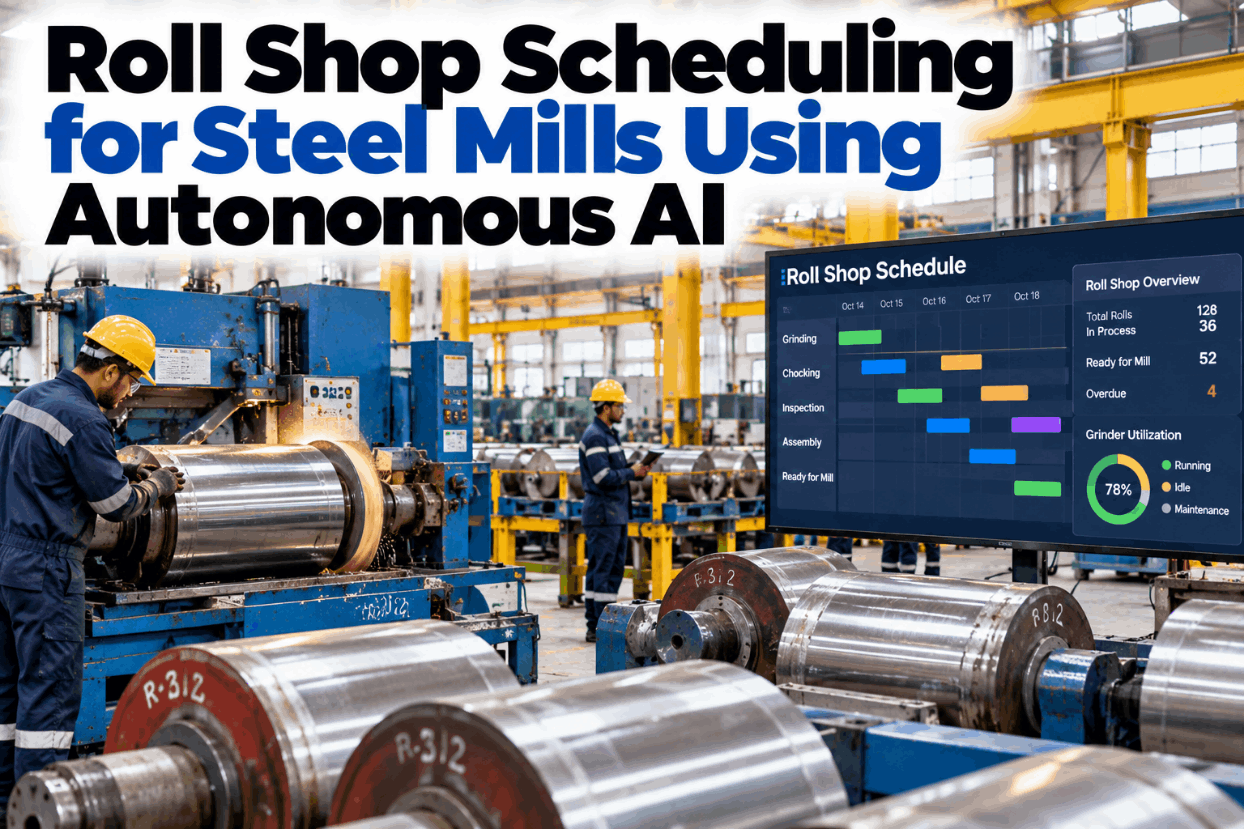
In most rolling mills, the roll shop sets the pace more than anyone admits. When a set of finishing work rolls is not ground, chocked and staged in time, the mill waits, or it rolls a few more coils on worn rolls and pays for it in surface quality. This guide covers the roll shop cycle, roll demand, a worked capacity example and how an autonomous agent keeps grinders and chocking crews in step with the mill. See the agent plan a real campaign in a short roll shop scheduling demo.

AUTONOMOUS AGENT · ROLL SHOP

Roll Sets Ready Before the Mill Asks for Them

The iFactory Autonomous Scheduling Agent reads the rolling schedule and roll inventory, then sequences grinding and chock assembly to meet each roll change. It moves roll-set cards across the roll shop kanban, and grinders confirm every step by voice.

Roll shop board · HSMAgent live
Next change: F1 to F4 work rolls at 21:40
GrindingWR 4418 · F2WR 4431 · F3
ChockingWR 4417 · F2WR 4402 · F1
StagedF1 topF4 pair
Grinder 2 said"Roll 4417 done, 742.6 millimetres, eddy current clear."
iFactoryLogged. 4417 moved to chocking. Partner 4418 is next on grinder 2.
F1 to F4 set forecast ready 21:05 · 35 min ahead
THE ROLL SHOP CYCLE

Eight Steps Between Roll Out and Roll Set Ready

Every roll that leaves the mill goes round the same loop of cooling, inspection, grinding and chocking. Modern roll grinders check rolls as part of that loop: eddy current finds open cracks and changes in surface texture, and a separate ultrasonic test looks inside the roll for manufacturing defects and fatigue from mill service. Each step has its own crew, machine or crane, which is why the loop is a scheduling problem. Map your own loop with our roll shop support team.

1Roll outSet pulled at the planned change, tonnage and km logged
2Cool downRolls wait until they can be measured true
3Chock removalChocks pulled, bearings sent to the chock shop
4InspectEddy current for surface cracks, ultrasonic for internal defects
5GrindDamage removed, profile and crown ground to program
6MeasureDiameter, profile and roughness recorded
7Chock assemblyBearings checked, greased, seals fitted, chocks mounted
8Stage as setMatched pair placed in the rack for its stand
Back to the mill at the next roll change, and the loop starts again
WORK ROLL VS BACKUP ROLL CAMPAIGNS

Two Roll Types, Two Very Different Rhythms

Work rolls touch the strip, so they wear and mark quickly and come back to the shop many times a week. Backup rolls support the work rolls, run much longer campaigns and take far more grinder and crane time when they do come in. Their chocks differ too. Work roll necks commonly run on four-row tapered roller bearings, while backup rolls in many flat mills run on oil film bearings. See both campaigns on one board in a live planning session.

Aspect
Work rolls
Backup rolls
What the schedule must protect
What ends a campaign
Tonnes or km rolled, surface marks, width program, grade change
Planned tonnage, spalling risk, profile wear, mill outage window
Change times agreed with the mill, not guessed
How often they visit the shop
Many times a week
Far less often, usually in planned stops
Grinder hours booked ahead for backup rolls
Chock bearings
Rolling element bearings, often four-row tapered
Often oil film bearings, with their own care
Chock shop crew and spares on hand
Biggest scheduling risk
Too few ground pairs in the right diameter
A long grind clashing with a work roll rush
Separate lanes, one shared view
ROLL CAMPAIGN PLANNING

How the Rolling Schedule Decides What the Roll Shop Makes

The roll shop never chooses its own workload. The rolling program does. Campaign length sets how often sets come out, the width order sets how long each set can run, and the grade mix decides which stands need fresh, well-finished rolls. Many hot strip mills plan widths from wide to narrow within a work roll campaign, because a narrow strip wears a band into the roll that would mark a wider strip rolled later. Ask our planning support team how the agent reads your program.

Schedule inputCampaign length
→
Roll shop effectSets needed per shift and when each change falls
Schedule inputWidth sequence
→
Roll shop effectHow much wear and banding comes back, and how deep the next grind must go
Schedule inputSteel grade
→
Roll shop effectHard or surface-critical grades call for fresh rolls on the last stands
Schedule inputThickness and stand loads
→
Roll shop effectCrown and profile program per stand, and which diameters can pair

An Agent That Plans the Shop From the Mill Program

iFactory reads the rolling schedule and the live roll inventory, sequences each grind and chock assembly against the next roll change and moves the cards on the roll shop kanban. Grinders confirm by voice.

Roll shop planner and iFactory
PlannerThe mill moved the exposed-grade campaign up to 02:00. Can we make it?
iFactoryYes, if F5 to F7 go first on grinders 1 and 3. That pushes two F1 rolls to the next shift, and F1 still has 3 staged pairs.
PlannerDo it. Tell the chocking crew.
iFactoryDone. Cards moved, crew notified, set forecast ready at 01:20.
ROLL INVENTORY MANAGEMENT

Count Rolls by Diameter, Not Just by Number

Forty rolls in the rack can still mean a shortage. Each roll shrinks with every grind until it reaches its discard diameter, and top and bottom work rolls are normally paired within a diameter tolerance your mill sets. So the real question is how many pairs you can build for each stand this week. The example below is an illustration of finishing work rolls sorted into diameter bands. Bring your own roll list to a roll inventory review.

Finishing work rolls by diameterIllustration · 45 rolls
780 to 800 mm6
760 to 780 mm10
740 to 760 mm12
720 to 740 mm9
700 to 720 mm5
Near discard3
Three rolls near discard and only six in the top band: order new rolls before the pairing choices run out, not after.
ROLL SHOP SCHEDULING STEEL MILLS EXAMPLES

Worked Example: Rolls Needed per Shift vs Grinder Hours

Grinder utilization is where small gaps hide. The example below uses assumed inputs for a seven-stand finishing mill, with roughing and backup rolls on separate grinders. Replace each input with your own figures. Our support engineers can run it on your shop.

Demand per shift
Stands × work rolls7 × 2 = 14 rolls per change
Changes per 8 h shift, assumed2
Rolls to grind14 × 2 = 28
Cycle per roll, assumed45 min, load to unload
Grinder hours needed28 × 45 = 1,260 min = 21.0 h
Capacity per shift
Work roll grinders3
Shift length8 h
Availability, assumed85%, after dressing and breaks
Hours per grinder8 × 0.85 = 6.8 h
Grinder hours available3 × 6.8 = 20.4 h
Gap per shift21.0 − 20.4 = 0.6 h, or 36 min
Gap per week, 21 shifts21 × 36 = 756 min = 12.6 h
Rolls drawn from buffer756 ÷ 45 = 16.8 rolls a week
ROLL SHOP KANBAN

What the Autonomous Scheduling Agent Does All Shift

The agent treats every roll change as a deadline and works backwards. It checks which rolls are cool enough to measure, which grinder has the right program loaded, which chocks and bearings are ready and which pairs match in diameter. Then it orders the queue and moves the cards. People stay in charge: the roll shop lead can pin, hold or reorder any card, and the agent replans around it. See the board run on your roll data in a kanban walkthrough.

Out of mill 4
WR 4409 · F6 · cooling
WR 4410 · F6 · cooling
Inspect 2
WR 4425 · eddy current
BUR 207 · ultrasonic due
Grind 3
WR 4418 · G2 · need-by 21:40
WR 4431 · G3 · need-by 21:40
Chock 2
WR 4417 · chocks C-31
WR 4402 · chocks C-12
Staged 5
F1 pair · 762 / 761
F4 pair · 748 / 748
Need-by firstCards sorted by the next roll change they serve
Pairs togetherTop and bottom rolls kept within tolerance
Cooling holdNo grind before the roll can be measured true
Right grinderMatched to wheel, program and roll size
GRINDERS CONFIRM BY VOICE

Spoken Confirmations That Move the Card

A grinder operator with gloves on should not have to walk to a terminal to say a roll is done. With voice confirmation, they speak the roll number, the result and any finding. iFactory repeats it back, waits for a yes and then moves the card, logs the reading and tells the next station. Ask our support team how voice works in a noisy shop.

Grinder says"Roll 4431 ground, 755.2, eddy current clear."
iFactory repeats4431, 755.2 mm, clear. Confirm?
Board actionCard to chocking, diameter on the roll record
Grinder says"Roll 4425, crack indication at the barrel edge, hold."
iFactory repeats4425 on hold, crack indication. Confirm?
Board actionCard held, roll shop lead alerted, spare pair pulled in
Chock crew says"F4 pair chocked, bearings greased, set staged."
iFactory repeatsF4 pair staged. Confirm?
Board actionCard to staged, mill pulpit sees set ready
ROLL SHOP SCHEDULING STEEL MILLS TEMPLATE

A Roll Life Record Behind Every Card

Each card on the board points to one roll record. That record is what makes roll life tracking possible: every campaign, every grind and every inspection result in one place. Use the fields below as a template for your own roll register. See a filled record set in a roll record demo.

Roll WR 4417Finishing work roll · F2 · ready for chocking
Roll type and materialWork roll, grade per supplier
Stand and positionF2, top
Diameter now742.6 mm
New and discard diameterFrom supplier drawing
Grinds to dateCounted per regrind
Last campaignTonnes and km rolled
Stock removed last grindRecorded in mm
Inspection resultEddy current clear
Ultrasonic testLast date and next due
Chocks and bearingsChock IDs, bearing hours
Pair partnerWR 4418
Next need-byF1 to F4 change, 21:40
ROLL SHOP SCHEDULING STEEL MILLS COST AND ROI

Size the Value With Your Own Numbers

The clearest value of a scheduled roll shop is fewer rush grinds. When a set is late, the usual answer is to grind fast and deep, which takes diameter off the roll that inspection did not ask for. The worksheet below uses assumed inputs to show the arithmetic only. Stock removal must always follow the damage found in inspection, so test any target before you count on it. Our team can help you build the case with your roll data.

Usable diameter per roll, new to discard60 mm, assumed
Average removal per regrind today0.6 mm, assumed
Average removal with planned grinding0.5 mm, assumed target
Regrinds per roll60 ÷ 0.6 = 100, against 60 ÷ 0.5 = 120
Work rolls used a year today40, assumed
Rolls needed for the same tonnage40 × 100 ÷ 120 = 33.3, about 6.7 fewer
ROLL SHOP SCHEDULING STEEL MILLS FOR PLANT MANAGERS

Five Numbers Worth a Weekly Look

Plant managers rarely need the full roll register. They need to know whether the roll shop is ahead of the mill or behind it, and whether roll spend is under control. See them on a live dashboard in a plant manager briefing.

Hours of coverHow far staged sets run ahead of the next roll changes
Grinder utilizationGrinding hours against hours available, per grinder
Removal per regrindAverage mm taken off, by stand and roll type
Roll consumptionRoll cost or weight used per tonne rolled
Unplanned changesRoll changes forced by marks, spalls or late sets
ROLL SHOP SCHEDULING STEEL MILLS IMPLEMENTATION GUIDE

Four Steps From Whiteboard to Live Board

Start with finishing work rolls, where changes are most frequent, then add roughing and backup rolls once the crew trusts the board. Plan your first roll group with our implementation team.

Step 1Clean the roll registerOne record per roll, with diameters, chocks and history
Step 2Connect the scheduleRolling program and roll change plan read automatically
Step 3Run the board in shadowAgent proposes, roll shop lead decides, both compared
Step 4Hand over the queueAgent sequences, crews confirm by voice
TURNKEY AI DEPLOYMENT

Scheduling Agent, Voice and AI Server in One Package

iFactory delivers the Autonomous Scheduling Agent as a turnkey bundle. A pre-configured NVIDIA AI server ships racked and ready with the agent, the roll shop kanban and the voice model pre-loaded. You rack it, plug in power and Ethernet, and the AI is live. To scope it for your mill, book a turnkey planning call.

What's Included
  • Pre-configured NVIDIA AI server, racked and ready
  • Autonomous Scheduling Agent for grinding and chocking
  • Roll shop kanban for work and backup roll sets
  • Connectors for the rolling schedule and roll grinders
  • Voice confirmation for grinders and chock crews
  • Roll life records and weekly roll shop reports
  • 24×7 remote monitoring of software and hardware
Live in 6–12 weeks
Wk 1–4
Install and Connect

Server racked, roll register loaded, schedule and grinder data linked.

Wk 5–8
Shadow Planning

Agent plans alongside the roll shop lead on finishing work rolls.

Wk 9–12
Go-Live and Voice

Agent runs the queue, crews trained on voice, backup rolls added.

HOW iFACTORY FITS

Built for the Pace of a Rolling Mill

iFactory plans the roll shop the way a good roll shop lead does, only continuously and against the live mill program. Our support team can show how it fits beside your roll grinders and CMMS.

1
Reads the mill program. The rolling schedule and roll inventory set the grinding and chocking plan.
2
Sequences the shop. Grinds and chock assemblies are ordered against each roll change deadline.
3
Moves the cards. Roll-set cards travel across the kanban as work is done, with no manual shuffling.
4
Confirmed by voice. Grinders and chock crews speak each result, and it is repeated back before it is saved.
1000+
Industrial clients running iFactory
99.9%
Platform uptime for round-the-clock mills
6-12 wks
From racked server to a live roll shop board
FREQUENTLY ASKED QUESTIONS

What Plant Managers Ask About Roll Shop Scheduling

What is roll shop scheduling in a steel mill?
It is the plan that decides which rolls are cooled, inspected, ground, chocked and staged, in what order and on which machine, so that a matched roll set is ready for every roll change in the rolling program.
How does the rolling schedule affect roll grinding?
Campaign length sets how often sets come out, the width order affects how much wear and banding the rolls carry back, and the grade mix decides which stands need fresh, well-finished rolls. When the program changes, the grinding sequence should change with it.
Why track roll inventory by diameter?
Rolls lose diameter with every grind and top and bottom work rolls are normally paired within a diameter tolerance. A rack full of rolls can still be short of usable pairs for a stand. Tracking by diameter band shows real cover and when to order new rolls.
Does the agent replace the roll shop lead?
No. The agent does the constant replanning that eats a lead's shift. The lead can pin, hold or reorder any card at any time, and the agent plans around that decision.
Can it work with our existing roll grinders?
In most cases, yes. Grinder results such as diameter and inspection outcome can be read from the grinder or roll shop system where an interface exists, or confirmed by voice where it does not.
How do we start?
Start with finishing work rolls. Clean the roll register, connect the rolling schedule and run the agent in shadow next to your roll shop lead before it takes over the queue. Our support team can help plan that first step.

Never Let the Mill Wait for Rolls Again

Let the agent read your rolling program, sequence grinding and chocking and keep the roll shop kanban current, with every step confirmed by voice. Delivered turnkey and live in 6 to 12 weeks.

Example shift plan · Roll shop
Roll changes coveredF1 to F7, two per shift
Grinding queueSequenced by need-by time
Chock assemblyMatched to staged pairs
ConfirmationsSpoken and repeated back
Every roll set traceable to its grind

Share This Story, Choose Your Platform!