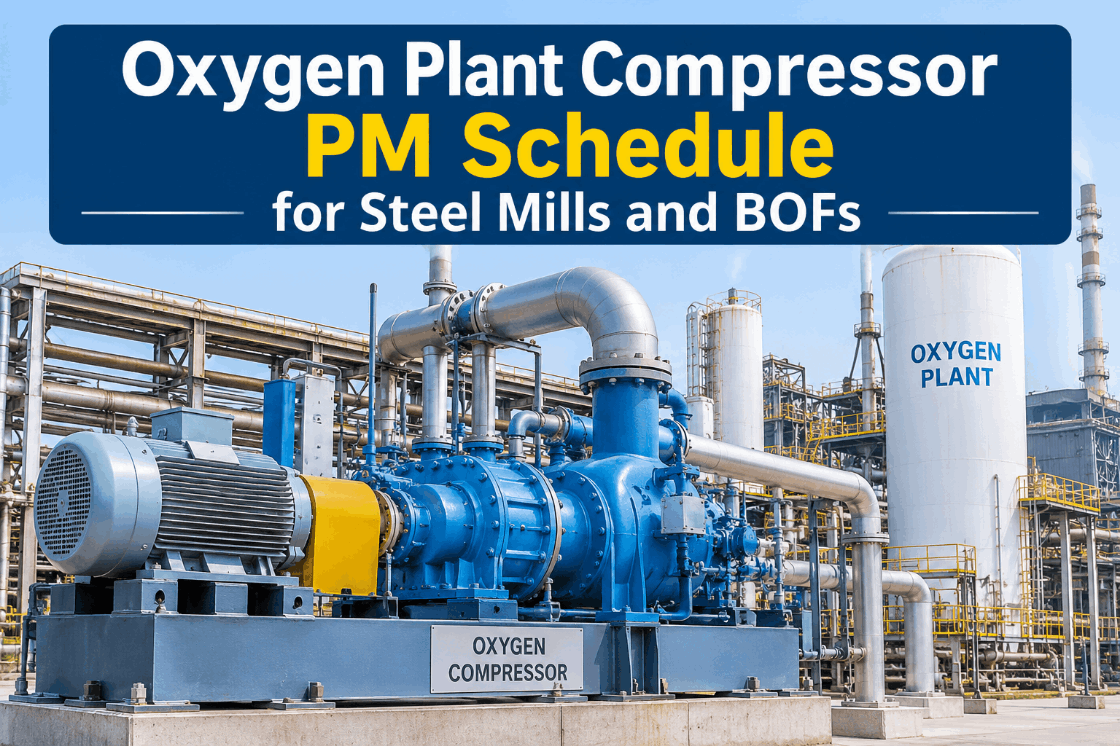
Oxygen Plant Compressor PM Schedule for Steel Mills and BOFs

By Jackson T on November 19, 2026

oxygen-plant-compressor-pm-schedule-steel-mills-bofs

A basic oxygen furnace cannot blow without oxygen, and that oxygen depends on a chain of machines running around the clock: main air compressor, purification beds, cold box, booster and oxygen compressor. Most warn before they fail, through vibration, cooler approach or seal gas trends. This page sets out a PM schedule by asset, shows how run hours and condition move each interval, and covers mills supplied over the fence. Walk through your train in a short planning call.

PM SCHEDULER + VIBRATION AI · OXYGEN PLANT

An Oxygen Plant Compressor PM Schedule That Moves With Run Hours and Vibration

iFactory counts equivalent run hours on every compressor in the air separation train, watches vibration and cooler trends, and pulls a PM forward when the condition says so. The utilities crew hears about it by voice, with the reason attached.

ASU train · air in to BOF lanceIllustrative values
01Main air compressor21,000 of 24,000 EOHStage 2 vibration rising · PM pulled forward 600 h
→
02Pre-cooling and purificationSwitch valves · 6,100 of 8,000 h
→
03Cold boxExpander · 9,800 of 16,000 h
→
04O2 compressorSeal check · 5,300 of 8,000 h
→
05BOF headerLOX backup level 72%
MAC inspection moved into the next planned outage window · utilities crew told by voice
AIR SEPARATION UNIT MAINTENANCE

Six Machine Groups Keep Oxygen Flowing to the Converter

In a cryogenic air separation unit, the main air compressor (MAC) raises air to between 4 and 10 atm, direct contact aftercoolers bring it back to ambient, and molecular sieve beds strip water, carbon dioxide and hydrocarbons before the cold box, per the AIGA 056 safe practices guide. Plants that pump liquid oxygen use a booster air compressor; gas plants compress oxygen after the columns. Ask our support engineers to map your own train.

Main air compressor
Usually the biggest drive in the ASUMulti-stage machine with intercoolers. Watch vibration, stage temperatures and inlet filter loss.
Booster air compressor
Pumped LOX cyclesSupplies high-pressure air that vaporises pumped oxygen in the main exchanger.
Oxygen compressor
Gas plant cyclesRaises gaseous oxygen to header pressure, where fire is the main hazard.
Intercoolers and aftercoolers
Heat out between stagesFouling raises approach temperature and the power each stage draws.
Oil and seal systems
Lube, buffer and seal gasOil kept out of process gas. Seal gas must be dry and oil-free.
Anti-surge control
Recycle or blow-off valveValve stroke, transmitter checks and controller tuning protect against surge.
OXYGEN SUPPLY RELIABILITY

Your Plant or Theirs: Who Owns the Compressor PM

Many steel mills do not run their own ASU. Oxygen often comes over the fence from an industrial gas company that builds, owns and operates the plant under a long-term contract, as Air Products announced for its second unit at Big River Steel. In that case the gas company maintains the compressors and the mill watches supply. Compare both models in a working session.

OWNER-OPERATED ASU
  • Your utilities crew runs the PM schedule for every compressor
  • Run hours, vibration and cooler data feed your own work orders
  • Oxygen cleaning, permits and OEM overhauls are your scope
  • LOX storage and vaporisers are your backup to plan and test
OVER-THE-FENCE SUPPLY
  • The gas company maintains the ASU and its compressors
  • The mill monitors header pressure, purity and delivered flow
  • Outage dates are agreed so they miss heavy blowing periods
  • Your PM work moves to the mill side: valves, piping and lance supply
Questions to settle with an oxygen supplier
OXYGEN SERVICE RULES

Cleanliness and Fire Risk Set the Limits on Every PM

An oxygen compressor can burn violently, warns AIGA 071/23, Centrifugal Compressors for Oxygen Service, which was first published by EIGA as Doc 27. Oil, grease, debris and mechanical rubs are listed ignition sources, and it notes that a number of fires have occurred right after overhauls. AI changes none of these rules; it only helps you plan the work. Review your procedures with our support team.

Clean for oxygen serviceParts that touch oxygen are cleaned and inspected to AIGA 012 before they go back in (071/23, 11.3).
Oil-free sealsInternal seals are labyrinth type, seal gas is dry and oil-free, and lube and seal systems are interlocked.
Safe entryIsolate, purge and test the area: oxygen between 19.5% and 23.5% before work starts (15.1.3).
Trip testingFull functional test of trips and dump or isolation valves at least every 3 years (15.1.4).
OXYGEN PLANT COMPRESSOR PM SCHEDULE TEMPLATE

A PM Matrix by Asset With Run-Hour and Condition Triggers

Final intervals come from your OEM manuals and your own failure history. The run-hour figures and trigger values here are illustrative placeholders, and the condition triggers show the kind of signal that should pull a task forward. Load a blank copy in a guided setup call.

Asset
Shift or daily
Run-hour task (illustrative)
Condition trigger
Owner
Main air compressor
Stage temps, vibration, inlet filter loss
Internal inspection at 24,000 EOH
Vibration trend or stage temp rise
Rotating equipment
Booster air compressor
Discharge temp, seal leakage
Bearing and seal check at 16,000 EOH
Axial position change
Rotating equipment
Oxygen compressor
Seal gas flow, vent oil check
Seal and rotor check at 8,000 EOH, oxygen clean
Seal gas pressure loss or rub signature
OEM plus utilities
Intercoolers
Approach temperature per stage
Tube-side clean at 8,760 h
Approach up 3 K over baseline
Utilities
Lube oil system
Oil temp, filter differential pressure
Oil analysis monthly, filter change by DP
Water or particle count rising
Lubrication tech
Purification beds
Switch valve timing, CO2 at outlet
Valve seal check at 8,000 h
CO2 breakthrough earlier in cycle
Process operator
Anti-surge system
Valve position versus demand
Stroke test at each outage
Slow valve response
Instrument tech
Trip and isolation valves
Alarm log review
Functional test at least every 3 years
Any failed trip or override
Instrument tech

Ask Why a PM Moved Before the Crew Asks You

Every interval change in iFactory carries its reason: the run hours counted, the trend that triggered it and the outage window it now lands in. Planners approve the move; nothing shifts silently.

ASU-1 · Utilities planner and iFactory
Utilities plannerWhy is the MAC inspection showing next outage instead of March?
iFactoryStage 2 bearing vibration has risen for five weeks and sits inside zone B. The task is 3,000 EOH from due, and the next outage window is 2,400 h away, so I moved it 600 h earlier.
Utilities plannerApproved. Tell the night crew.
iFactoryVoice note sent to utilities shift B, and the OEM visit request is attached to the work order.
INTERCOOLER CLEANING

Approach Temperature Tells You When a Cooler Is Fouling

Approach is the gas temperature leaving a cooler minus the cooling water temperature entering it. As scale or biofilm builds on the tubes, approach climbs and the next stage compresses warmer air for more power. In one Ecolab case study on an ASU, online cleaning cut approach temperatures by 1 to 3 °C and normalised consumption fell from 93 to 90 kW per ton. Request an example approach chart from our support desk.

MAC intercooler 2 · approach temperatureIllustrative monthly averages, K
Jan6.0
Mar7.0
May9.0
Jul11.0
Aug, cleaned7.0
Compare like with like

Approach moves with cooling water temperature and air flow, so a hot week can look like fouling. Trend approach at similar load and water temperature, and check the water side before blaming the air side. Leaking cooler tubes matter twice on oxygen service: AIGA 071/23 notes the rust they cause can seed ignition.

COMPRESSOR VIBRATION MONITORING

Vibration Zones, Trip Limits and When a PM Should Escalate

ISO 20816-3:2022 covers industrial machines above 15 kW running between 120 and 30,000 r/min, rotary compressors included, and grades readings in zones A to D. For oxygen machines, AIGA 071/23 bases alarm and trip settings on API 617 and keeps them below 75% of internal clearance. AIGA 056 adds: do not restart after high vibration until the cause is found. See the escalation in a live demo.

1Baseline per stageNormal vibration at each load band after a clean start
2Watch the slopeA steady rise inside zone B is flagged before alarm
3Escalate the PMThe next inspection moves to the earliest outage window
4Tell the crewVoice note to utilities shift with the trend attached
5Protect the tripHardwired alarms and trips stay exactly as set
BOF OXYGEN DEMAND

Blowing Cycles Make Oxygen Demand Spiky, Not Steady

A BOF heat takes around 40 to 50 minutes tap to tap, and oxygen is blown for about 15 to 20 minutes of that, using roughly 55 to 60 cubic metres per tonne at 99.5% purity or better, per ispatguru. The ASU runs steadily, so header pressure swings between blows, and AIGA 056 notes liquid may be stored for pipeline backup. Plan outage windows with our support engineers.

One heat, illustrative 45-minute cycle
ChargeOxygen blowSample, tap, slag off
Header pressureFalls during blow, recovers after
LOX backupCovers a trip for as long as the tank lasts
PM timingMajor work in converter reline or mill outages
RUN HOUR BASED PM

Worked Example: Moving a MAC Inspection by Run Hours and Condition

Calendar dates ignore how hard a compressor has worked. Equivalent operating hours (EOH) add a weight for each start, because starts load the machine more than steady running. All inputs below are assumed; use your OEM's interval and start weighting. Check your own figures in a review call.

OEM inspection interval, assumed24,000 EOH
Run hours since last inspection, assumed20,600 h
Starts × weight, assumed 40 × 10 h400 EOH
Equivalent hours used20,600 + 400 = 21,000 EOH
Remaining to interval24,000 − 21,000 = 3,000 EOH
Next planned outage, assumed2,400 h away
Vibration rising, so take the earlier window3,000 − 2,400 = 600 h earlier
Illustrative · steady machine
No trend, no moveBooster vibration flat for six months. The bearing check stays at its run-hour due point.
Illustrative · rising trend
MAC stage 2Five weeks of slow rise. Inspection pulled into the next outage, with OEM support booked.
Illustrative · fouling
Intercooler 2 approachUp 5 K at similar load. Cleaning set for the next low-demand weekend.
OXYGEN PLANT COMPRESSOR PM SCHEDULE COST AND ROI

Put a Tonnage on One Compressor Trip

No savings figure is promised here. Every input in this worksheet is an assumption that exists only to make the sum visible; replace each with your trip log, heat size and LOX contract price. Ask our support desk which records hold those inputs.

Unplanned oxygen compressor trips per year2, assumed
Heats delayed per trip4, assumed
Tonnes per heat250, assumed
Tonnes delayed per year2 × 4 × 250 = 2,000 t
LOX drawn from backup per trip60 t, assumed · 2 × 60 = 120 t
Yearly exposure2,000 t × your margin + 120 t × your LOX price
TURNKEY AI DEPLOYMENT

PM Scheduler, Vibration AI and the Server, Shipped Ready

iFactory comes as hardware and software together. A pre-configured NVIDIA AI server ships racked and ready, with the PM scheduler, run-hour counters and vibration models pre-loaded, so compressor data stays on site. You rack it, plug in power and Ethernet, and the AI is live. The scope includes cabling, the plant network, PLC/SCADA integration, operator training and 24×7 remote monitoring. Plan it in a deployment planning call.

What's Included
  • Pre-configured NVIDIA AI server, racked and ready
  • Connectors for compressor controls, vibration racks and DCS
  • Run-hour and EOH counters for every compressor
  • Vibration and cooler approach models per stage
  • PM schedule matrix loaded with your OEM intervals
  • Voice alerts to the utilities crew with read-back
  • Install scope: cabling, network, PLC/SCADA links, training, 24×7 monitoring
Live in 6–12 weeks
Wk 1–4
Connect and Count

Server racked, compressor and vibration signals linked, run hours and starts back-filled.

Wk 5–8
Shadow the Schedule

Proposed interval moves are logged but not applied, and checked by planners.

Wk 9–12
Go Live and Extend

Approved escalations and voice alerts switched on, then piping and valves added.

HOW iFACTORY FITS

Oxygen Plant Compressor PM Schedule Software for Utilities Teams

iFactory sits beside your compressor controls and CMMS, adding run-hour logic and condition triggers to both. Questions on fit go to our support engineers.

1
Counts real wear. Run hours and weighted starts on every compressor, not calendar dates.
2
Escalates on condition. Vibration slopes and cooler approach move tasks to the earliest safe window.
3
Keeps planners in charge. Every move shows its reason and waits for approval.
4
Speaks to the crew. Voice notes reach the utilities shift with the trend attached.
1000+
Industrial clients running iFactory
99.9%
Uptime the utilities shift can lean on
6-12 wks
From racked server to live PM escalation
FREQUENTLY ASKED QUESTIONS

What Utilities Managers Ask About Oxygen Compressor PMs

What should an oxygen plant compressor PM schedule include?
Each compressor in the train, its intercoolers, the lube and seal systems, anti-surge controls and the trip valves. Give every task a run-hour point from the OEM and a condition trigger that can pull it forward. You can see a sample schedule built from those parts.
Our oxygen comes from a gas company. Is this still useful?
Yes, in a different way. The supplier maintains its own compressors, so you track header pressure, purity, delivered flow and outage notices, and keep PMs on the mill side of the fence. To set up supply monitoring, book a short call.
Does AI change oxygen cleaning or safety rules?
No. Cleaning for oxygen service, approved materials, oil-free seals and trip testing follow AIGA or EIGA guidance, your OEM and your own procedures. iFactory plans and records the work; it never relaxes a rule.
How does a vibration trend move a PM?
The model compares each stage with its own baseline at the same load. A steady rise inside the normal zone proposes moving the next inspection to the earliest outage window, and a planner approves it. Our support team can review your vibration points first.
Which ISO standard covers compressor vibration?
ISO 20816-3:2022 covers industrial machines above 15 kW from 120 to 30,000 r/min, including rotary compressors. For oxygen machines, AIGA 071/23 bases alarm and trip settings on API 617.
Where should we start?
Start with the main air compressor, since every product depends on it. Back-fill its run hours and starts, baseline vibration by stage, and trend intercooler approach for a few weeks before moving any interval. To plan that pilot, book a 30-minute session.

Service Compressors When Their Hours and Trends Say So

Count equivalent run hours, escalate PMs on vibration and cooler approach, and tell the utilities crew by voice. Shipped as one bundle, in service within 6 to 12 weeks.
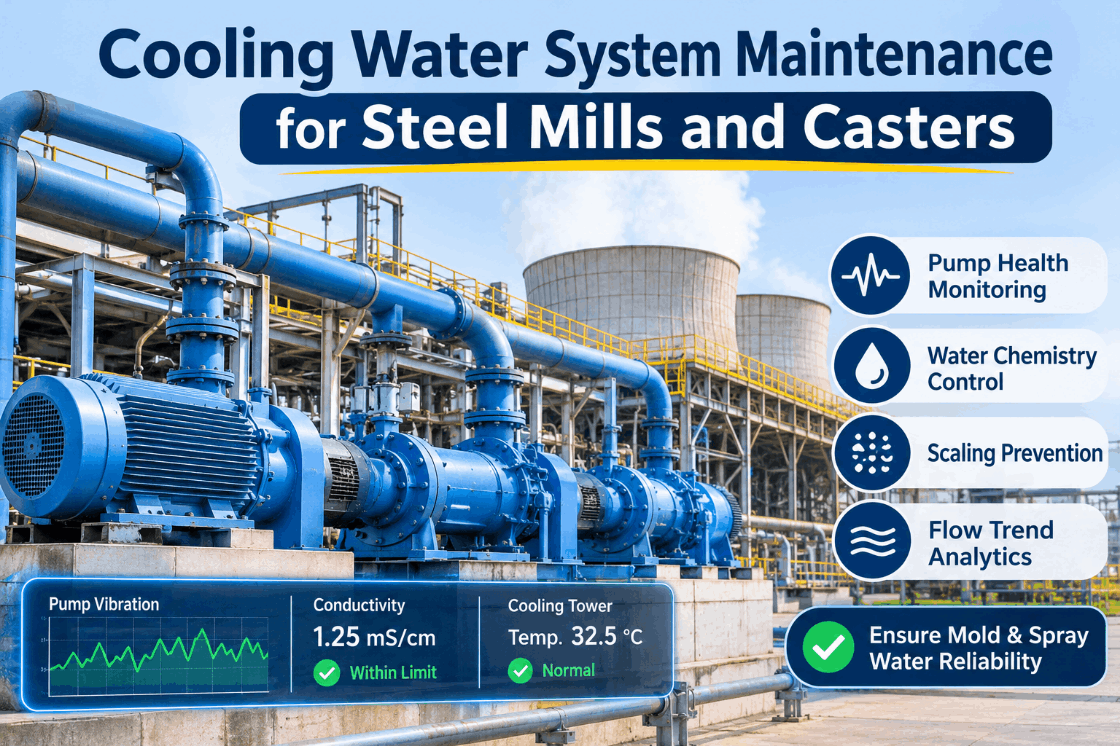

Example weekly view · ASU-1
MAC stage 2 vibrationRising, inside zone B
MAC inspectionMoved 600 h earlier
Intercooler 2 approach+1.0 K after cleaning
LOX backup level72%, normal
Every interval move carries its reason and approval

Share This Story, Choose Your Platform!