Every mill superintendent knows the tension: push rolling speed toward 1,850 m/min and Cpk begins to slide; pull back to 1,780 m/min and tonnage targets suffer. Neither extreme is acceptable when you're running tight-tolerance orders for automotive or appliance customers. The answer isn't a fixed speed target — it's a dynamic recommendation that accounts for the current recipe, the live Cpk trajectory, the customer spec band, and the specific coil running at that moment. iFactory's AI Copilot delivers exactly that: a per-recipe, per-coil speed recommendation updated continuously throughout the rolling campaign so your superintendent and pulpit operators are always running the fastest speed the process can support without compromising yield. Book a Demo to see the AI speed recommendation engine live.
The Speed-Quality Trade-Off: Why Static Targets Fail Rolling Operations
Mill speed targets set during annual process reviews are useful as starting points, but they cannot account for the real variability that occurs shift to shift on the mill floor. Hot-band incoming gauge variation, work roll wear progression, coolant temperature drift, and entry tension fluctuations all shift the speed-quality curve throughout a rolling campaign. A target that delivered Cpk 1.67 on Monday morning may produce Cpk 1.21 by Thursday afternoon on the same recipe — not because the operators changed anything, but because the process environment changed around them.
Traditional approaches force mill superintendents into a conservative posture: set speeds below the theoretical optimum to maintain a Cpk buffer, and accept the tonnage shortfall as the cost of quality assurance. iFactory's AI Copilot replaces this static conservatism with a live optimization model. By continuously ingesting exit-gauge Cpk, roll-force data, AGC loop feedback, and recipe parameters, the Copilot calculates the highest speed at which the process can still meet the customer spec band — and updates that recommendation in real time as conditions evolve. Book a Demo to walk through a speed optimization session with the iFactory team.
How the AI Copilot Resolves the Throughput-Quality Conflict
The speed-quality conflict in rolling operations is not a people problem — it is an information problem. Operators and superintendents cannot simultaneously process exit-gauge Cpk trends, roll-force deviations, AGC loop activity, and incoming strip variation fast enough to make optimal speed decisions coil by coil. The AI Copilot processes all of those signals in parallel and surfaces a single, actionable recommendation: the current optimal speed for the active recipe and coil.
- Speed targets set from annual process reviews; rarely updated mid-campaign
- Operators default to conservative speeds to avoid customer rejections
- Cpk measured post-coil; speed adjustments applied to the next order
- Throughput losses accepted as the cost of quality assurance
- No correlation between process condition changes and speed decisions
- Speed recommendation updated continuously based on live process signals
- AI finds the maximum speed the current process state can support at spec
- Cpk trajectory monitored in real time; speed adjusted before a violation occurs
- Throughput recovered safely — no compromise to customer quality requirements
- Every speed decision logged with the process conditions that drove it
Five Process Variables the AI Copilot Balances to Recommend Optimal Speed
The AI Copilot does not operate on a simple speed-versus-gauge lookup table. It evaluates multiple interacting process variables simultaneously to generate a speed recommendation that is valid for the current coil, not just the recipe average.
Live Exit-Gauge Cpk Trajectory
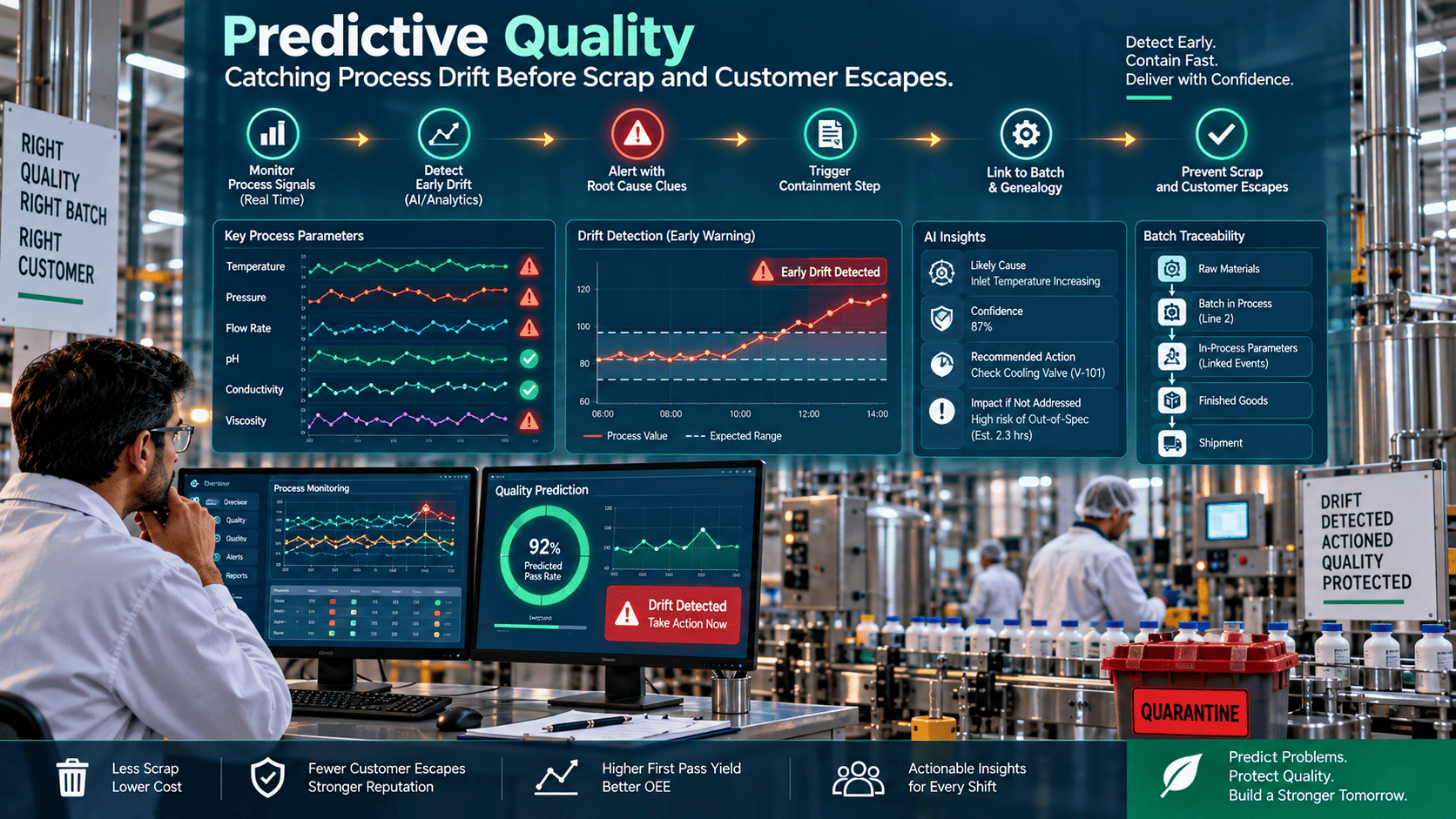
The Copilot monitors the rolling Cpk against the active recipe's customer spec band. If Cpk is stable and well-centered, the recommendation may support a speed increase. If Cpk is drifting toward the spec limit, the Copilot flags a reduction before the violation occurs — not after.
Work Roll Wear State
As a roll campaign progresses, surface roughness and crown change. The Copilot tracks cumulative tonnage on the active work roll set and adjusts the speed envelope accordingly — allowing higher speeds on fresh rolls and protecting quality on worn rolls near the change window.
Incoming Hot-Band Gauge Variation
High entry-gauge spread increases the demand on the AGC loop and directly limits achievable exit-gauge Cpk at a given speed. The Copilot reads entry-gauge deviation from the coil header and factors it into the speed recommendation before the first meter is rolled.
Customer Spec Band Width
A ±0.008 mm tolerance band permits a different speed ceiling than a ±0.004 mm band, even on the same grade and nominal thickness. The Copilot reads the active recipe's USL/LSL from the order spec and calibrates its speed envelope to the specific customer requirement — not a generic grade default.
AGC Loop Performance
The AGC loop's response latency at higher speeds determines how well it can compensate for incoming variation. The Copilot monitors AGC correction magnitude and frequency as a real-time indicator of loop saturation — pulling back the speed recommendation when the AGC is working at its limit. Book a Demo to see how the Copilot reads AGC loop data live.
AI Copilot Speed Optimization: Feature-to-Outcome Mapping
Each capability in iFactory's mill speed optimization module is designed to deliver a specific operational or commercial outcome for rolling operations. The table below maps features to the results mill superintendents and process engineers can expect.
| AI Copilot Feature | Operational Function | Outcome for Mill Operations | Primary User |
|---|---|---|---|
| Per-Recipe Speed Envelope | Maintains a learned speed-quality model for each recipe based on historical coil data | Eliminates the one-speed-fits-all conservatism that sacrifices throughput on wide-tolerance orders | Mill Superintendent |
| Live Cpk Trajectory Monitor | Tracks rolling Cpk in real time against the customer spec band | Enables proactive speed reduction before a gauge violation occurs, preventing non-conforming coils | Process Metallurgist |
| Incoming Variation Pre-Read | Ingests hot-band entry gauge data before rolling begins | Sets a coil-specific speed ceiling before the first meter runs, not after Cpk degrades | Pulpit Operator |
| Work Roll Wear Model | Tracks cumulative campaign tonnage and correlates to surface condition | Recovers speed on fresh rolls; protects quality near the roll change window | Mill Superintendent |
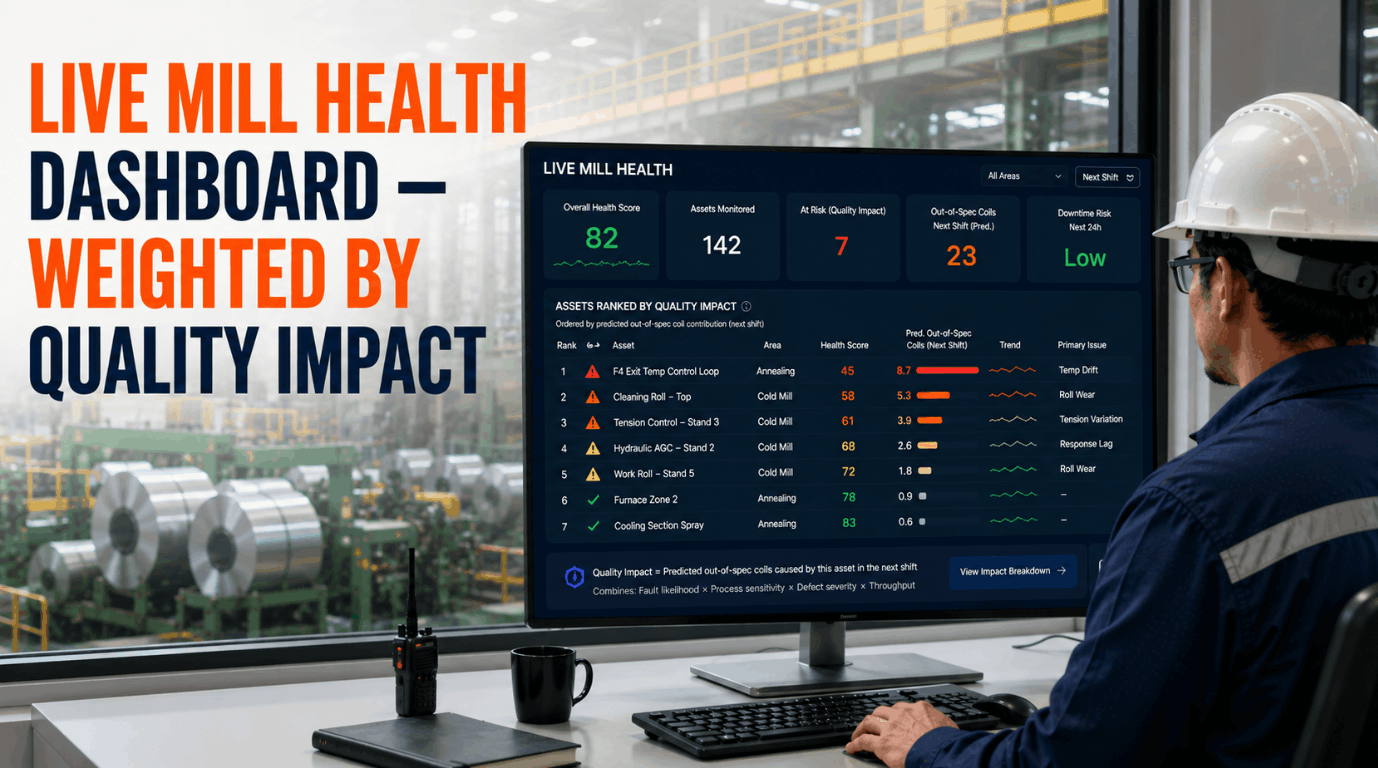
| Speed Decision Audit Log | Records every speed recommendation with the process signals that generated it | Provides traceable justification for each speed decision — useful for customer quality investigations | Quality / Process Engineering |
| Shift-Level Throughput Dashboard | Displays speed vs. Cpk performance across all coils per shift | Gives superintendents a single view of where speed was recovered and where quality limited throughput | Mill Superintendent / Plant Manager |
The Hidden Cost of Conservative Speed Targets
When process teams cannot trust real-time quality feedback, the natural response is to pad the safety margin into the speed target. A mill running at 1,780 m/min when the process could support 1,840 m/min is leaving meaningful tonnage on the table every shift. Across a full year of production, that conservatism compounds into a substantial throughput shortfall — without any corresponding quality benefit.
Consider a tandem cold mill running 40 coils per shift at an average of 1,800 m/min against a theoretical process optimum of 1,840 m/min. That 40 m/min gap represents roughly 2.2% lost throughput per shift. On a mill producing 500,000 tons per year, 2.2% is approximately 11,000 tons of unrealized saleable output. iFactory's AI Copilot does not promise to close that entire gap on every coil — but by identifying the specific coils and recipes where the process can safely support higher speeds, it systematically recovers throughput that static targets permanently leave behind. Book a Demo to review a throughput recovery analysis for your mill configuration.
Expert Review: What Mill Superintendents Need from AI Speed Optimization
Conclusion: Dynamic Speed Optimization Is the New Standard for Competitive Rolling
The mills that will win on tight-tolerance orders in 2026 and beyond are not the ones with the fastest theoretical speed — they are the ones that can consistently find and hold the optimal operating point as process conditions shift throughout a rolling campaign. Static speed targets, set quarterly or annually, cannot deliver that consistency. iFactory's AI Copilot gives mill superintendents a live, per-recipe, per-coil speed recommendation grounded in real process data: exit-gauge Cpk, roll wear state, incoming strip variation, and the specific customer spec band for the active order. The result is throughput recovery without quality compromise — a measurable, repeatable improvement that shows up in both your tonnage reports and your customer rejection rates. Book a Demo and let the iFactory engineering team walk you through a live optimization session on your mill configuration.
Frequently Asked Questions: AI Mill Speed Optimization
Does the AI Copilot automatically change mill speed, or does it only recommend?
The Copilot operates in advisory mode — it displays the recommended speed to the pulpit operator and superintendent, who make the final decision to adjust; it does not write setpoints to the mill drives.
How does the AI learn the speed-quality relationship for each recipe?
The Copilot builds its per-recipe model from historical coil data already in iFactory — correlating rolling speed, process parameters, and exit-gauge Cpk outcomes across past campaigns to identify the optimal operating envelope.
Can the system handle multiple customer spec bands for the same grade?
Yes. The speed recommendation is driven by the active recipe's USL/LSL, so different orders on the same nominal gauge with different tolerance bands will receive different speed envelopes automatically.
What data connections are required to run the AI Copilot?
iFactory connects to your exit gauge, AGC system, and mill drive data via OPC-UA or Modbus; most tandem cold-mill configurations can be integrated without new hardware.
How quickly does the Copilot respond when Cpk begins to drift?
The Copilot evaluates the Cpk trajectory on every incoming data batch — typically every few seconds — and updates its speed recommendation within the same scan cycle that the drift is detected.