Cleaning rolls in rolling mills are the unsung workhorses of surface quality — silently scrubbing scale, coolant residue, and oxide films from strip surfaces shift after shift. The problem is that they degrade gradually and invisibly, and by the time a surface defect is traced back to a worn cleaning roll, thousands of tons of product have already shipped with quality risk. Remaining Useful Life (RUL) forecasting on cleaning rolls, work rolls, and back-up rolls is not a luxury reserved for automotive-grade mills — it is the precision tool every reliability engineer needs to stop treating roll changes as calendar events and start treating them as data-driven decisions. Book a Demo with iFactory AI to see how RUL forecasting on rolls changes the economics of mill maintenance.
AI-Powered RUL Forecasting on Cleaning Rolls, Work Rolls & Back-Up Rolls
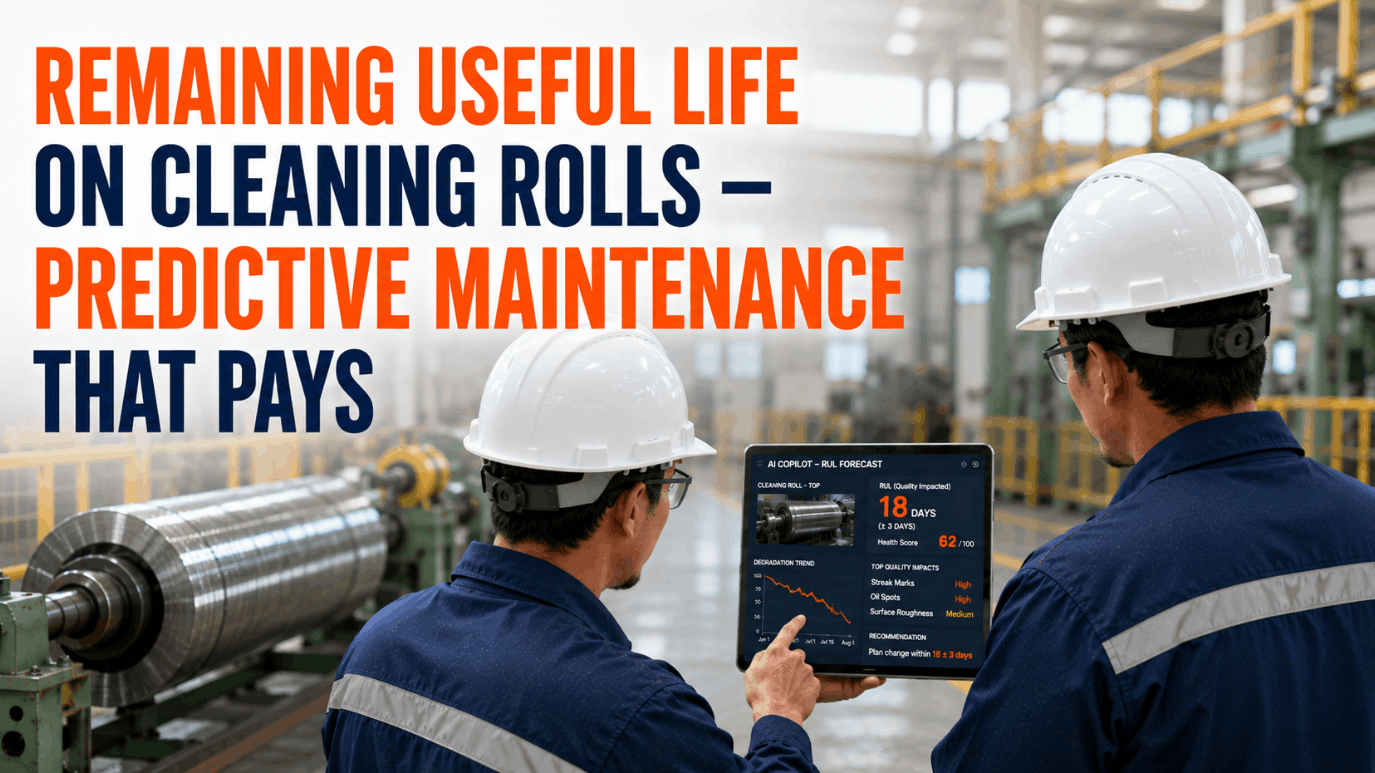
iFactory AI Copilot delivers quality-impact-weighted remaining useful life forecasts for every roll in your mill — not just hours run, but surface quality degradation scored against your actual defect thresholds.
Why Cleaning Roll Degradation Is a Surface Quality Problem, Not Just a Maintenance Problem
Cleaning rolls operate under conditions that accelerate wear in ways that standard hour-based replacement schedules cannot capture. Roll-to-strip contact pressure, coolant contamination loading, scale particle abrasion, and strip tension fluctuations all interact to degrade roll surface condition at variable rates across different campaigns, product mixes, and operating speeds. A cleaning roll running at high-speed on thin-gauge automotive exposed panel material degrades its surface finish far faster than the same roll on structural strip — yet most mills run both on the same fixed replacement interval.
The downstream consequence is predictable: a cleaning roll operating past its effective surface life transfers contaminants rather than removing them, generating streak defects, roll marks, and surface oxidation that are often misattributed to upstream process causes. Reliability engineers who have implemented Book a Demo-grade RUL systems consistently report that 30–40% of surface quality escapes previously labeled as process upsets were actually late cleaning roll changes.
Abrasive Wear
Scale particles and oxide fines embed into roll surface texture, reducing cleaning effectiveness and transferring contamination back to strip. Accelerates sharply above 1,200 m/min line speed.
Chemical Degradation
Coolant chemistry — pH drift, iron saturation, biocide depletion — attacks roll surface binders and fiber structures. Effect is nonlinear and invisible until surface condition collapses.
Mechanical Fatigue
Repeated contact loading cycles generate subsurface microfractures in roll cores. For back-up rolls, this is the primary RUL determinant — detectable through vibration signature changes before visible surface damage.
Thermal Cycling
Work rolls in hot rolling applications experience steep thermal gradients that cause surface spalling and fire cracking. Thermal fatigue RUL tracks heat exposure integral, not pass count alone.
How iFactory AI Copilot Calculates Quality-Impact-Weighted RUL — Not Just Hours Run
Conventional roll life tracking counts operational hours, tonnage, or pass count against a fixed interval established from historical averages. This approach systematically underestimates wear during demanding campaigns and wastes roll life during lighter operations. iFactory's AI Copilot replaces the fixed interval with a continuous, multi-variable degradation model that weights remaining life against actual quality impact — meaning the forecast reflects not just when the roll will fail, but when it will begin generating defects.
RUL Forecasting Across Every Roll Position in the Mill
Effective roll life management cannot address cleaning rolls in isolation. The surface quality of finished strip is the product of the combined condition of cleaning rolls, work rolls, and back-up rolls operating together. iFactory's RUL module covers all three roll classes with position-specific degradation models trained on rolling mill operational data. Book a Demo to see how the multi-roll RUL dashboard presents the full picture in one view.
| Roll Position | Primary Wear Mechanism | RUL Input Signals | Quality Impact Indicator | Typical Change Interval Reduction |
|---|---|---|---|---|
| Cleaning Rolls | Abrasive + Chemical | Surface camera, coolant pH, roll pressure, motor current | Strip cleanliness index, residue measurement | 20–35% interval extension on light campaigns |
| Work Rolls (Hot Mill) | Thermal fatigue + Spalling | Roll force variance, vibration, thermal imaging, surface grind log | Strip surface roughness Ra, mark defect rate | 15–25% reduction in early change waste |
| Work Rolls (Cold Mill) | Contact fatigue + Wear | Mill load cells, flatness meter, AGC deviation, grind records | Flatness defects, chatter marks, strip gauge deviation | Targeted 10–20% tonnage extension on suitable grades |
| Back-Up Rolls | Contact fatigue + Spalling | Bearing temperature, vibration spectrum, roll force profile, Hertz contact stress calc | Roll force distribution uniformity, flatness profile | Risk-based extension — 2–4 week interval optimisation |
| Bridle Rolls / Tension Rolls | Groove wear + Surface wear | Slip detection, diameter measurement, surface inspection | Strip tension stability, surface scoring | Condition-based vs. calendar replacement |
Fixed Interval vs. AI RUL — The True Cost of Calendar-Based Roll Management
The business case for RUL forecasting on cleaning rolls and work rolls is straightforward when the full cost structure is mapped. Fixed-interval programs optimize for simplicity, not economics. The hidden costs — early changes that waste usable roll life, late changes that generate defect-related customer claims, and unplanned emergency changes during production — consistently exceed the investment in AI-based RUL forecasting within the first operating year.
Deploying RUL on Cleaning Rolls: From Sensor Integration to Live Forecast in 8 Weeks
Implementation timelines for AI RUL on cleaning rolls are substantially shorter than full predictive maintenance platform deployments because most mills already have the sensor infrastructure in place — the data simply is not being used for life prediction. iFactory's deployment model connects to existing mill automation, OPC-UA historian, surface inspection systems, and CMMS in a phased approach that delivers first RUL forecasts within eight weeks of project kickoff.
Data Audit & Signal Mapping
iFactory engineers map available sensor outputs — vibration, roll force, surface inspection, coolant chemistry, motor current — against the degradation model input requirements for each roll position. Signal gaps are identified and addressed before model training begins.
Historical Data Ingestion & Model Training
Minimum 12 months of roll change records, defect logs, and process historian data are ingested to train the degradation model. Quality-impact thresholds are calibrated against actual defect onset events in the mill's own data — not generic industry benchmarks.
Shadow Mode Validation
The AI Copilot runs in shadow mode alongside the existing roll change program, generating RUL forecasts without triggering operational changes. Forecast accuracy is validated against actual roll condition at change time, and thresholds are adjusted before live deployment.
Live Deployment & CMMS Integration
RUL forecasts go live across the reliability engineer dashboard, supervisor app, and CMMS work order interface. Automated roll change work orders generate at configurable lead times, grind shop schedules align with forecast queues, and the model continues learning from each new roll change event.
Replace Tonnage Counters with Quality-Impact RUL Forecasting
iFactory AI Copilot delivers 72-hour RUL forecasts on cleaning rolls, work rolls, and back-up rolls — quality-impact weighted, CMMS-integrated, and live within 8 weeks of project kickoff.
RUL on Cleaning Rolls Is Not a Future-State Initiative — It Is a Data Connection Problem
The sensors, historian data, and surface inspection systems needed to run AI-based RUL forecasting on cleaning rolls, work rolls, and back-up rolls already exist in the vast majority of modern flat-rolled mills. The gap is not instrumentation — it is the absence of a model that connects those data streams into a quality-impact-weighted life forecast that a reliability engineer can act on 72 hours before a defect event occurs. Fixed-interval roll change programs are a proxy for that forecast, and they are a consistently poor one: they systematically waste roll life on light campaigns and generate surface quality escapes on demanding ones.
iFactory AI Copilot's RUL module closes that gap in eight weeks, without replacing existing infrastructure. For reliability engineers managing roll-related downtime, quality customer claims, and grind shop scheduling pressure simultaneously, this is the most direct path from where the program is today to where it needs to be.
Remaining Useful Life on Cleaning Rolls — Frequently Asked Questions
Stop Changing Rolls on Calendars. Start Changing Them on Data.
iFactory AI Copilot delivers remaining useful life forecasts for every roll position in your mill — quality-impact weighted, 72-hour horizon, and live within 8 weeks. One dashboard. No new sensors required.