Historian Backfill + Replay — Build SPC Baselines Without Waiting Months
By David Cook on May 30, 2026
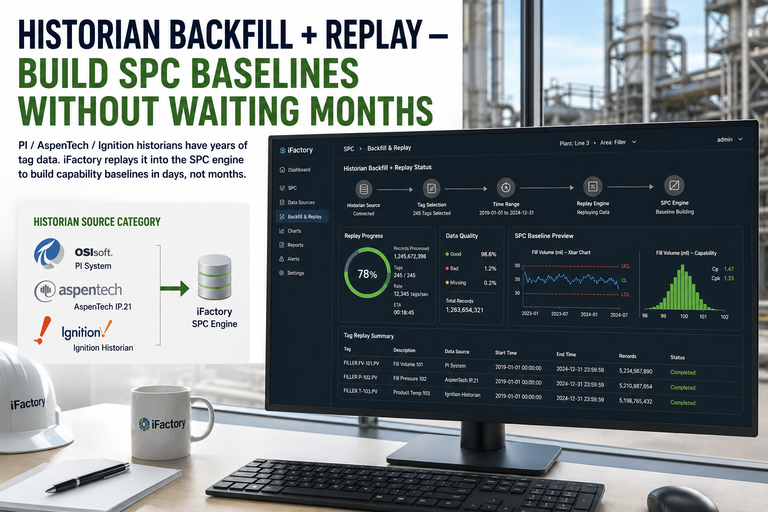
The data to prove your process is capable already exists. It has been sitting in your historian for years — every temperature, pressure, flow, and weight reading your PI, AspenTech IP.21, or Ignition system has dutifully compressed and archived since the day it was commissioned. Yet most SPC rollouts start from zero, collecting fresh samples for weeks or months before a single capability baseline can be trusted. That waiting period is the most common reason an SPC program stalls before it delivers anything. There is a faster path. Instead of waiting for new data to accumulate, iFactory replays the history you already own — pulling archived tag data straight into the SPC engine and computing capability baselines retroactively. A historian-to-SPC bridge turns decades of stranded time-series data into a baseline you can build in days.
iFactory Historian Source
Historian Backfill + Replay — Build SPC Baselines Without Waiting Months
Replay years of PI, AspenTech, and Ignition tag data into the SPC engine to compute capability baselines retroactively — days to a trusted Cpk, not months of fresh collection.
Every SPC deployment hits the same wall. Control limits and capability indices are only meaningful once you have enough data to describe the process across its real variation — shifts, lots, seasons. Start collecting from scratch and you are blind for weeks: no trustworthy limits, no Cpk anyone will sign off on, and a quality team waiting on a number that does not exist yet. Momentum dies in that gap. The irony is that the data needed to skip the wait is already on disk.
Cold Start
Wait for New Data
Weeks or months of fresh sampling before limits are trustworthy
No Cpk anyone will sign off on during the collection window
Program loses momentum and stakeholder confidence before first value
Years of existing history sit unused on the historian
Replay Existing History
Backfill From What You Own
Archived tag data replayed into the SPC engine in days
Capability baseline computed across months of real variation at once
Control limits derived from history, then live data flows straight on
Decades of stranded data finally put to work
How Replay Builds a Baseline
The mechanic is straightforward: connect to the historian, pull the tags that matter, replay that history through the same SPC calculations a live stream would feed, and out comes a capability baseline grounded in real production. Because the data already spans shifts, lots, and seasons, the resulting limits and Cpk reflect how the process truly behaves — not a hand-picked afternoon.
From Archived Tag to Capability Baseline
1
Connect
Historian Source
Bridge to PI, AspenTech IP.21, or Ignition over standard interfaces
2
Select
Map Tags
Pick the critical-to-quality tags and the time window to replay
3
Replay
Backfill SPC
History streams through the SPC engine as if it happened in real time
4
Baseline
Limits + Cpk
Control limits and capability computed, then live data continues seamlessly
Months to Days — the Timeline Difference
The whole value is in the calendar. A cold-start baseline waits for the clock; a replayed baseline reads history that already happened. The same trustworthy Cpk — one path takes a quarter, the other takes a few days.
Time to a Trusted Capability Baseline
Same statistical rigor, same real-variation coverage — replay just reads the history that already exists instead of waiting for it to accumulate.
Built for the Historians You Already Run
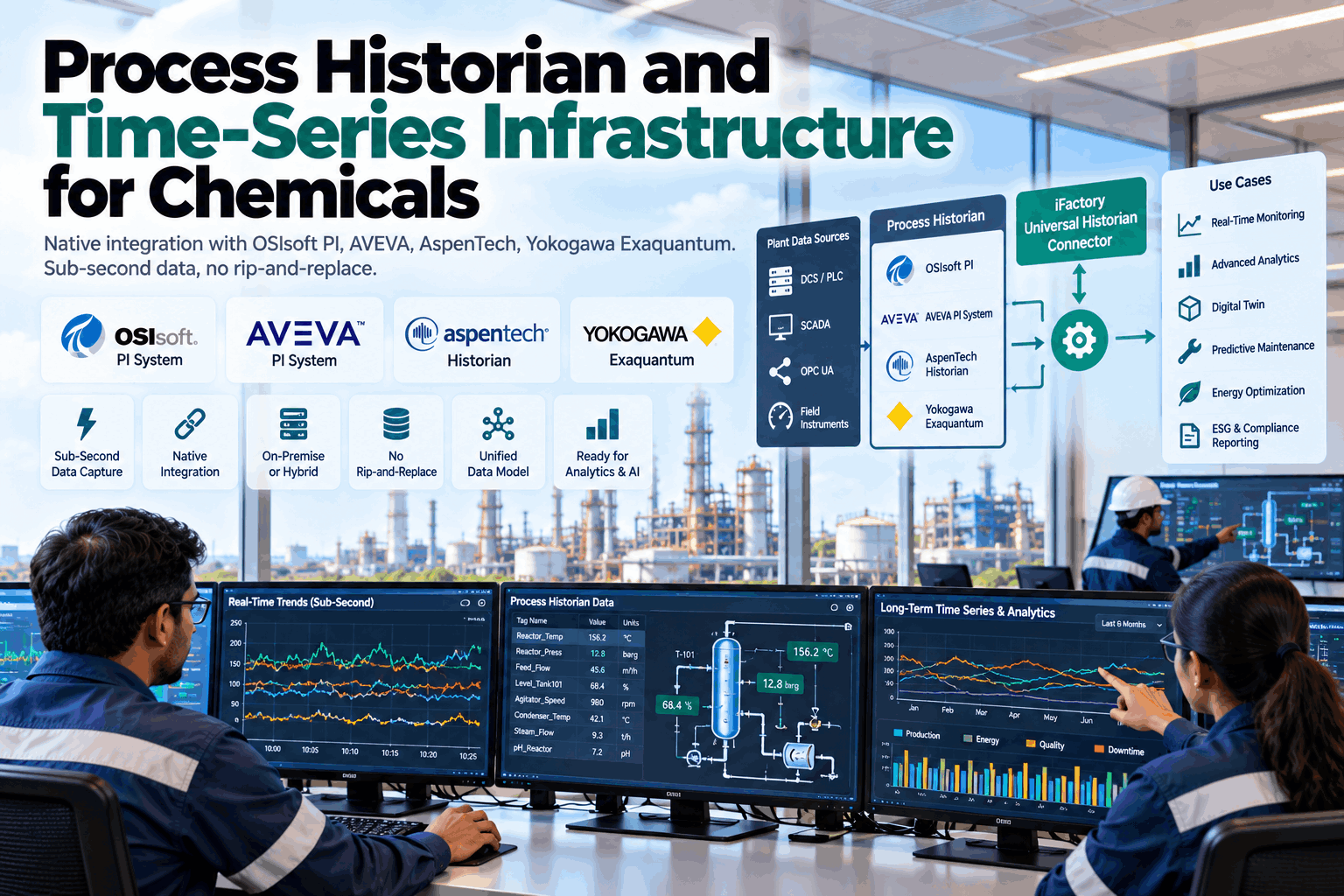
The feature meets your data where it lives. Historians are time-series databases purpose-built to capture, compress, and store high-frequency process data — and each major platform exposes that archive through standard interfaces the bridge connects to.
OSIsoft / AVEVA PI
The most widely deployed historian in the control space. Each measured variable is a PI tag; Swinging Door compression lets plants retain decades of high-resolution data — all replayable into SPC.
AspenTech IP.21
Aspen InfoPlus.21 collects from DCS, PLC, SCADA, ERP, and other historians via OPC, ODBC, and REST — a deep archive of contextualized tag data ready to replay.
Ignition
Inductive Automation's platform, strong on integration with a flexible historian module — its stored tag history feeds the same backfill path.
Want to see your own historian's tags replayed into a live capability baseline? Book a 30-minute walkthrough and we'll backfill a real process from your archive.
The Data-Quality Discipline
Replaying history is powerful, but a baseline is only as good as the data behind it — and historian archives have their own quirks. Compression artifacts, sensor dropouts, frozen values, and bad-quality flags all have to be handled, or the baseline inherits them. Done right, the replay screens for these so the resulting Cpk is evidence, not an artifact of dirty data.
Gap & Dropout Handling
Sensor outages and missing intervals are identified rather than silently averaged over, so they don't distort the computed spread.
Compression Awareness
Historian compression (like Swinging Door) stores deltas, not every raw point — the replay reconstructs the signal faithfully before charting.
Quality-Flag Respect
Bad, stale, and questionable value flags carried by the historian are honored, so flagged data doesn't quietly inflate or deflate capability.
Window Policy
The replay window and lot policy are defined up front and documented, so the baseline includes routine variation and survives an audit.
What Replay Unlocks
Backfilling from the historian is not just a faster start — it changes what an SPC program can do on day one. The value compounds across speed, rigor, and the ability to look backward as well as forward.
Days
To first baseline
replay archived history instead of waiting to collect it
Months
Of variation captured
shifts, lots, and seasons already in the archive
Retro
Capability studies
compute Cpk for any past period, not just from now forward
Zero
New instrumentation
the tags you need are already being recorded
Every baseline starts with the history you already own. Want the historian bridge scoped to your tag structure? Talk to our data engineers.
Frequently Asked Questions
How is replay different from just exporting historian data to a spreadsheet?
An export gives you raw numbers; replay runs that history through the actual SPC engine — the same calculations a live stream feeds — so it produces real control limits, capability indices, and rule evaluations, not just a table. It also handles compression reconstruction and quality flags along the way, which a flat export drops. The output is a working baseline the live data continues from, not a one-off analysis.
Which historians can iFactory replay from?
The historian source category connects to the major platforms — OSIsoft/AVEVA PI, AspenTech IP.21, and Ignition — over the standard interfaces they expose, such as OPC, ODBC, and REST. Because these systems are purpose-built time-series databases holding years of tag data, the same backfill path applies across them; only the connection details differ.
Will historian compression distort the baseline?
Not if it's handled correctly. Historians like PI use compression such as Swinging Door Trending that stores significant changes rather than every raw point, which is why naive replay can misrepresent the signal. The backfill reconstructs the trace faithfully before it charts, and respects the historian's own quality flags, so the resulting Cpk reflects the true process rather than a compression artifact.
Can we run retrospective capability studies on past events?
Yes — that's a direct benefit of replay. Because you're reading stored history, you can compute capability for any past window: before and after a known change, during a problem period, or across a specific campaign. It turns the historian from a passive archive into a tool for answering "how capable was this process last quarter?" with the same rigor as a live study.
Do we need new sensors or tags to start?
No. The premise of replay is that the data already exists — a large plant may carry tens or hundreds of thousands of active tags, recording the critical-to-quality variables continuously. You map the tags that matter to your SPC parameters and replay them; no new instrumentation, no waiting for fresh collection, no capital for hardware you already have feeding the historian.
Your Baseline Is Already on Disk.
See Years of Historian Data Become an SPC Baseline — in 30 Minutes
Bring a process with history in PI, AspenTech, or Ignition. We'll connect the historian, map the critical tags, replay the archive through the SPC engine, and stand up a real capability baseline live — then show the live data continuing straight on from it.