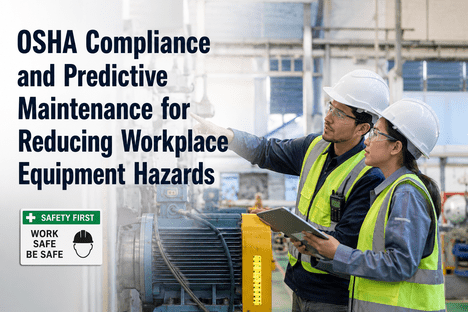
The Occupational Safety and Health Administration (OSHA) recorded approximately 2.6 million nonfatal workplace injuries and illnesses in private industry in 2023, with manufacturing accounting for a disproportionate share of serious incidents involving machinery, powered industrial trucks, and energy-release events during maintenance activities. The agency's most frequently cited standards — lockout/tagout (29 CFR 1910.147), machine guarding (29 CFR 1910.212), hazard communication (29 CFR 1910.1200), and powered industrial trucks (29 CFR 1910.178) — all share a common root cause: equipment condition that degrades gradually until it creates an unsafe state. Predictive maintenance, applied systematically across industrial equipment, directly addresses the machinery failure mechanisms that produce OSHA-recordable incidents. Rather than reacting after an injury or relying on periodic inspections that miss rapidly developing hazards, AI-driven condition monitoring detects the vibration anomalies, temperature excursions, and wear patterns that precede both equipment failure and the safety incidents those failures cause. iFactory's platform bridges the gap between safety compliance and maintenance operations by delivering continuous, documented condition data that satisfies OSHA recordkeeping requirements while preventing the mechanical failures that lead to lost-time injuries. Safety and reliability leaders who Book a Demo consistently find that the same data stream that protects their workforce also protects their production schedule.
The Structural Link Between Equipment Failure and OSHA-Recordable Injuries
The connection between equipment condition and workplace injury is not theoretical — it is documented in OSHA's own inspection data and in the Bureau of Labor Statistics (BLS) industry incident rate tables. Machinery-related incidents — caught-in, struck-by, burn, and energy-release events — consistently rank among the top causes of workplace fatalities and lost-time injuries in manufacturing. The National Safety Council reports that 25 to 30 percent of workplace deaths in manufacturing are related to maintenance activities specifically. These incidents share a predictable pattern: an equipment component degrades to the point of failure during operation, and the failure mode — a coupling shattering, a bearing seizing, a hydraulic line bursting — creates a hazardous energy release or mechanical motion that injures nearby workers.
Traditional safety programs address this through three mechanisms: periodic equipment inspections, preventive maintenance schedules, and employee training on hazard recognition. Each of these approaches has a critical blind spot — they cannot detect rapidly developing failure modes that progress between inspection intervals. A bearing that was measured at normal vibration levels during the monthly inspection can develop spalling 72 hours later, generate sufficient heat to compromise the housing, and produce a catastrophic failure with an energetic release that endangers operators. This is not a failure of the inspection program — it is a limitation of periodic measurement in a continuous process environment. iFactory's continuous condition monitoring closes this gap by measuring every critical asset 24/7 and flagging deviations at the first moment they become detectable, not at the next scheduled inspection. Book a Demo to see how continuous monitoring transforms safety incident prevention.
- Equipment inspected on fixed intervals — failures developing between inspections are invisible until they cause injury or breakdown
- Incident investigations conducted after injury — root cause analysis confirms what monitoring could have predicted
- LOTO procedures verified manually — no automated confirmation that energy isolation is complete before maintenance access
- Machine guarding inspections performed on calendar — guard condition between inspections is unknown
- Safety data collected for compliance reporting — not used for predictive risk reduction
- TRIR and DART rates reviewed quarterly — no leading indicator of emerging equipment-related hazards
- Equipment condition monitored continuously — degradation detected at onset, correction before failure or injury
- Pre-incident condition data preserved automatically — root cause analysis begins with full data history
- Energy isolation status monitored via vibration and temperature — confirmation that systems have reached zero-energy state
- Guard position and integrity monitored via proximity sensors and vibration — tampering or damage detected immediately
- Safety data analyzed continuously for predictive risk scoring — leading indicators of equipment-related hazard emergence
- TRIR reduction tracked causally to specific condition monitoring interventions — demonstrating safety ROI
How AI-Driven Condition Monitoring Aligns with OSHA's Hazard Prevention Framework
OSHA's Recommended Practices for Safety and Health Programs establish a continuous hazard identification and control cycle: identify hazards, assess risks, implement controls, and verify effectiveness. Predictive maintenance equipment monitoring maps directly onto this framework. The AI condition monitoring that iFactory deploys for predictive maintenance simultaneously serves as a continuous hazard identification system — because every equipment failure mode is also a potential injury mechanism. A pump bearing degradation is a production risk and a safety risk simultaneously. A coupling imbalance is a maintenance issue and a struck-by hazard concurrently. Treating them as separate problems creates duplicate effort and missed detection opportunities.
iFactory's platform operationalizes this integrated view by monitoring the same asset parameters — vibration, temperature, pressure, current draw, acoustic emission — for both reliability and safety outcomes. When the system detects a bearing degradation signature that indicates risk of catastrophic failure within 30 days, it generates a simultaneous alert to the maintenance team and the safety team. The maintenance work order is created, and the safety hazard is documented in the incident prevention log. This dual-purpose monitoring is the practical expression of what OSHA describes as "finding and fixing hazards before they cause injury or illness" — applied to the equipment failure mechanisms that produce manufacturing's most serious safety incidents. Book a Demo to see iFactory's hazard-to-maintenance workflow integration.
TRIR Reduction Through Predictive Maintenance: Measurable Safety Outcomes
The Total Recordable Incident Rate (TRIR) is OSHA's primary metric for measuring workplace safety performance, calculated as the number of recordable incidents per 100 full-time equivalent workers per year. The BLS-reported average TRIR for manufacturing was 2.3 recordable cases per 100 FTE in 2023, with specific sectors — fabricated metal product manufacturing (3.8), machinery manufacturing (3.1), and primary metal manufacturing (3.5) — significantly higher. Each recordable incident carries direct costs from medical treatment, indemnity payments, and OSHA penalties, plus indirect costs from production interruption, investigation time, and insurance premium increases that typically multiply the direct cost by 4 to 10 times. Predictive maintenance reduces TRIR by preventing the equipment failure events that cause recordable injuries — and the effect is measurable and predictable.
iFactory's customers in heavy manufacturing sectors have documented TRIR reductions of 18 to 35% within the first 12 months of deployment, driven by the elimination of equipment failure events that previously generated recordable injuries. These reductions are achieved not through new safety procedures or training — though both remain important — but through the structural elimination of the hazard mechanism itself. A coupling that is replaced preventively based on vibration trend analysis cannot produce a struck-by injury because it does not fail catastrophically. A bearing that is changed during planned maintenance based on temperature trend monitoring cannot seize and create a caught-in event. The safety improvement is inherent in the equipment reliability improvement — they are the same outcome measured in different units. Book a Demo to see the TRIR reduction model calibrated for your facility's incident history and equipment roster.
Documenting Compliance: How iFactory Supports OSHA Recordkeeping and Audit Readiness
OSHA's recordkeeping requirements under 29 CFR 1904 mandate that employers document work-related injuries and illnesses on the OSHA 300 log, maintain records of hazard assessments, and retain exposure monitoring and medical records for specified periods. What is less widely recognized is that these same regulations require employers to document the hazard identification and control measures that prevent recordable incidents — and that this documentation, when structured properly, serves as affirmative evidence of an effective safety program during OSHA inspections. iFactory's platform automatically generates compliance documentation from its condition monitoring data stream, providing auditable evidence that equipment-related hazards were identified, assessed, and controlled before they produced injuries.
Equipment Hazard Classification: Predictive Maintenance by Failure Mechanism
Different equipment failure mechanisms produce different hazard profiles. Understanding the specific injury mechanism associated with each failure mode allows safety professionals to prioritize condition monitoring investments based on potential severity. iFactory's hazard classification framework maps each monitored asset's failure modes to their OSHA injury classifications — enabling safety teams to see not just which assets are degrading, but what injury risk that degradation represents to the workforce.
| Equipment Failure Mode | Primary Injury Mechanism | OSHA Classification | iFactory Detection Method | Warning Lead Time |
|---|---|---|---|---|
| Rotating shaft coupling failure | Struck-by — coupling fragments ejected at high velocity | 29 CFR 1910.212 machine guarding / 1910.147 energy control | Vibration at 1× RPM sidebands, temperature rise at coupling hubs | 14–28 days |
| Bearing catastrophic seizure | Caught-in — rotating element stops abruptly, operator contact with rotating mass | 29 CFR 1910.212 machine guarding | High-frequency vibration (bearing defect frequencies), temperature acceleration, acoustic emission | 7–21 days |
| Hydraulic hose or fitting rupture | Struck-by — fluid injection injury, burn from hot hydraulic fluid | 29 CFR 1910.147 energy control / 1910.1200 hazard communication | Pressure decay rate, pump current signature, fluid temperature trend | 3–10 days |
| Belt or chain drive failure | Struck-by / caught-in — belt fragments or chain whipping | 29 CFR 1910.219 mechanical power-transmission apparatus | Drive speed fluctuation, vibration at belt-pass frequency, temperature at sheave bearings | 5–14 days |
| Electrical motor winding failure | Arc-flash / burn — electrical fault during operation or startup | 29 CFR 1910.303 electrical systems / NFPA 70E | Current asymmetry, insulation resistance trend, operating temperature, partial discharge | 7–30 days |
| Pressure vessel or receiver corrosion | Explosion / struck-by — vessel rupture releases stored energy as projectiles | 29 CFR 1910.166–169 pressure vessels / 1910.147 energy control | Corrosion rate trend from ultrasonic thickness measurement, pressure cycling count | 30–90 days |
| Forklift mast or carriage wear | Struck-by — load shift or mast collapse during lifting | 29 CFR 1910.178 powered industrial trucks | Hydraulic pressure asymmetry, mast vibration during lift cycle, tilt cylinder drift | 14–30 days |
Implementation Roadmap: Integrating Predictive Maintenance with Your Safety Management System
Effective integration of predictive maintenance into safety management does not require replacing your existing safety program — it requires adding continuous condition data to the hazard identification and control cycle that your safety team already runs. iFactory's implementation follows a phased approach that respects existing safety processes while systematically adding data-driven hazard detection capability. For facilities unsure where to begin, Book a Demo includes a complimentary hazard assessment mapping your highest-risk equipment to the appropriate monitoring strategy.
Hazard-Asset Mapping & Sensor Deployment
iFactory's engineers conduct a structured assessment of your facility's equipment inventory, mapping each asset class to its primary failure modes and the OSHA injury classification associated with each mode. Sensors are deployed on assets ranked by hazard severity — starting with rotating equipment over 50 HP, hydraulic systems over 1,000 PSI, and powered industrial trucks in high-traffic zones. Timeline: 4–6 weeks.
Continuous Monitoring & Safety Alert Integration
iFactory's condition monitoring platform is configured to generate dual-purpose alerts: maintenance work orders for equipment degradation and safety notifications for the hazard mechanisms those degradation modes represent. Safety team members receive direct alert integration into their existing incident management workflow — no separate dashboard required. Timeline: 4–8 weeks.
Compliance Documentation & TRIR Benchmarking
iFactory's automated documentation module generates OSHA-compliant hazard identification logs, maintenance-incident correlation reports, and periodic TRIR tracking dashboards that demonstrate the safety impact of predictive maintenance investments. Safety leadership uses this data to target residual hazards and prioritize capital investments in equipment replacement or redesign. Timeline: Ongoing.
Real-World Impact: Predictive Maintenance Preventing Injury Events
We had a history of coupling-related struck-by injuries in our pump house — three recordable incidents over four years from couplings that failed without warning and ejected fragments through the guard mesh. We installed guards with finer mesh after the first incident, tightened inspection intervals after the second, and added coupling-specific visual checklists after the third. None of it worked because the failure mechanism was high-speed fatigue cracking that developed between monthly inspections. When we deployed iFactory's vibration monitoring on those pump couplings, the first two months of data showed that coupling degradation was developing over 18 to 26 days — well within the detection window of continuous monitoring but invisible to monthly inspection. We replaced nine couplings preventively in the first quarter based on iFactory's predictions. None of those couplings would have lasted until the next monthly inspection without failing. We have had zero coupling-related injuries in the two years since. The OSHA recordable rate for our pump house area dropped from 3.2 to zero. That is not a safety program improvement — that is an injury elimination that the safety program alone could not achieve.
Frequently Asked Questions: OSHA Compliance and Predictive Maintenance
No. OSHA does not mandate predictive maintenance specifically. However, OSHA's general duty clause (Section 5(a)(1) of the OSH Act) requires employers to provide a workplace free from recognized hazards — and equipment failure mechanisms are recognized hazards in industrial manufacturing. Courts have held that employers who know about equipment degradation and fail to address it before it causes injury can face serious citations. Predictive maintenance provides documented evidence of proactive hazard management that directly supports the employer's defense against general duty clause citations. The OSHA Field Inspection Reference Manual instructs compliance officers to examine maintenance records as part of their inspection — a well-maintained predictive maintenance program with documented condition data significantly reduces the risk of citation.
Yes — and it is among the strongest forms of affirmative safety documentation. Continuous condition monitoring data demonstrates that the employer had a systematic process for identifying equipment hazards, assessing their severity, and controlling them before they caused injury. OSHA compliance officers view documented preventive and predictive maintenance programs as indicators of a proactive safety culture. iFactory's automated documentation module generates the specific records that inspectors look for: hazard identification logs, maintenance work order histories linked to equipment condition data, and trend analyses showing hazard reduction over time. These records are timestamped, tamper-evident, and directly exportable for inspection presentation.
iFactory's initial deployment — covering hazard-asset mapping, sensor installation on the highest-priority equipment, and alert integration with your existing safety workflow — is typically completed in 4 to 6 weeks. The compliance documentation module begins generating auditable hazard identification logs from the first day of continuous monitoring. Full site deployment covering all critical assets with integrated TRIR reporting and safety incident correlation typically reaches steady state within 12 to 16 weeks. Book a Demo for a deployment timeline tailored to your facility size and equipment hazard profile.
The ROI for safety-focused predictive maintenance is typically equal to or greater than the reliability-focused ROI because the cost of a single OSHA-recordable injury — direct plus indirect — often exceeds the annual cost of monitoring an entire production line. A single amputation, fracture, or burn injury carries average total costs of $800,000 to $2.5 million when medical treatment, indemnity, OSHA penalties, litigation, insurance increases, and production disruption are included. The annual cost of monitoring a rotating equipment asset with iFactory — including edge IoT sensor, data processing, and alert generation — is approximately $800 to $1,500 per asset. The financial break-even point is one prevented injury every three to five years for a 200-asset facility. Most iFactory customers report multiple injury-prevention events within the first year of deployment, producing a safety ROI that substantially exceeds the reliability ROI alone — even before the production uptime benefits are calculated.
Yes. iFactory provides API-based integration with leading EHS platforms including Sphera, Cority, Intelex, Enablon, Gensuite, and VelocityEHS. Condition monitoring alerts that have safety implications are automatically posted to the EHS system's hazard register or incident prevention log, creating a unified data flow from equipment sensor to safety record. For facilities without a dedicated EHS platform, iFactory's built-in documentation module provides OSHA-compliant hazard identification logs and TRIR tracking dashboards that satisfy recordkeeping requirements without requiring additional software.
iFactory's electrical asset monitoring module tracks motor winding temperature, current asymmetry, insulation resistance trends, and partial discharge activity — the four leading indicators of electrical failure mechanisms that produce arc-flash events. When monitoring detects conditions consistent with incipient insulation breakdown, iFactory generates an arc-flash hazard alert that recommends de-energized inspection and testing before a catastrophic failure occurs. This is particularly valuable for NFPA 70E compliance, where the standard requires employers to identify arc-flash hazards before employees work on or near energized electrical equipment. iFactory's monitoring data provides documented evidence that the employer has assessed the condition of electrical equipment and taken appropriate action based on that assessment — directly supporting the risk assessment documentation that NFPA 70E Article 130 requires.