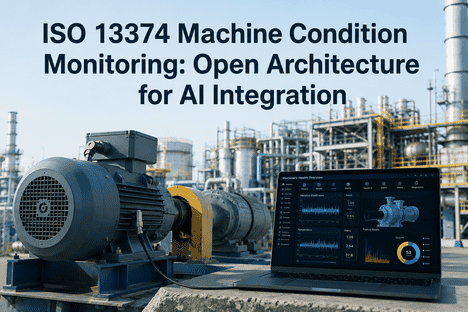
The ISO 13374 standard, formally titled "Condition monitoring and diagnostics of machines — Data processing, communication and presentation, defines the foundational reference architecture for modern condition monitoring systems. Published by the International Organization for Standardization under Technical Committee ISO/TC 108/SC 5, this multi-part standard establishes a six-layer functional block architecture that underpins virtually every serious predictive maintenance implementation in industrial manufacturing. Originally ratified in 2003 and confirmed as current in 2025, ISO 13374 provides the data processing and communication framework that allows sensor data to flow from acquisition through manipulation, state detection, health assessment, prognostics, and finally into actionable maintenance advisories. For industrial organizations seeking to deploy AI-driven condition monitoring at scale, understanding this architecture is not optional — it is the blueprint without which plug-and-play interoperability remains impossible. Teams that Book a Demo with iFactory consistently find that our platform maps natively to every layer of the ISO 13374 specification, turning a compliance requirement into a competitive advantage.
Deploy an OSA-CBM Compliant AI Platform Today
iFactory's industrial AI architecture maps natively to every functional layer of ISO 13374 — from multi-spectrum data acquisition through AI-driven prognostic assessment and closed-loop advisory generation.
The Six Functional Blocks of ISO 13374
ISO 13374 decomposes a condition monitoring system into six sequential functional blocks, each with defined inputs, outputs, and processing semantics. This layered architecture ensures that components from different vendors can be composed into a working system without custom integration — a principle MIMOSA later formalized in its OSA-CBM (Open System Architecture for Condition-Based Maintenance) specification. The six blocks form a data pipeline from raw sensor voltages to executive maintenance decisions. For a deeper understanding of how iFactory implements each block, Book a Demo with our solutions engineering team.
Data Acquisition
Core Function: The DA block converts physical phenomena into digital data. Sensors — accelerometers, thermocouples, pressure transducers, current clamps, acoustic emission sensors — produce analog signals that are sampled, digitized, and timestamped at the edge.
Data Manipulation
Core Function: Raw digitized signals are processed into meaningful features. This includes filtering (low-pass, band-pass), time-to-frequency transforms (FFT, wavelet), statistical extraction (RMS, peak, crest factor), and normalization against baseline conditions.
State Detection
Core Function: The SD block compares extracted features against defined thresholds or expected behavior envelopes. It generates status flags: Normal, Warning, Alarm. This is where simple condition monitoring becomes reactive or proactive based on threshold conformance.
Health Assessment
Core Function: The HA block diagnoses the current health of the asset. It fuses data from multiple sensors, correlates symptoms with known failure modes (FMEA), and produces a diagnostic conclusion: what is failing and how severely.
Prognostics Assessment
Core Function: The PA block predicts future health states. Using degradation models, machine learning regression, or physics-based fatigue analysis, it estimates Remaining Useful Life (RUL) and projects the evolution of the fault over time.
Advisory Generation
Core Function: The AG block converts diagnostic and prognostic outputs into actionable recommendations. It generates maintenance work orders, suggests operational constraints (speed, load reductions), and prioritizes interventions based on risk and cost.
"Before adopting iFactory, our condition monitoring stack was a patchwork of five different vendor systems — vibration analysts used one platform, thermography another, and oil analysis lived in a spreadsheet. None of them spoke to each other. By mapping our entire CM workflow to the ISO 13374 architecture within iFactory, we eliminated the integration tax and gained a single pane of glass across 2,400 critical assets. For the first time, our prognostics engine had access to clean, structured data from every DA block in the plant."
ISO 13374 Functional Block vs. iFactory AI Capability Mapping
The power of the ISO 13374 reference architecture lies in its vendor-neutral layering. Each block communicates with its neighbors through a well-defined interface, meaning a Data Acquisition module from one vendor can feed a Health Assessment engine from another — provided both adhere to the standard. In practice, however, achieving true interoperability requires a platform that was designed for the architecture from day one. iFactory natively implements every block of the ISO 13374 pipeline, from edge-based DA through AI-driven AG. Reliability engineers who Book a Demo discover that this native mapping eliminates the data translation and schema mediation that plague multi-vendor CM deployments.
| ISO 13374 Block | Standard Function | Standard Output | iFactory AI Implementation |
|---|---|---|---|
| Data Acquisition (DA) | Sensor signal sampling & digitization | Time-series waveforms & scalar readings | Edge IoT gateway with Modbus, OPC-UA, MQTT, BLE, and direct sensor I/O support |
| Data Manipulation (DM) | Signal processing & feature extraction | RMS, FFT bins, statistical moments, trend vectors | Edge-based real-time FFT, envelope analysis, and automated feature engineering pipeline |
| State Detection (SD) | Threshold comparison & status classification | Normal / Warning / Alarm flags | Adaptive threshold engine with dynamic baselines learned from normal operating conditions |
| Health Assessment (HA) | Failure mode diagnosis & severity scoring | Fault identification, severity index, confidence level | Causal AI engine correlating multi-sensor signatures against FMEA-based failure mode libraries |
| Prognostics Assessment (PA) | RUL estimation & future health projection | Days-to-failure, degradation curves, probability distributions | Ensemble ML regression models providing 180-day failure foresight with 95% accuracy |
| Advisory Generation (AG) | Maintenance recommendation & action prioritization | Work orders, operational constraints, risk-ranked actions | Auto-generated work orders with technician assignment, part reservation, and deadline optimization |
Beyond Compliance: Why an ISO 13374-Native AI Platform Matters
Most condition monitoring software claims to be "open" or "standards-based," but in practice, these systems expose proprietary APIs that require expensive custom adapters to achieve basic interoperability. An ISO 13374-native platform like iFactory provides three structural advantages that directly impact operational outcomes. First, data liquidity — because every block produces standardized output schemas, data flows freely between DA sensors, DM feature stores, and HA diagnostic models without brittle point-to-point integrations. Second, algorithm portability — your best-in-class vibration analysis model can be swapped in without touching the DA or AG layers. Third, future-proofing — as MIMOSA evolves the OSA-CBM specification, your architecture evolves with it. These advantages compound over the life of a plant. Leaders who Book a Demo see precisely how this architectural discipline translates into lower total cost of ownership and faster time-to-value.
Phased ISO 13374 Deployment: From DA to AG in Three Milestones
Adopting a standards-based condition monitoring architecture does not require a forklift upgrade of existing infrastructure. iFactory's implementation methodology follows a progressive three-phase roadmap that respects legacy investments while systematically building toward full ISO 13374 compliance. Each phase delivers independent value while laying the foundation for the next. For organizations unsure of their current architecture maturity, Book a Demo provides a structured assessment of existing CM capabilities and a prioritized migration plan.
Connect & Acquire: Building the DA–DM Foundation
Deploy iFactory edge gateways to existing sensors and PLCs. Establish standardized data acquisition across vibration, temperature, pressure, current, and acoustic channels. Implement edge-based feature extraction (RMS, FFT, envelope spectra) so that raw data is immediately structured into ISO 13374-compliant DM output schemas. Timeline: 6–10 weeks.
Diagnose & Predict: Activating SD–HA–PA Intelligence
Implement adaptive thresholding for state detection on all connected assets. Deploy iFactory's Causal AI engine for health assessment, mapping multi-sensor signatures to your existing FMEA failure modes. Activate prognostic models to generate RUL estimates and degradation curves. Timeline: 8–14 weeks.
Act & Optimize: Closing the Loop with AG Integration
Connect advisory generation to your CMMS, EAM, or ERP (SAP, Oracle, Microsoft Dynamics). Enable auto-generated work orders, dynamic spares reservation, and risk-prioritized maintenance scheduling. Integrate with production planning systems for condition-based operational adjustments. Timeline: Ongoing.
ISO 13374 & Open Architecture Condition Monitoring — Frequently Asked Questions
What is the difference between ISO 13374 and MIMOSA OSA-CBM?
ISO 13374 is the international standard that defines the six functional blocks for condition monitoring data processing. OSA-CBM, published by the MIMOSA organization, is a concrete implementation specification that adds data structures, XML schemas, and web service interfaces to the ISO 13374 functional architecture. Think of ISO 13374 as the architectural blueprint and OSA-CBM as the construction code.
Does ISO 13374 require specific sensor hardware or protocols?
No. ISO 13374 is protocol-agnostic by design. It defines the functional blocks and data interfaces, not the physical transport layer. iFactory supports Modbus, OPC-UA, MQTT, BLE, PROFINET, EtherNet/IP, and direct analog/digital I/O — any of these can serve as the DA block as long as the output conforms to the standard's data model.
Can a plant implement only some ISO 13374 blocks and still be compliant?
Yes. ISO 13374 does not require all six blocks to be present in every deployment. A simple system might implement only DA, DM, and SD for basic alarm monitoring. The standard only requires that whichever blocks are implemented conform to the interface specifications. iFactory's modular architecture supports this — you can deploy DA+DM+SD today and add HA+PA+AG later.
How does ISO 13374 relate to ISO 17359?
ISO 17359 provides the high-level procedure for setting up a condition monitoring program — it tells you what to monitor and when. ISO 13374 provides the technical architecture for how to process, communicate, and present that monitoring data. They are complementary: ISO 17359 is your strategic framework, ISO 13374 is your technical infrastructure.
How does AI fit into the ISO 13374 architecture?
AI models primarily operate in the HA (Health Assessment) and PA (Prognostics Assessment) blocks, where machine learning algorithms perform diagnostic classification and RUL regression. However, AI can also enhance DM (adaptive feature selection), SD (dynamic threshold learning), and AG (recommendation optimization). iFactory embeds AI natively across all applicable blocks while maintaining strict ISO 13374 interface compliance.
What is the business case for ISO 13374 compliance?
The primary business case is vendor independence. Without a standards-based architecture, plants become locked into proprietary CM ecosystems with expensive switching costs. ISO 13374 compliance ensures that sensor hardware, analytics software, and enterprise systems can be independently sourced and replaced. iFactory's customers report 70% lower integration costs and 3.5x faster deployment of new monitoring use cases compared to proprietary alternatives.
Can iFactory integrate with my existing vibration analyzers and oil analysis lab?
Yes. iFactory's DA block accepts structured data from third-party vibration collectors (CSI, Emerson, Bently Nevada), oil analysis labs, thermography cameras, and ultrasonic detectors. The DM block then normalizes these heterogeneous data sources into a unified feature space for the SD, HA, and PA blocks. Book a Demo to see a live integration example with your specific equipment roster.
How long does it take to deploy a full ISO 13374-compliant system with iFactory?
A full six-block deployment covering DA through AG typically requires 14–20 weeks for a single plant site, including edge gateway installation, model training, and CMMS integration. Phased deployments that start with DA+DM+SD and add HA+PA+AG later can go live in 6–10 weeks for the initial phase. We provide a detailed implementation timeline during your Book a Demo.
Build Your Condition Monitoring Architecture on an Open Standard
iFactory's industrial AI platform is the only predictive maintenance solution architected from the ground up to map natively to the ISO 13374 functional specification — delivering data liquidity, algorithm portability, and vendor independence at every layer.