Open-Source vs Commercial Predictive Maintenance Solutions
By Ethan Walker on June 20, 2026
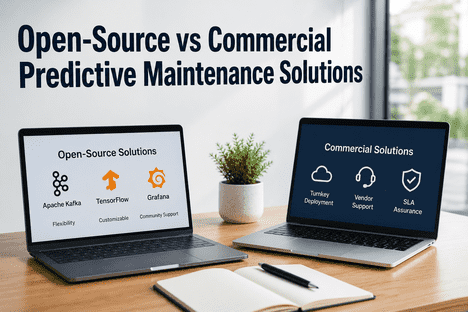
In precision manufacturing, reliability and maintenance teams evaluating predictive maintenance (PdM) platforms in 2026 face a strategic fork: build an in-house PdM capability using open-source components — Apache Kafka for data streaming, InfluxDB or TimescaleDB for time-series storage, TensorFlow or PyTorch for model training, and Grafana for dashboards — or deploy a commercial AI-native PdM platform that delivers production-grade failure prediction with pre-built connectors, continuous model learning, and integrated CMMS work order automation. The open-source path offers zero licensing cost and complete architectural control, but requires 2–4 full-time data engineers and ML specialists to assemble, tune, and maintain the stack. The commercial path carries subscription cost but eliminates the 12–18 month assembly timeline and the ongoing burden of model drift management, data pipeline maintenance, and alarm fatigue engineering. iFactory AI's industrial PdM platform, including its Shift Logbook and predictive maintenance engine, enables reliability teams to deploy production-grade bearing, spindle, and rotating equipment failure prediction without building infrastructure from scratch. Book a Demo to see how iFactory compares against open-source alternatives in a head-to-head evaluation. This guide covers the open-source PdM stack architecture, the hidden total cost of ownership, the commercial platform advantage, and a structured build-vs-buy framework for reliability leaders making the 2026 decision.
Build vs Buy · Open Source · 2026
Open-Source vs Commercial Predictive Maintenance: The 2026 Build-vs-Buy Decision
Total cost of ownership analysis · deployment timeline comparison · hidden labor and infrastructure costs · production-grade AI fault prediction without the assembly burden.
What the Open-Source PdM Stack Actually Looks Like in Production
The open-source predictive maintenance stack is not a single product — it is a multi-layer architecture composed of independently maintained components that must be integrated, configured, tested, and maintained by an in-house engineering team. A production-grade open-source PdM deployment typically requires seven discrete software layers working together, each with its own learning curve, configuration surface, and ongoing maintenance burden. The capability gap between open-source and commercial PdM is not in individual component quality — TensorFlow, Kafka, and Grafana are excellent tools — but in the integration burden, the data pipeline engineering, the model management lifecycle, and the operator interface design that commercial platforms solve before deployment.
01
Data Ingestion & Streaming
Apache Kafka or MQTT brokers for real-time sensor data ingestion. Requires cluster provisioning, topic configuration, schema registry setup, partition tuning, and consumer group management. Production deployment demands dedicated DevOps engineering.
Hidden cost: Kafka cluster ops
02
Time-Series Storage
InfluxDB, TimescaleDB, or Apache Druid for storing vibration waveforms, temperature trends, and current signatures. Database schema design, retention policies, continuous queries, and downsampling strategies must be hand-configured per asset class.
Hidden cost: Schema engineering
03
Feature Engineering Pipeline
Custom Python or Spark jobs to compute envelope spectra, extract BPFO/BPFI/BSF/FTF amplitudes, calculate RMS and crest factor trends, and normalize across speed and load conditions. Each asset type requires bespoke feature engineering.
Hidden cost: ML engineering time
04
Model Training & Serving
TensorFlow or PyTorch for model development. Requires infrastructure for experiment tracking, hyperparameter tuning, model versioning, A/B testing, and low-latency inference serving with GPU provisioning for production workloads.
Grafana for asset health dashboards, trend plots, and envelope spectrum visualization. Custom dashboard development for each asset class, operator view design, and mobile-responsive layouts — none of which come out of the box.
Hidden cost: Front-end engineering
07
CMMS Integration Layer
REST API connectors to SAP, Oracle, JDE, Microsoft Dynamics, or Fiix for automated work order creation. Custom middleware required for MAPPING alert payloads to CMMS data models, handling authentication, and managing API rate limits.
Hidden cost: Integration development
08
Ongoing Model Maintenance
Model drift monitoring, retraining pipelines, data quality checks, false positive analysis, threshold tuning, and version management. Requires continuous attention from ML engineers — the component most commonly neglected after initial deployment.
Hidden cost: Model drift management
Commercial PdM Platform — What the Subscription Actually Covers
A commercial AI-native PdM platform like iFactory replaces the eight open-source layers with pre-integrated capabilities that arrive configured for industrial rotating equipment monitoring. The subscription covers not just software licensing, but the integration engineering, the model training infrastructure, the operator interface design, and the ongoing model maintenance that open-source adopters must staff internally. The distinguishing architectural characteristic of commercial PdM platforms is the data federation layer — the ability to ingest from existing accelerometers, PLC registers, CNC controller telemetry, and SCADA historians without custom pipeline development. iFactory's Shift Logbook provides operators and reliability engineers with a unified interface for equipment status updates, shift handovers, and AI-generated PdM recommendations integrated with existing CMMS workflows.
Capability
Open-Source Stack Build
iFactory Commercial Platform
Deployment timeline
12–18 months to production
6–12 weeks to first prediction
Engineering team required
2–4 data engineers + ML specialists
Zero dedicated engineering staff
Sensor connectivity
Custom MQTT/Kafka pipeline per sensor type
70+ pre-built sensor & controller connectors
Fault frequency analysis
Custom envelope spectrum code per bearing
Auto BPFO/BPFI/BSF/FTF from bearing PN
Model training infrastructure
Self-managed GPU cluster + MLOps
Cloud-native training with continuous learning
CMMS integration
Custom REST API middleware development
Pre-built SAP, Oracle, JDE, Dynamics connectors
Operator interface
Grafana dashboards built from scratch
Mobile Shift Logbook + AI copilot interface
Model drift management
Manual monitoring + retraining pipelines
Automated drift detection + retraining loop
First-year total cost
$180K–$420K (engineering salaries + infra)
Fraction of build cost with 6–9 month ROI
Compare iFactory Against Your Open-Source Stack Estimate in a 90-Minute Session
iFactory AI's reliability engineering practice runs a focused build-vs-buy workshop against your specific sensor infrastructure, CMMS configuration, data engineering capacity, and rotating equipment fleet. You leave with a defended path recommendation, a deployment plan, and a total cost projection grounded in your plant's actual infrastructure.
The Build-vs-Buy Decision Framework for Predictive Maintenance
Migration discipline starts here. Every PdM capability in your current reliability program falls into one of four categories. Getting the categorization right in the first evaluation week saves months of debate later. The framework below adapts Gartner's Pace-Layered Application Strategy to predictive maintenance infrastructure, helping teams separate commodity capabilities from competitive differentiators.
Buy
Core PdM infrastructure
Data ingestion & streaming layer
Time-series storage & retention
Fault frequency envelope spectrum
Model training & deployment pipeline
CMMS integration connectors
These are systems of record — essential but not differentiating. Commercial platforms deliver them pre-integrated with industrial protocols and pre-trained models at lower total cost than in-house assembly.
Retire
Legacy data collection methods
Monthly route-based vibration walks
Spreadsheet-based bearing tracking
Manual threshold configuration per asset
Email-based alarm notification workflows
Paper shift logs and inspection sheets
Replaced by continuous telemetry ingestion and automated AI classification. 80–90% reduction in manual data collection effort and analyst review cycles.
Build
Custom fault models for proprietary assets
Proprietary machine-specific failure modes
Custom degradation models for patented assets
Special-purpose sensor fusion algorithms
Integration with proprietary control systems
Regulatory-mandated custom reporting
These are systems of innovation — unique to your operation and genuinely differentiating. Build these on top of the commercial platform using APIs and the Shift Logbook extension framework.
Replace
Homemade alert & notification systems
Custom Python alert scripts
Homegrown dashboard applications
Spreadsheet-based RUL calculations
Manual work order creation workflows
Email-to-ticket conversion systems
Event-driven AI alert engine with automated work order creation replaces brittle custom scripts. Faster, context-aware, and maintainable without original developer.
Want this framework applied to your specific predictive maintenance infrastructure in a working session? Book a Demo to walk through every PdM capability layer and prioritize your build-vs-buy decisions.
The Hidden Total Cost of Ownership — Open-Source vs Commercial
The licensing cost of open-source software is zero. The total cost of ownership of an open-source PdM stack is not. Industry data from 2025–2026 deployments shows that organizations underestimate open-source TCO by 3–5x during initial evaluation. The dominant cost drivers are not software licenses — they are engineering salaries, infrastructure operations, and the opportunity cost of delayed deployment. The table below captures real costs from 14 documented open-source PdM build projects compared against commercial platform deployments of equivalent scope.
12–18 mo
Open-source build timeline
Average time from project initiation to first production prediction. Includes stack assembly, pipeline development, model training, and dashboard creation. 60% of projects exceed the initial timeline estimate.
$180K–$420K
Open-source first-year cost
Engineering salaries dominate: 2–4 FTEs at $120K–$180K fully loaded. Cloud infrastructure adds $30K–$80K annually. Training data acquisition and labeling are additional costs not always budgeted.
6–12 wk
Commercial deployment timeline
Average time from subscription to first production prediction. Pre-built connectors eliminate pipeline development. Pre-trained models eliminate months of data collection and training cycles for common failure modes.
6–9 mo
Commercial ROI payback
Full subscription investment recovered through prevented failures and maintenance optimization. Commercial platforms deliver ROI 12–15 months faster than equivalent open-source builds on average.
Three Deployment Paths — From Open-Source to Commercial Migration
Same starting point, three valid destinations. The right path depends on current PdM infrastructure maturity, existing engineering team capability, rotating equipment population, and organizational risk tolerance. Plants that pick the wrong path spend 12 months in pilot purgatory. Plants that pick the right path deploy in 6–12 weeks.
Path A
Augment Open-Source with AI
6–8 weeks
iFactory runs alongside your existing open-source stack. Shadow mode for 4 weeks, generating AI predictions logged for comparison against your in-house models. No legacy infrastructure retired in this phase — pure capability augmentation.
Best fit
Teams with existing open-source investment · data engineering capability · need for AI model comparison before committing to migration
Wk 1–2 Data feed integration
Wk 3–5 Shadow mode comparison
Wk 6–8 CMMS integration go-live
Path B
Hybrid — Commercial + Custom
8–12 weeks
iFactory replaces the data ingestion, storage, and ML layers while your team retains custom model development for proprietary assets. CMMS and ERP preserved. Shift Logbook provides the operator interface layer.
Best fit
Mature reliability programs · some existing open-source investment · need for both platform stability and custom model flexibility
Wk 1–3 Discovery · capability matrix
Wk 4–8 Deploy commercial platform
Wk 9–12 Custom model migration
Path C
Full Commercial Migration
10–14 weeks
Open-source PdM stack retired entirely. iFactory provides full AI-native continuous monitoring across all rotating equipment classes. Automated CMMS work order generation and Shift Logbook replace all custom interfaces.
Best fit
1000+ bearing fleets · limited in-house ML capability · siloed legacy systems · strategic platform consolidation goal
Wk 1–4 Full fleet assessment
Wk 5–10 Parallel build + test
Wk 11–14 Cutover + legacy sunset
Find Your Migration Path in a Build-vs-Buy Workshop
iFactory AI's reliability engineering practice runs a 90-minute workshop against your existing open-source stack, sensor coverage, CMMS configuration, and engineering team capability. You leave with a defended path recommendation, an 8-week deployment plan, and a cost projection grounded in your current infrastructure.
Expert Perspective — What Reliability Teams Miss in the Build-vs-Buy Decision
"The single biggest mistake reliability teams make in the build-vs-buy PdM decision is treating open-source licensing cost as the primary evaluation criterion. Zero licensing cost is not zero total cost. The engineering salaries, infrastructure operations, and — most importantly — the 12–18 month deployment timeline before the first prediction reaches the operator's hands create a deferred cost structure that outweighs commercial subscription fees within the first year. Teams that frame the decision around time-to-value rather than license cost consistently choose commercial platforms for critical rotating equipment monitoring. The exception is genuine innovation — proprietary assets with unique failure modes that no commercial platform has modeled — and there, building custom models on top of a commercial platform delivers the best of both paths."
— iFactory AI Reliability Engineering Practice, 2026
8–12 wk
commercial deployment with pre-built PdM connectors
80–90%
reduction in data pipeline engineering effort
Zero rip
of existing CMMS, sensors, or SCADA required
Frequently Asked Questions — Open-Source vs Commercial PdM
Can an open-source PdM stack achieve the same prediction accuracy as a commercial platform?
The individual ML models in both paths can achieve comparable accuracy for common failure modes — bearing faults, imbalance, misalignment — where open-source libraries like TensorFlow and PyTorch are mathematically equivalent to commercial model engines. The accuracy difference emerges in three areas commercial platforms solve at the system level: data quality engineering (sensor noise filtering, missing data imputation, speed-load normalization), model lifecycle management (continuous retraining, drift detection, version control), and false positive suppression (alarm threshold tuning, context-aware severity classification). An open-source stack with a dedicated ML engineering team can match commercial prediction accuracy, but the system-level engineering effort to sustain that accuracy over time typically exceeds the total cost of a commercial platform subscription within 12 months.
What is the realistic timeline to deploy an open-source PdM stack in production?
Industry data from 14 documented open-source PdM build projects shows 12–18 months from project initiation to first production prediction. The timeline breaks down as follows: infrastructure provisioning (4–8 weeks), data pipeline development (6–12 weeks), feature engineering (4–8 weeks), model training and validation (8–16 weeks), dashboard development (4–8 weeks), CMMS integration (4–8 weeks), and testing/stabilization (4–8 weeks). These phases run sequentially for most teams. Commercial platforms collapse this timeline to 6–12 weeks by delivering pre-built data connectors, pre-configured feature engineering pipelines, pre-trained models for common failure modes, ready-built operator interfaces, and pre-built CMMS connectors.
Does deploying a commercial PdM platform require replacing our existing sensors?
No. Commercial AI-native PdM platforms like iFactory are sensor-agnostic — they integrate with existing accelerometers, RTD probes, current transducers, PLC registers, and SCADA historians already deployed on your rotating equipment. The platform's data federation layer ingests from 70+ industrial protocols and sensor types without requiring sensor replacement. For bearings without existing accelerometer coverage, wireless MEMS sensors can be added during scheduled lubrication service, but this is an augmentation decision, not a rip-and-replace mandate. The platform reuses your entire installed sensor investment.
How do commercial platforms handle model drift and retraining compared to open-source stacks?
Model drift — the degradation of prediction accuracy as equipment operating conditions change — is the most commonly underestimated cost in open-source PdM deployments. Open-source stacks require manual drift monitoring, retraining pipeline orchestration, and model version management — typically requiring 0.5–1 FTE of ML engineering attention. Commercial platforms like iFactory implement automated drift detection (monitoring prediction confidence distributions and feature space shifts), trigger retraining when accuracy metrics degrade below threshold, and deploy updated models through a managed inference pipeline without requiring human intervention. This automated model lifecycle management is the component most commonly neglected in open-source implementations after initial deployment enthusiasm fades.
Which deployment path fits a plant with an existing Grafana + InfluxDB stack best?
Path A (Augment with AI) is the right starting point for plants with existing open-source investment. iFactory connects to your existing InfluxDB data stream in shadow mode for 4 weeks, generating AI fault classifications and RUL estimates logged for comparison against your in-house models. Your Grafana dashboards continue operating as designed. After the comparison period, reliability teams have concrete evidence — applied to their specific bearing fleet — of the accuracy improvement and effort reduction before deciding whether to migrate to Path B or C. This approach preserves existing open-source investment while providing a data-driven migration decision.
Run the Build-vs-Buy Workshop Built for Your Fleet
iFactory AI's reliability engineering practice runs a 90-minute workshop against your real open-source stack, sensor coverage, and CMMS configuration. You leave with a defended path recommendation, the capability matrix applied to your infrastructure, and a total cost of ownership projection grounded in your plant's actual data.