API Recommended Practice 691, "Risk-based Machinery Management," published by the American Petroleum Institute in June 2017, defines the minimum requirements for managing health, safety, and environmental (HSE) risks across the entire machinery life cycle in petroleum, petrochemical, and chemical processing facilities. The standard applies to rotating equipment, auxiliaries, and related system components — pumps, compressors, gas turbines, gearboxes, and expanders — where failure presents a credible risk of loss of containment, high-energy release, or process safety event. API 691 establishes a risk-based framework organized around two fundamental variables: Probability of Failure (POF) and Consequence of Failure (COF), with the core equation Risk = POF × COF. For operating companies managing aging rotating equipment fleets under increasing regulatory scrutiny, API 691 compliance requires documented evidence that machinery risks have been identified, assessed, and mitigated through the design, procurement, installation, commissioning, and operational phases. iFactory's predictive maintenance platform directly supports API 691 compliance by providing the continuous condition monitoring data that reduces POF through early failure detection and documents the systematic hazard identification that the standard requires. Reliability and integrity leaders who Book a Demo consistently find that the same platform that protects their rotating equipment also generates the auditable compliance trail API 691 demands.
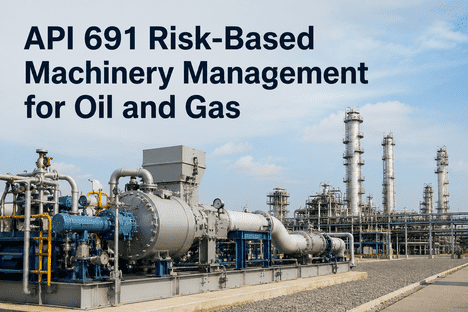
Centrifugal pump bearing prediction · Compressor vibration monitoring · Gas turbine degradation detection · Seal system failure forecasting — all flowing into iFactory's auditable condition data platform for risk-based machinery management.
The API 691 Risk Framework: Probability of Failure and Consequence of Failure
API 691 structures its machinery management requirements around a formal risk assessment framework. Every covered asset is evaluated on two axes: the likelihood that it will fail (POF), considering its current condition, design, and operating environment, and the severity of the outcome if it does fail (COF), accounting for process safety events, toxic releases, flammable material loss of containment, and high-energy mechanical failures such as overspeed events or rotating element fragmentation. Operating companies are required to define their own risk tolerance thresholds and apply them consistently across their machinery fleet — a task that demands reliable, continuously updated equipment condition data.
Traditional approaches to API 691 compliance rely on periodic machinery condition assessments — quarterly vibration surveys, annual lube oil analysis, and scheduled overhauls. These periodic data points provide a snapshot of risk at the moment of measurement but leave long intervals of undetected degradation. A centrifugal pump impeller that develops cracking in the first month after an annual inspection can fail catastrophically eleven months before the next scheduled assessment. iFactory's continuous condition monitoring closes this gap by measuring every critical machine 24/7 and updating the POF estimate in real time, enabling risk-based decisions driven by actual equipment condition data rather than calendar assumptions. Book a Demo to see how continuous monitoring transforms API 691 risk assessment.
- POF estimated from periodic vibration surveys and manual inspection data — up to 12 months between assessments
- COF assessed at installation and rarely updated — does not reflect changes in operating conditions or asset age
- Risk ranking reviewed annually — machinery can migrate into high-risk category between reviews without detection
- Maintenance intervals fixed by calendar or operating hours — risk reduction potential of condition-based extension unrealized
- Documentation effort intensive — manual data collection and report generation for each assessment cycle
- POF estimated from real-time vibration, temperature, pressure, and current data — continuously updated with every operating hour
- COF dynamically adjusted for changes in operating envelope, process fluid properties, and degradation accumulation
- Risk ranking updated continuously — machinery crossing risk thresholds triggers immediate review and mitigation action
- Condition-based maintenance intervals extended safely using AI-predicted remaining useful life — risk reduction improved
- Auditable documentation generated automatically — condition data, risk assessments, and mitigation actions recorded with full traceability
How Continuous Condition Monitoring Reduces Probability of Failure for Rotating Machinery
The Probability of Failure component of API 691's risk equation is the variable most directly influenced by predictive maintenance. POF is a function of equipment condition, and equipment condition is a function of time under load — but the relationship is not linear. A bearing that operates within normal parameters for 80% of its life can progress from initial spalling to catastrophic seizure in the final 10% of its life, compressing the detection window for preventive intervention. API 691-identified high-risk machinery — typically centrifugal pumps in hydrocarbon service, compressors handling flammable or toxic gas, and turbines driving critical process loads — demands a POF management approach that detects this nonlinear degradation behavior.
iFactory's platform addresses this by deploying multiple sensing modalities on each critical rotating asset. Accelerometers measure casing vibration across frequency bands corresponding to specific failure modes — bearing defect frequencies, blade pass frequencies, gear mesh harmonics. Temperature probes track bearing and oil sump temperatures against load-compensated baselines. Motor current signature analysis detects electrical anomalies in motor-driven machinery that precede mechanical failures. Acoustic emission sensors capture high-frequency energy release from crack propagation and friction changes invisible to conventional vibration monitoring. The fusion of these data streams into ensemble ML models produces a POF estimate that improves as operating data accumulates — and that estimate is continuously available for risk ranking and maintenance decision-making. Book a Demo to see iFactory's multi-sensor POF estimation models in operation.
The API 691 Machinery Lifecycle and iFactory Integration Points
API 691 applies to the full machinery lifecycle: feasibility and concept selection, front-end engineering design (FEED), detailed design, manufacturing and factory acceptance testing, installation and commissioning, and operation and maintenance. While the standard's earlier phases emphasize design risk mitigation through vendor selection, material specification, and Design FMEA, the operation and maintenance phase is where ongoing condition verification and risk reassessment occur — and where iFactory's platform delivers its most concentrated value.
Machinery Risk Screening: Mapping API 691 Equipment to iFactory Monitoring Strategies
API 691 requires operating companies to establish risk screening criteria that determine which of their rotating assets qualify as "high-risk machinery" warranting the standard's full lifecycle management requirements. The screening considers factors including process fluid hazard classification, operating pressure and temperature, rotating element stored energy, and the consequence of loss of containment or mechanical failure. iFactory's monitoring strategies are calibrated to the specific failure mechanisms of each asset class in the API 691 machinery population.
| API 691 Machinery Class | Primary Failure Modes | Hazard Mechanism | iFactory Monitoring Method | Risk Reduction |
|---|---|---|---|---|
| Centrifugal Pumps — Hydrocarbon Service | Bearing wear, mechanical seal failure, impeller erosion | Loss of containment — flammable liquid release | Vibration (bearing defect freq.), seal pressure, bearing temp., motor current | 7–21 day warning; 60% seal failure reduction |
| Centrifugal Compressors — Process Gas | Thrust bearing overload, labyrinth seal wear, rotor imbalance | Loss of containment — toxic/flammable gas release, overspeed | Proximity probes, thrust position, casing vibration, surge margin monitoring | 14–30 day warning; 50% unplanned trip reduction |
| Gas Turbines — Driver Service | Combustion liner cracking, blade creep, bearing degradation | High-energy rotor failure, fire, loss of critical process driver | Exhaust gas temperature spread, case vibration, lube oil analysis, combustion dynamics | 21–45 day warning; extended TBO intervals |
| Gearboxes — High-Speed/Power | Tooth fatigue, bearing spalling, lubricant breakdown | Loss of driven equipment, high-energy debris generation | Accelerometer at mesh freq., oil temp., ferrous particle count, load monitoring | 14–21 day warning; 40% gearbox failure reduction |
| Steam Turbines — Driver Service | Blade erosion, bearing wiping, governor valve sticking | Loss of containment, overspeed, loss of critical driver | Casing vibration, steam chest temp., thrust position, speed/load deviation | 14–28 day warning; extended overhaul cycles |
| Positive Displacement Pumps | Valve wear, diaphragm failure, piston packing degradation | Loss of containment, process deviation, hazardous material release | Pressure pulsation analysis, valve signature, piston rod position, pump frame vibration | 7–14 day warning; 45% packing failure reduction |
Documentation and Audit Readiness: The Compliance Evidence API 691 Requires
API 691 explicitly requires documentation of the risk management process: risk screening results, risk assessment methodologies, mitigating actions, management of change records, and audit findings. The standard also mandates periodic reassessment to verify that risk levels remain within acceptable thresholds and that mitigation measures are effective. For operating companies with large rotating equipment fleets, assembling this documentation from manual records is a significant administrative burden — one that often results in gaps that are discovered only during internal or regulatory audits.
iFactory's platform addresses this by generating auditable compliance documentation automatically from the continuous condition monitoring data stream. Every sensor measurement, anomaly detection event, risk level change, and maintenance action is logged with a timestamp, equipment identifier, data value, and the specific API 691 risk parameter it affects. When an inspector or auditor requests evidence of risk management for a specific machine, iFactory produces a complete machinery health record — including POF trend over any date range, all condition alerts with their resolution status, and the current risk ranking — in seconds. The Shift Logbook captures operator observations, repair histories, and technician notes alongside sensor data, creating a unified machinery management record that satisfies API 691's documentation requirements without manual compilation effort. Book a Demo to see iFactory's API 691 compliance documentation module in action.
Integration with Existing API Standards and CMMS/EAM Systems
API 691 does not replace existing API machinery standards — API 610 (centrifugal pumps), API 617 (centrifugal compressors), API 618 (reciprocating compressors), API 682 (mechanical seals), and API 670 (machinery protection systems) remain in effect. API 691 supplements these standards by adding a risk management framework that owners/operators apply across the machinery fleet. iFactory's platform integrates with all of these API standard compliance activities, ingesting data from API 670-compliant protection systems, contributing condition data to API 610 pump reliability assessments, and providing the seal health monitoring that API 682's lifecycle management requirements assume.
The platform connects via REST API, OPC-UA, Modbus TCP, and direct PLC interface to existing plant systems — including SAP, Oracle, and major CMMS/EAM platforms. When iFactory's condition monitoring detects a POF increase that crosses the API 691 risk threshold, a work order is automatically created in the plant's CMMS with the risk assessment data attached. This one-way flow from condition detection to maintenance action ensures that risk mitigation is not only identified but executed and documented — closing the loop that API 691's risk management process requires.
Implementation Roadmap: Building Your API 691 Predictive Maintenance Program
Transitioning from periodic machinery inspection to continuous condition-based risk management does not require replacing your existing reliability program. iFactory's implementation follows a phased approach that layers condition monitoring capability onto your current API 691 compliance activities, delivering measurable risk reduction at each phase.
Criticality Assessment and Sensor Deployment
iFactory's engineers conduct a structured review of your API 691-identified high-risk machinery population, mapping each asset to its failure modes, hazard mechanisms, and monitoring strategy. Accelerometers, temperature probes, current transducers, and other sensors are deployed on the highest-risk machines first, with continuous data streaming beginning immediately. Timeline: 4–8 weeks.
Baseline Establishment and POF Model Training
As monitoring data accumulates, iFactory's ML models establish baseline vibration, temperature, and current signatures for each machine under its specific operating conditions. The continuous learning loop begins separating normal operating variation from early-stage degradation. API 691 risk rankings are updated with continuously calculated POF values. Timeline: 4–12 weeks of data accumulation.
Alert Integration and Compliance Documentation Activation
Condition alerts are integrated with the plant's CMMS/EAM for automatic work order generation. The compliance documentation module begins producing auditable risk registers, condition logs, and reassessment reports. The Shift Logbook captures operator rounds and technician findings alongside sensor data. Full API 691 documentation suite is operational. Timeline: 2–4 weeks for integration.
Real-World Impact: Predictive Maintenance Reducing API 691 Machinery Risk
We operate 1,800 API 610 pumps across four refineries, and our API 691 risk assessments had been based on quarterly vibration data and annual lube oil analysis for years. The gap between data points was the source of our highest residual risk — machinery that looked acceptable at the last survey but degraded in the months following. When we deployed iFactory's continuous monitoring on our highest-risk machinery population — approximately 240 pumps handling flammable hydrocarbons above 500°F — the first year of data identified 14 pumps with bearing degradation developing between quarterly surveys that would have reached catastrophic stage before the next manual measurement. We intervened on all 14 before failure. The estimated cost of a single catastrophic seal fire or pump bearing fragmentation event at those operating conditions is $4-8 million when including production loss and remediation. The platform paid for itself across the refinery fleet in seven months. Our API 691 audit findings dropped by 80% in the first year.
Frequently Asked Questions: API 691 and Predictive Maintenance
No. API 670 protection systems remain essential for automated machinery shutdown during abnormal operation. iFactory's platform supplements API 670 systems by providing advanced condition monitoring and predictive analytics that detect degradation before protection system setpoints are reached. Where API 670 systems protect against failure, iFactory predicts and prevents it. Both systems operate in parallel, with iFactory's condition data feeding into the risk assessment framework that API 691 requires.
iFactory integrates with existing data sources already present in most oil and gas facilities: vibration data from portable data collectors or online systems, temperature readings from bearing RTDs and oil sump probes, process data from DCS/SCADA (pressure, flow, temperature, speed), motor current from variable frequency drives or current transducers, and lube oil analysis from routine sampling. The platform does not require greenfield sensor installation to begin — it can ingest whatever data is already available and layer additional sensing capability on the highest-risk machines as the program matures.
iFactory's ML models are trained on each individual machine's operating history under its specific process conditions — not on generic threshold tables. A centrifugal pump that runs at varying speeds due to process turndown has its vibration baselines dynamically adjusted for speed, flow rate, fluid specific gravity, and temperature. The model learns which operating windows produce which normal vibration signatures and flags only deviations that fall outside the learned envelope. This dynamic baseline approach eliminates the false alarm problem that plagues fixed-threshold monitoring in variable-service refinery applications. Our customers report 90%+ of iFactory alerts are actionable with 7+ days of response lead time.
iFactory's oil and gas deployments typically achieve full cost recovery within 6 to 12 months, driven by prevented high-consequence rotating equipment failures on API 691-classified high-risk machinery. The primary ROI driver is the cost avoidance of a single major machinery failure event — a catastrophic centrifugal pump seal fire, compressor bearing failure, or gas turbine blade release — each of which carries total costs of $2 million to $10 million when production loss, repair cost, and environmental remediation are included. Secondary ROI contributions come from extended overhaul intervals, reduced manual data collection labor, and lower insurance premiums supported by documented risk reduction. Book a Demo for an ROI model specific to your facility's machinery population and risk profile.
Yes. iFactory's platform includes a portable data collection integration module that ingests manual vibration readings from walk-around routes alongside continuous sensor data. This allows operating companies to apply API 691's risk-based approach across their entire machinery fleet — continuous monitoring for high-risk assets, periodic portable data collection for moderate-risk assets, and calendar-based PM for low-risk equipment — all managed within a single risk assessment framework. The Shift Logbook captures manual readings with the same traceability and documentation standards as continuous sensor data, ensuring that every asset's condition history is complete for API 691 audit purposes.
AI-powered predictive maintenance platform connecting centrifugal pumps, compressors, gas turbines, and gearboxes into one unified risk management intelligence layer — with continuous condition monitoring, automated POF estimation, and auditable API 691 compliance documentation.