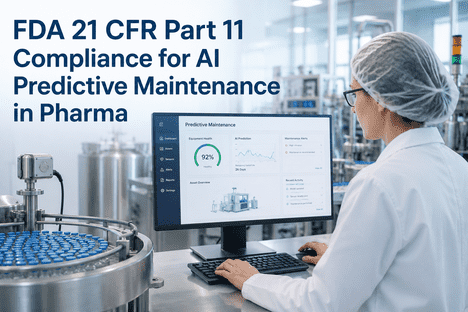
FDA 21 CFR Part 11 Compliance for AI Predictive Maintenance in Pharma
By Daniel Carter on June 20, 2026
In pharmaceutical manufacturing, every electronic record created during equipment maintenance — work order approvals, calibration certificates, sensor readings, predictive model outputs, and shift handover logs — falls under FDA 21 CFR Part 11 when used to demonstrate GMP compliance. Part 11 establishes the criteria under which electronic records and electronic signatures are legally equivalent to paper records and handwritten signatures, requiring validated systems, secure computer-generated time-stamped audit trails, access controls limited to authorised individuals, operational and authority checks, training documentation, and written policies holding individuals accountable for actions taken under their electronic signatures. AI-driven predictive maintenance platforms that ingest sensor data, generate failure predictions, and trigger CMMS work orders must satisfy these Part 11 controls — particularly §11.10(a) system validation, §11.10(e) audit trail requirements, §11.10(d) access controls, and §11.50 signature manifestation — because the predictions and alerts they generate become part of the regulated record set that FDA investigators review during inspections. iFactory AI's platform, including its Shift Logbook and predictive maintenance engine, is architected to support 21 CFR Part 11 compliance in pharmaceutical environments — with configurable audit trails, role-based access controls, electronic signature capture, and system validation documentation packages that align with GAMP 5 guidance and FDA's 2023 data integrity expectations. Book a Demo to see how iFactory addresses Part 11 requirements for AI predictive maintenance in regulated pharmaceutical manufacturing.
21 CFR Part 11 · AI Predictive Maintenance · 2026
FDA 21 CFR Part 11 Compliance for AI Predictive Maintenance in Pharma
Validated audit trails · Electronic signatures · Access controls · All flowing into iFactory Shift Logbook & CMMS for GMP-compliant pharmaceutical maintenance operations.
Why 21 CFR Part 11 Compliance Matters for Predictive Maintenance in Pharma
Pharmaceutical manufacturing operates under Current Good Manufacturing Practices (CGMP) as defined in 21 CFR Parts 210 and 211, which require that equipment used in the manufacture, processing, packing, or holding of drug products be maintained in a validated state. When predictive maintenance platforms generate electronic records — sensor readings, AI fault classifications, remaining useful life estimates, maintenance recommendations, work order approvals — those records become subject to Part 11 controls because they support GMP predicate rule requirements for equipment qualification, maintenance documentation, and deviation investigation. An unvalidated predictive maintenance system that triggers a maintenance work order for a tablet press or filling line creates an electronic record that FDA investigators may request during an inspection. If that system lacks audit trails, access controls, and validation documentation, the result is a Form 483 observation or Warning Letter citation. The 2026 FDA inspection trend confirms that data integrity and electronic record controls remain among the top five cited deficiencies across pharmaceutical and biologic manufacturing sites.
FDA 21 CFR PART 11 — KEY ELECTRONIC RECORD CONTROLS FOR PdM SYSTEMS
1
§11.10(a) System Validation — PdM platforms must be validated to ensure accuracy, reliability, and consistent intended performance. Validation includes installation qualification (IQ), operational qualification (OQ), and performance qualification (PQ) per GAMP 5 guidance.
2
§11.10(e) Audit Trails — Secure, computer-generated, time-stamped audit trails must independently record the date and time of operator entries and actions that create, modify, or delete electronic records. Record changes shall not obscure previously recorded information.
3
§11.10(d)+(g) Access & Authority Checks — System access limited to authorised individuals. Authority checks ensure only permitted users can electronically sign a record, alter a record, or perform the operation at hand — enforced through role-based access controls.
4
§11.50 + §11.100 Signature Manifestation — Signed electronic records must clearly indicate the printed name of the signer, the date and time of signing, and the meaning associated with the signature. Electronic signatures must be unique to one individual and not reused or reassigned.
Three Compliance Challenges AI Predictive Maintenance Solves in Pharma
01
Equipment Validation Drift Detection
Pharmaceutical manufacturing equipment — tablet presses, filling lines, bioreactors, lyophilizers, granulators, coating pans — operates under validated process parameters that must remain within established ranges. Subtle equipment degradation such as filling pump wear, sealing jaw temperature drift, or granulator impeller imbalance can push process parameters outside validated ranges before conventional alarm thresholds trigger, producing out-of-specification batches that trigger costly deviation investigations. iFactory's AI models ingest continuous sensor telemetry — temperature, pressure, vibration, torque, motor current — to detect equipment drift 2–3 weeks before it compromises process capability. Every prediction, sensor reading, and model output is logged in a secure, time-stamped audit trail that supports Part 11 compliance and provides investigators with traceable evidence of the equipment's validated state throughout the production campaign. Book a Demo to see iFactory's validated drift detection for pharma manufacturing equipment.
2-3 week lead timeGMP-compliant audit trailsDeviation reduction
02
Electronic Records for Maintenance Work Orders
In pharmaceutical plants, every maintenance work order — whether corrective, preventive, or predictive — generates electronic records that must satisfy Part 11 controls. The work order creation, supervisory review, parts issuance, technician assignment, completion verification, and quality assurance approval all occur electronically and must be captured in a validated system with full audit trail traceability. iFactory's Shift Logbook provides operators, maintenance technicians, and QA reviewers with a unified Part 11-aware interface for equipment status updates, shift handovers, maintenance requests, and AI-generated recommendations. Each signature, approval, and record modification is captured with user identity, timestamp, and prior value — creating an immutable chain of custody for every maintenance action that FDA investigators can review.
AI and machine learning models used in GMP environments present a unique compliance challenge: models that continuously learn from new data may drift from their validated state over time, raising questions about re-validation obligations under §11.10(a). FDA's emerging framework for AI in pharmaceutical manufacturing recommends treating each model release as a changed state requiring re-validation, with documented version control, training data provenance, performance monitoring, and human-in-the-loop oversight for all AI-generated decisions. iFactory's platform is architected for this paradigm — model versions are tracked, training datasets are logged, prediction outputs are attributable to specific model versions, and all AI-generated recommendations include confidence scores and model metadata that support QA review and electronic signature before any maintenance action is executed.
How iFactory Supports 21 CFR Part 11 Compliance in Pharma PdM
iFactory is the AI software intelligence layer for industrial reliability — not a sensor manufacturer or hardware vendor. The platform integrates with existing PLCs, SCADA systems, CMMS platforms (SAP, Oracle, JDE, Microsoft Dynamics), vibration sensors, temperature probes, motor current transducers, and thermal cameras already deployed on pharmaceutical manufacturing equipment. The Shift Logbook captures operator shift reports, daily inspection findings, calibrated sensor readings, and maintenance notes alongside the real-time sensor stream — all within a validated system architecture designed to support Part 11 compliance. iFactory provides a system validation documentation package including IQ/OQ/PQ protocols, a traceability matrix mapping system functions to 21 CFR Part 11 requirements, a security architecture document, and disaster recovery procedures — enabling pharmaceutical quality teams to qualify the platform for GMP use without building validation documentation from scratch.
Part 11 Requirement
Control Description
iFactory Implementation
Validation Evidence
§11.10(a) Validation
System accuracy, reliability, consistent performance
IQ/OQ/PQ protocols · GAMP 5 category 4
Validated configuration per site
§11.10(e) Audit Trail
Secure computer-generated time-stamped logs
Immutable audit trails for all record actions
OQ test scripts · audit trail review
§11.10(d)+(g) Access
Limited access · authority checks for operations
Role-based access control · LDAP/SSO integration
User acceptance testing · authority matrix
§11.50 Signatures
Printed name · date/time · meaning of signature
Electronic signature capture with full manifestation
Signature verification test cases
§11.10(i) Training
Determination of education, training, experience
Training records · role-based SOPs
Training completion logs
§11.10(k) Documentation
System documentation · change control procedures
Version-controlled docs · change audit trail
Doc review · change control SOP
Pharma Equipment Types Where Part 11-Compliant PdM Delivers the Highest Value
Solid Dosage
Tablet Press & Encapsulation Machine Monitoring
Continuous
Tablet presses and encapsulation machines are the most critical assets in solid-dose pharmaceutical manufacturing. Punch wear, compression force drift, turret speed variation, and fill weight deviation are the dominant failure modes — each capable of producing out-of-specification tablets that fail hardness, dissolution, or content uniformity testing. iFactory monitors compression force sensors, turret vibration, motor current draw, and fill weight trends continuously. AI models trained on historical batch data predict punch wear and compression drift 2–3 weeks before hardness or dissolution specs drift out of range. Every prediction event is logged in the Part 11-compliant audit trail with full traceability to the sensor data and model version that triggered the alert — providing QA investigators with documented evidence of equipment state throughout the batch campaign.
Filling lines for liquid and injectable pharmaceuticals operate under strict GMP controls where seal integrity, fill weight accuracy, and pump calibration drift directly affect product sterility and dose uniformity. A peristaltic pump tube that begins to fatigue or a sealing jaw that drifts in temperature can produce hundreds of non-conforming units before the next checkweigh or visual inspection station detects the trend. iFactory monitors pump motor current signature, fill weight trend deviation, sealing jaw temperature profiles, and conveyor tension. The Shift Logbook captures operator observations — visible fill discrepancies, seal appearance changes, pump noise — alongside automated sensor data to build richer prediction models for filling line equipment.
Bioreactors, incubators, and stability chambers operate under validated environmental parameters where temperature, pH, dissolved oxygen, and agitation speed deviations of even 1–2% can compromise cell growth, protein expression, or product stability. iFactory monitors RTD temperature sensors, pH probe drift, agitation motor current, and gas flow rate trends continuously. The platform's AI models detect parameter drift before it exceeds validated ranges and trigger Part 11-compliant maintenance notifications with complete audit trail documentation. The Shift Logbook provides batch record correlation — linking equipment condition data to specific production campaigns for comprehensive deviation investigation support during FDA inspections.
The ALCOA+ Data Integrity Framework for PdM Records
FDA's data integrity guidance establishes ALCOA+ as the framework for evaluating electronic record trustworthiness — and every predictive maintenance platform used in GMP environments must demonstrate that its records satisfy these principles. The Shift Logbook and iFactory's prediction engine are designed to generate ALCOA+-compliant records by default: each sensor reading, model inference, work order, signature, and status change is attributable to a specific user or automated process, legible in human-readable format, contemporaneous with a validated system clock, original and not derived from obscured intermediate steps, accurate and verified against source data, complete with all metadata, consistent across correlated records, enduring for the full records retention period, and available for FDA inspection in both human-readable and electronic format.
A
Attributable
Every record identifies the user or system that created it
L
Legible
Human-readable views and exportable reports
C
Contemporaneous
Validated system clock · time-stamped at point of entry
O
Original
Primary record with full provenance · not derived
A
Accurate
Verified against source data · error-checking controls
+
Complete · Consistent · Enduring · Available
All metadata captured · cross-record correlated · retained · inspection-ready
Vendor Evaluation Framework — Part 11 Compliance Questions for PdM Platforms
Generic predictive maintenance platforms may claim general data logging capabilities, but pharma-grade PdM vendors must demonstrate specific Part 11 controls — validated system architecture, immutable audit trails that capture before-and-after values, electronic signature manifestation with printed name, date/time, and meaning, role-based access control with authority checks, system validation documentation packages, and SOPs for change control, training, and disaster recovery. Eight criteria separate vendors who understand pharmaceutical compliance from vendors selling general industrial PdM with a compliance sticker.
01
System validation documentation package
Ask:
"Does your PdM platform include pre-built IQ/OQ/PQ protocols, a traceability matrix to 21 CFR Part 11 requirements, and a GAMP 5 software category assessment?"
Validation documentation must cover all Part 11 controls — audit trail configuration, access control enforcement, electronic signature capture, data integrity checks, and change control procedures. Vendors providing pre-built validation packages reduce qualification effort by 60–80% compared to building from scratch.
02
Audit trail completeness and immutability
Ask:
"Does your platform capture before-and-after values for every record modification, including AI model predictions and sensor data adjustments?"
Audit trails must record who, what, when, and why for every create, modify, delete, view, and export action on regulated records. Previous values must be preserved — record changes shall not obscure previously recorded information per §11.10(e).
03
Electronic signature manifestation and controls
Ask:
"Does your platform display the printed name, date/time of signing, and meaning (review, approval, authorship) for every electronic signature on a maintenance record?"
Electronic signatures must be unique to one individual, not reused or reassigned, and verified before each signing event. The signature manifestation must be displayed on both the screen and printed output per §11.50 and §11.100.
04
Role-based access control with authority checks
Ask:
"Does your platform enforce authority checks before allowing a user to electronically sign a record, approve a work order, or modify a maintenance record?"
Access controls must segregate duties — operators, maintenance technicians, supervisors, QA reviewers, and administrators must have distinct permission sets. Authority checks must validate that the user is authorised for the specific operation before execution.
05
AI model version control and prediction traceability
Ask:
"Does your platform track AI model versions, training dataset provenance, and make every prediction attributable to a specific model version?"
Each model release is a changed state requiring documented re-validation. Predictions must include model version, confidence score, input data hash, and timestamp — enabling QA to trace any alert back to the specific model, training data, and sensor readings that produced it.
06
Data integrity and ALCOA+ compliance
Ask:
"Does your platform generate records that satisfy all seven ALCOA+ criteria — attributable, legible, contemporaneous, original, accurate, complete, consistent, enduring, and available?"
Sensor data, model predictions, work orders, shift log entries, electronic signatures, and audit trail records must each be evaluated against ALCOA+ criteria. Platforms designed for pharma compliance produce ALCOA+-compliant records by default without post-hoc data remediation.
07
Change control and re-validation procedures
Ask:
"What change control procedures govern updates to your PdM platform — including AI model updates, configuration changes, and software version upgrades?"
Any change to a validated system triggers re-validation obligations. Vendors must provide documented change control procedures, impact assessment templates, regression test protocols, and re-validation guidance aligned with GAMP 5 change management processes.
08
Training and SOP documentation
Ask:
"Does your platform include role-based training materials, SOP templates, and a training record module that supports §11.10(i) requirements?"
Personnel who develop, maintain, or use Part 11 systems must have documented education, training, and experience. Vendors should provide role-specific training content — operator, maintenance, supervisor, QA — and a mechanism to capture training completion records with electronic signature acknowledgment.
Want to score your shortlisted PdM vendors against this 8-criterion Part 11 framework? Run a vendor evaluation working session with our team and get a structured scorecard mapped to your pharma site's specific GMP equipment classes and inspection history.
The ROI of Part 11-Compliant Predictive Maintenance in Pharma
The business case for Part 11-compliant AI predictive maintenance in pharmaceutical manufacturing extends beyond traditional reliability metrics — it includes compliance risk reduction, deviation avoidance, batch protection, and inspection readiness. Pharmaceutical plants deploying validated PdM platforms with full Part 11 controls report measurable improvements in the first two quarters.
−40–60%
Unplanned equipment downtime
AI identifies equipment drift 2–3 weeks before it causes process deviations. Emergency repairs shift to planned maintenance with full GMP documentation and QA oversight.
−50–70%
Deviation investigations from equipment drift
Predictive alerts catch parameter drift before it exceeds validated ranges. Fewer out-of-specification batches reduce deviation investigation costs by eliminating root cause analysis for known failure modes.
+30–50%
GMP inspection readiness
Immutable audit trails, validated system documentation, and ALCOA+-compliant records provide investigators with immediate traceability from equipment condition data to batch records and maintenance actions.
8–12 mo
Typical validation and ROI payback
Full investment recovery through downtime reduction, deviation cost avoidance, and streamlined FDA inspection outcomes — with system validation completed within the first 8–12 weeks of deployment.
Expert Perspective
"The most common misconception I encounter in pharmaceutical reliability programs is that predictive maintenance platforms are 'just another sensor system' and therefore outside the scope of 21 CFR Part 11. That interpretation is wrong and dangerous. Any electronic record created to demonstrate GMP compliance — including a PdM platform's sensor reading, AI prediction, maintenance recommendation, work order approval, or equipment status change — is a regulated record subject to Part 11 controls. The FDA's 2023 data integrity guidance and the 2026 inspection trends make this explicit: if the record supports a predicate rule requirement, Part 11 applies. The pharmaceutical plants that navigate this correctly treat their PdM platform as a validated GMP system from day one — with IQ/OQ/PQ, immutable audit trails, electronic signature controls, and ALCOA+-compliant records designed in, not bolted on after an FDA observation. The ones that treat compliance as an afterthought spend 6–12 months in remediation and generate Form 483 observations that could have been avoided."
validation deployment with pre-built IQ/OQ/PQ protocols
60–80%
reduction in validation documentation effort vs build-from-scratch
Zero rip
of existing CMMS, SCADA, or ERP systems required
Conclusion: Part 11 Compliance Is a PdM Design Requirement, Not an Add-On
Pharmaceutical manufacturers evaluating AI predictive maintenance platforms face a choice that determines both inspection outcomes and equipment reliability: treat Part 11 compliance as a design requirement embedded in the platform architecture, or treat it as a gap to be remediated after deployment. Platforms designed for Part 11 compliance from the ground up — with validated system architecture, immutable audit trails capturing every record action with before-and-after values, electronic signature manifestation compliant with §11.50, role-based access controls with authority checks per §11.10(g), AI model version control and prediction traceability, and ALCOA+-compliant records by default — enable pharmaceutical reliability teams to deploy predictive maintenance without creating compliance exposure. iFactory AI's platform, including its Shift Logbook and predictive maintenance engine, delivers AI-driven equipment failure prediction within a Part 11-aware architecture that integrates with existing CMMS, SCADA, and ERP systems without requiring sensor hardware replacement or rip-and-replace of validated GMP infrastructure. Walk through your specific pharma equipment classes, GMP compliance requirements, and predictive maintenance priorities with our team.
Run the Part 11-Compliant PdM Assessment Built for Your Pharma Site
iFactory's pharmaceutical reliability practice runs a focused assessment against your specific GMP equipment classes, existing CMMS configuration, validation documentation status, and inspection history. You leave with a defended Part 11 deployment recommendation, a 12-week validation roadmap, and a compliance gap analysis grounded in your site's specific regulatory context.
Yes. If the electronic records created by a PdM platform — sensor readings, AI predictions, remaining useful life estimates, work order approvals, equipment status changes — support a predicate rule requirement such as 21 CFR 211 (CGMP for finished pharmaceuticals), 21 CFR 600 (biologics), or 21 CFR 820 (medical devices), those records are subject to Part 11 controls. The platform must be validated, must generate secure computer-generated time-stamped audit trails, must enforce access controls and authority checks, and must capture electronic signatures with proper manifestation. iFactory's platform is designed to meet these requirements in pharmaceutical environments.
Yes. iFactory provides a system validation documentation package including installation qualification (IQ), operational qualification (OQ), and performance qualification (PQ) protocols, a traceability matrix mapping system functions to 21 CFR Part 11 requirements, a security architecture document, disaster recovery and backup procedures, and role-based SOP templates. The validation package is designed to align with GAMP 5 guidance for software category 4 (configurable packaged software) and can be adapted to your site's specific validation protocol requirements.
iFactory treats each AI model release as a changed state requiring documented re-validation. Model versions are tracked with unique identifiers, training datasets are logged with provenance metadata, prediction outputs include model version and confidence score, and all AI-generated recommendations require QA review and electronic signature before triggering maintenance actions. The platform supports a human-in-the-loop paradigm where AI predictions are decision support — the final maintenance decision and record approval remain with qualified personnel under their electronic signatures.
Yes. iFactory's architecture integrates with SAP, Oracle, JDE, Microsoft Dynamics, and major CMMS platforms without requiring modifications to validated GMP systems. The platform reads sensor data from existing PLCs, SCADA, vibration systems, and IoT gateways through standard API and OPC-UA connectors. The Shift Logbook captures operator entries, maintenance actions, and AI-generated predictions alongside existing system records — creating a unified Part 11-compliant data fabric for equipment reliability without rip-and-replace of validated infrastructure.
The initial iFactory validation typically requires 8–12 weeks for a single pharma site, including IQ/OQ/PQ execution, user acceptance testing, audit trail configuration verification, electronic signature control testing, and role-based access control validation. The pre-built validation documentation package reduces qualification effort by 60–80% compared to building validation protocols from scratch. iFactory recommends starting with one GMP equipment class — such as tablet presses or filling lines — proving validation completeness and predictive value before expanding to the full pharmaceutical equipment fleet.