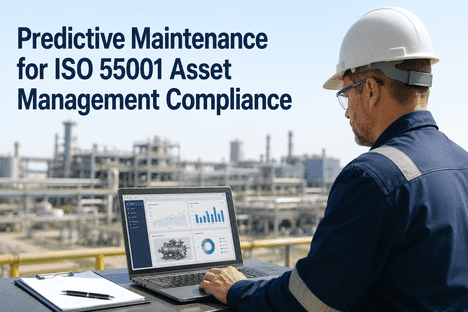
Predictive Maintenance for ISO 55001 Asset Management Compliance
By Rebecca on June 19, 2026
ISO 55001 is the international standard for asset management that specifies requirements for establishing, implementing, maintaining, and improving an asset management system. Certification demonstrates that an organization has a systematic framework for managing asset risk, optimizing life cycle cost, and maintaining documented evidence of every decision that affects asset performance. Predictive maintenance — specifically AI-native continuous condition monitoring — has become the operational backbone of ISO 55001 compliance because it directly generates the data that clauses 6.1 (risk-based planning), 7.5 (documented information), 8.2 (life cycle management), and 9.1 (performance evaluation) require. Traditional time-based or run-to-failure maintenance approaches cannot provide the continuous risk assessment data or the documented condition trajectory evidence that ISO 55001 auditors now expect. iFactory AI's industrial software platform — including its predictive maintenance engine, Shift Logbook, and CMMS integration layer — enables asset management teams to meet ISO 55001 documentation, risk assessment, and life cycle optimization requirements using the real-time condition data their rotating equipment already generates. Book a Demo to see how iFactory's platform generates the continuous compliance evidence that ISO 55001 auditors expect.
ISO 55001 · Asset Management · Predictive Maintenance · 2026
AI Predictive Maintenance for ISO 55001 Asset Management Compliance
Continuous condition data for clause 6.1 risk planning · Documented evidence for clause 7.5 records · Life cycle cost optimization for clause 8.2 · Performance dashboards for clause 9.1 evaluation — all flowing through iFactory's unified asset management platform.
Continuous condition telemetry for clause 7.5 evidence
Risk-based RUL scoring aligned with clause 6.1
Automated work orders with full audit trail
Life cycle cost optimization dashboards
Why Traditional Maintenance Management Falls Short of ISO 55001 Requirements
Most plants pursuing ISO 55001 certification already operate a CMMS, maintain a preventive maintenance schedule, and document corrective work orders. These are necessary but not sufficient for certification. ISO 55001 auditors increasingly expect evidence of condition-based decision-making, continuous risk assessment, and documented life cycle cost optimization — capabilities that traditional time-based maintenance programs were not designed to provide. The four specific compliance gaps are well documented in certification audit findings.
01
Documentation Gap — Clause 7.5
Traditional CMMS captures work order completion dates and technician notes but lacks continuous condition evidence — vibration trends, temperature trajectories, and degradation curves that demonstrate why a maintenance decision was made at a specific point in time.
Gap: Event records vs Continuous evidence
02
Risk Assessment Gap — Clause 6.1
Risk-based maintenance planning requires current, quantified risk scores per asset. Traditional programs assess risk annually based on generic failure mode libraries. Actual asset condition can diverge from the annual risk rating within weeks of a changing duty cycle.
Gap: Periodic risk review vs Continuous risk scoring
03
Life Cycle Cost Gap — Clause 8.2
ISO 55001 requires life cycle cost optimization — not just cost minimization. Without remaining useful life estimates and degradation trajectory data, maintenance decisions default to either premature replacement (overspending) or run-to-failure (collateral damage cost).
Gap: Fixed intervals vs Condition-based LCC
04
Audit Trail Gap — Clause 9.1
Performance evaluation requires trendable evidence of asset condition over time. Paper-based shift logs, disconnected vibration analysis reports, and email-based alarm notifications create an audit trail that is difficult to aggregate, search, and present during certification audits.
Gap: Fragmented records vs Unified traceability
What AI Predictive Maintenance Delivers for ISO 55001 Compliance
The misconception some asset management teams hold: AI predictive maintenance is an operational technology investment that runs parallel to compliance requirements. In practice, AI-native condition monitoring directly generates the three forms of evidence ISO 55001 auditors evaluate: documented information showing what condition data drove each maintenance decision, risk-based planning records demonstrating continuous risk score updates, and life cycle cost trajectories proving optimization of replacement timing. iFactory AI's platform, including the Shift Logbook for operator observations and the predictive maintenance engine for RUL estimation, transforms these compliance requirements from manual documentation exercises into automated outputs of the condition monitoring workflow.
ISO 55001 Clause
Compliance Requirement
What AI PdM Delivers
Clause 4.4 — AM System
Establish, implement, maintain and continually improve an asset management system
Continuous condition monitoring platform with documented data governance, automated workflows, and evidence-based decision support across all asset classes
Clause 6.1 — Risk Planning
Plan actions to address risks and opportunities for the asset portfolio
Per-asset remaining useful life scores, continuous fault probability updates, and risk-based maintenance prioritization with quantified confidence intervals
Clause 7.5 — Documented Information
Maintain documented evidence of asset management activities and decisions
Full telemetry history, AI prediction records, Shift Logbook entries, and work order audit trail — all time-stamped, searchable, and exportable for certification audits
Clause 8.2 — Life Cycle Management
Manage asset life cycle activities including maintenance, renewal, and disposal
Degradation trajectory-based RUL estimates, economic replacement optimization, and condition-triggered renewal planning with cost-benefit analysis per asset
Clause 9.1 — Performance Evaluation
Monitor, measure, analyse and evaluate asset management performance
Real-time asset health dashboards, fleet-wide reliability KPIs, trended failure frequency and MTBF reporting, and automated performance deviation alerts
Clause 10.1 — Continual Improvement
Continually improve the suitability, adequacy and effectiveness of the AM system
Automated model retraining with each new failure event, closed-loop prediction-to-outcome tracking, and documented improvement evidence from AI accuracy trends
ISO 55001 Clauses Most Directly Supported by AI Predictive Maintenance
Six ISO 55001 clauses have direct, measurable dependencies on condition monitoring data quality and continuity. For each clause below, the specific AI predictive maintenance capability that produces compliance evidence is identified, along with the documentation format that certification auditors accept.
6.1
Risk-Based Maintenance Planning
Clause 6.1 requires organizations to plan actions addressing asset risks. AI PdM delivers continuous risk scores per asset by fusing real-time condition telemetry with failure probability models. Each asset receives a quantified risk score updated every telemetry cycle, replacing annual spreadsheet risk assessments with dynamic, evidence-based risk profiles that auditors can review in real time.
Evidence: RUL score + fault probability + confidence interval
7.5
Documented Information Management
Clause 7.5 requires organizations to maintain documented information proving the AM system is operating as designed. AI PdM generates automatically timestamped condition records for every asset — vibration trends, temperature histories, alarm events, prediction outputs, and maintenance actions — stored in a unified, searchable audit trail that eliminates manual documentation collection for certification audits.
Evidence: Continuous telemetry + AI prediction history + work order linkage
8.2
Life Cycle Cost Optimization
Clause 8.2 requires life cycle management activities that optimize asset value over its entire life. AI PdM's remaining useful life models provide the degradation trajectory data needed to determine the economic replacement point for each asset — neither replacing too early (wasting remaining life) nor too late (incurring collateral damage costs). RUL trajectories with confidence bounds provide auditable LCC evidence.
Clause 9.1 requires monitoring, measurement, analysis, and evaluation of asset management performance. AI PdM provides real-time dashboards tracking asset health scores, fleet-wide reliability trends, prediction accuracy rates, and maintenance effectiveness metrics — all trendable over selectable time windows with automated deviation alerts when performance strays from target bands.
Evidence: Health score trends + KPI dashboards + deviation alerts
The Keep / Retire / Transform / Replace Decision Matrix
Migration discipline starts here. Every asset management artifact in your current ISO 55001 compliance program falls into one of four categories. Getting the categorization right in week one saves quarters of debate later.
Keep
Core compliance foundations
CMMS work order engine
AM policy and strategy documentation
Existing risk assessment framework
ERP financial integration
Competence and training records
Established asset management capabilities. No business case to replace. AI PdM writes condition evidence and prediction records to these systems.
Retire
Legacy documentation layers
Paper-based shift log sheets
Email-based alarm notification
Annual spreadsheet risk assessments
Manual vibration data collection route sheets
Standalone inspection report filing
Replaced by continuous telemetry ingestion, automated Shift Logbook, and AI-driven risk scoring. 80–90% reduction in manual documentation effort.
Transform
Analysis and reporting workflows
Asset health scoring
Reliability KPI reporting
Failure mode frequency analysis
Maintenance effectiveness review
Management review inputs
Become automated outputs from continuous condition data. Intelligence upgraded via iFactory Shift Logbook and AI prediction engine integration.
Replace
Alert and notification layer
Legacy alarm threshold gateways
Manual work order escalation
Paper-based shift handover
Siloed vibration analysis reports
Disconnected condition monitoring data
Event-driven AI alert engine replaces manual notification and documentation. Faster, context-aware, with automated audit trail generation.
Want this matrix applied to your specific asset classes and ISO 55001 compliance gap analysis in a working session? Book a Demo to walk through every asset category and prioritize your AI deployment for maximum compliance impact.
Three Deployment Paths for ISO 55001-Aligned AI Predictive Maintenance
Same starting point, three valid destinations. The right path depends on your certification timeline, current CMMS maturity, asset data availability, and compliance documentation gaps. Plants that pick the wrong path spend 12 months building infrastructure that doesn't move the certification needle. Plants that pick the right path deploy in 6–14 weeks.
Path A
Compliance Evidence Layer
6–8 weeks
AI PdM runs alongside existing maintenance program in documentation mode. Continuous condition data streams into iFactory Shift Logbook with automated evidence capture. Current CMMS and PM program unchanged. Audit-ready documentation generated automatically.
Best fit
Plants pursuing initial ISO 55001 certification · need documented condition evidence for clause 7.5 · risk-averse compliance teams
Wk 1–2 Data source audit & connectivity
Wk 3–5 Evidence capture live
Wk 6–8 CMMS integration & audit readiness
Path B
Risk-Based Decision Integration
8–12 weeks
AI prediction layer replaces manual risk assessment and documentation processes. Continuous risk scores feed CMMS work order prioritization. RUL estimates drive life cycle replacement decisions. Full clause 6.1, 7.5, and 8.2 compliance evidence generated automatically.
Best fit
Mature AM programs targeting ISO 55001 recertification · moderate budget authority · existing CMMS with integration capability
Wk 1–3 Compliance gap analysis
Wk 4–8 Deploy AI risk scoring layer
Wk 9–12 Audit evidence validation
Path C
Full AM System Modernization
10–14 weeks
Complete AI-native asset management platform deployment. All ISO 55001 clauses supported by continuous condition data, automated risk scoring, RUL-based life cycle planning, and real-time performance dashboards. Legacy documentation processes retired.
Best fit
Plants designing new AM system for certification · siloed legacy systems · strategic digital transformation goal aligned with ISO 55001
Wk 1–4 Full AM system architecture
Wk 5–10 Parallel build + clause mapping
Wk 11–14 Audit simulation + cutover
Pick the Right Path for Your ISO 55001 Certification Timeline
iFactory AI's asset management practice runs a focused workshop against your specific certification scope, current CMMS configuration, asset data availability, and audit timeline. You leave with a defended path recommendation, an 8-week deployment plan, and a clause-by-clause compliance evidence map grounded in your asset portfolio reality.
Generic PdM vendors focus on sensor hardware and alert thresholds. ISO 55001-aware vendors understand the compliance evidence architecture — documented information management, risk-based scoring integration with CMMS, life cycle cost optimization data, and audit-ready reporting. Eight criteria separate vendors who understand compliance-driven PdM from vendors selling a generic condition monitoring dashboard.
01
Documented information generation
Ask:
"Does your platform automatically generate clause 7.5-compliant documented information for every maintenance decision, or do our teams need to compile evidence manually?"
Platforms should timestamp and store every sensor reading, AI prediction, alert event, work order creation, and maintenance action in a searchable, exportable format suitable for direct submission to ISO 55001 certification auditors.
02
Risk scoring integration with CMMS
Ask:
"Does your platform write continuous risk scores back to our CMMS so work orders are prioritized based on current asset condition data?"
ISO 55001 clause 6.1 requires risk-based planning. Platforms must generate per-asset risk scores updated with each telemetry cycle and integrate them into the CMMS work order prioritization engine, replacing annual manual risk ratings with dynamic condition-based scores.
03
Life cycle cost data export
Ask:
"Does your platform export remaining useful life trajectories and economic replacement cost data in a format suitable for clause 8.2 life cycle cost analysis?"
LCC optimization requires degradation curve data, RUL confidence intervals, and replacement cost comparison outputs. Platforms must export these in standard formats (CSV, JSON, Excel) for integration with financial analysis and asset renewal planning workflows.
04
Audit trail searchability
Ask:
"Can your platform produce a complete maintenance decision audit trail for any asset — from sensor data through AI prediction to work order outcome — in under 30 seconds?"
ISO 55001 auditors increasingly request traceability from condition data through decision to outcome. Platforms must support full audit trail queries with filterable time ranges, asset hierarchies, and exportable reports showing the complete decision chain.
05
Performance KPI automation
Ask:
"Does your platform automatically generate clause 9.1 performance evaluation dashboards with trendable reliability KPIs and automated deviation alerts?"
Performance evaluation requires monitoring and measurement data trended over time. Platforms must provide configurable dashboards with asset health scores, MTBF trends, prediction accuracy rates, and automated alerts when performance deviates from target bands — all exportable for management review.
06
Continual improvement evidence
Ask:
"Does your platform track prediction-to-outcome accuracy over time and document the improvement loop for clause 10.1?"
Clause 10.1 requires documented evidence of continual improvement. Platforms must track prediction accuracy per asset class, model retraining events, and the resulting improvement in prediction precision — providing auditable evidence that the AM system is improving over time.
07
Shift Logbook integration
Ask:
"Does your platform include an operator shift logbook that captures clause 7.5 documented information during normal shift operations?"
Operator observations are a critical documented information source. Platforms must provide a digital shift logbook that captures operator defect reports, shift handover notes, and inspection findings with timestamps and user authentication — replacing paper logs that fail audit scrutiny.
08
Deployment timeline commitment
Ask:
"When does the first ISO 55001-compliant documented evidence record reach our audit trail in production?"
6–14 weeks is the production-grade benchmark depending on deployment path. Path A is 6–8 weeks. Path C is 10–14 weeks. Vendors quoting 6+ months are building custom development rather than deploying a proven compliance platform.
Want to score your shortlisted vendors against this 8-criterion framework? Run a vendor evaluation working session with our team and get a structured scorecard against your ISO 55001 compliance requirements and certification timeline.
The Business Case — Cost of ISO 55001 Compliance vs Cost of Non-Compliance
The investment in AI-native predictive maintenance for ISO 55001 compliance is justified not by certification alone, but by the operational cost reduction that continuous condition monitoring delivers while simultaneously generating compliance evidence. Plants moving from periodic maintenance management to AI-driven, compliance-aligned asset management see measurable improvements across four metrics.
−40–60%
Audit preparation effort
Continuous condition evidence eliminates manual documentation collection for certification audits. Audit-ready evidence is generated automatically as a byproduct of the condition monitoring workflow.
−25–35%
Asset maintenance cost
Condition-based replacement eliminates premature maintenance while catching degradation before collateral damage inflates repair costs. RUL-based planning optimizes life cycle replacement timing.
+30–50%
Risk assessment accuracy
Continuous risk scores based on actual asset condition replace annual manual risk assessments. Risk ratings reflect current degradation state rather than last year's failure mode analysis.
8–12 mo
Typical ROI payback
Full investment recovery through maintenance cost reduction, certification audit efficiency, and extended asset life — independent of the certification value delivered.
Expert Perspective
"The single biggest mistake plants make in ISO 55001 certification is treating documented information as a documentation project — assigning someone to collect evidence after the fact rather than designing operations to generate evidence as a natural output. We certified our first plant in 2019 using manual evidence collection. It took 14 months and cost over $200,000 in consultant time alone. When we certified our second plant in 2023 using iFactory's continuous condition monitoring platform, the evidence generation was already built into the maintenance workflow — sensor data, AI predictions, Shift Logbook entries, and work order histories were automatically timestamped and linked. The second certification took 6 months and cost $40,000 in evidence compilation. The difference wasn't the standard. It was that the first plant treated evidence as an afterthought and the second treated it as a byproduct of how maintenance was done every shift."
— Asset Management Director, Global Chemicals Manufacturer — ISO 55001 Certified Across 12 Plants
6–14 wk
deployment to first audit-ready evidence record
80–90%
reduction in manual documentation effort for audit preparation
Zero rip
of existing CMMS, ERP, or condition monitoring systems required
Conclusion: AI Predictive Maintenance Is the Evidence Engine for ISO 55001 Compliance
ISO 55001 certification is not primarily a documentation exercise — it is an operational evidence exercise. The standard requires organizations to demonstrate that asset management decisions are based on current condition data, that risks are assessed continuously rather than annually, that life cycle costs are optimized rather than minimized, and that performance is evaluated against trendable evidence rather than snapshot metrics. AI predictive maintenance platforms like iFactory AI transform these compliance requirements from manual documentation burdens into automated outputs of the normal maintenance workflow — continuous condition telemetry provides clause 7.5 documented information, AI risk scores support clause 6.1 risk-based planning, RUL estimates enable clause 8.2 life cycle optimization, and health dashboards satisfy clause 9.1 performance evaluation. The compliance distinction worth making in 2026 is not between plants that use predictive maintenance and plants that don't. It is between plants that use predictive maintenance as an operational tool and plants that use it as a compliance evidence engine — generating the documented, risk-based, life cycle-optimized asset management data that ISO 55001 auditors now expect as the standard of evidence for certification. Walk through your specific certification scope and gap analysis with our team.
Run the ISO 55001 Compliance Workshop Built for Your Asset Portfolio
iFactory AI's asset management practice runs a 90-minute workshop against your real certification scope, current CMMS configuration, asset data availability, and audit timeline. You leave with a defended path recommendation, a clause-by-clause compliance evidence map, and a cost reduction projection grounded in your asset portfolio data.
Does implementing AI predictive maintenance guarantee ISO 55001 certification?
No. AI predictive maintenance provides the condition monitoring evidence infrastructure that supports ISO 55001 compliance across clauses 6.1 (risk-based planning), 7.5 (documented information), 8.2 (life cycle management), and 9.1 (performance evaluation). Certification also requires asset management policy, strategy, leadership commitment, competence management, and internal audit processes that are outside the scope of any technology platform. What AI PdM eliminates is the most time-consuming and costly compliance activity — compiling documented condition evidence for certification auditors. Plants using iFactory report 80–90% reduction in audit preparation effort.
Can iFactory AI integrate with our existing CMMS and ERP systems for ISO 55001 evidence management?
Yes. iFactory connects to SAP, Oracle, JDE, Microsoft Dynamics, and major CMMS platforms. The platform writes prediction records, risk scores, and Shift Logbook entries directly to your existing systems — preserving your current work order engine, parts inventory, and financial integration while adding the continuous condition evidence layer that ISO 55001 auditors require. No data migration or system replacement is needed.
How does iFactory's Shift Logbook contribute to ISO 55001 clause 7.5 documented information compliance?
The Shift Logbook captures operator defect reports, daily inspection findings, vibration reading trends, maintenance notes, and shift handover observations alongside real-time sensor data and AI prediction outputs. Every entry is timestamped with user authentication, creating a searchable, exportable documented information trail that satisfies clause 7.5 requirements for evidence of asset management activities. ISO 55001 auditors reviewing plants using the Shift Logbook consistently cite the platform's traceability as best-practice evidence management.
What is the typical timeline from deployment to first ISO 55001 audit-ready evidence output?
Path A (Compliance Evidence Layer) generates audit-ready documented information within 6–8 weeks of deployment start. The first week establishes data source connectivity to existing sensors and CMMS. By week four, continuous condition telemetry and Shift Logbook data are streaming into the evidence repository. By week eight, the platform is generating clause-mapped audit evidence reports that certification auditors can review. Full certification timelines depend on the organization's AM system maturity and internal audit readiness, not on the AI platform deployment.
Does iFactory support multi-plant ISO 55001 certification with different deployment models per site?
Yes. iFactory's platform supports on-premise edge, private cloud, public cloud, and hybrid deployment — each generating the same ISO 55001 compliance evidence in the same format regardless of deployment model. A centralized audit team can access clause-mapped evidence from every plant through a unified dashboard, enabling enterprise-wide certification management while allowing each site to deploy according to its connectivity, latency, and data sovereignty requirements.