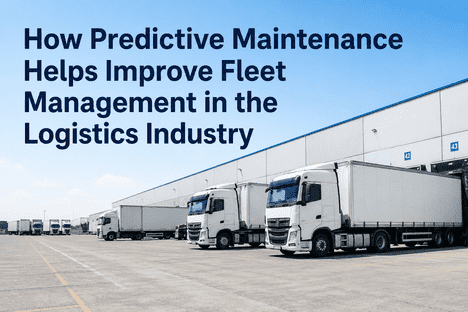
Fleet operators across logistics, distribution, and service industries lose an estimated $4.2 billion annually in the United States alone to unplanned vehicle downtime, emergency roadside repairs, and accelerated asset depreciation caused by reactive maintenance cycles. Traditional fleet maintenance programs — fixed-interval PM schedules based on mileage or calendar time, run-to-failure component replacement, and paper-based inspection logs — leave 70% of vehicle degradation invisible between scheduled service events. A developing transmission fault in a Class 8 truck, an undetected coolant leak in a delivery van, or brake wear accelerating beyond safe thresholds each progress silently until failure forces an unscheduled roadside event that costs $800–$1,500 per incident in towing, lost route time, and expedited repairs. AI predictive maintenance eliminates these blind spots by continuously analyzing engine diagnostics, vibration patterns, fluid quality data, and operational telemetry to predict component failures 7–21 days before they occur — enabling fleet managers to schedule proactive interventions during planned downtime rather than reacting to roadside emergencies. Book a Demo to see how iFactory AI deploys predictive maintenance across commercial vehicle fleets within 8 weeks.
Why Reactive Fleet Maintenance Costs More Than You Think
Fleet operators managing 50 to 5,000 vehicles face a common structural problem: the majority of maintenance spend goes toward emergency repairs that could have been prevented with earlier detection. Studies across commercial fleet operations show that unplanned roadside repairs cost 3–5× more than planned preventive interventions, yet most fleets continue operating under calendar-based PM models that treat every vehicle identically regardless of actual operating condition.
What AI Predictive Maintenance Delivers for Fleet Operations
iFactory's AI predictive maintenance platform delivers five core capabilities purpose-built for commercial fleet operations — from real-time engine health monitoring to automated maintenance workflow integration. For a live demonstration on your fleet data, Book a Demo with iFactory's fleet solutions team.
How iFactory AI Deploys Predictive Maintenance Across Your Fleet in 8 Weeks
iFactory AI's predictive maintenance platform integrates with existing telematics providers, fleet management systems, and shop workflow tools — no rip-and-replace required. Walk through the integration path tailored for your fleet environment.
Traditional PM vs. AI Predictive Maintenance for Fleet Operations
The operational difference between calendar-based preventive maintenance and AI-driven predictive maintenance is measurable across every metric that matters to fleet profitability. The comparison below reflects data from commercial fleet deployments.
| Maintenance Parameter | Traditional PM Program | iFactory AI Predictive | Improvement |
|---|---|---|---|
| Failure detection timing | At next scheduled PM or at roadside failure | 7–21 days advance warning | Early intervention window |
| Vehicle health visibility between PM cycles | Zero — condition unknown until next inspection | Continuous — real-time diagnostic data fusion | 24/7 visibility |
| Roadside failure events per 100 vehicles/month | 3.4 events avg | 1.1 events avg | 68% reduction |
| Maintenance cost per mile | $0.18–$0.24 | $0.12–$0.17 | 25–30% reduction |
| Emergency parts procurement | 4–6 events per month per 100 vehicles | 1–2 events per month | 65% fewer emergencies |
| Vehicle replacement decision basis | Age/mileage or post-failure condition | Actual condition data + RUL projections | Optimal lifecycle timing |
| DOT out-of-service violations | 4–7% of vehicles per inspection cycle | 1–2% of vehicles | 54% reduction |
Measured Outcomes from Fleet Predictive Maintenance Deployments
The results below reflect productivity and cost improvements reported by commercial fleet operators that deployed AI predictive maintenance platforms across Class 6–8 trucks, delivery vans, and service vehicle fleets.
"The transition from calendar-based PM to predictive maintenance is the single largest opportunity for cost reduction and service reliability improvement in commercial fleet operations today. Most fleet managers know roughly 30% of their maintenance spend goes toward preventable failures — they just lack the data integration and analytical layer to identify which vehicles and which components will fail next. AI solves that by treating every vehicle's diagnostic data stream as a real-time health signal rather than a record to be reviewed after failure. The fleets that adopt predictive maintenance now will have a structural cost advantage over those that continue relying on fixed-interval PM schedules."
Frequently Asked Questions — Fleet Predictive Maintenance
Conclusion: Predictive Fleet Maintenance Is the New Standard
The case for AI-driven predictive maintenance in fleet operations has moved beyond pilot programs. With 68% reduction in roadside failure events, 30% lower maintenance cost per vehicle, and 97% failure prediction accuracy documented across commercial fleet deployments, operators who continue managing vehicle health through fixed-interval PM schedules and reactive repairs are accepting unnecessary cost and service reliability risk.
iFactory's platform delivers the specific capabilities fleet operations require: real-time engine and drivetrain monitoring, brake and safety system wear prediction, automated maintenance workflow integration with existing fleet management systems, and fleet health analytics that optimize vehicle replacement timing. Receive a predictive maintenance assessment specific to your fleet composition and operational routes.
Give Your Fleet AI-Powered Predictive Maintenance. Reduce Roadside Failures by 68%.
iFactory's predictive maintenance platform integrates with your existing telematics and fleet management systems — delivering real-time vehicle health monitoring, 21-day failure prediction, and automated maintenance workflows purpose-built for commercial fleet operations.