At 1:47 AM on the third shift at a tier-one automotive stamping plant, the transfer press line #4 begins oscillating — a 12 Hz vibration that the seasoned die-setter recognizes instantly as a worn bushing in the slide guide. He radios the maintenance lead, who radios the shift supervisor, who radios the plant manager. By the time the decision to stop the line clears the chain of command, 317 stamped door panels have cycled through with micro-cracks invisible to the naked eye. Those panels will be installed, painted, and shipped before the 100% inspection station catches them on Tuesday. The total cost of that single bushing failure — scrapped panels, rework labor, overtime for the die-change crew, and the 47-minute production gap — lands at $23,400. For automotive manufacturers running 24x7 assembly operations with just-in-time inventory buffers measured in hours, unplanned downtime is not a maintenance problem. It is a production crisis that compounds by the minute. Book a Demo to see how iFactory predicts these failures 48–72 hours before they happen.
Predictive Maintenance for Automotive Manufacturing: Cut Unplanned Downtime by 54% Across Press Lines, Body Shops & Assembly
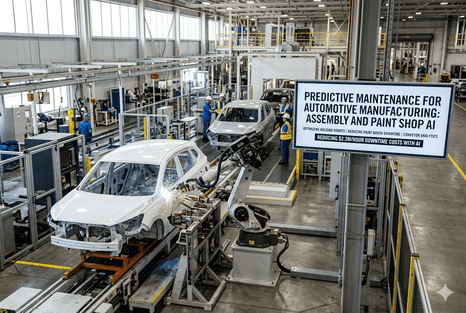
iFactory monitors your stamping presses, weld guns, conveyors, and robotic cells in real time — predicting failures 48–72 hours before they stop production. On-premise AI. Zero cloud dependency.
Why Unplanned Downtime Costs Automotive Plants $1.2M+ Per Line Per Year
Automotive manufacturing runs on synchronized production systems where every station depends on the station before it. When a single press, weld gun, or conveyor fails, the entire line stops. Here is how that breaks down across a typical plant.
Stamping Press Bushing & Die Wear Shuts Down the Line
A worn bushing in a 2,500-ton transfer press causes a 12 Hz vibration that goes unnoticed for three shifts. The resulting micro-cracks in 317 door panels cost $23,400 in scrap, rework, and lost production. With press lines running 24x7 at 12–15 strokes per minute, every hour of unplanned stop equals 720–900 lost panels.
Weld Gun Tip Degradation Causes Body Quality Defects
Resistance spot weld gun tips wear after 800–1,200 welds. When tip diameter exceeds spec, weld nugget strength drops below the 4.0 kN minimum for body-in-white structural panels. A single weak weld on a C-pillar triggers a 100% re-inspection of that body — adding 23 minutes to production and risking a line-side quality hold that cascades through the entire body shop.
Robotic Cell Servo Motor Failures Drop Throughput by 37%
A servo motor on a floor-mounted welding robot begins oscillating in the Z-axis after 14,000 hours of operation. The robot misses 3% of its weld positions, triggering fault cycles that slow the entire cell from 60 jobs per hour to 38. With each lost job representing $187 in value-added content, the one-week wait for a replacement motor costs $247,000 in lost throughput.
Conveyor & Transfer System Failures Idle the Assembly Line
A seized roller bearing on a skid conveyor in the paint shop stops the entire paint line for 54 minutes. Every minute of downtime costs $4,200 in lost production at a plant running 68 jobs per hour at $3,700 margin per vehicle. The single bearing failure costs $226,800 in lost margin before the first coat of primer dries.
Maintenance Teams Chase Failures Instead of Preventing Them
Planned maintenance compliance in automotive plants averages 63%. The other 37% of maintenance hours are reactive — emergency repairs on presses, weld guns, and conveyors that already failed. Maintenance supervisors report that 43% of their team's capacity is consumed by breakdown response, leaving no time for condition-based monitoring or predictive intervention.
Reactive maintenance costs automotive plants $1.2M+ per line per year. iFactory predicts failures 48–72 hours in advance. Book a 30-min walkthrough and see iFactory on your production data.
How Maintenance Changes When AI Predicts Equipment Failure on the Line
Most automotive plants today rely on fixed-interval maintenance schedules and reactive break-fix. The contrast with predictive maintenance is stark across every dimension that matters to production.
Without iFactory
- Maintenance on fixed calendar intervals — regardless of actual equipment condition
- Failures detected by operator observation or catastrophic breakdown — always after the fact
- Root cause buried in paper logs and disconnected CMMS records — finding it takes 2–3 days
- Spare parts inventory held at "just in case" levels — $350K+ tied up in emergency spares
- OEE losses from unplanned downtime: 12–18% of available production time
With iFactory
- Maintenance triggered by actual equipment condition — AI predicts wear 48–72 hours before failure
- Failures detected by predictive model — operator gets alert with specific corrective action before breakdown
- Root cause linked automatically to sensor data — identified in minutes, not days
- Spare parts ordered on demand based on predicted failure — inventory reduced by 38%
- OEE losses from unplanned downtime reduced to 4–7% of available production time
From Line Data to Failure Prediction in 6–12 Weeks
iFactory is an end-to-end, turnkey platform. We connect to your existing line sensors and deliver a working predictive model — no data scientists required on your end.
Connect Your Production Data
We connect to your press PLCs, weld controller networks, robot servo drives, and conveyor systems — no new sensors required. iFactory ingests vibration, current, temperature, and cycle time data from your existing instrumentation.
AI Trains on Your Equipment Signatures
Our AI learns the normal operating envelope for each press, weld gun, robot, and conveyor from 30 days of historical data — vibration signatures, motor current profiles, temperature gradients, and cycle time baselines.
Maintenance Gets 48–72 Hour Alerts
When the model detects a pattern that precedes a failure — bearing frequency shift, servo current oscillation, weld tip resistance change — it alerts the maintenance team via mobile device or CMMS work order.
Close the Loop With Root Cause Correlation
Every alert links to the sensor data that triggered it. Maintenance sees "Press #4 slide guide bearing degradation detected — replace within 48 hours." No more hunting for the root cause after the failure.
Predictive Maintenance Features for Automotive Manufacturing
iFactory's AI-native platform delivers capabilities purpose-built for automotive production environments — all running on-premise with zero cloud dependency.
Press & Die Wear Monitoring
iFactory models vibration signatures, ram position profiles, and tonnage curves on every stroke of your transfer and tandem presses. When bushing wear, die misalignment, or cushion degradation patterns emerge, the system alerts maintenance 48 hours before a critical failure. No more $23,000 events from undetected vibration.
Resistance Weld Gun Health
By correlating weld current, tip resistance, and pneumatic cylinder pressure, iFactory predicts tip wear and electrode degradation 24–48 hours before weld nugget strength drops below spec. Maintenance replaces tips during planned breaks, not emergency stops.
Robotic Cell Servo Diagnostics
iFactory ingests servo drive current, position error, and vibration data from welding, handling, and painting robots. When a servo motor begins oscillating or a gearbox shows frequency shift, the system alerts maintenance before the robot drops below cycle time target.
Conveyor & Skid System Monitoring
Bearing temperature, motor current, and chain tension data feed iFactory's predictive models. When a skid conveyor bearing shows thermal drift or a chain drive exhibits torque oscillation, maintenance gets a 72-hour alert — preventing line-wide stoppages that cost $4,200 per minute.
What Predictive Maintenance Delivers in 90 Days
Automotive plants that deploy iFactory see measurable improvements within the first quarter. Here is what a typical three-line plant achieves.
iFactory Delivers Predictive Maintenance Without the Complexity
Every capability below is built into the iFactory deployment — no optional add-ons or future roadmap.
End-to-End Turnkey Deployment
iFactory connects to your press PLCs, weld controllers, robot drives, and conveyor systems. We build the AI model, deploy the dashboard, and train your team — all in 6–12 weeks. Your plant engineers don't touch a line of code.
100% On-Premise — No Cloud Dependency
iFactory runs on an NVIDIA appliance on your plant network. Zero data leaves the facility. No cloud latency, no data egress fees, no cybersecurity exposure. Compliant with automotive OEM data governance requirements.
Pilot-to-ROI in One Quarter
Most automotive plants see unplanned downtime reduction within 60 days of go-live. The pilot pays for itself before the second quarter starts. We guarantee a pilot that demonstrates value before you commit to a full rollout.
Works With Existing Line Controls
iFactory connects to Siemens, Rockwell, Fanuc, Kuka, ABB, and any OPC-UA or Modbus-compatible PLC and robot controller. No rip-and-replace of your existing control systems.
24x7 Managed Service
iFactory's operations team monitors your models and infrastructure around the clock. If a model drifts or a sensor fails, we detect and fix it. You don't need an on-site data science team.
Scalable Across All Lines and Plants
Once the model works on one press line or body shop, iFactory replicates it across your entire plant network. Standardized predictive maintenance at every production site.
Real Answers From Automotive Production Leaders
Stop Reacting to Equipment Failures. Start Predicting Them.
iFactory gives your maintenance team a 48–72 hour look-ahead on press, weld gun, robot, and conveyor failures — and saves your plant $1.8M+ per year in downtime costs. The pilot takes 6–12 weeks. The ROI shows up in one quarter.