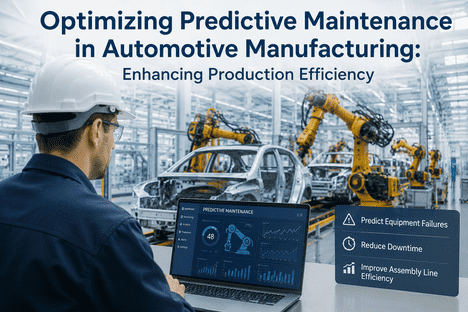
Predictive Maintenance for Automotive Manufacturing: Assembly and Paint Shop AI
By Ethan Walker on June 5, 2026
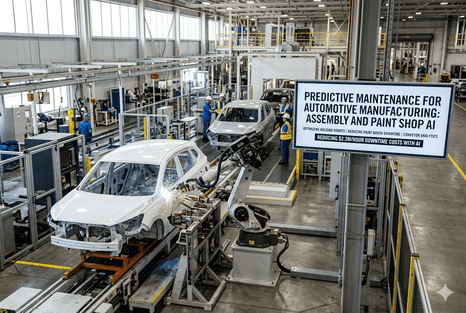
Automotive manufacturing plants in 2026 face an unprecedented cost-of-downtime crisis — a single unplanned stoppage on a high-volume assembly line can exceed $2.3 million per hour in lost production, with welding robot cell failures, paint shop defects, press line jams, and conveyor breakdowns accounting for the majority of events. Traditional run-to-failure and fixed-interval maintenance strategies leave plant managers reacting to failures after production is already halted, while quality escapes from degrading equipment accumulate unnoticed until end-of-line inspection or customer complaint. AI-powered predictive maintenance now fuses vibration, thermal, acoustic, and process telemetry from IIoT sensors with adaptive machine learning models that detect developing faults in welding robots, paint booths, press lines, and conveyors 48–96 hours before failure — reducing unplanned downtime, improving first-pass yield, and lowering maintenance costs by 18–30% in documented automotive deployments. Book a Demo to see how iFactory connects your automotive production telemetry to predictive maintenance intelligence.
AI Predictive Maintenance · Automotive Manufacturing 2026
Predictive Maintenance for Automotive Manufacturing: Assembly & Paint Shop AI
Welding robot servo degradation · Paint booth atomiser wear · Press line die fatigue · Conveyor bearing failure · All predicted in real time by iFactory with zero cloud dependency.
Book a DemoTalk to an Expert
$2.3M
Cost per hour of unplanned assembly line downtime
18-30%
Maintenance cost reduction with AI predictive models
30-50%
Unplanned downtime reduction across documented deployments
48-96hr
Advance warning on robot, paint, press, and conveyor failures
Why Traditional Maintenance Falls Short in Automotive Manufacturing
Most automotive plants today rely on fixed-interval preventive maintenance schedules and run-to-failure strategies for the majority of production equipment. PM schedules are based on calendar days or runtime hours that bear no relation to actual equipment condition — a welding robot that operates at 95% duty cycle on a high-volume model year degrades four times faster than an identical robot on a low-volume program, yet both receive the same PM interval. Run-to-failure on press line dies, paint atomisers, and conveyor drives guarantees that every failure triggers a production stoppage. The gap is condition visibility: plant managers know a robot cell is down but not which servo motor, gearbox, or cabling harness caused the fault — until maintenance tears down the cell. AI predictive maintenance closes this gap by monitoring every critical asset continuously and flagging degradation patterns 48–96 hours before failure, enabling planned intervention during scheduled changeovers rather than emergency stoppages during production.
Automotive Production — The AI Predictive Maintenance Connection
Sensing
IIoT Data Layer
Vibration · temp · current · acoustic · torque
Edge inference
Detection
Anomaly Models
Adaptive ML · ensemble · autoencoder
93.4% accuracy
Prediction
Failure Forecast
CNN-LSTM · RUL prediction · R² 0.947
48-96hr lead time
Action
CMMS Integration
Auto work orders · parts · changeover slot
Auto-triggered
Quality
Closed-Loop
Yield impact · defect containment · CAPA
Audit-ready
Three Critical Automotive Failure Categories iFactory Predicts
01
Welding Robot Servo Motor & Gearbox Degradation
Welding robots are the most downtime-sensitive assets in body shop assembly — a single robot cell failure can stop an entire framing line within seconds. iFactory monitors servo motor current draw, axis vibration, gearbox temperature, repeatability metrics, and welding process parameters (current, voltage, wire feed) from every robot in the cell. Adaptive ensemble ML models trained on 6–12 months of historical data detect servo bearing degradation, gearbox tooth wear, and cabling fatigue 48–72 hours before they induce robot positioning drift or axis lockout. Alerts include the specific robot ID, affected axis, fault type, and recommended corrective action — enabling maintenance teams to swap a servo motor or gearbox during a planned break rather than during a line stoppage.
48hr advance warning93.4% detection accuracyAuto work orders
02
Paint Booth Atomiser & Conveyor Drive Degradation
Paint shop defects are the most costly quality escapes in automotive manufacturing — a single atomiser bell failure can produce repaint costs exceeding $500 per vehicle, while conveyor drive failures halt the entire paint line for hours. iFactory monitors atomiser bearing vibration, turbine speed accuracy, paint flow consistency, booth air balance, conveyor drive motor current, chain tension, and trolley bearing temperature. ML models detect atomiser bearing degradation, nozzle clogging trends, and conveyor drive fatigue 48–96 hours before they produce visible paint defects or drive lockout. Predicted maintenance windows are aligned to colour changeover breaks — eliminating the emergency paint line stoppages that occur when atomisers fail mid-production.
48-96hr paint line alertAtomiser bearing wearChangeover-aligned
03
Press Line Die Fatigue & Cushion System Degradation
Press line dies and cushion systems produce the highest-value dimensional defects in stamping operations — a single die fatigue crack can scrap thousands of body panels before end-of-line inspection detects the issue. iFactory monitors press tonnage per station, die temperature, cushion pressure and position, vibration signatures, and cycle time trends. Adaptive ML models detect die fatigue patterns, cushion seal degradation, and ram alignment drift 48 hours before they produce out-of-tolerance stampings. Every predictive event is logged in iFactory's Shift Logbook with full traceability to the panel lots produced during the degradation window — enabling quality teams to contain suspect material before it reaches body shop or customer.
48hr die fatigue alertTonnage + vibration fusionLot traceability
What Tier-1 Automotive Manufacturers Have Publicly Deployed in AI PdM
Public industry coverage documents AI-driven predictive maintenance deployments across automotive body shop, paint shop, press shop, and final assembly — including Toyota achieving 90% reduction in unplanned line stops with AI-powered root-cause analysis, BMW deploying machine learning for paint shop defect prediction, and Ford using IIoT sensor fusion for press line predictive maintenance. iFactory is the AI software intelligence layer — turning equipment telemetry, quality data, and production schedules into predictive intelligence, closed-loop maintenance planning, and audit-ready compliance records regardless of the automation platform deployed.
Production Zone
AI Technology
iFactory Output
Production Impact
Body Shop — Welding Robots
Servo current · vibration · gearbox temp
48hr bearing/gearbox failure forecast
Prevents framing line stoppages
Paint Shop — Atomisers & Conveyors
Bearing vibro · turbine speed · flow
96hr atomiser failure forecast
Eliminates emergency paint line stops
Press Shop — Dies & Cushions
Tonnage · temp · vibration · pressure
48hr die fatigue alert · lot traceability
Prevents scrap panel escapes
Final Assembly — Conveyors & Drives
Motor current · chain tension · bearing temp
72hr drive failure forecast
Prevents assembly line halts
Quality & Compliance
Defect correlation · lot traceability
Root-cause analysis · auto CAPA · Shift Logbook
Audit-ready compliance records
AI Predictive Maintenance Use Cases in Automotive Manufacturing
iFactory monitors servo motor current draw per axis, gearbox vibration and temperature, repeatability metrics, and welding process parameters on every robot in the body shop cell. Adaptive ML models detect bearing degradation, gear tooth wear, and cabling fatigue 48–72 hours before failure. Alerts include the specific robot ID, affected axis, fault type, and corrective action — enabling planned servo swaps during break periods rather than emergency stoppages.
iFactory monitors atomiser bearing vibration, turbine speed accuracy, paint flow consistency, booth air balance, conveyor drive motor current, chain tension, and trolley bearing temperature. ML models detect atomiser bearing wear and conveyor drive fatigue 48–96 hours before failure. Predicted maintenance windows align to colour changeover breaks — eliminating emergency paint line stoppages.
MonitoringAtomiser · conveyor · booth · flow
AlignmentColour changeover breaks
Press Shop
Press Die Fatigue & Cushion System Degradation Detection
Continuous
Die fatigue cracks and cushion seal degradation produce the highest-value dimensional defects in stamping. iFactory monitors press tonnage per station, die temperature profiles, cushion pressure and position accuracy, and vibration signatures. Adaptive ML detects die fatigue, cushion seal wear, and ram alignment drift 48 hours before out-of-tolerance stampings are produced. Quality lots during the degradation window are flagged for containment with full Shift Logbook traceability.
ParametersTonnage · temp · vibration · position
OutputDie alert · lot trace · work order
Book a Demo
What iFactory Delivers for Automotive Manufacturing
$2.3M
Cost avoided per hour of unplanned line stoppage
AI prediction enables planned intervention
18-30%
Maintenance cost reduction with AI predictive models
Emergency repairs replaced by planned work
30-50%
Reduction in unplanned downtime
48-96hr prediction vs reactive response
48-96hr
Advance warning on critical asset failures
Robot · paint · press · conveyor
FAQ
Customer deployments are governed by confidentiality agreements; facility-specific references are shared during qualified buyer conversations under NDA. References to Toyota, BMW, Ford, and other OEMs reflect publicly documented industry adoption of AI predictive maintenance methods — not direct claims about iFactory customer relationships. Book a demo to discuss applicable references in your automotive production segment.
iFactory links each predictive maintenance alert to the production schedule, quality lots produced during the degradation window, and shift records in the Shift Logbook. When a welding robot servo alert is generated, the platform traces all body panels produced on that cell in the preceding shift hours and flags them for dimensional inspection. This closed-loop connection between equipment health, production schedule, and product quality enables operators to contain suspect material before it progresses down the assembly line — transforming PdM from a maintenance tool into a quality prevention system aligned with your production cadence.
iFactory is an AI software intelligence layer — not a sensor manufacturer or hardware vendor. The platform integrates with existing automation networks (Rockwell, Siemens, Fanuc, KUKA, ABB), PLC and SCADA systems, robot controllers, paint booth controllers, press controllers, CMMS (SAP, IBM Maximo, Infor), and quality management systems via standard protocols including OPC UA, Modbus TCP, Profinet, MQTT, and REST API. Your plant selects the sensing and automation infrastructure; iFactory turns the data into predictive intelligence, maintenance planning, and audit-ready quality compliance records.
iFactory deploys against pre-built templates covering welding robots, paint atomisers, conveyors, press lines, and assembly drives — most equipment running in automotive body, paint, press, and final assembly shops. The platform requires 6–12 months of historical machine data to establish baseline health thresholds and train initial models. If data is available in your existing historian, SCADA, or robot controller database, initial models can be trained in under four weeks. The turnkey program including new AI infrastructure runs 12 weeks end-to-end with 90-day implementation support.
Deploy iFactory for Automotive Predictive Maintenance
AI-powered predictive maintenance platform connecting welding robots, paint atomisers, press dies, conveyors, and assembly drives into one unified intelligence layer — with adaptive ML failure prediction, production-aligned maintenance windows, Shift Logbook integration, CMMS workflow automation, and audit-ready quality compliance records.
Book a DemoTalk to an Expert
Robot PdMPaint Shop AIPress Die AnalyticsConveyor PdMShift Logbook