The global predictive maintenance market hit $13.65 billion in 2025 and is racing toward $97 billion by 2034 — growing at over 24% annually. Why? Because every manufacturer on the planet is asking the same question: "How do we stop unexpected equipment failures before they wipe out our production schedule?" The answer is AI + IoT-powered Predictive Maintenance — and in 2026, platforms like iFactory are redefining what's possible. Whether you're still reacting to breakdowns or evaluating your next move, this guide covers everything: what predictive maintenance is, how it works, what it costs you not to have it, and why iFactory delivers results from day one.
What Is Predictive Maintenance — And How Does It Work?
Predictive Maintenance (PdM) uses IoT sensors, AI, and machine learning to continuously monitor your equipment's health and forecast failures before they happen. Instead of waiting for a breakdown — or replacing parts on a fixed calendar schedule — you act on real data from your actual machines, in real time.
In 2026, predictive maintenance has evolved far beyond vibration meters and manual inspections. Modern platforms like iFactory combine AI-powered anomaly detection, cloud-connected IoT sensor feeds, automated work orders, and real-time dashboards into one system that tells you exactly which asset is degrading, how fast, and when it will fail — days or weeks before it actually does.
Reactive vs. Preventive vs. Predictive: Which Mode Are You In?
Most manufacturers fall into one of three maintenance modes. Only one eliminates both surprise breakdowns and wasted maintenance spend at the same time. Here's the clearest comparison:
Think of it this way: Reactive maintenance is fighting fires. Preventive maintenance is fire drills on a fixed schedule. Predictive maintenance is a smoke detector — it tells you exactly where, when, and how serious, before a single flame appears. iFactory is that smoke detector, for every machine on your floor. See it live in a free demo →
Ready to See AI Predictive Maintenance in Action?
In 30 minutes, we'll walk you through iFactory's live platform — sensor feeds, AI failure predictions, automated work orders, and real-time dashboards — customized for your industry and equipment types.
The 4-Step AI + IoT Process: How Prediction Actually Happens
Modern predictive maintenance isn't magic — it's a clear, repeatable process. Here's how iFactory turns raw sensor signals into actionable repair intelligence, automatically, every single day:
Sensors Collect
IoT sensors on every critical machine continuously capture vibration, temperature, pressure, current, and acoustic data — 24 hours a day, 7 days a week, with zero manual effort.
AI Analyzes
Machine learning models compare live readings against each asset's established baseline. Tiny deviations — too small for any human to catch — are flagged instantly as early-warning anomalies.
Alert Triggers
When AI detects a developing fault, iFactory sends an alert with the asset ID, fault type, severity level, and estimated time to failure — days or weeks before any breakdown occurs.
Team Acts
A work order is auto-generated with repair instructions and required parts already attached. Your team schedules the fix during planned downtime — zero emergencies, zero surprises.
Want to see all 4 steps working live? Book a free demo and we'll show you iFactory's complete predictive pipeline on real equipment data in 30 minutes.
Why Predictive Maintenance Can't Wait in 2026
Three forces are making predictive maintenance adoption non-optional for any asset-intensive manufacturer — and all three are intensifying at the same time:
Unplanned Downtime Costs Are Exploding
The average cost of unplanned downtime has roughly doubled since 2019. Fortune 500 manufacturers lose an estimated $2.8 billion annually — about 11% of revenue — to preventable equipment failures. In automotive and high-precision manufacturing, a single hour of downtime can exceed $1 million. AI predictive maintenance cuts this downtime by 30–50%, turning catastrophic emergency repairs into calm, planned interventions that cost a fraction of the alternative.
Skilled Technicians Are Disappearing Fast
2.1 million manufacturing jobs are forecast to go unfilled by 2030. The experienced technicians who could "hear" a bad bearing or "feel" a misaligned shaft are retiring faster than they can be replaced. AI predictive maintenance solves this by doing the continuous monitoring that used to require a seasoned expert — while guiding newer team members through complex repairs step by step, at veteran skill levels, from day one on the job.
Compliance Documentation Is Now Mandatory
From ISO 55001 to FDA to OSHA, regulators increasingly require timestamped, traceable digital proof of systematic asset management — not paper logs or manual checklists. iFactory auto-generates compliance records as a byproduct of every predictive maintenance action, so every audit becomes a non-event instead of a three-week scramble through filing cabinets.
Proven ROI: What Manufacturers Actually Achieve
These results come from documented research by Deloitte, IBM, and the U.S. Department of Energy — not vendor marketing. Predictive maintenance delivers measurable returns across four key dimensions:
AI flags failures weeks before they occur. Repairs happen on your schedule — not at 2 AM when a production line goes cold.
Fix what actually needs fixing. Stop replacing components that have months of usable life remaining and wasting labor on unnecessary PMs.
Early intervention stops small faults from cascading. Equipment that once lasted 8 years now reliably runs for 11 or more with condition-based care.
The U.S. Department of Energy documents 10× returns on predictive maintenance investments — with full payback achieved within 12–18 months.
Calculate Your Predictive Maintenance ROI
In 30 minutes, we'll walk you through iFactory's platform and calculate your projected savings based on your actual asset count, downtime history, and maintenance spend — with a roadmap you can take to leadership today.
Real-World Use Cases: Industry by Industry
CNC Machine & Robotic Arm Failure Prediction
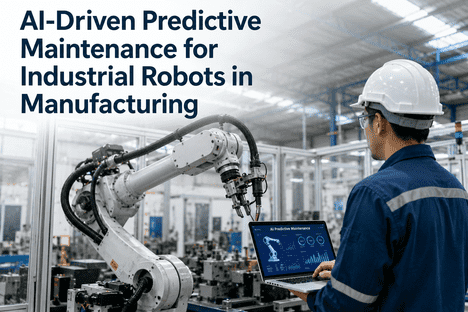
AI detects micro-vibration shifts in spindles and actuators weeks before bearing failure. Assembly lines that previously suffered 3–5 unplanned stops per quarter now operate for entire quarters without a single emergency shutdown — saving hundreds of production hours annually per facility.
Compressor & Conveyor Condition Monitoring
By tracking temperature, pressure, and motor current alongside batch data, manufacturers now identify the exact conditions preceding material contamination and line stoppages — eliminating entire-day shutdowns that were previously accepted as an unavoidable cost of operations.
Turbine & Rotating Equipment Health
AI-driven sensors on turbines, pumps, and generators detect thermal anomalies and vibration signatures that indicate developing faults weeks before they become catastrophic. Critical infrastructure now operates on predictable, planned maintenance cycles — not emergency responses.
Calibration & GMP Compliance Monitoring
Every machine parameter is tracked against FDA and ISO tolerances in real time. Predictive alerts prevent out-of-spec production runs before they contaminate a batch — protecting quality, avoiding costly recalls, and keeping audit records automatically current with zero manual documentation burden.
How to Implement Predictive Maintenance: The iFactory 5-Step Path
Most manufacturers overcomplicate implementation and stall before they start. Here is the practical path that iFactory customers use to go live in weeks — and see measurable ROI within months:
Identify Your Highest-Risk Assets
Start where failures hurt most. Map your top 10 machines by downtime cost, criticality, and failure frequency. This is where predictive maintenance pays back fastest — and where iFactory focuses implementation effort first.
Deploy IoT Sensors & Establish Baselines
Install vibration, thermal, and current sensors on priority assets. iFactory captures each machine's "normal" operating signature — so AI knows exactly what deviation looks like and learns your equipment from the very first day of operation.
Connect to iFactory's AI Platform
Sensor feeds, work order history, and maintenance logs are ingested into iFactory's cloud platform — which immediately starts identifying patterns, anomalies, and failure precursors in your real operational data, specific to your machines.
Configure Alerts & Automated Work Orders
Set alert thresholds per asset. When AI detects a developing fault, iFactory auto-creates a work order with repair instructions and required parts already attached — so your team acts on data, not guesswork, every single time a machine needs attention.
Expand, Optimize & Scale Across Sites
As AI models learn from every repair and every sensor reading, accuracy improves continuously. Roll out to additional assets and facilities. Most organizations achieve first measurable ROI within 3–6 months and full payback within 12–18.
What iFactory's AI Predictive Maintenance Delivers
iFactory combines the simplicity of a CMMS with the intelligence of enterprise AI — all in one cloud-native platform that connects to your sensors, learns your machines, and automates your entire maintenance operation from alert to completion:
Failure Prediction Engine
Analyzes vibration, thermal, and current data to predict failures 30–90 days in advance with 80–97% accuracy. No more calendar guesswork. No more surprise shutdowns at the worst possible time.
Smart Work Orders
AI predictions auto-generate work orders with repair steps, required parts, and optimal scheduling already attached. Your team executes. iFactory handles all the routing and prioritization.
Real-Time Dashboards
Asset health scores, MTTR, MTBF, energy consumption, and compliance status — all visible in real time from any device. Leadership sees the big picture. Technicians see their next task.
Multi-Site, Cloud-Native
Manage predictive maintenance across every plant, warehouse, and field location from one platform — with cross-site benchmarking and AI best-practice replication built in from the ground up.
Start Predicting Failures — Not Reacting to Them
Predictive maintenance is no longer a luxury for large enterprises. Cloud-native, AI-powered platforms like iFactory have made it accessible, affordable, and deployable for operations of any size — with payback that starts in months, not years. With the global market growing at 24% annually, manufacturers who adopt it now build a competitive advantage that only compounds over time. The question isn't whether predictive maintenance is right for your operation — it's how much you're losing every month without it.
Your First Step? See iFactory Predict a Failure Live
30 minutes. Zero obligation. We'll show you how iFactory's AI detects equipment anomalies on real sensor data, calculate your projected downtime savings, and give you an implementation roadmap you can take to your team today.