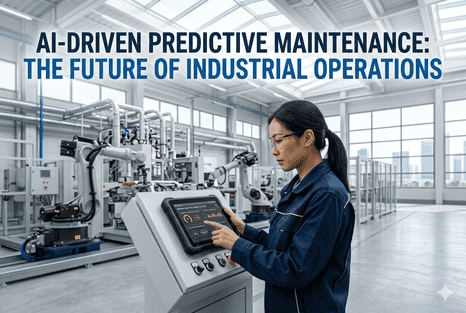
The factory of 2030 won't wait for a bearing to fail, a pump to seize, or a motor to overheat. It will know weeks in advance, schedule repairs autonomously, and order parts before a technician even opens a work order. This isn't speculation — it's the trajectory that $98 billion in global predictive maintenance investment is building toward right now. As Industry 4.0 matures into the autonomous industrial era, seven converging technologies are fundamentally rewriting how manufacturing maintains its most critical assets. Here's what's coming — and what it means for your operations.
$14B
Global Predictive Maintenance Market in 2025
$98B
Projected Market Size by 2033
28%
Annual Market Growth Rate (CAGR)
65%
Of Maintenance Teams Planning AI Adoption
The Industry 4.0 Maintenance Evolution: Where We Are Now
Most factories are in the middle of a transition. Preventive maintenance still dominates — 71% of facilities rely on calendar-based schedules as their primary strategy. But only 27% have implemented predictive maintenance, even as unplanned downtime costs manufacturers an estimated $50 billion annually. The gap between what's possible and what's deployed represents one of the biggest operational opportunities in modern manufacturing.
Industry 2.0
Reactive
Run equipment until failure. Fix what breaks. Accept downtime as inevitable.
Legacy approach — still used by 38% of facilities
Industry 3.0
Preventive
Service on fixed schedules. Reduce failures. Over-maintain healthy assets.
Current standard — 71% of facilities
Industry 4.0
Predictive
Sensor-driven, AI-analyzed, condition-based. Maintain only what needs it, when it needs it.
Rapid adoption — 27% and accelerating
Industry 5.0
Autonomous
Self-diagnosing, self-scheduling, self-optimizing. Human oversight on exceptions only.
Emerging — built on today's CMMS data quality
The organizations investing in predictive maintenance infrastructure today aren't just solving current problems — they're building the data foundation that autonomous maintenance will require by 2030. The quality of the CMMS data being captured right now determines who will be ready for autonomous operations in five years and who will need another decade to catch up.
7 Technologies Defining the Future of Predictive Maintenance
These aren't independent trends. They're interconnected technologies that amplify each other — forming a new industrial intelligence stack where sensor data, AI models, digital replicas, and autonomous agents work together to eliminate unplanned downtime entirely.
Foundational Shift
01
AI & Machine Learning: From Threshold Alerts to Failure Prediction
Traditional monitoring triggers alarms when a sensor reading crosses a threshold. By then, damage is already underway. AI-powered predictive maintenance detects the early-stage process deviations that precede failure — weeks before any conventional alarm would trigger. Modern ML models self-calibrate per asset, learning each machine's unique operational baseline rather than comparing against generic fleet averages. On well-instrumented rotating equipment, failure prediction windows now extend to 8–12 weeks, giving maintenance teams enough lead time to schedule repairs during planned downtime. Plants with condition monitoring connected to a CMMS are reporting 40–60% reductions in unplanned bearing and gearbox failures within the first 12 months of deployment.
90%
Failure prediction accuracy with AI-driven analytics
8–12 wk
Advance warning on critical rotating equipment
3–5x
ML outperforms scheduled PM on failure detection
02
Digital Twins: Virtual Replicas That Predict Real Failures
A digital twin is a continuously updated virtual replica of a physical asset that combines real-time sensor data, historical performance records, and physics-based simulation models. Unlike dashboards that show current state, digital twins simulate future scenarios — answering "what if" questions without risking actual equipment. Manufacturing facilities using digital twins for predictive maintenance report 85–90% prevention of catastrophic equipment failures. The technology has matured rapidly: over half of large industrial facilities have deployed at least one digital twin for maintenance simulation as of 2025, with initial investments of $200K–$600K typically generating $1.2–3.5 million in annual savings.
50–70%
Reduction in unplanned downtime with comprehensive digital twin programs
03
Edge AI: Intelligence at the Machine, Not in the Cloud
Edge computing processes data locally — directly on sensors, PLCs, or gateway devices at the machine — rather than sending everything to the cloud for analysis. This means anomalies are detected in milliseconds, not minutes. Edge AI is particularly critical for high-speed production lines where even seconds of analysis delay can mean damaged products or safety incidents. By 2026, agentic AI systems at the edge will handle local decisions and closed-loop actions — inspecting, adjusting, and remediating systems in near real-time without cloud dependency.
50%
Of enterprise data to be processed at the edge, reducing latency by 70–90%
04
IIoT Sensor Networks: The Nervous System of Smart Factories
Industrial IoT has evolved far beyond basic vibration and temperature probes. Modern sensor platforms combine acoustic, thermal, power-signature, and chemical monitoring on a single board — creating multi-dimensional asset health profiles. Edge gateways process thousands of data points per second locally while feeding aggregated intelligence to cloud analytics. As sensor prices decline and 5G private networks mature, even legacy equipment can be retrofitted with predictive intelligence at $50–100 per asset per month.
1M+
Connected devices per sq km supported by 5G-powered edge infrastructure
05
Cloud-Native CMMS: The Execution Engine for Predictions
Predictions without execution are just dashboards. A cloud-native CMMS converts AI alerts and sensor anomalies into automated work orders with asset context, failure history, and pre-staged parts information — in under 60 seconds. Cloud platforms represented 67% of the predictive maintenance market in 2025, growing at 37% CAGR, because they enable remote access, seamless scaling, and integration with enterprise ERP and MES systems without heavy on-premise infrastructure investment.
67%
Of predictive maintenance market on cloud platforms, growing 37% annually
06
AR-Guided Maintenance: Expert Knowledge at the Point of Work
Augmented reality is putting real-time equipment data, interactive repair guides, and remote expert collaboration directly in front of maintenance technicians — overlaid on the actual equipment they're servicing. Combined with small language models embedded at the edge, frontline workers can troubleshoot error codes and complex procedures on the spot without waiting for specialist support. This is critical as the manufacturing skills gap widens and tribal knowledge disappears with retiring workforce.
66%
Annual growth in AR adoption for industrial maintenance applications
07
Autonomous Maintenance Systems: The End State
The convergence of edge AI, digital twins, agentic AI, and advanced CMMS is building toward truly autonomous maintenance — systems that diagnose issues, create work orders, schedule technicians, order parts, and optimize themselves without human intervention except for exception handling. Agentic AI architectures use a main orchestration agent coordinating specialized child agents that autonomously handle diagnostics, work order creation, and system remediation. By 2030, plants building high-quality CMMS data foundations today will be ready for this level of autonomy.
2030
Target for full autonomous maintenance — built on data captured starting now
The Convergence Map: How These Technologies Connect
No single technology delivers the autonomous factory. The real power emerges when they work as an integrated stack — each layer feeding and amplifying the others. Here's how the future predictive maintenance architecture fits together.
Sensing Layer
IIoT sensors, vibration probes, thermal cameras, acoustic monitors, power analyzers — continuously streaming multi-dimensional asset health data
Edge Intelligence Layer
Edge AI processors analyze data locally in milliseconds — detecting anomalies, triggering immediate safety actions, and filtering signal from noise before cloud transmission
Digital Twin Layer
Virtual replicas simulate future failure scenarios, estimate remaining useful life, and test maintenance strategies in virtual environments before real-world execution
AI Prediction Layer
Machine learning models identify degradation patterns invisible to humans — predicting failures 8–12 weeks in advance and continuously improving through feedback loops
CMMS Execution Layer
Predictions converted to automated work orders, technician assignments, parts procurement, compliance documentation, and closed-loop resolution tracking
Autonomous Operations Layer
Agentic AI orchestrates end-to-end maintenance workflows — from detection through resolution — with human oversight reserved for exceptions and strategic decisions
Industry 4.0 Readiness: Where Does Your Operation Stand?
The journey from reactive maintenance to autonomous operations is a progression — each stage building on the capabilities and data quality of the one before it. Knowing where you stand today determines what you should invest in next.
Level 1
Reactive
No sensor infrastructure. Run-to-failure culture. Manual work orders on paper or spreadsheets. No historical failure data. Emergency repairs dominate budgets.
Next step: Implement a CMMS and begin digitizing work orders to build your data foundation.
Level 2
Preventive
Calendar-based PM schedules. CMMS deployed but underutilized. Basic asset tracking. Maintenance history exists but isn't analyzed. Over-servicing healthy equipment.
Next step: Add IoT sensors to critical assets and connect telemetry to your CMMS for condition-based alerts.
Level 3
Condition-Based
Sensors on critical assets. Real-time monitoring dashboards. Threshold-based alerts generating work orders. Some trend analysis. Maintenance driven by actual equipment condition.
Next step: Deploy AI/ML analytics to move from threshold alerts to predictive failure modeling.
Level 4
Predictive
AI models predicting failures weeks ahead. Automated work order generation. Digital twin pilots. Edge processing on critical lines. Proactive parts ordering. Maintenance aligned with production schedules.
Next step: Expand digital twin coverage and integrate agentic AI for autonomous decision loops.
Level 5
Autonomous
Self-diagnosing, self-scheduling, self-optimizing maintenance. Agentic AI orchestrating end-to-end workflows. Human role shifts to strategic oversight and exception handling only.
The destination: built on years of high-quality, structured CMMS data and continuous AI refinement.
The Future Is Built on the Data You Capture Today
Autonomous maintenance in 2030 requires years of high-quality CMMS data — structured work orders, asset failure histories, condition monitoring trends, and documented maintenance outcomes. iFactory gives you the platform to start building that foundation now, with AI integration, IoT connectivity, and automated workflows that scale from your first sensor to full autonomous operations.
What This Means for Your Team in 2026 and Beyond
The future of predictive maintenance isn't just about technology — it's about how your maintenance organization operates. Here's what changes at every level as Industry 4.0 technologies mature.
Maintenance Technicians
From firefighters to precision specialists
AR-guided procedures, AI-recommended repair sequences, and mobile CMMS access transform the technician role. Instead of reacting to emergencies, they execute planned, data-informed interventions with real-time expert guidance. Small language models embedded at the edge put troubleshooting knowledge directly at the point of work.
Maintenance Managers
From schedule coordinators to data strategists
When AI handles failure prediction and CMMS automates work order generation, the manager's role shifts to optimizing overall maintenance strategy — balancing predictive models, managing capital budgets informed by remaining useful life data, and driving continuous improvement through analytics.
Operations Leaders
From downtime managers to uptime architects
Real-time equipment health visibility across the entire fleet, energy optimization driven by maintenance condition data, and ESG compliance automated through documented sustainability metrics. Maintenance becomes a strategic advantage rather than a cost center.
CFOs & Executive Teams
From emergency budgets to predictable investment
Equipment lifespan extensions of 20–40% defer massive capital expenditures. Predictive parts ordering eliminates emergency premiums. Energy savings of 15–20% hit the bottom line directly. The 10x ROI on predictive maintenance investment makes the business case self-evident.
The Market Trajectory: Why Now Is the Inflection Point
Several forces are converging to make 2026 the tipping point for predictive maintenance adoption. The technology is mature, the costs have dropped, and the competitive penalty for waiting is growing.
Sensor Costs Plummeting
Multi-modal IoT sensors now cost a fraction of what they did five years ago. Pay-as-you-go pricing lets even SMEs pilot predictive maintenance at $50–100 per asset per month, achieving positive ROI within 12–18 months.
AI Models Production-Ready
Machine learning for maintenance has moved from research to operational deployment. Task-specific small language models run on edge devices without cloud dependency, making AI accessible to facilities of every size.
5G Enabling Real-Time
Private 5G networks support over 1 million connected devices per square kilometer — enabling dense sensor deployments with the bandwidth and latency needed for real-time predictive analytics on the factory floor.
Skills Crisis Forcing Automation
An aging workforce and widening maintenance skills gap make AI-assisted and autonomous maintenance not optional but essential. Knowledge capture in CMMS systems preserves tribal expertise as experienced workers retire.
Sustainability Mandates
Carbon pricing, ESG reporting, and energy efficiency regulations are pushing maintenance teams to track and optimize energy performance at the asset level. Poorly maintained equipment consumes 15–30% more energy than optimized equivalents.
Competitive Pressure
Early adopters are achieving 5–10x returns within 2–3 years. SMEs are the fastest-growing segment at 36% CAGR. The gap between predictive-first and reactive-last operations widens every quarter.
Don't Wait for 2030. Start Building the Foundation Now.
Every month of high-quality CMMS data you capture today accelerates your path to autonomous maintenance tomorrow. iFactory's platform is built for where maintenance is heading — AI prediction, IoT integration, automated workflows, and compliance documentation that scales from your first predictive pilot to full autonomous operations.
Frequently Asked Questions