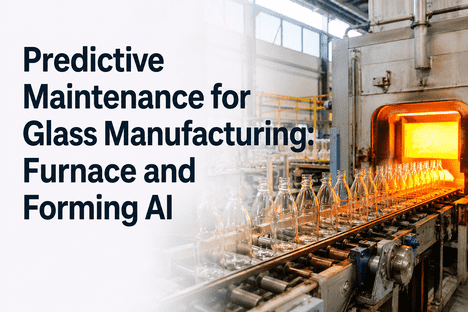
Predictive Maintenance for Glass Manufacturing: Furnace and Forming AI
By Daniel Carter on June 7, 2026
In glass manufacturing, unplanned failures on melting furnaces, IS forming machines, annealing lehrs, and batch chargers represent the most disruptive production losses — a single furnace refractory breach can cost $50–$100 million in rebuild expenses and halt production for 4-6 months. Traditional reactive and time-based maintenance cannot address the extreme thermal cycling, abrasive batch wear, and creep degradation that accelerate refractory erosion and mechanical wear in glass plants. iFactory's predictive maintenance platform fuses IoT sensor telemetry, thermal imaging, vibration data, and equipment history into machine learning models that forecast refractory hot spots, IS machine mechanism degradation, lehr belt drift, and furnace campaign life limits 2-4 weeks in advance, enabling maintenance teams to act before the failure occurs. Book a Demo to see how iFactory connects your glass plant equipment data to predictive intelligence.
Predictive Maintenance · Glass 2026
Predictive Maintenance for Glass Manufacturing: Furnace & Forming AI
Furnace refractory hot-spot prediction · IS machine mechanism monitoring · Annealing lehr belt & temp analytics · Batch charger & regenerator surveillance · All flowing into iFactory CMMS & Shift Logbook.
Why Reactive Maintenance Fails in Glass Manufacturing Environments
Glass manufacturing equipment operates under extreme conditions that accelerate wear far beyond what scheduled maintenance intervals can predict. Glass melting furnaces run at 1500–1600°C with refractory linings that erode continuously from thermal cycling, alkali attack, and glass penetration. IS forming machines cycle 300–600 containers per minute with precision mechanisms subject to alignment drift and wear. Annealing lehrs maintain precise temperature gradients across 2–4 meter belts that track and tension continuously. Batch chargers handle abrasive raw materials that erode feed mechanisms daily. Fixed-interval maintenance replaces components based on campaign time or tonnage rather than actual condition — meaning refractory is either patched too early (wasting campaign life) or too late (causing catastrophic glass penetration). iFactory's condition-based approach replaces the calendar with sensor-driven prediction.
LIMITATIONS OF TIME-BASED MAINTENANCE IN GLASS PLANTS
1
Extreme thermal variation ignored — same interval regardless of furnace pull rate, cullet ratio, or temperature cycling severity
2
Sensor-blind to refractory degradation — crown sag, sidewall thinning, and hot spots not continuously monitored between thermographic inspections
3
Catastrophic failure risk — glass penetration through eroded refractory causes $50-100M rebuild and 4-6 month production halt
4
IS machine drift undetected — mechanism misalignment and wear accumulate between scheduled rebuilds, reducing container quality and forming efficiency
Three Glass Manufacturing Equipment Failure Categories iFactory Predicts
01
Furnace Refractory Hot-Spot & Campaign Life Prediction
Furnace refractory breaches represent the single highest-risk event in glass manufacturing — each penetration can cost $50–$100 million in rebuild expenses and halt production for 4-6 months. iFactory ingests crown temperature profiles, sidewall thermal imaging, bottom thermocouple arrays, and regenerator condition data to train ML models that predict refractory hot spot formation and campaign life limits 2-4 weeks in advance. Sites running these systems report extending furnace campaign life by 12-18 months through targeted hot-spot cooling and scheduled patching. Maintenance planners schedule repairs during planned glass level reductions rather than responding to catastrophic glass run-outs. Book a Demo to see iFactory's furnace prediction models in production.
2-4 week lead time12-18 mo. campaign extensionHot-spot detection
02
IS Forming Machine Mechanism & Cycle Degradation Forecasting
IS machines forming 300–600 containers per minute rely on precisely timed mechanisms — blank side, blow side, take-out, and conveyor synchronisation. Wear and alignment drift cause container defects, production speed reductions, and jam-related downtime. iFactory monitors vibration signatures, mechanism cycle times, air consumption, and gob weight variation to detect early-stage degradation patterns before they cause quality rejects or machine stoppages. One North American glass container plant using iFactory's IS machine monitoring reported a 25% reduction in forming-related defect rates and 15% fewer unplanned forming line stoppages. The platform correlates sensor anomalies with container quality data, alerting maintenance to the specific mechanism requiring adjustment.
Lehr belts, batch chargers, and regenerators operate in continuously variable conditions — different ware sizes, pull rates, and ambient temperatures — producing data signatures that challenge conventional threshold-based monitoring. iFactory applies ensemble ML models that separate signal from noise in lehr belt tracking, temperature zone profiles, batch charger motor current, and regenerator draft pressure data. While prediction accuracy in this category is lower (50-60%), the platform's continuous learning loop improves model precision over time as more operating data accumulates. The Shift Logbook captures operator-reported anomalies alongside sensor data, creating a richer training corpus for the prediction models. Book a Demo to see iFactory's complete glass plant predictive maintenance platform.
Ensemble ML modelsContinuous learning loopShift Logbook correlation
How iFactory Transforms Glass Plant Telemetry Into Predictive Intelligence
iFactory is the AI software intelligence layer — not a sensor manufacturer or hardware vendor. The platform integrates with existing glass plant telemetry from DCS, PLCs, SCADA (Rockwell, Siemens, Wonderware), ERP (SAP, Oracle), thermal cameras, thermocouple arrays, vibration sensors, and IoT gateways already deployed across your facility. The Shift Logbook captures operator shift reports, forming machine setup notes, and maintenance actions alongside the sensor stream, creating a unified data fabric for predictive model training.
Belt tracking · temp zone profile · drive motor current · fan vibration
Belt RUL · temp zone deviation · drive bearing fault alert
Reduced ware stress & breakage
Batch & Regenerator
Charger motor load · screw wear index · checker temp · draft pressure
Charger mechanism failure · checker plugging index
Fewer batch variations & fuel loss
Predictive Maintenance Use Cases in Glass Manufacturing
Furnace
Refractory Hot-Spot & Campaign Life Prediction
Continuous
iFactory ingests crown temperature arrays, sidewall thermal image data, bottom thermocouple readings, and regenerator condition data from each furnace. ML models trained on historical hot-spot formation and refractory failure patterns predict critical hot spots and campaign milestones 2-4 weeks in advance. Predicted events are assigned a confidence score and recommended intervention window — targeted cooling, patch repair, or glass level reduction. Maintenance planners schedule interventions during planned outages, avoiding catastrophic glass run-outs that require full furnace rebuild. Every prediction event is logged in iFactory's Shift Logbook with full traceability to the sensor data that triggered the alert.
IS machines cycling 300-600 containers per minute are the core forming asset in glass container production. iFactory monitors vibration signatures, mechanism cycle times, air consumption, and gob weight variation to detect early-stage wear and misalignment. The platform pinpoints the specific mechanism — blank side, blow side, or take-out — requiring adjustment before defects escalate. Alerts route directly to the maintenance shift in the Shift Logbook with location metadata, severity score, and recommended action.
Lehr belts, batch chargers, and regenerators face highly variable operating conditions — different ware configurations, pull rates, and ambient thermal profiles — that produce noisy sensor data. iFactory applies ensemble ML models with a continuous learning loop that improves prediction precision as more operating data accumulates. The Shift Logbook captures operator-reported anomalies (belt tracking changes, charger wear observations, regenerator draft fluctuations) alongside sensor data, creating a richer training corpus. The result is steadily improving prediction accuracy for lehr belt failure, batch charger mechanism wear, and regenerator checker plugging.
What iFactory Delivers for Glass Plant Reliability
$50-100M
Prevented loss per furnace refractory breach avoided
Rebuild cost + production loss savings
12-18 mo.
Extended furnace campaign life through hot-spot management
Targeted cooling and scheduled patch repair
25%
Fewer forming defects from IS machine monitoring
Mechanism wear · cycle timing · gob weight
15%
Reduction in unplanned forming line stoppages
Planned intervention replaces emergency repair
FAQ
iFactory is the AI software intelligence layer — not a sensor manufacturer or hardware vendor. The platform integrates with thermal cameras, thermocouple arrays, vibration sensors, DCS, PLCs, SCADA (Rockwell, Siemens, Wonderware), ERP (SAP, Oracle), and IoT gateways already deployed on your glass manufacturing equipment. Your plant selects the sensor and telemetry hardware; iFactory turns the data into predictive intelligence, maintenance alerts, and shift-ready work orders.
Model tuning typically requires 6-12 months of operation on a specific glass plant to eliminate false positives, tune threshold parameters, and build maintenance team confidence. The platform's continuous learning loop improves precision over time as more failure and operating data accumulates. iFactory recommends starting with one equipment type and one failure mode — such as furnace refractory hot-spot prediction — proving value before expanding plant-wide.
Yes. iFactory connects to SAP, Oracle, JDE, Microsoft Dynamics, and major CMMS platforms. The Shift Logbook captures operator defect reports, shift handover notes, and maintenance actions alongside sensor-generated predictions. Every prediction event, sensor reading, and maintenance action is recorded with full traceability for audit, compliance, and continuous model improvement.
Deploy iFactory for Glass Manufacturing Predictive Maintenance
AI-powered predictive maintenance platform connecting furnace, IS machine, lehr, and batch charger telemetry into one unified intelligence layer — with ML-based failure prediction, Shift Logbook integration, CMMS workflow automation, and plant-wide reliability analytics.