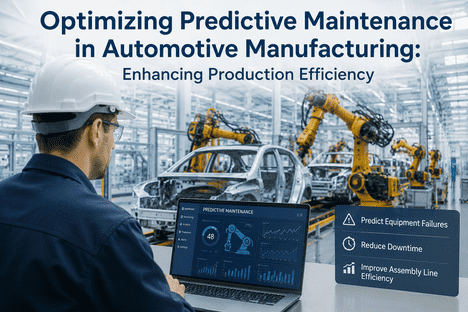
Manufacturing operations are undergoing a fundamental transformation as AI-driven predictive maintenance replaces reactive and calendar-based strategies at scale. The global predictive maintenance market reached $14.29 billion in 2025, with manufacturing accounting for the largest end-use segment at 30–32% of total spending. Yet traditional maintenance approaches remain dominant: 82% of companies have experienced unplanned downtime in the past three years, and the average large plant still loses 27 hours per month to unexpected equipment failures. The gap between technology availability and operational adoption is where the transformation opportunity lies. iFactory AI unifies real-time IoT sensor ingestion, machine learning failure prediction, and automated work order generation into a single platform — delivering documented 30–50% unplanned downtime reduction, 18–25% maintenance cost savings, and 10:1 to 30:1 ROI within 12–18 months. Book a Demo to see how AI predictive maintenance transforms your manufacturing operations.
Why Traditional Maintenance Falls Short in Modern Manufacturing
Calendar-based preventive maintenance follows OEM-recommended intervals regardless of actual equipment condition — either replacing components with 60% remaining useful life or leaving degradation undetected until catastrophic failure. This approach was designed for an era when plants had limited sensor data and no AI analytics. Today's manufacturing environment — with 24/7 production cycles, hundreds of interconnected assets, and real-time data from thousands of IoT sensors — requires a fundamentally different reliability model. Here is why traditional maintenance is the bottleneck in manufacturing transformation.
Preventive maintenance replaces components on calendar schedules regardless of actual wear. Studies show 30–40% of PM tasks are unnecessary — replacing bearings, belts, and seals with significant remaining life. Condition-based AI PdM eliminates this waste while improving reliability. The result: 18–25% maintenance cost reduction vs preventive approaches, and up to 40% vs pure reactive models.
Manufacturing plants generate massive data from PLCs, SCADA systems, and IoT sensors. Yet only 43% of that data is used effectively. The intelligence to predict failures exists in the data streams — but without machine learning models, raw telemetry remains noise. AI PdM converts this untapped data into prioritized, actionable maintenance decisions.
Unplanned downtime costs a median of $125,000 per hour for mid-to-large manufacturing operations. Fortune 500 companies lose $1.4 trillion annually to downtime. Emergency maintenance labor, expedited parts shipping, and lost production revenue compound rapidly. AI PdM predicts failures 30–60 days in advance, enabling planned interventions during low-production windows.
78% of maintenance organizations report skills-related obstacles. The manufacturing sector faces 2.1 million unfilled jobs projected by 2030. Experienced technicians retire, taking tribal knowledge with them. AI PdM captures and codifies failure patterns, enabling junior technicians to perform at expert level — reducing troubleshooting time by 60% through prescriptive recommendations.
Most plants report OEE daily or weekly — creating a 12–24 hour lag between problem occurrence and management visibility. In that window, a defect spike contaminates thousands of units, a micro-stop cascade costs hours of throughput, or an equipment fault escalates to catastrophic failure. AI PdM transmits real-time OEE data every 60 seconds, enabling immediate response.
What Actually Transforms Manufacturing Operations
Documented solutions deployed across automotive, food & beverage, semiconductor, and discrete manufacturing. Each transforms operations by replacing calendar-based maintenance with condition-based intelligence. Book a Demo to see which solutions map to your facility's biggest operational bottlenecks.
Real-time ingestion of vibration, temperature, current draw, and pressure data from plant-floor equipment. ML models trained on historical failure patterns detect anomalies 30–60 days before failure. 85%+ prediction accuracy with 60–80% fewer false alarms than threshold-based monitoring. Documented across 50+ manufacturing deployments.
AI-generated maintenance windows optimized around production peaks. Interventions scheduled during natural capacity gaps rather than interrupting production runs. Adaptive scheduling reduced planned downtime conflicts by 40% in documented deployments. Work orders auto-generated with parts lists, skill requirements, and procedure references.
Connects existing plant-floor sensors, PLCs, and SCADA systems into unified equipment health view. Supports Modbus, OPC-UA, MQTT, and 200+ OEM device protocols. No rip-and-replace required. 40% of sensor data is sufficient for high-value predictions — existing infrastructure often eliminates need for new hardware investment.
Live equipment health data feeds MES, CMMS, and ERP systems every 60 seconds. Production directors see real-time OEE trends, distinguish downtime causes (defect spikes, changeover delays, equipment faults), and respond with targeted interventions. Documented 8–11% OEE improvement in facilities with full AI-CMMS integration.
Manufacturing Transformation Deployments: What Actually Happened
Real-world manufacturing deployments of AI predictive maintenance at production scale. These are not pilot concepts — they are deployed across global facilities with measurable, documented outcomes.
Documented Manufacturing Transformation Outcomes
These outcomes come from actual AI predictive maintenance deployments across global manufacturing — not theoretical projections.
Across manufacturing PdM deployments. Best documented results reach 70–75% reduction in equipment breakdowns.
Vs traditional preventive approaches. Up to 40% vs pure reactive models. Unilever achieved 45% from $5.1M baseline.
Condition-based intervention prevents breakdown trauma and unnecessary PM teardowns. AI-monitored assets last significantly longer.
27% of manufacturers achieve full payback within 12 months. 75% report measurable ROI in under 6 months (MaintainX 2026).
Facilities integrating AI with CMMS report sustained OEE gains. Micro-stops reduced 35% through AI pattern recognition.
Fortune 500 companies could collectively save with full PdM adoption. 2.1 million hours of downtime recoverable annually.
The Manufacturing PdM Transformation Timeline: From Reactive to Predictive
Manufacturing operations do not transform overnight. The shift from reactive to predictive maintenance follows a documented maturity curve that leading plants navigate in 12–18 months.
IoT and SCADA data ingestion established. Equipment health baselines computed. Historical failure data integrated into AI training pipeline. 82% of plants already have sufficient data for model training — no new sensor investment required for initial deployment.
Failure prediction models calibrated per asset class. First anomalies detected — typically 30–60 day advance warning. False positive rate drops below 5% within 6 months through human-in-the-loop feedback. First documented "saves" (failures avoided) appear.
Automated work orders replace calendar-based PM schedules. Emergency maintenance reduced 60–75%. OEE improvement of 8–11% documented. First ROI milestones achieved — typically 10:1 within 12 months. 27% of manufacturers achieve full payback by month 12.
AI-driven maintenance scheduling fully integrated with MES and production planning. Self-optimizing maintenance windows. Predictive models extended to quality and energy optimization. Multi-site expansion at fraction of initial deployment cost. 90%+ dispatch reliability sustained.