At 6:47 AM on a Monday at a major international airport serving 45 million passengers annually, the baggage handling system's carousel #3 drive motor bearing temperature reaches 87°C — 22°C above its normal operating baseline of 65°C. The SCADA alarm panel lights up on the maintenance desk, but the duty technician is 15 minutes away in terminal C responding to a reported escalator vibration. By the time he reaches the carousel, the motor has already drawn 2.4× its rated current for 11 minutes, the winding insulation is degraded by an estimated 40%, and the carousel will need a full motor replacement during the night's maintenance window — a $34,000 repair that could have been a $1,200 bearing replacement if the degradation trend had been caught 72 hours earlier. For airport operations teams managing baggage systems, boarding bridges, HVAC, escalators, runway lighting, and UPS infrastructure across terminals that never close, equipment failure is never just a maintenance event. It is a passenger experience failure, a flight delay, a security checkpoint closure, and a cascade of airline compensation claims that compound by the hour. Book a Demo to see how iFactory predicts baggage system, HVAC, escalator, and power infrastructure failures 72–96 hours before they disrupt airport operations.
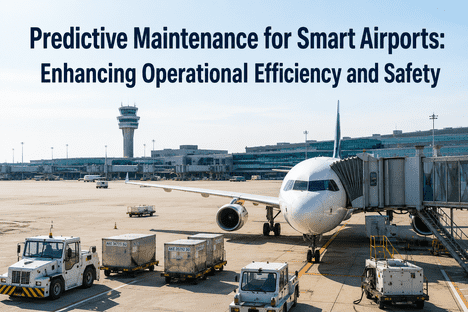
Predictive Maintenance for Smart Airports: Enhancing Operational Efficiency and Safety Across Terminal and Airfield Infrastructure
iFactory monitors your baggage handling systems, boarding bridges, escalators, HVAC, runway lighting, UPS, and security screening equipment in real time — predicting failures 72–96 hours before they disrupt flight operations, passenger flow, or safety systems. On-premise AI. Zero cloud dependency. Works with existing BMS, SCADA, and IoT sensors.
What changes when your airport operations team stops reacting to equipment failures and starts preventing them with AI-driven predictions
The gap between an airport that experiences 4–6 unplanned baggage system stoppages per month and one that experiences zero is not better technicians — it is better intelligence. Here is what that shift looks like for a typical hub airport managing 30+ terminal assets and 100+ airfield systems.
Without iFactory
- Maintenance team responds to alarm after alarm — escalator vibration, carousel overcurrent, HVAC chiller high-head pressure — with no prioritization
- Baggage system breakdown forces manual sorting of 8,000 bags per hour through a single backup carousel
- Boarding bridge hydraulic leak grounds a gate for 6 hours — 4 flight departures are reassigned to remote stands at $12,000 in additional busing and towing costs
- Runway edge light failure goes undetected until the daily airfield inspection — 18 hours after the fault occurred
- Maintenance is calendar-based: HVAC filters changed every 90 days regardless of actual load or particulate accumulation
With iFactory
- Predictive alerts are prioritized by impact on flight operations and passenger experience — "Carousel #3 bearing degradation — 84 hours remaining — schedule replacement during night window"
- Baggage drive motor, belt splice, and bearing health are monitored continuously — zero unplanned stoppages in the first 90 days
- Boarding bridge hydraulic cylinder seal degradation detected 72 hours before failure — replacement completed during scheduled gate downtime
- Runway light current draw monitored in real time — LED driver failure predicted 96 hours before complete outage
- Maintenance becomes condition-based: HVAC pre-filter changes triggered by differential pressure sensor data, not a calendar
Every unplanned equipment failure at an airport costs more than the repair — it costs on-time performance, passenger satisfaction, and airline relations
In airport operations, equipment failures cascade across multiple stakeholders. A single baggage system stoppage affects 15+ flights. An escalator failure forces passengers with heavy luggage to wait for elevators, creating queues that back up through security. Here is what reactive maintenance actually costs across a typical hub airport.
Baggage handling system breakdown — airline compensation + OT labor
When a baggage carousel drive motor fails, 8,000 bags per hour must be manually sorted and transported to aircraft. Airlines pay $12–$25 per delayed bag in compensation. A 45-minute stoppage on a peak departure bank costs $48,000 in airline claims plus 6 hours of overtime for 30 baggage handlers.
Boarding bridge hydraulic failure — gate reassignment + busing
A boarding bridge hydraulic leak grounds a gate for 6 hours. Four departing flights are reassigned to remote hardstands, requiring busing for 1,200 passengers at $4/passenger, plus 20-minute boarding delays that cascade into missed slots and ATC fines.
Escalator or moving walkway failure — passenger flow disruption
An escalator drive chain failure in a connector corridor between terminals forces 8,000 passengers per hour to use a single bank of elevators. Average transit time triples. Missed connections increase by 40%, costing the hub airline $120,000 in rebooking and hotel costs per major failure event.
HVAC chiller failure — terminal temperature excursion + retail revenue loss
An HVAC chiller compressor failure in a concourse during summer peak causes terminal temperature to rise to 88°F. Passengers move to cooler gates, concourse retail sales drop 35%, and airlines file comfort complaints. Chiller replacement costs $280,000, plus $90,000 in lost retail revenue during the 3-day outage.
Runway edge light or signage failure — FAA compliance + safety risk
An LED constant-current regulator for runway edge lights fails, taking out 200 ft of taxiway lighting. The FAA mandates reduced operations in low visibility until repaired. A 4-hour repair delay during an IFR period forces 8 flight cancellations at $22,000 per cancellation.
Airports that deploy predictive maintenance cut unplanned equipment failures by 56% and save $3M+ per year in avoided flight delays, passenger compensation, and emergency repairs. Book a Demo and we will show you how iFactory predicts your next baggage system, boarding bridge, or HVAC failure before it disrupts operations.
From BMS data connection to failure prediction in 8–12 weeks — no data science team required
iFactory connects to your existing building management system, baggage SCADA, escalator monitoring controllers, airfield lighting control systems, and UPS monitoring infrastructure — all on your OT network with zero cloud egress. The platform ingests data, trains predictive models on your specific terminal and airfield assets, and delivers alerts to operations teams in plain language.
Connect your airport asset data
We connect to your existing BMS, baggage handling SCADA, escalator PLCs, boarding bridge controllers, airfield lighting CMS, fire alarm panels, and UPS monitoring systems — no new instrumentation required, no cloud connectivity.
Train AI on your asset signatures
iFactory ingests 60–90 days of historical vibration, temperature, current, pressure, and cycle time data to learn the normal operating envelope for each baggage carousel, boarding bridge, escalator, chiller, and runway lighting circuit in your airport.
Receive 72–96 hour failure alerts
When the model detects a bearing degradation pattern on a carousel drive, hydraulic cylinder seal wear on a boarding bridge, or compressor efficiency drop on an HVAC chiller, operations teams receive a plain-language alert with remaining useful life and recommended action.
Close the loop with root cause correlation
Every alert traces back to the sensor data that triggered it — current draw trend on a baggage motor, vibration spectrum on an escalator gearbox, differential pressure on an HVAC filter. Maintenance teams see exactly which operating conditions accelerated the degradation.
Predictive maintenance capabilities purpose-built for airport terminal and airfield infrastructure
These are live capabilities shipping with every iFactory deployment — running on your OT network, connected to your critical airport assets, and delivering predictions within 8–12 weeks of project kickoff.
Baggage handling system drive and conveyor monitoring
iFactory models motor current, bearing vibration, belt tension, and gearbox temperature on every baggage carousel, belt conveyor, and sortation drive. When bearing fatigue, belt splice degradation, or gear wear patterns emerge, the system alerts maintenance 72 hours before a stoppage that would affect flight departures.
Boarding bridge hydraulic and structural diagnostics
By correlating hydraulic cylinder pressure, extension/retraction cycle time, and structural vibration during passenger boarding, iFactory predicts seal degradation, hydraulic pump wear, and structural joint fatigue 96 hours before a gate closure is required.
Escalator and moving walkway gearbox and drive monitoring
Motor current signature analysis, gearbox vibration, step chain tension, and brake wear data feed iFactory's predictive models. An escalator drive chain elongation pattern or gear tooth fatigue trend triggers an alert 72 hours before a passenger-moving equipment shutdown is required.
100% on-premise deployment — zero cloud dependency
iFactory runs on an NVIDIA appliance inside your airport's OT network. Zero data leaves the facility. No cloud connectivity required. Fully compliant with airport cybersecurity requirements, including TSA Security Directives, ACI cybersecurity guidelines, and IEC 62443 standards for critical infrastructure.
Everything you need to go from calendar-based maintenance to AI-driven condition-based maintenance across your airport — delivered as a turnkey managed service
iFactory is a managed service that arrives pre-configured to your airport's terminal and airfield equipment, runs on a dedicated NVIDIA appliance on your OT network, and delivers first predictions in 8–12 weeks. Here is exactly what is included.
Turnkey pilot delivery in 8–12 weeks
We connect to your BMS, baggage SCADA, escalator controllers, boarding bridge systems, and airfield lighting CMS, train the AI on your critical terminal assets, and deliver live predictions — all within 12 weeks of project kickoff.
100% on-premise — secure and compliant
The entire system runs on a dedicated NVIDIA appliance inside your OT network. No data egress. No cloud subscription. Fully compliant with TSA Security Directives, ACI cybersecurity guidelines, and your internal IT security policies for critical airport infrastructure.
Operations-facing plain-language alerts
No dashboards to configure. No complex analytics software. The AI speaks to your airport operations team: "Baggage carousel #3 drive motor bearing degradation detected — 78 hours remaining useful life — schedule replacement during night maintenance window." That is the interface.
24x7 managed service from iFactory engineers
Our operations team monitors your predictive models and appliance infrastructure around the clock. If a model drifts or a data feed drops, we fix it before your next departure bank begins. No on-site data science team required.
Proven 56% reduction in unplanned equipment failures
Across airport deployments, iFactory delivers an average 56% reduction in unplanned baggage, boarding bridge, escalator, and HVAC failures within 90 days of go-live. We target measurable improvement in terminal asset reliability from quarter one.
Continuous model retraining as equipment and traffic patterns evolve
As your airport adds gates, upgrades baggage systems, installs new escalators, or experiences seasonal traffic shifts, the AI retrains automatically. Your predictions stay accurate as your terminal infrastructure evolves and passenger volumes grow.
Questions airport operations leaders ask about AI-driven predictive maintenance for terminal and airfield infrastructure
Stop Responding to Airport Equipment Failures. Start Predicting Them.
iFactory gives your airport operations and maintenance team a 72–96 hour look-ahead on baggage system, boarding bridge, escalator, HVAC, and airfield lighting failures — saving your airport $3M–$6M per year in avoided flight delays, airline compensation, emergency repairs, and lost retail revenue. The pilot takes 8–12 weeks. The ROI shows up in one quarter.