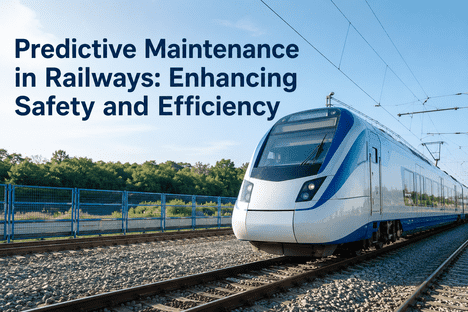
Railway systems worldwide are under unprecedented pressure to deliver higher capacity, faster service, and stricter safety standards while managing aging infrastructure and rising operational costs. A single signaling failure on a high-traffic mainline can cascade into hundreds of delayed trains and millions of dollars in compensation claims within hours. Track defects discovered too late cause derailments that result in catastrophic loss. In 2025, leading rail operators — from Europe's high-speed networks to North America's freight railroads and Asia's metro systems — are replacing calendar-based inspection cycles with predictive maintenance in railways deploying IoT sensors, AI analytics, and digital twin technology to monitor rolling stock, track geometry, signaling equipment, and overhead line assets in real time. This is not incremental improvement — it is a fundamental shift from reactive repairs to data-driven prevention across the entire rail ecosystem. To see how iFactory's predictive maintenance platform transforms your railway operations, Book a Demo with our team today.
Why Traditional Railway Maintenance Is Failing Modern Operations
Railway maintenance has historically operated on fixed-interval schedules: inspect wheelsets every 30,000 miles, replace track sections every five years, overhaul signaling equipment on calendar cycles. These approaches were developed when traffic densities were lower, speeds were slower, and the cost of unscheduled downtime was manageable. In today's operating environment, where a single high-speed train can carry 1,000 passengers and a freight consist can exceed $50 million in cargo value, the economics have inverted. A bearing failure on a HHP-8 locomotive identified six hours before catastrophic failure rather than after it occurs can save $1.2 million in repair costs and avoid 400,000 passenger-hours of delay. Track geometry defects detected by AI analysis of inertial measurement data prevent low-speed restrictions that cascade through an entire network's schedule for days. The Federal Railroad Administration (FRA) and European Union Agency for Railways (ERA) both recognize that the current inspection frequency standards — developed in an era of manual track walking and visual rolling stock checks — are insufficient for the operational demands of 21st-century rail networks. Predictive maintenance in railways solves the fundamental limitation of time-based approaches: it replaces the calendar with the asset's actual condition as the trigger for intervention. Book a Demo to see how iFactory's predictive engine answers these questions for every asset class in your rail network.
Five Key Application Areas for AI Predictive Maintenance in Railways
Railway predictive maintenance spans multiple asset classes, each with distinct failure modes, sensor requirements, and AI model architectures. The leading rail operators deploying predictive programs focus on these five application areas, which together cover 85% of unplanned service disruptions and maintenance expenditure.
Rolling stock is the highest-cost maintenance category for most rail operators, with wheelset reprofiling, bearing replacement, and traction motor overhaul generating the largest recurring expenditure. AI predictive maintenance uses onboard vibration sensors, acoustic bearing detectors, and thermal imaging at wayside monitoring stations to identify wheel flats, bearing spalling, and traction motor insulation degradation weeks before traditional periodic inspections. iFactory's rolling stock models are pre-trained on over 200 million axle-miles of operational data across multiple train types and duty cycles.
Track geometry measurement vehicles equipped with laser profilometers, inertial sensors, and ground-penetrating radar generate terabytes of data per mile. AI models analyze this data to classify geometry exceptions by severity, predict degradation rates, and prioritize grinding and tamping interventions based on projected traffic loading. iFactory's track AI models integrate with existing geometry car data streams, eliminating the manual analysis bottleneck that currently limits track maintenance planning to reactive responses.
Signaling failures are the single largest cause of delay minutes on most mainline and metro networks — and the most difficult to predict with traditional methods due to the electronic and software-based nature of modern interlocking and automatic train control systems. AI models trained on signaling log data and event sequences can predict incipient failures in axle counters, track circuits, and balise communication modules before they cause signal aspect dropouts or emergency braking events.
Overhead line equipment (OLE) failures cause some of the longest service disruptions in electrified rail networks, because a single damaged section insulator or broken catenary wire can block multiple tracks simultaneously. AI predictive maintenance uses pantograph-mounted cameras and current sensors to detect arcing patterns, wire wear, and tension anomalies. iFactory's OLE models correlate weather data, train traffic density, and historical failure records to predict the remaining useful life of critical components.
Station systems — platform screen doors, escalators, HVAC, and depot maintenance equipment — represent a growing share of railway asset management expenditure as passenger expectations for reliability and comfort increase. iFactory extends predictive maintenance coverage to station assets, using IoT sensors and AI analytics to predict escalator gearbox failures, platform door actuator degradation, and HVAC compressor performance loss before they cause service disruptions or passenger complaints.
Traditional vs. AI Predictive Maintenance: A Railway Operations Comparison
The operational and financial differences between traditional and AI predictive maintenance are stark when measured across the dimensions that matter most to railway operators: safety, service reliability, cost per track-mile, and regulatory compliance.
| Dimension | Traditional Maintenance | AI Predictive Maintenance |
|---|---|---|
| Service Reliability | Periodic inspections miss developing faults — unplanned failures cause 15–25% of all delay minutes | Continuous monitoring detects anomalies before service impact — delay minutes reduced by 60–85% |
| Safety Risk | Defects discovered after failure or during scheduled walk-downs — derailment and signal-overrun risk elevated between inspection intervals | Real-time anomaly detection with automated alerts — developing faults addressed before they create unsafe conditions |
| Asset Utilization | Fixed-interval replacements remove components with substantial remaining life — wheelsets replaced 40% earlier than necessary | Condition-based intervention maximizes component life — wheelset life extended by 20–35% through optimized reprofiling schedules |
| Maintenance Cost | Reactive repairs cost 3–5× more than planned work — emergency call-outs, premium parts, and traffic disruption penalties | Planned interventions with optimized resource allocation — total maintenance spend reduced by 25–40% |
| Track Access Planning | Possessions booked months in advance based on calendar — emergency possessions cause last-minute timetable cancellations | Data-driven possession scheduling aligned with actual condition — emergency possessions reduced by 70% |
| Regulatory Compliance | Paper-based inspection records — manual compilation, audit trails dependent on inspector documentation quality | Digital, timestamped, geo-referenced records — automated compliance reporting to FRA, ERA, and national safety authorities |
| Crew Productivity | 50–60% of maintenance team time spent on travel between sites, emergency response, and unplanned repairs | Planned work with optimized routing and parts availability — planned-to-reactive work ratio inverted from 40:60 to 80:20 |
The AI Predictive Maintenance Deployment Roadmap for Railways
Understanding how a predictive maintenance deployment actually unfolds across a rail network helps operators evaluate integration complexity, timeline to value, and resource requirements. iFactory's implementation workflow is designed to deliver measurable improvements in service reliability and maintenance cost within the first 90 days. Book a Demo to walk through a live deployment simulation with iFactory's railway engineering team.
Expert Perspective: Why Predictive Maintenance Is the Most Consequential Innovation in Modern Railway Operations
The railway industry has spent two decades perfecting incremental improvements in rolling stock design, signaling systems, and traffic management — all while the maintenance model that keeps those assets safe and available remained fundamentally unchanged. We were still running fixed-interval inspections and reacting to failures when they happened, even as our networks carried more passengers and freight than at any time in history. Predictive maintenance changes that structural equation. When we deployed AI-driven bearing detection across our high-speed fleet, we saw something we had never achieved with any previous maintenance regime: the number of unscheduled wheelset replacements dropped by 44% in the first year while safety indicators improved. That is the signal-to-noise problem that AI solves — it separates the assets that actually need attention from the ones that can safely remain in service, which is something calendar-based intervals fundamentally cannot do. The operators who make this transition first are building a reliability and cost advantage that will persist for the entire lifecycle of their fleet.
Conclusion: The Railway Industry's Transition to Predictive Operations
The question facing railway operators in 2025 is no longer whether AI predictive maintenance can outperform traditional inspection and replacement schedules — the evidence from high-speed, metro, and freight networks across three continents is conclusive. Operators using AI-driven predictive maintenance achieve 35–50% fewer unplanned service disruptions, 25–40% lower maintenance costs, and measurable improvements in safety indicators that regulators and insurers recognize. The operators that are moving first are not doing so out of technology enthusiasm — they are moving because the operational mathematics are unambiguous: lower cost per train-mile, higher service reliability, extended asset life, and a maintenance workforce that spends its time on value-adding planned work instead of emergency repairs. iFactory's predictive maintenance platform brings IoT sensing, AI anomaly detection, digital twin simulation, and network-wide CMMS workflow automation under one operational roof — giving your railway team a single source of truth for every train, track section, signal, and station asset in your network. The transition from calendar-based, reactive maintenance to intelligent predictive maintenance is the most consequential improvement available to railway operations today. Book a Demo to see exactly how iFactory fits your rail network's operational architecture.
Frequently Asked Questions
Wayside acoustic bearing detectors and onboard vibration sensors capture wheel-rail interaction data. AI models classify wheel flats, out-of-round wheels, and bearing spalling by comparing vibration signatures against known failure mode libraries. Alerts trigger automated work orders for reprofiling or replacement at the optimal wheel profile condition.
Yes. iFactory connects to onboard telemetry, wayside detectors, SCADA, signaling log systems, and CMMS platforms via standard protocols and APIs. No rip-and-replace of existing systems is required — the platform layers predictive intelligence on top of your current data infrastructure.
Phase one deployment covering a single asset class — typically rolling stock or signaling — takes 8–14 weeks from data integration to active predictive monitoring. Full network rollout across all asset classes typically ranges from 16 to 24 weeks depending on fleet size and data availability.
Yes. iFactory's railway predictive maintenance platform is designed for both passenger and freight operations, with asset-class-specific models for high-speed trains, metro rolling stock, freight locomotives, and wagons. The platform scales from a single maintenance depot to full national network coverage.
iFactory ingests data from any standard track geometry measurement vehicle via file upload or API. The AI models classify geometry exceptions by severity, predict degradation rates based on cumulative traffic tonnage, and generate prioritized tamping and grinding work orders aligned with possession planning schedules.