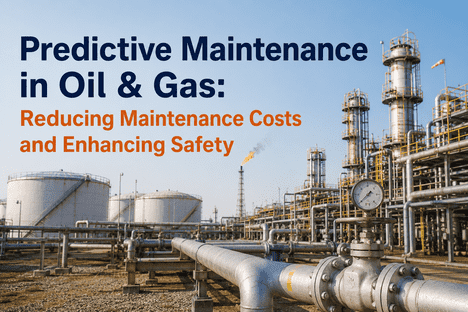
Predictive Maintenance in Oil & Gas: Reducing Maintenance Costs and Enhancing Safety
By Rebecca on June 2, 2026
Oil and gas operations face extreme conditions that push equipment to its limits — high pressure, corrosive environments, temperature extremes, and continuous duty cycles on pumps, compressors, turbines, pipelines, and drilling rigs. A single unplanned failure on a critical asset can cost millions in lost production, environmental remediation, and safety incident response. Traditional preventive maintenance based on calendar intervals or runtime hours cannot account for the variability in operating conditions across different wells, pipelines, and processing facilities. Predictive maintenance powered by AI and IoT telemetry is transforming how oil and gas operators manage asset health: vibration analysis detects compressor blade fatigue, acoustic monitoring identifies pipeline wall thinning, thermal imaging predicts refinery furnace tube failures, and corrosion sensors forecast integrity loss before leaks occur. iFactory AI's industrial software platform, including its Shift Logbook and predictive maintenance engine, enables oil and gas operators to deploy AI-native predictive maintenance without replacing existing SCADA, CMMS, or ERP systems. Book a Demo to see how iFactory applies predictive maintenance for oil and gas operations. This guide explores the technology stack, critical failure modes, safety implications, and the practical deployment path for operators evaluating modernization.
Oil & Gas · Asset Safety · 2026
Predictive Maintenance for Oil & Gas
AI-driven failure prediction · corrosion monitoring · rotating equipment prognostics — reducing unplanned downtime, enhancing safety, and extending asset life across upstream, midstream, and downstream operations.
Why Traditional Maintenance Is Hitting Its Ceiling in Oil and Gas
The traditional approach — scheduled shut-downs, time-based component replacement, and manual inspection rounds — treats every asset identically regardless of actual operating conditions. A compressor in a sour gas field with high H2S concentration corrodes at 5x the rate of the same model in a sweet gas field. A subsea pipeline in deepwater experiences fatigue cycles that differ dramatically from a onshore pipeline. Fixed-interval maintenance either over-serves healthy assets (wasting production uptime and parts) or under-serves assets approaching failure (risking catastrophic leaks, blowouts, and safety incidents). Four specific ceilings are visible across every mature oil and gas operation.
01
Fixed Shutdown Schedules
Calendar-based turnarounds ignore actual equipment condition. A gas turbine running in clean gas may run 30,000 hours between overhauls; the same model in dirty gas fails at 12,000. AI models use vibration, temperature, and combustion data per asset.
Gap: Calendar-based vs Condition-based
02
No Cross-Asset Learning
Each wellhead, compressor, and pipeline segment has siloed data. Patterns — a specific valve model failing in H2S environments, or pump seal degradation correlating with produced-water chemistry — remain invisible. AI models learn across the entire asset base.
Gap: Siloed vs Enterprise-wide
03
Reactive Safety Response
Leaks, blowouts, and fires follow identifiable precursor patterns in pressure, temperature, and flow data. Manual inspection intervals miss the precursors. AI predictive models detect degradation 14–30 days before failure — enabling intervention before safety events.
Gap: Reactive vs Predictive Safety
04
Fragmented Data Architecture
SCADA data lives in one system, corrosion monitoring in another, vibration analysis in a third, maintenance records in a CMMS, and safety logs in spreadsheets. No unified view connects asset health to risk. AI-native platforms fuse all streams into single asset dashboards.
Gap: Fragmented vs Unified
What Predictive Maintenance Actually Adds to Oil and Gas Operations
The misconception some operators carry: predictive maintenance replaces existing SCADA, CMMS, or ERP systems. It doesn't. Your CMMS continues handling work orders, parts inventory, and maintenance schedules. Your SCADA continues monitoring process variables in real time. What changes is the intelligence layer feeding those systems. Time-based maintenance schedules migrate to AI-driven condition-based predictions. SCADA alarm thresholds gain predictive context. The existing CMMS receives higher-quality input — not just "compressor failed — repair" but "compressor shows blade-pass vibration elevation at 91% confidence — estimated 18 days remaining useful life — root cause: upstream filter bypass — recommended parts pre-ordered." iFactory AI's Shift Logbook provides operators and maintenance teams with a unified interface for shift handovers, equipment status, and AI-generated maintenance recommendations integrated with existing workflows.
Capability
Traditional Maintenance
AI Predictive Maintenance
Service trigger
Calendar / runtime hours
Predicted remaining useful life per asset
Corrosion monitoring
Manual UT inspection on schedule
Continuous AI prediction from corrosion sensor arrays
Failure notification
After leak / failure (reactive)
14–30 day predictive lead time before failure
Safety monitoring
Manual rounds + fixed gas detectors
Continuous AI monitoring of safety-critical parameters
Spare parts planning
Reactive after breakdown
Predictive demand — pre-positioned to site
Asset coverage
Critical assets only
All instrumented assets enterprise-wide
Operator interface
Paper logs + SCADA dashboards
Mobile dashboards + shift logbook + AI copilot
Critical Failure Modes in Oil and Gas — What AI Catches That Manual Inspections Miss
Oil and gas equipment fails through specific mechanical and corrosion processes that leave identifiable signatures in sensor data before they become visible to operators or inspectors. AI models trained on these signatures detect degradation 14–30 days before failure — the window that separates planned intervention from catastrophic event.
R
Rotating Equipment
Compressor blade fatigue, turbine bearing wear, pump seal degradation, gearbox pitting, centrifugal compressor surge precursors. AI correlates 12+ sensor streams per machine to predict remaining life.
Predictive lead time: 14–21 days
C
Corrosion & Erosion
Pipeline wall thinning, vessel corrosion under insulation, erosion in choke valves and bends, sour service cracking, galvanic corrosion at flanges. AI models fuse UT data, process conditions, and fluid chemistry.
Predictive lead time: 21–30 days
P
Piping & Valves
Valve seat leakage, actuator failure, pressure safety valve degradation, pipeline fatigue crack propagation, flange joint integrity loss. AI detects leak signatures before they reach detectable concentration.
Predictive lead time: 14–21 days
S
Safety Systems
ESD valve partial stroke degradation, fire suppression system corrosion, blowout preventer control system drift, gas detection sensor calibration drift, relief valve set-point creep.
Predictive lead time: 14–30 days
The Keep / Retire / Transform / Replace Decision Matrix
Migration discipline starts here. Every asset management artifact in your current operation falls into one of four categories. Getting the categorization right in week one of the workshop saves quarters of debate later.
Keep
Core operations foundations
CMMS work order engine
SCADA / DCS process control
Parts inventory & procurement
ERP financial integration
Safety management systems
Established capabilities. No business case to replace. AI predictive maintenance writes recommendations and work orders to these systems.
Retire
Legacy inspection layers
Fixed calendar-based turnarounds
Paper inspection checklists
Standalone corrosion monitoring silos
Manual vibration data collection
Email-based alert notification
Replaced by AI-driven condition-based predictions and unified interface. 70–90% reduction in manual monitoring effort.
Transform
Analysis workflows
Asset health scoring
Corrosion rate trending
Risk-based inspection prioritization
Turnaround optimization
Shift handover reporting
Become AI model invocations grounded in real-time data. Intelligence upgraded via iFactory Shift Logbook.
Replace
Alert & notification layer
Legacy alarm notification gateways
Manual escalation workflows
Standalone safety alert systems
Paper-based shift logs
Siloed corrosion reports
Event-driven AI alert engine replaces manual notification. Safety-critical alerts with automated work order creation.
Want this matrix applied to your specific asset inventory in a working session? Book a Demo to walk through every asset class and prioritize your predictive maintenance rollout.
Three Deployment Paths for Oil and Gas Predictive Maintenance
Same starting point, three valid destinations. The right path depends on asset criticality, regulatory exposure, remote location, and current sensor instrumentation. Operators that pick the wrong path spend 12 months in pilot purgatory. Operators that pick the right path deploy in 8–12 weeks.
Path A
Augment in Place
6–8 weeks
AI predictive monitoring runs alongside existing PM and RBI programs. Shadow mode for 4 weeks. Alerts flow to CMMS for review. No legacy systems retired.
Best fit
Safety-critical environments · risk-averse operations · first AI deployment in asset management
Wk 1–2 Sensor data federation
Wk 3–5 Shadow mode AI
Wk 6–8 CMMS integration live
Path B
Hybrid Migration
8–12 weeks
AI predictive layer replaces fixed turnaround schedules. Legacy dashboards retire for unified mobile UX. SCADA, CMMS, and ERP preserved. Corrosion data federated.
Best fit
Mature operations · moderate budget authority · sponsorship for digital transformation
Wk 1–3 Discovery · matrix
Wk 4–8 Deploy AI prediction layer
Wk 9–12 Mobile UX migration · cutover
Path C
Full Modernization
10–14 weeks
Legacy fixed-interval programs retired. iFactory platform provides full predictive capability. CMMS retained. All asset classes covered against matrix.
Best fit
Large multi-asset operations · siloed legacy systems · strategic platform consolidation
Wk 1–4 Full asset inventory + matrix
Wk 5–10 Parallel build + test
Wk 11–14 Cutover + legacy sunset
Pick the Right Path for Your Assets in a 90-Minute Workshop
iFactory AI's oil and gas practice runs a focused workshop against your specific asset classes, sensor coverage, existing CMMS configuration, and regulatory requirements. You leave with a defended path recommendation, a 12-week deployment plan, and a cost reduction projection grounded in your maintenance history.
Vendor Evaluation Framework — Oil and Gas Specific Questions
Generic predictive maintenance vendors handle the AI math. Oil and gas-aware vendors handle the integration reality — upstream, midstream, and downstream asset diversity, hazardous area certification, corrosion management integration, remote and offshore connectivity, and zero-disruption deployment. Eight criteria separate vendors who've done oil and gas modernizations from vendors selling a demo.
01
Hazardous area deployment capability
Ask:
"Can your AI platform run in classified areas (ATEX / IECEx Zone 1 and 2) on existing infrastructure?"
Platforms requiring cloud access or non-certified hardware cannot operate in hazardous zones. On-premise edge deployment with ATEX/IECEx-certified hardware is required for upstream and downstream classified areas.
02
Corrosion and erosion monitoring
Ask:
"Does your platform integrate with UT sensors, corrosion coupons, electrical resistance probes, and acoustic emission sensors?"
Corrosion is the leading failure mode in oil and gas. Platforms that only monitor rotating equipment miss 40% of failure risk. Production-grade platforms fuse corrosion data with process conditions.
03
Remote and offshore connectivity
Ask:
"How does your platform handle intermittent satellite connectivity on offshore platforms and remote well sites?"
Edge processing with local model inference and store-and-forward data synchronization is required. Cloud-dependent platforms fail on offshore platforms with limited bandwidth.
04
Safety system integration
Ask:
"Does your platform integrate with ESD, fire and gas, and BOP control systems for predictive monitoring?"
Safety-critical system monitoring requires read-only connections (no control loop interference) and the highest data integrity standards. Platforms must demonstrate SIL-rated integration patterns.
05
Rotating equipment prognostics
Ask:
"Which rotating equipment types does your platform provide remaining useful life predictions for?"
Gas turbines, centrifugal and reciprocating compressors, pumps (API 610), generators, gearboxes, and fans are the minimum set. Single-asset-type platforms deliver limited ROI for multi-asset facilities.
06
Pipeline integrity management
Ask:
"Does your platform integrate with pipeline integrity data — ILI, cathodic protection, pressure cycling, and geohazard monitoring?"
Pipeline predictive maintenance requires fusing inline inspection data with continuous pressure, flow, and cathodic protection monitoring. Platforms without pipeline capability miss midstream entirely.
07
Regulatory compliance reporting
Ask:
"Does your platform generate reports aligned with BSEE, PHMSA, OSHA PSM, and EPA RMP requirements?"
Regulated operators need predictive maintenance records that satisfy jurisdictional reporting requirements. Platforms with pre-built regulatory report templates save months of deployment time.
08
Deployment timeline commitment
Ask:
"When does the first validated predictive alert reach our CMMS in production?"
8–12 weeks is the production-grade benchmark. Path A is 6–8 weeks. Path C is 10–14 weeks. Vendors quoting 6+ months are building custom development.
Want to score your shortlisted vendors against this 8-criterion framework? Book a Demo to run a vendor evaluation working session with our team.
The ROI Math — What Predictive Maintenance Delivers for Oil and Gas
The business case for AI-native predictive maintenance in oil and gas isn't about software cost — it's about cost avoidance on unplanned production loss, environmental remediation, and safety incidents. Operators moving from preventive to AI-native predictive maintenance see measurable improvements across four metrics in the first quarter post-deployment.
−35–55%
Unplanned downtime reduction
AI identifies equipment degradation 14–30 days before failure. Emergency shutdowns shift to planned maintenance during scheduled turnarounds.
−20–40%
Maintenance cost reduction
Condition-based service eliminates unnecessary overhaul work while catching failures before cascading damage inflates repair costs.
−50–70%
Leak / release event reduction
Corrosion and seal failure predictions produce 14–30 day lead time — enabling intervention before loss of containment.
6–12 mo
Typical ROI payback
Full investment recovery through downtime avoidance, incident cost reduction, and extended turnaround intervals.
Expert Perspective
"The single biggest mistake oil and gas operators make in predictive maintenance modernization is treating it as a CMMS replacement project. It isn't. Your work order engine, SCADA system, and procurement processes work as designed — there's no business case to replace them. What needs to change is the intelligence layer feeding those systems. Calendar-based turnaround schedules and fixed-interval inspection programs need to migrate to AI model invocations running remaining useful life predictions across rotating equipment, pipelines, pressure vessels, and safety systems. Corrosion monitoring data that currently sits in a quarterly spreadsheet needs to stream continuously into fusion models that predict loss of containment 30 days before it happens. The architectural decision isn't CMMS-or-AI — it's CMMS-plus-AI-plus-corrosion-plus-vibration-plus-process. Operators that frame it correctly deploy in 8–12 weeks. Operators that frame it as rip-and-replace spend 12 months in pilot purgatory."
— Oil and Gas Asset Management Practice, 2026 industry insight
8–12 wk
hybrid deployment with pre-configured oil and gas templates
70–90%
reduction in custom deployment scope with templates
Zero rip
of existing CMMS, SCADA, or ERP required
Conclusion: The Modernization Decision Has Three Right Answers
Calendar-based maintenance programs aren't failing in oil and gas — they're hitting an architectural ceiling that fixed-interval analysis can't cross. AI-native predictive maintenance adds the condition-based intelligence layer that traditional systems were never designed to deliver: remaining useful life predictions across rotating equipment and pipelines, corrosion rate fusion, safety-critical system monitoring, self-updating models from operator confirmations, and mobile-native operator interfaces grounded in real-time asset data. The modernization conversation has three valid answers depending on asset criticality and regulatory exposure — augment in place (6–8 weeks), hybrid migration (8–12 weeks), or full modernization (10–14 weeks). All three keep existing CMMS intact and reuse current sensor infrastructure. All three deliver 35–55% reduction in unplanned downtime and 50–70% reduction in leak events within the first quarter. The decision worth making in 2026 isn't whether to adopt AI predictive maintenance — it's which of the three paths fits your specific asset portfolio. Book a Demo to walk through your specific asset classes and predictive maintenance requirements.
Run the Predictive Maintenance Workshop Built for Your Operations
iFactory AI's oil and gas practice runs a 90-minute workshop against your real asset classes, sensor coverage, and CMMS configuration. You leave with a defended path recommendation, the keep/retire/transform/replace matrix applied to your assets, and a cost reduction projection grounded in your maintenance history.
Does predictive maintenance replace our existing SCADA or DCS system?
No. Your SCADA or DCS continues handling process control, alarm management, and operator interface exactly as today — these are mature, safety-critical systems with no business case to replace. What changes is that process data now feeds AI models that predict asset failures 14–30 days in advance, in addition to the real-time monitoring your operators already perform. The predictive layer sits on top of existing control systems through standard OPC UA and Modbus TCP integration. Deployment does not require any changes to control logic or safety instrumented systems.
What oil and gas failure modes can AI actually predict?
Production-grade AI predictive maintenance covers rotating equipment (gas turbine blade fatigue, compressor surge precursors, pump seal degradation, gearbox pitting), corrosion and erosion (pipeline wall thinning, vessel corrosion under insulation, choke valve erosion), piping and valves (valve seat leakage, actuator failure, PSV degradation, crack propagation), safety systems (ESD valve partial stroke degradation, BOP control drift, fire suppression system integrity), and process-specific failure modes (heat exchanger fouling, fractionator tray damage, reformer catalyst degradation, separator emulsion issues). Each failure mode has a characteristic sensor signature detectable 14–30 days before catastrophic failure.
Does deployment require new sensors on existing equipment?
No. Production-grade predictive maintenance platforms integrate with existing instrumentation already installed on most oil and gas assets — vibration probes, temperature transmitters, pressure sensors, flow meters, corrosion probes, and acoustic sensors. iFactory's federation layer reuses current instrument data through existing SCADA, DCS, and PLC infrastructure. For older assets without continuous monitoring, retrofittable wireless sensor kits are available, but the platform is designed to extract maximum value from existing instrumentation first.
How does predictive maintenance improve safety outcomes in oil and gas?
Safety improvements come through three mechanisms. First, loss-of-containment events (leaks, releases, blowouts) follow identifiable precursor patterns in pressure, temperature, flow, and corrosion data — AI models detect these patterns 14–30 days before failure, enabling intervention before release occurs. Second, safety-critical system health (ESD valves, fire suppression, BOP controls) is monitored continuously rather than at inspection intervals, catching degradation that manual stroke testing misses. Third, operators receive prescriptive alerts with confidence scores — reducing the cognitive load of evaluating multiple alarm streams during high-stress situations. Plants deploying predictive maintenance typically see 50–70% reduction in leak and release events within the first year.
Which deployment path fits a regulated offshore platform best?
Path A (Augment in Place) is the right starting point for regulated offshore environments with BSEE or equivalent oversight. The platform runs alongside existing maintenance and inspection programs for 4 weeks in shadow mode, generating predictions logged for review but not triggering automatic work orders. Operations teams compare AI predictions against actual events, document performance, and approve cutover with full traceability. No legacy systems retire in Path A — existing maintenance programs and safety systems continue running as a control comparison. Edge deployment with store-and-forward data sync handles intermittent satellite connectivity. After 6–12 months, most operators progress to Path B or C to capture additional efficiency gains.