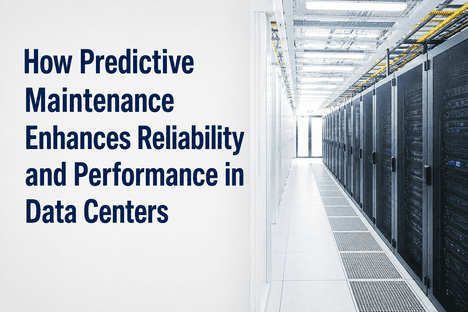
How Predictive Maintenance Enhances Reliability and Performance in Data Centers

By Daniel Carter on June 2, 2026

predictive-maintenance-data-centers-reliability-performance-url

Data center facility managers in 2026 face a paradox — IT uptime commitments of 99.999% depend on mechanical and electrical infrastructure that is maintained on fixed schedules rather than actual condition. A single CRAC compressor lockout in data hall 3 can raise hot-aisle temperature to 86°F in 12 minutes, triggering curtailment notices to colocation tenants and exposing the facility to six-figure SLA penalty exposure. Meanwhile, generator block heater degradation that drifts coolant temperature 8°F below standby range during idle periods remains invisible on weekly exercise logs until a utility outage exposes the gap. AI-powered predictive maintenance now detects compressor bearing degradation, UPS battery impedance rise, generator coolant temperature drift, cooling coil fouling, and PDU load imbalance 48–72 hours before failure — integrating with existing BMS, EPMS, and IoT sensor infrastructure without cloud dependency. Book a Demo to see how iFactory turns your existing facility telemetry into a live predictive maintenance layer for every critical infrastructure asset in your data center.

Predictive Maintenance · Data Centers 2026
Predictive Maintenance for Data Center Reliability & Performance

CRAC compressor degradation · UPS battery wear · Generator readiness · Cooling coil fouling · PDU load imbalance · All predicted in real time by iFactory with zero cloud dependency.

01
55%
Unplanned downtime reduction with AI predictive models
02
48-72hr
Advance warning on cooling, power, and generator failures
03
67%
Fewer emergency cooling events in documented deployments
04
18-24mo
Extended critical infrastructure asset life under condition-based monitoring

Why Fixed-Threshold BMS Alarms Fail to Protect Critical Loads

Most data centers today rely on BMS and DCIM systems that apply fixed thresholds to individual parameters — supply air temperature setpoint ranges, UPS load percentages, or humidity dead bands. These systems detect alarms only after a parameter has already exceeded its configured range, by which point the asset is already degrading or has failed. A CRAC compressor drawing 8% above nameplate current due to bearing wear over six weeks never triggers a single alarm threshold on a BMS — until the compressor locks out on thermal overload and hot-aisle temperature spikes to 86°F. iFactory's machine learning models compute adaptive anomaly detection limits that account for your facility's actual operational variability, seasonal cooling loads, and IT equipment density changes — detecting multivariate degradation patterns that fixed-threshold systems miss entirely.

Critical Infrastructure Assets — Where Predictive Maintenance Protects Uptime
72hr
CRAC / Chillers
Compressor current·fan vibration·coil temp
Cooling PdM
48hr
UPS & Batteries
Impedance·internal temp·capacitor bank
Power PdM
48hr
Generators
Block heater·coolant·battery·fuel system
Standby PdM
48hr
PDU / Switchgear
Load balance·breaker temp·power quality
Distribution PdM
72hr
Leak Detection
Underfloor·overhead·condensate·roof
Water PdM

Three Critical Infrastructure Failure Categories iFactory Predicts

01
Cooling System Degradation — CRAC, Chiller & Compressor Failure Prediction
Cooling systems account for the majority of unplanned data center infrastructure events. iFactory monitors CRAC supply air temperature, return air humidity, compressor current draw, fan vibration, chilled water differential pressure, and refrigerant circuit parameters simultaneously. The ML model detects multivariate degradation patterns — a 3°F rise in return air temperature combined with a 5% increase in compressor current draw indicates degrading refrigerant charge or bearing wear 72 hours before compressor lockout. Each alert includes the asset ID, the parameters that triggered it, and a recommended corrective action. If you'd like to see how cooling PdM data flows into iFactory's asset health dashboard and work order system, book a demo with our data center team.
72hr advance warningMultivariate detectionCompressor wear
02
UPS Battery Impedance & Capacitor Bank Degradation
UPS modules and battery strings are the most failure-sensitive components in the power chain — a single battery cell with rising internal impedance can reduce string runtime by 40% during an outage. iFactory monitors UPS module internal temperature, battery impedance per string, capacitor bank ripple current, and rectifier efficiency. The platform detects impedance drift trends that indicate end-of-life cells before they compromise runtime. Predicted battery replacement windows are generated with recommended intervention schedules aligned to planned maintenance windows — eliminating the emergency battery replacements that occur when cells fail unexpectedly during outage events.
Cell-level impedanceRuntime predictionPlanned replacement
03
Generator Block Heater, Coolant & Fuel System Readiness Monitoring
Generator standby readiness is the most critical gap in data center backup power — a generator starts reliably only if its block heater maintains coolant temperature, its batteries hold charge, and its fuel system remains free of contamination. iFactory monitors generator jacket water temperature during idle periods (detecting block heater element degradation), battery voltage and charger output, fuel level trends, and coolant system pressure. A 6°F coolant temperature drift below standby range triggers a predictive alert 48 hours before the generator's standby readiness is compromised. Every predictive event is logged in iFactory's Shift Logbook with full traceability to the sensor data and recommended corrective action.
Block heater driftStandby readiness48hr alert

How iFactory Turns Data Center Telemetry Into Predictive Intelligence

iFactory is the AI software intelligence layer — not a sensor manufacturer or hardware vendor. The platform integrates with existing data center infrastructure telemetry from BMS controllers, EPMS meters, UPS modules (Schneider, Eaton, Vertiv), generator controllers (Cummins, Caterpillar, Kohler), leak detection sensors, environmental monitoring gateways, and DCIM databases. The Shift Logbook captures facilities engineer shift reports, NOC handover notes, and vendor service records alongside the sensor stream — creating a unified data fabric for predictive model training across every critical infrastructure asset in your facility.

Asset Type
Telemetry Sources
iFactory Prediction Output
Uptime Impact
CRAC / Chillers
Supply temp·current draw·vibration·DP
Compressor wear alert·72hr forecast
Prevents hot-aisle curtailment events
UPS Modules
Internal temp·impedance·ripple current
Battery RUL·capacitor bank alert
Eliminates runtime surprises
Generators
Coolant temp·battery·fuel·pressure
Standby readiness score·48hr drift alert
Ensures backup power reliability
PDU / Switchgear
Load balance·breaker temp·power quality
Imbalance alert·overload forecast
Prevents breaker trip events

Predictive Maintenance Use Cases in Data Center Operations

Cooling
CRAC Compressor & Chiller Degradation Detection
Continuous

iFactory monitors CRAC supply air temperature, return air humidity, compressor current draw, fan vibration, and chilled water differential pressure. ML models trained on 6-12 months of historical facility data detect multivariate degradation patterns — a compressor drawing 8% above nameplate current with correlated fan vibration trends — 72 hours before thermal overload lockout. Alerts include asset ID, parameters triggered, current vs. baseline trend, and recommended corrective action.

Detection72hr before compressor lockout
Outcome67% fewer emergency cooling events
Book a Demo
Power
UPS Battery String & Capacitor Bank Health Monitoring
Continuous

UPS battery strings are the most failure-sensitive link in backup power. iFactory monitors battery impedance per cell, internal temperature, capacitor bank ripple current, and rectifier efficiency. Impedance drift trends indicating end-of-life cells are flagged 48 hours before runtime is compromised. Recommended replacement windows align with planned maintenance schedules — eliminating emergency battery change-outs. If you'd like to see how battery health predictions integrate with your existing UPS monitoring and CMMS workflows, schedule a demo with our team.

MonitoringCell impedance · temp · ripple
OutputRUL · planned replacement window
Book a Demo
Backup Power
Generator Standby Readiness & Block Heater Monitoring
Continuous

Generator standby readiness degrades invisibly between weekly exercise cycles. iFactory monitors jacket water temperature during idle periods (block heater element degradation), battery voltage and charger output, fuel level trends, and coolant system pressure. Coolant temperature drift below standby range triggers a 48-hour predictive alert with recommended corrective action — block heater element replacement, battery charger service, or fuel system maintenance.

Window48hr before readiness compromised
AssetsGenerator · ATS · fuel system
Distribution
PDU Load Balance & Breaker Temperature Monitoring
Continuous

PDU load imbalances and breaker temperature rises are early indicators of impending power distribution failures. iFactory monitors per-phase load balance, breaker case temperature, power quality metrics, and harmonic distortion. Load imbalance trends and temperature drift patterns generate predictive alerts 48 hours before potential breaker trip events. All events log to the Shift Logbook with full traceability for compliance and SLA reporting.

ParametersLoad · temp · THD · power factor
OutputImbalance alert · work order

What iFactory Delivers for Data Center Reliability

55%
Reduction in unplanned infrastructure downtime
AI-driven prediction vs reactive BMS alarms
48-72hr
Advance warning on cooling and power failures
Planned intervention replaces emergency response
67%
Fewer emergency cooling events
Compressor·chiller·fan degradation detection
18-24mo
Extended critical asset service life
Condition-based vs calendar-based replacement

FAQ

iFactory deploys on an on-premise NVIDIA appliance that sits on your data center's operational network — no cloud dependency, no data leaving your facility. The platform ingests data from BMS controllers, EPMS meters, UPS modules, generator controllers, and IoT sensors directly on the OT network. ML inference runs locally on the appliance. Dashboards and alerts are accessible from any browser on the facility network. This architecture meets the security requirements of colocation, enterprise, and hyperscale data centers that cannot transmit operational telemetry off-site.
Initial deployment typically takes 6-12 weeks depending on data availability and integration scope. The platform requires 6-12 months of historical BMS, EPMS, and asset controller data to establish baseline health thresholds and failure prediction models for each asset type. If that data is available in your existing historian or DCIM database, initial models can be trained in under four weeks. Model accuracy improves continuously as new data flows in — refining predictions automatically without manual recalibration for seasonal load changes or facility configuration changes.
iFactory integrates with major BMS platforms (Schneider EcoStruxure, Siemens Desigo CC, Johnson Controls Metasys, Honeywell), EPMS/DCIM systems (Schneider StruxureWare, Eaton Brightlayer, Vertiv Trellis, Nlyte, Sunbird), UPS controllers (Schneeder, Eaton, Vertiv), generator controllers (Cummins PowerCommand, Caterpillar EMCP, Kohler Decision-Maker), and IoT sensor gateways via Modbus TCP, BACnet/IP, SNMP, REST API, and OPC UA. The platform normalises data from multi-vendor infrastructure into a unified asset health model.
Deploy iFactory for Data Center Predictive Maintenance

On-premise AI-powered predictive maintenance platform connecting CRAC, chiller, UPS, generator, PDU, and leak detection telemetry into one unified intelligence layer — with ML-based failure prediction, Shift Logbook integration, CMMS workflow automation, and fleet-wide infrastructure reliability analytics. Zero cloud dependency.


Cooling PdM UPS Health Generator Readiness PDU Balance Zero Cloud

Share This Story, Choose Your Platform!