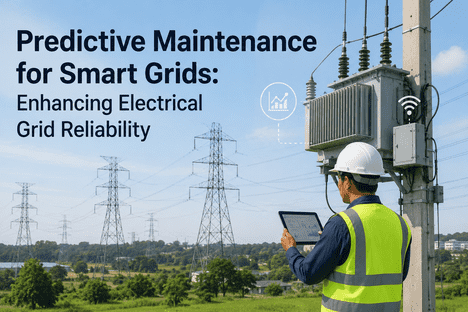
Predictive Maintenance for Smart Grids: Enhancing Electrical Grid Reliability
By Christopher Hayes on June 2, 2026
Power transformers, substation breakers, and distribution feeders form the backbone of electrical grid reliability — yet unplanned failures in these assets remain the primary cause of service interruptions, voltage sags, and cascading blackouts across transmission and distribution networks. Traditional time-based maintenance schedules cannot account for the variable loading patterns introduced by renewable integration, distributed generation, and dynamic demand profiles that define modern smart grids. iFactory's predictive maintenance platform ingests SCADA telemetry, dissolved gas analysis (DGA), partial discharge data, thermal imaging, and smart meter load profiles into machine learning models that forecast transformer insulation breakdown, breaker contact wear, feeder overload conditions, and bushing degradation weeks before failure — enabling utility engineers to shift from reactive repair to condition-based intervention. Book a Demo to see how iFactory connects your grid telemetry to predictive intelligence.
Predictive Maintenance · Smart Grids 2026
Predictive Maintenance for Smart Grid Electrical Reliability
Load profiles · voltage stability · thermal stress
⟐
Distribution
Smart meters · pole transformers · reclosers
Why Time-Based Maintenance Falls Short in Modern Smart Grids
Electrical grids today face loading patterns that change by the hour — solar generation ramps during midday, EV charging loads peak overnight, and distributed energy resources create bidirectional power flows that legacy protection and monitoring systems were never designed to handle. Fixed-interval maintenance on transformers, breakers, and feeders assumes steady-state operating conditions that no longer exist. iFactory replaces calendar-based schedules with continuous condition monitoring — ingesting data from IEDs, SCADA historians, smart meters, and online DGA analyzers to detect insulation degradation, contact erosion, and thermal overload before they escalate into service interruptions.
LIMITATIONS OF SCHEDULED MAINTENANCE IN SMART GRIDS
1
Renewable variability ignored — solar and wind ramps create loading cycles that accelerate aging beyond scheduled interval assumptions
2
No real-time gap detection — incipient faults in DGA, partial discharge, and thermal imagery develop between inspection cycles
3
One-size-fits-all intervals — same schedule applied regardless of actual load, ambient temperature, or asset age profile
4
No fleet-wide trend visibility — cross-substation degradation patterns invisible when each asset is inspected in isolation
Three Grid Asset Categories iFactory Predicts and Prevents
01
Power Transformer Insulation, Bushing & OLTC Failure Prediction
Power transformer failures rank among the highest-cost events in electrical grids — each catastrophic failure can exceed $1M in replacement cost plus lost revenue from extended outages. iFactory integrates online DGA (H₂, CO, C₂H₂, CH₄), partial discharge acoustic signals, bushing capacitance and tan-delta trends, OLTC mechanism vibration, and thermal imaging data into ensemble ML models. The platform classifies transformer health into four states — healthy, moderately stressed, highly stressed, critical — enabling engineers to prioritise interventions before insulation breakdown or bushing flashover occurs. Sites using similar AI-driven transformer monitoring report 28% fewer unplanned outages and 22% lower maintenance costs. Book a Demo to see iFactory's transformer prediction models in production.
Circuit breakers and switchgear in modern substations operate under increasing switching frequency driven by renewable intermittency and EV charging cycles. iFactory monitors breaker travel time, contact resistance, SF₆ gas density, mechanism vibration, and accumulated interruption duty to predict contact erosion and mechanism degradation before failure. The Shift Logbook captures field inspection notes, infrared scan results, and operator observations alongside sensor data — creating a unified asset health record that feeds remaining useful life (RUL) estimates for each breaker. Predicted failures trigger work order generation in iFactory with recommended intervention windows aligned to planned outage schedules.
Distribution Feeder & Pole Transformer Overload & Thermal Stress Detection
Distribution feeders and pole transformers face growing stress from EV charging clusters, rooftop solar backfeed, and peak demand growth that legacy conductor and transformer ratings cannot accommodate. iFactory ingests smart meter interval data, feeder SCADA telemetry, ambient temperature readings, and historical load profiles into thermal stress models based on IEC 60076 loading guides. The platform identifies feeders and transformers operating in the "highly stressed" or "critical" categories — flagging assets requiring prioritised maintenance, reconductoring, or capacity upgrades before thermal overload causes failure. Every alert is logged in iFactory with full traceability to the meter and sensor data that triggered the prediction.
IEC 60076 thermal modelSmart meter integrationPriority asset flagging
How iFactory Transforms Grid Telemetry Into Predictive Intelligence
iFactory is the AI software intelligence layer — not a sensor manufacturer or hardware vendor. The platform integrates with existing grid telemetry from SCADA (Rockwell, Siemens, Wonderware, ABB), IEDs (Schweitzer, Siemens, GE), online DGA analyzers, partial discharge sensors, infrared thermal cameras, smart meter head-end systems, and ERP (SAP, Oracle). The Shift Logbook captures operator shift reports, fault logs, switching orders, and field inspection notes alongside the sensor stream — creating a unified data fabric for predictive model training across your entire grid asset fleet.
Contact resistance · travel time · SF₆ density · interruption count
Contact wear RUL · mechanism degradation alert
Reduced emergency breaker replacement
Distribution Feeders
SCADA load · smart meter profiles · ambient temp · voltage
Thermal stress score · overload probability
Prioritised reconductoring & capacity upgrades
Pole Transformers
Smart meter interval · ambient temp · historical load
Health classification · replacement priority
Fewer pole transformer burnouts
Predictive Maintenance Use Cases in Smart Grid Operations
Transformers
Online DGA & Partial Discharge Transformer Health Monitoring
Continuous
iFactory fuses online dissolved gas analysis (H₂, CO, C₂H₂, CH₄), partial discharge acoustic signals, bushing capacitance and tan-delta trends, and thermal imaging data into a single transformer health model. The stacked ensemble classifier assigns a health score — healthy, moderately stressed, highly stressed, or critical — based on multi-dimensional feature fusion. Transformers flagged as critical trigger automated alerts in the Shift Logbook with recommended actions, RUL estimates, and links to historical fault records. Maintenance planners schedule interventions based on actual condition rather than calendar intervals.
Circuit breakers in modern substations face increasing switching frequency from renewable intermittency and EV load patterns. iFactory monitors contact resistance via online micro-ohmmeter integration, accumulated interruption duty, travel time drift, mechanism vibration signature, and SF₆ gas density. The ensemble ML model predicts remaining useful life for each breaker contact set and mechanism assembly. Predicted end-of-life triggers work order generation in iFactory with outage window recommendations aligned to the grid maintenance schedule.
Distribution Feeder Thermal Stress & Overload Probability Forecasting
Continuous
Distribution feeders face growing thermal stress from EV charging clusters and rooftop solar backfeed. iFactory ingests smart meter interval data, feeder SCADA load, ambient temperature, and conductor ratings into thermal stress models based on IEC 60076 loading guides. The platform generates a per-feeder thermal stress score and overload probability forecast — flagging feeders approaching critical thresholds for reconductoring or capacity upgrade. Every forecast event is logged in iFactory with full traceability to the sensor and meter data that triggered the prediction.
iFactory is the AI software intelligence layer — not a sensor manufacturer or hardware vendor. The platform integrates with online DGA analyzers, partial discharge sensors, infrared thermal cameras, IEDs, SCADA systems (Rockwell, Siemens, Wonderware, ABB), smart meter head-end systems, and ERP (SAP, Oracle) already deployed across your grid. Your utility selects the monitoring hardware; iFactory turns the data into predictive intelligence, health scores, RUL estimates, and maintenance work orders.
iFactory integrates with IEC 61850 (substation automation), CIM IEC-61970/61968 (energy management), OPC UA (industrial interoperability), DNP3 (SCADA), Modbus/TCP (IEDs and sensors), and IEC 62443 (cybersecurity). The platform normalises data from multi-vendor IEDs, RTUs, smart meters, and sensors into a unified asset health model — eliminating the integration overhead of managing disparate monitoring systems.
Yes. iFactory connects to SAP, Oracle, IBM Maximo, and major utility CMMS platforms. The Shift Logbook captures operator shift reports, fault logs, switching orders, and field inspection notes alongside sensor-generated predictions. Every prediction event, sensor reading, and maintenance action is recorded with full traceability for audit, NERC compliance, and continuous model improvement across the grid asset fleet.
Deploy iFactory for Smart Grid Predictive Maintenance
AI-powered predictive maintenance platform connecting transformer DGA, breaker condition monitoring, feeder thermal stress, and smart meter telemetry into one unified intelligence layer — with ML-based failure prediction, Shift Logbook integration, CMMS workflow automation, and fleet-wide grid reliability analytics.