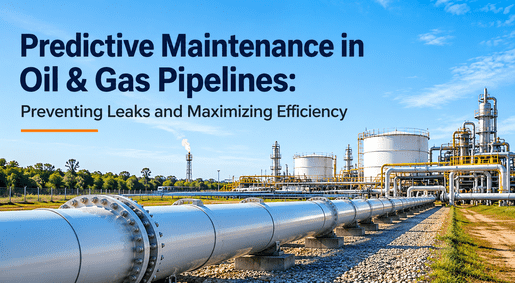
The pipeline control room operator on the night shift at a midstream oil and gas company watches the pressure differential on Line 7 creep upward — 3 psi over baseline, then 5 psi, then 7 psi. She logs it in the shift report. By the time the integrity team reviews the trend two weeks later, the wall-loss anomaly at mile marker 142 has grown from 12% to 19% through-wall, and the repair window has narrowed from a planned excavation to an emergency shutdown at triple the cost. Across the operator's pipeline network, 1,200 miles of pipe run without real-time integrity analytics, each segment a similar leak event waiting to happen. Book a Demo and see how iFactory AI turns your existing pipeline data into a live integrity early-warning system.
Stop reacting to pipeline degradation. Let AI-driven predictive maintenance catch every developing threat — in real time, on every segment.
iFactory ingests your SCADA data, corrosion survey records, cathodic protection readings, and ILI reports, applies machine-learning anomaly detection, and alerts your integrity team within seconds of a developing wall-loss, pressure anomaly, or coating failure. No more emergency excavations. No more reportable events that could have been prevented.
AI-native pipeline integrity that covers every critical threat on your network
iFactory is not a bolt-on analytics dashboard. It is an on-premise, turnkey pipeline integrity platform that sits on your control network, ingests data from SCADA historians, CP rectifier controllers, corrosion probes, and inline inspection tools, and runs machine-learning anomaly detection on every data stream. The platform replaces the manual data compilation and delayed analysis that cost pipeline operators millions each year in emergency repairs, lost throughput, and PHMSA-reportable events. Every integrity threshold, every anomaly score, every alert is computed in real time on an NVIDIA appliance — no cloud dependency, no data leaving your facility, no IT project lasting longer than twelve weeks.
Six core capabilities that turn raw pipeline data into real-time integrity control
Each capability is a standalone module that works on any pipeline — liquid, gas, or multiphase. Together they form a complete integrity management system that covers every critical threat from corrosion under insulation to pressure excursion risk.
Multivariate integrity monitoring with AI detection limits
Monitors pressure differential, flow rate, cathodic protection potential, corrosion probe rate, and wall-loss trend simultaneously. Detection limits are computed by a machine-learning model trained on your pipeline's historical data — not textbook corrosion rates. The system flags anomalies that a manual review would miss until the defect is already reportable.
Real-time integrity alerts with corrective guidance
When a developing anomaly is detected, the platform sends an alert to the control room operator's console, the integrity engineer's mobile device, and the operations manager's dashboard. The alert includes the segment location, the parameter that triggered it, the current value versus baseline, and a recommended action — schedule an ILI run, adjust CP rectifier output, or reduce operating pressure.
Automated event logging for PHMSA and regulatory compliance
Every integrity event is automatically logged with a timestamp, parameter values, operator acknowledgment, and corrective action taken. The system generates a searchable archive that satisfies PHMSA Part 195 and Part 192 record-keeping requirements and supports audit requests for specific segments or date ranges without manual data retrieval.
Predictive degradation detection before leak occurrence
The platform's machine-learning model analyzes rate-of-change in corrosion probe readings, CP trends, and pressure cycles, predicting when a defect will cross the reportable threshold. Operators receive a predictive alert 48 to 72 hours before the anomaly would require an emergency response, giving them time to plan a scheduled repair rather than a shutdown.
Automated integrity and compliance dashboards
iFactory generates weekly, monthly, and quarterly reports that combine integrity data with operational metrics — throughput, pressure cycles, CP effectiveness, and anomaly trends. Integrity threats are automatically attributed to the specific parameter or location that caused them, eliminating the manual data compilation that consumes two days of every integrity engineer's month.
Direct data ingestion from any SCADA or integrity data source
The platform connects directly to your existing SCADA historians, CP rectifier controllers, corrosion probe transmitters, and ILI databases. No middleware, no custom API development, no data staging. iFactory's edge appliance reads the data at the source and runs integrity computations locally.
From SCADA data to integrity action in four steps
iFactory's AI pipeline integrity system is designed to be operational within eight to twelve weeks of data-source access. The platform requires no changes to your existing control systems and no additional instrumentation on your pipeline.
Connect
iFactory's edge appliance connects to your control network and begins reading data from your SCADA historian, CP rectifiers, corrosion probes, and ILI databases. No data leaves your facility.
Learn
The platform's machine-learning model ingests twelve months of historical pipeline data to establish baseline integrity thresholds, anomaly detection rules, and prediction parameters specific to each segment and product type.
Monitor
Every sixty seconds, the platform evaluates all monitored parameters against the learned integrity baselines. Anomalies are detected and classified as pressure excursions, CP degradation, corrosion acceleration, or wall-loss progression.
Act
Alerts are sent to control room operators, integrity engineers, and operations managers with specific corrective guidance. The event is logged for PHMSA compliance. Predictive alerts give the integrity team time to plan a repair before the anomaly becomes reportable.
Three integrity events that cost pipeline operators millions every year
Manual integrity management — compiling data from quarterly surveys, reviewing paper reports, waiting for ILI results — introduces a detection delay that turns small degradation trends into large leak events. Here are three common scenarios and their real cost impact.
Corrosion under insulation at a pipe support
CUI develops silently beneath pipe insulation at a river-crossing support. A 0.3 mm/year corrosion acceleration goes undetected for six months, growing from 15% to 35% wall loss. The repair window shifts from a planned recoating during a scheduled shutdown to an emergency excavation and pipe replacement. Cost per incident: $340,000 to $520,000.
Cathodic protection rectifier failure on a coated line
A CP rectifier at mile marker 88 drops output by 40% due to a failed diode. The quarterly survey misses it by three weeks. During those weeks, a 500-foot segment with a coating holiday experiences accelerated corrosion — 0.5 mm of additional wall loss. Repair cost including pipe replacement: $180,000 to $310,000.
Pressure cycle fatigue at a compressor station
A high-frequency pressure cycle from a reciprocating compressor causes a crack-like defect to grow at a girth weld. The cycle is invisible on daily SCADA trends but detected by iFactory's multivariate model. Emergency shutdown and repair during peak throughput season: $420,000 to $680,000 in lost throughput and repair cost.
What AI-driven pipeline integrity delivers in the first quarter
Pilot deployments across midstream pipeline operators show consistent returns within the first 90 days of operation. The platform pays for itself before the second quarter begins.
Your pipeline's integrity data is already flowing through your SCADA system and corrosion monitoring equipment. iFactory can read it, analyze it, and alert your team within eight to twelve weeks. Book a Demo and we'll show you live on your data.
Questions pipeline integrity leaders ask about AI-driven predictive maintenance
Your pipeline integrity data is already flowing. iFactory can turn it into real-time threat detection in eight to twelve weeks.
See the platform running on a live pipeline segment. Book a 30-minute demo and we'll show you how AI-driven predictive maintenance catches every developing anomaly before it becomes a reportable leak.