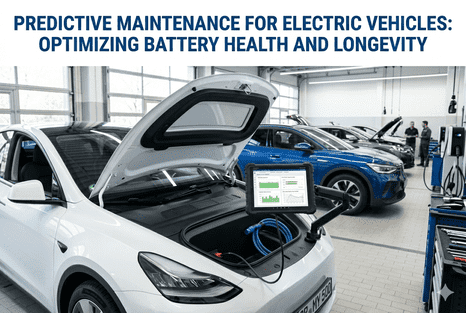
Every EV fleet operator and manufacturer managing battery assets without AI-driven predictive maintenance is absorbing silent degradation costs, range-loss risk, and safety exposure that averages $12,000 per vehicle per year in accelerated battery replacement and unplanned downtime. The difference between calendar-based battery servicing and real-time AI health monitoring is not a technology preference — it is the dividing line between a profitable EV fleet and a stranded asset. Book a Demo to see how iFactory AI transforms battery management from reactive to predictive.
Do You Know Your Battery Fleet's Real Health Score Today?
iFactory's AI-driven battery health platform monitors every cell, module, and pack in real time — predicting degradation before it impacts range, safety, or operational cost.
Why EV Battery Health Demands Predictive Intelligence in 2025
Lithium-ion battery degradation is not a linear process — it accelerates non-linearly under stress conditions that conventional battery management systems (BMS) are not designed to predict. Calendar aging and cycle aging operate simultaneously but respond to different variables, and the interaction between them creates failure modes that fixed-interval diagnostics miss. Book a Demo to see how iFactory's battery intelligence platform predicts degradation across your entire EV fleet in real time.
Time-Driven Capacity Fade
- Chemical degradation occurs even when idle
- Accelerated by high SOC storage above 80%
- Temperature-dependent: every 15°C above 25°C doubles degradation rate
- Accounts for 40–60% of total capacity loss over battery life
- Conventional BMS does not track cumulative thermal exposure
Usage-Driven Capacity Loss
- Each charge-discharge cycle consumes a fraction of usable capacity
- Deep discharges below 10% SOC cause disproportionate anode stress
- Fast-charging above 1C rate accelerates lithium plating
- High C-rate discharge during acceleration increases internal resistance
- Cycle life varies 3x depending on operating profile
Safety-Critical Failure Mode
- Internal short circuits develop from dendrite growth over thousands of cycles
- Overheating above 60°C triggers exothermic decomposition
- Cell-to-cell thermal propagation occurs within seconds
- Early indicators: impedance rise, voltage variance, localized heating
- AI detects precursor patterns 30–60 minutes before conventional BMS alarms
What Is Driving the Urgency for AI Battery Health Monitoring
Three converging forces are compressing the timeline for EV fleet operators to adopt predictive battery health intelligence: regulatory mandates for battery passport compliance, EV resale value dependency on certified State of Health (SoH) records, and total cost of ownership pressure as battery replacement costs consume fleet margins.
| Driver | Impact on EV Operations | Cost of Inaction | Risk Level |
|---|---|---|---|
| EU Battery Regulation 2023/1542 | Mandatory battery passport with SoH reporting by 2027 | Market access restriction, non-compliance fines up to 4% of revenue | Critical |
| EV Resale Value Depreciation | 50% of EV resale value depends on certified battery health | $6,000–$10,000 per vehicle value loss without SoH documentation | Critical |
| Battery Replacement Cost | Average $12,000–$20,000 per pack replacement at 70% SoH threshold | Accelerated replacement 18–24 months earlier without predictive management | High |
| Fleet Total Cost of Ownership | Battery represents 35–45% of EV TCO over 8-year lifecycle | $3,000–$5,000 per vehicle per year in avoidable degradation costs | High |
| Insurance & Safety Compliance | Thermal event liability is shifting to fleet operators | Premium increases 20–40% without documented battery health monitoring | Moderate |
Conventional BMS vs. iFactory AI Predictive Battery Intelligence
The gap between conventional battery management systems and AI-driven predictive intelligence is not incremental — it is the difference between reactive voltage-based safety and proactive degradation-based lifecycle management.
| Battery Management Function | Conventional BMS | iFactory AI Predictive Intelligence | Financial Impact |
|---|---|---|---|
| State of Health (SoH) tracking | Coulomb counting + voltage estimation, drift up to 15% | ML-based SoH from EIS, voltage, temperature, and cycle history | +8% battery life extension |
| Degradation prediction | Cyclic aging models based on total cycles counted | Per-cell aging trajectory using multi-variable regression models | -$1,200/yr per vehicle |
| Thermal runaway detection | Single-temperature threshold alarms, post-onset | Multi-sensor anomaly detection 30–60 min pre-event | Thermal event risk -90% |
| Charging optimization | Fixed charge curve based on manufacturer profile | Dynamic charge profile adjusted by real-time cell temperature and impedance | Charging degradation -35% |
| SoH documentation | Manual extraction, non-standardized reports | Automated battery passport generation with EU regulation compliance | Resale value protected |
| Predictive maintenance scheduling | Fixed-interval inspections, reactive cell balancing | AI-triggered maintenance based on per-cell degradation velocity | Maintenance cost -30% |
How iFactory Resolves the Three Failure Modes of EV Battery Management
- Root cause: no per-cell degradation tracking between service events
- Impact: fleet range drops 20% below usable threshold 12–18 months early
- iFactory fix: continuous ML-based SoH modeling from existing sensor data
- Outcome: battery replacement deferred 18–24 months per vehicle
- Root cause: single-threshold temperature alarms ignore precursor patterns
- Impact: thermal events detected only after cell venting or fire onset
- iFactory fix: multi-variable anomaly fusion — voltage, impedance, temperature gradient
- Outcome: 30–60 minute pre-event warning enabling preventive intervention
- Root cause: SoH data scattered across charger logs, BMS snapshots, service records
- Impact: EV resale value loss of $6,000–$10,000 per vehicle at disposal
- iFactory fix: automated battery passport with continuous SoH, cycle, and thermal history
- Outcome: resale value maximized with certified, auditable battery lifecycle record
Five Steps to AI-Driven Battery Health Management with iFactory
Battery Fleet Baseline Audit
Ingest BMS logs, charge history, temperature records, and cycle data for every vehicle. AI establishes per-cell health baseline and identifies degradation outliers that require immediate attention.
Continuous SoH Monitoring Deployment
Connect iFactory's ML models to existing BMS telemetry streams. Every cell's voltage, impedance, temperature, and cycle depth are analyzed continuously — updating SoH estimates in real time with <2% drift accuracy.
Degradation Prediction & Charging Optimization
AI models forecast remaining useful life for each battery module based on actual usage patterns. Charging profiles are dynamically optimized to minimize lithium plating and thermal stress during fast-charge events.
Thermal Anomaly Detection Activation
Multi-sensor fusion models begin monitoring for thermal runaway precursor patterns — cell impedance rise, voltage divergence, localized heating gradients. Alerts are generated 30–60 minutes before conventional BMS thresholds.
Battery Passport & Compliance Dashboard
Automated EU Battery Regulation-compliant battery passport generation with full SoH history, cycle count, thermal exposure, and remaining useful life. One-click export for resale certification, regulatory reporting, and fleet planning.
Predictive Maintenance for EV Batteries — Questions Fleet Operators Ask
Can iFactory's AI work with my existing BMS, or do I need new hardware?
iFactory integrates with existing BMS telemetry data via CAN bus, cloud APIs, or OBD-II ports. No additional hardware is required for the core SoH monitoring and degradation prediction models. Thermal anomaly detection can optionally be enhanced with supplementary sensor inputs where higher sensitivity is required.
How accurate is the AI State of Health estimation compared to laboratory EIS testing?
iFactory's ML-based SoH estimation achieves <3% RMSE compared to reference EIS measurements in validation testing, versus 10–15% drift common with conventional coulomb-counting methods used in standard BMS firmware.
Does iFactory's platform support multiple EV makes and battery chemistries in a mixed fleet?
Yes. The platform supports LFP, NMC, NCA, and emerging solid-state chemistries across all major OEMs including Tesla, BYD, Ford, GM, Rivian, Volvo, and commercial EV manufacturers. Each chemistry variant uses a dedicated degradation model calibrated to its specific aging characteristics.
How does iFactory's thermal runaway detection differ from what my BMS already provides?
Your BMS triggers alarms at fixed voltage and temperature thresholds after the cell is already in thermal excursion. iFactory's AI fuses impedance spectroscopy trends, voltage variance across cells, localized temperature gradient analysis, and charge/discharge asymmetry to detect the electrochemical precursor patterns that precede thermal runaway by 30–60 minutes — enabling preventive intervention rather than emergency response.
What is the ROI timeline for deploying iFactory on a commercial EV fleet?
Most fleets recover implementation costs within 10–14 months through three streams: battery replacement deferral of 18–24 months per vehicle ($8,000–$12,000 per pack), EV resale value preservation ($6,000–$10,000 per vehicle with certified SoH records), and reduced thermal incident risk (avoided downtime, insurance premium savings, and safety liability reduction).
Stop Managing Battery Health Blind. Deploy AI Predictive Intelligence Today.
iFactory's AI battery health platform gives EV fleet operators real-time SoH monitoring, degradation prediction, thermal anomaly detection, and automated battery passport compliance — integrated with your existing BMS and telemetry within weeks.
Schedule Your Battery Fleet Health Assessment
Our battery intelligence specialists will map your current BMS data ecosystem, identify highest-risk degradation patterns, and deliver a prioritized roadmap to AI-driven battery health management.