Every supply chain operation — from transportation fleets to warehouse conveyor systems to automated sortation hubs — depends on equipment uptime. When a forklift fails on the shipping dock at 2 PM, the ripple effect delays 14 outbound trailers by an average of 47 minutes each. When a conveyor bearing seizes during peak sortation, the entire distribution center throughput drops by 34% until maintenance arrives. The industry average for unplanned downtime across supply chain equipment is 8.5% of operating hours. For a regional DC processing 500,000 units per week at $0.28 margin per unit, that's over $600,000 in lost throughput per year. Traditional reactive maintenance — fixing equipment after it breaks — leaves logistics operations vulnerable to these disruptions. The shift from reactive to predictive maintenance is not a technology upgrade. It is a supply chain resilience strategy.
Predictive Maintenance for Supply Chain: Cut Unplanned Downtime by 47% Across Fleets, Warehouses & DCs
iFactory monitors your material handling equipment, fleet assets, and facility systems in real time — predicting failures 48–72 hours before they cause downtime. On-premise AI. Zero cloud dependency.
Why Reactive Maintenance Costs Supply Chains $600K+ Per DC Per Year
Most supply chain operations run on a break-fix model — equipment runs until it fails, then maintenance scrambles to restore it. Every hour of unplanned downtime compounds across the logistics network. Here is how that breaks down across your operation.
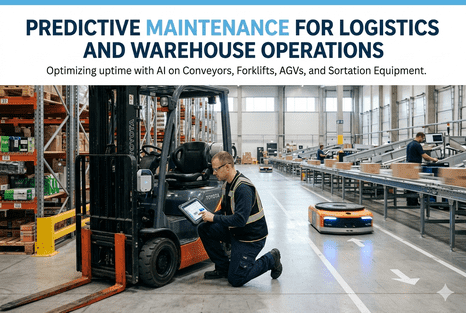
Forklift & AGV Failures Disrupt Dock-to-Stock Flow
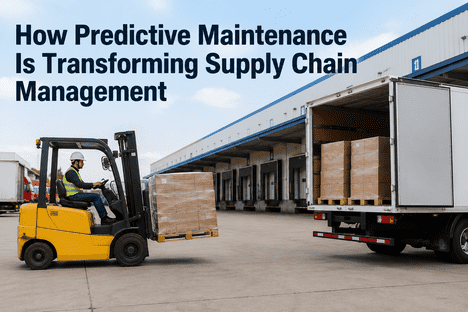
A single forklift breakdown during peak receiving hours delays 14 outbound trailers by an average of 47 minutes each. With warehouse labor at $22/hr and trailer detention fees at $85/hr, each failure event costs $2,100 in labor overrun plus detention penalties. Most DCs operate 15–40 forklifts per shift, and each one fails an average of 3.7 times per year unpredictably.
Conveyor & Sortation Downtime Kills Throughput
A seized bearing on a mainline conveyor during peak sortation cuts throughput by 34% until maintenance arrives. Average repair time: 58 minutes. For a DC processing 500,000 units per week at $0.28 margin per unit, every 1% throughput loss equals $72,800 in annual margin erosion. Conveyor systems account for 41% of all unplanned downtime events in distribution centers.
Fleet Vehicle Breakdowns Miss Customer Delivery Windows
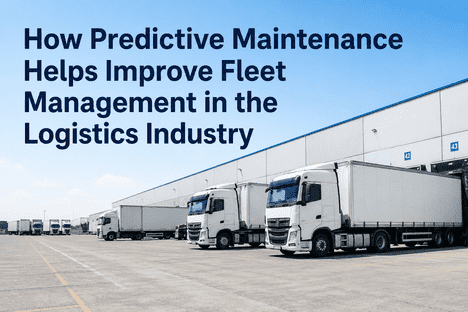
A Class 8 truck disabled en route causes a missed delivery window, triggering contractual penalties averaging $450 per occurrence plus expedite shipping costs of $1,200 for last-minute carrier coverage. With fleet utilization at 92%, a single truck down for 24 hours reduces route capacity by 8% for that day, cascading delays across the network.
Refrigeration & HVAC Failures Compromise Inventory
A cold storage HVAC failure goes undetected for 3 hours, raising ambient temperature from 34°F to 52°F. The entire perishables inventory in that zone — $120,000 of product — must be inspected and 23% is written off. Food safety audit non-compliance from uncontrolled temperature excursions can result in 2% revenue penalties from major grocery retailers.
Maintenance Teams Are Always Reacting, Never Preventing
Planned maintenance compliance averages 67% across supply chain operations. The other 33% of maintenance hours are reactive — chasing failures that already happened. Maintenance supervisors report that 40% of their team's capacity is consumed by emergency repairs, leaving no time for condition-based inspections or proactive component replacement.
Reactive maintenance costs supply chains $600K+ per DC per year. iFactory predicts failures 48–72 hours in advance. Book a 30-min walkthrough and see iFactory on your operation's data.
How iFactory Brings Predictive Maintenance to Supply Chain Operations in 4 Steps
iFactory connects directly to your equipment PLCs, telematics gateways, vibration sensors, and facility management systems — no cloud, no data leaving your network. In 6–12 weeks, you move from break-fix to predictive maintenance.
Connect to Existing Equipment Sensors
iFactory ingests data from conveyor PLCs, forklift battery management systems, truck J1939 telematics, vibration probes, and refrigeration controllers — whatever you already have deployed.
Train a Digital Twin of Your Operation
Our AI learns the normal operating envelope from 30 days of historical data — vibration signatures, temperature profiles, motor current draws, cycle times — and builds a predictive model of when they drift toward failure.
Deliver 48–72 Hour Advance Alerts
When the model detects a pattern that precedes a failure — bearing frequency shift, motor current oscillation, battery degradation curve — it alerts the maintenance team via mobile device or dashboard.
Close the Loop With Root Cause Correlation
Every alert links to the sensor data that triggered it. Maintenance sees "Conveyor bearing degradation detected — #3 drive pulley — replace within 48 hours." No more hunting for the root cause after the failure.
Predictive Maintenance Features Built for Supply Chain Operations
iFactory's AI-native platform gives you capabilities that reactive maintenance cannot match — all running on-premise on an NVIDIA appliance with zero cloud dependency.
Conveyor & Sortation Monitoring
iFactory models vibration, motor current, and bearing temperature on every drive pulley and idler. When frequency signatures shift by 8% or more — the established precursor to bearing failure — the system alerts maintenance 48 hours before seizure. No more emergency conveyor jams during peak sortation.
Forklift & AGV Health Prediction
By correlating battery discharge curves, hydraulic pressure cycles, and drive motor vibration, iFactory predicts forklift failure 72 hours before it occurs. Maintenance schedules replacement during off-shift hours. Dock-to-stock flow never stops.
Fleet Vehicle Diagnostics
iFactory ingests J1939 telematics data — engine load, coolant temperature, transmission behavior — and predicts component failures 48 hours before they strand a truck. Preventive repairs happen at the yard, not on the shoulder of I-75.
Cold Storage & HVAC Monitoring
Temperature drift patterns in refrigeration compressors and HVAC systems are detected 6–12 hours before they compromise inventory zones. iFactory alerts facilities before the temperature exceeds FDA cold chain requirements.
Zero Cloud Data Egress
The entire platform runs on an NVIDIA appliance inside your facility network. No data leaves your operation. No cloud subscription. No IT security review required.
6–12 Week Pilot to Live Model
iFactory's team connects to your data sources, trains the model, and delivers a working pilot in 6–12 weeks. No custom development. No data scientists on your payroll.
What Predictive Maintenance Delivers in 90 Days
Supply chain operations that deploy iFactory see measurable improvements within the first quarter. Here is what a typical DC achieves.
Why iFactory Is the Only Turnkey Predictive Maintenance Solution for Supply Chain
No consultants. No data scientists. No cloud migration. Just a working predictive model on your facility network in one quarter.
End-to-End Delivery — You Provide Data Access, We Deliver the Model
iFactory's engineers connect to your PLCs, telematics, vibration sensors, and facility controllers. We train the model. We validate it. You get a live alerting system in 6–12 weeks.
On-Premise NVIDIA Appliance — Zero Cloud Dependency
The entire platform runs on your facility network. No data egress. No cloud subscription. No IT security review. Fully compliant with data governance requirements.
24x7 Managed Service — We Monitor, You Operate
iFactory's operations team monitors model performance and retrains as your equipment changes. You get alerts. We handle the AI.
Pilot-to-ROI in One Quarter
Most operations see downtime reduction within 60 days of go-live. The pilot pays for itself before the second quarter starts.
No Custom Development — Works With Existing Sensors
iFactory ingests data from any OPC-UA, Modbus, MQTT, or J1939 source. No new sensors required. No integration headaches.
Scalable Across All Facilities and Fleets
Once the model works in one DC, iFactory replicates it across your entire network. Standardized predictive maintenance at every site.
Common Questions About Moving From Reactive to Predictive Maintenance
Stop Reacting to Equipment Failures. Start Predicting Them.
Book a 30-minute walkthrough with our supply chain operations team. We will connect to your data, show you what iFactory predicts on your equipment, and give you a custom ROI estimate — all before you commit a dollar.