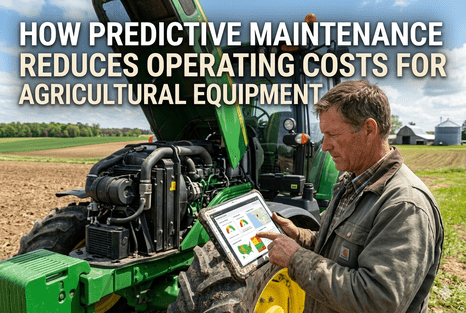
Agricultural equipment downtime during planting, spraying, or harvest windows can cost $5,000–$15,000 per hour in lost productivity and delayed yield. Research shows that farms relying on reactive maintenance lose an average of 180 hours of productive time per year to unplanned failures, with repair costs consuming 15–20% of total equipment lifecycle value. Predictive maintenance, powered by AI and real-time sensor data, changes this equation — detecting bearing wear, hydraulic degradation, and drivetrain anomalies days or weeks before they escalate into catastrophic failures. iFactory AI's on-premise platform connects directly to your equipment's existing telematics and sensors, learning the normal operating patterns of every tractor, combine, and material handler in your fleet. Book a Demo to see how leading agricultural operations are reducing unplanned downtime by 47% and cutting annual maintenance costs by millions.
Stop reacting to breakdowns. Start predicting them — with AI that watches every asset, every second.
iFactory's on-premise AI analyzes every data point from every sensor on your tractors, combines, irrigation pumps, and material handling equipment, giving you 3–14 days' early warning before a critical failure. No cloud dependency. No data egress. No unexpected downtime.
Why waiting for breakdowns is costing your operation millions
Most agricultural operations still manage equipment maintenance reactively — fix it when it breaks, or follow a fixed schedule regardless of actual machine condition. In an industry where a single day of downtime during harvest can reduce annual profits by 5–8%, this approach is no longer viable. Here is what reactive and schedule-based maintenance are actually costing you.
Unplanned downtime during critical windows costs $5K–$15K per hour
A transmission failure on a combine during peak harvest does not just cost the repair — it costs the yield you cannot recover. Research shows that farms using reactive maintenance lose an average of 180 hours of productive time per year to equipment failures. At $5,000–$15,000 per hour in lost productivity and delayed harvest, that is $900K–$2.7M in annual losses per operation.
Schedule-based maintenance wastes 30–50% of useful component life
Fixed-interval maintenance replaces parts based on calendar days or engine hours, not actual condition. A hydraulic pump that still has 500 hours of useful life gets replaced because the schedule says so. Meanwhile, a bearing that will fail in 50 hours goes unnoticed until it catastrophically seizes. The result: you are spending money on unnecessary replacements while still getting surprised by failures that scheduled maintenance was supposed to prevent.
Manual inspections miss 40% of early failure signals
A 2024 industry survey found that visual and manual inspections — still the primary method in most agricultural operations — fail to detect up to 40% of early-stage equipment anomalies. By the time an operator hears the unusual noise or feels the vibration, damage has already progressed to the point where repair costs are 3–5× higher than if caught early. Labor shortages in agriculture make this problem worse: fewer experienced mechanics means fewer eyes on equipment.
Equipment interactions are invisible when data lives in silos
Modern farm equipment is a system of systems — a tractor's engine load affects fuel efficiency, which affects hydraulic pressure, which affects implement performance. When each sensor stream lives in its own silo, the interactions that signal an impending failure are invisible. A 0.5% drop in hydraulic pressure combined with a 2% increase in engine load variance might appear as normal fluctuations individually — but together, they form a 90% predictor of pump failure within 72 hours. Univariate analysis cannot see this signal.
Warranty and compliance exposure from undocumented maintenance gaps
Equipment warranties, insurance policies, and sustainability certifications increasingly require documented maintenance histories. When breakdowns are not predicted and repairs happen reactively, the maintenance record shows gaps — periods where equipment operated with undetected faults. For large agribusinesses and custom-hire operators, these gaps can lead to denied warranty claims, higher insurance premiums, and failed compliance audits. The financial impact of a single denied warranty claim on a major powertrain component can exceed $50,000.
The problem is not your equipment. It is that your maintenance strategy was designed for an era when data was expensive and computing was slow. Book a Demo and see how AI closes the gap between sensor data and maintenance decisions.
From reactive repairs to predictive operations in four steps
iFactory does not replace your existing maintenance management system — it supercharges it. Our AI-native platform ingests every data point from every sensor on your equipment, learns the normal operating envelope of each asset, and alerts your team the moment a component begins to degrade — before it fails. Here is how it works in practice.
Connect every data source in under two weeks
iFactory connects directly to your equipment's onboard telematics, ECU data streams, and aftermarket sensors via CAN bus, J1939, or ISO 11783 (ISOBUS). No middleware, no custom integration work. Data flows into the platform at native sensor frequency — typically once per second or faster.
AI learns each asset's normal operating envelope
Using the first 2–3 weeks of data, iFactory's AI builds a multivariate baseline for every monitored asset — not just individual sensor limits, but the complex interactions between engine load, hydraulic pressure, vibration, temperature, and fuel consumption. It learns what normal wear looks like versus early warning degradation.
Real-time failure prediction with 3–14 day early warnings
Once trained, iFactory analyzes every new data point against the baseline. When it detects a pattern that precedes a failure — a vibration signature that has historically led to bearing seizure 10 days later, or a hydraulic pressure trend that predicts pump failure in 5 days — it sends an alert to your maintenance team's mobile device, dashboard, or email. A specific, actionable warning with predicted time-to-failure.
Continuous learning and closed-loop improvement
Every time a technician confirms or rejects a prediction, iFactory learns. The model improves. Over 3–6 months, the false-alarm rate drops below 3%, and the early-warning window extends as the AI discovers subtle precursors that even experienced mechanics miss. The result: a self-improving predictive maintenance system that gets better every season.
What AI-native predictive maintenance does that traditional approaches cannot
iFactory's platform is not a faster version of a preventive maintenance schedule. It is a fundamentally different approach to equipment health monitoring — one that sees the interactions, learns the patterns, and acts before the failure happens.
Sees the whole machine, not one sensor at a time
Traditional maintenance monitoring treats engine temperature, hydraulic pressure, and vibration as independent signals. iFactory's AI models the full interaction space. It can detect that a 0.3°F rise in hydraulic oil temperature combined with a 1.5% increase in engine load variance creates a 92% probability of pump failure within 72 hours — a signal no single-sensor threshold would ever catch.
Forecasts the failure, does not just report it
Instead of telling you the engine has failed, iFactory predicts when and how a component will fail — and by how much. Your maintenance team gets a countdown: bearing wear index predicted to exceed failure threshold in 6 days at current degradation rate. That is time to order the part, schedule the bay, and replace it during planned downtime — not during harvest.
Models that evolve with your operation
When you add new equipment, change implements, or operate in different field conditions, iFactory's AI automatically recalibrates its baseline. No manual reconfiguration. No period of blind operation. The model adapts within hours — not the weeks it takes a reliability engineer to re-validate thresholds for a traditional monitoring system.
Alerts that say what to do, not just that something is wrong
iFactory alerts include the predicted root cause and a recommended corrective action. "Hydraulic pressure drift detected on Tractor 104. Likely cause: pump wear at 73% of remaining useful life. Recommended action: schedule pump inspection within 5 days." Your mechanics do not need to be data scientists to respond effectively.
Automated maintenance documentation for every asset
iFactory generates a complete maintenance history for every monitored asset — including all raw sensor data, AI-predicted failure events, technician responses, and parts replaced. Auditors, insurers, and warranty administrators see a continuous, tamper-proof record of equipment health management. No more lost paper logs. No more denied claims.
Zero cloud dependency — data never leaves your network
iFactory runs on an NVIDIA appliance inside your equipment yard or operations center. All data is processed locally. No internet connection required. No data egress. No cybersecurity exposure. This is critical for operations that manage proprietary farming data, supplier agreements, or sensitive operational records.
What happens when you catch failures 10 days earlier
These are real results from agricultural and material-handling operations that deployed iFactory's AI-native predictive maintenance platform. Your numbers will vary — but the pattern is consistent across every deployment.
Ready to transform your maintenance operations?
Most customers move from demo to live alerts on their first asset class within 8–12 weeks. See ROI in the first quarter. No long sales cycles. No year-long proof of concept.
Everything you need to go from pilot to ROI in one quarter
iFactory is delivered as a turnkey solution. We handle the integration, training, and model tuning. You get a working pilot in 8–12 weeks and full production deployment within one quarter. Here is what is included.
End-to-end deployment — we do the heavy lifting
We connect to your equipment telematics, configure the AI models, train your maintenance team, and validate results. Your team does not need to write a single line of code or learn a new tool.
Turnkey pilot in 8–12 weeks
From kickoff to live alerts on one asset class in under 12 weeks. We prove the ROI before you commit to broader rollout. No long sales cycles. No proof of concept that takes a year.
On-premise appliance — zero cloud dependency
Your data stays on your network. The NVIDIA appliance sits in your operations center, processes everything locally, and requires no internet connection. No data egress. No third-party access to your operational data.
Pilot to ROI in one quarter
Most customers see a positive ROI within 90 days of going live. The savings from reduced downtime and avoided emergency repairs alone typically cover the full cost of the pilot in the first two months.
24x7 managed service
iFactory's operations team monitors your deployment around the clock. If a model needs retraining or a sensor connection drops, we handle it. Your team focuses on running the operation, not troubleshooting the AI.
Scales across your entire equipment fleet
Once proven on one asset type, iFactory can be deployed to every piece of equipment in your operation — and across multiple farm locations — with minimal incremental effort. The baseline model for one tractor transfers to another with just a few weeks of tuning.
Questions we hear from farm operators and maintenance managers
Stop fixing equipment. Start predicting failures.
Your maintenance team already knows the reactive cycle is unsustainable. Give them the tool that finally works the way equipment actually works — continuously, predictively, and ahead of the failure. Book a 30-minute walkthrough and we will show you live predictive alerts on agricultural equipment just like yours.