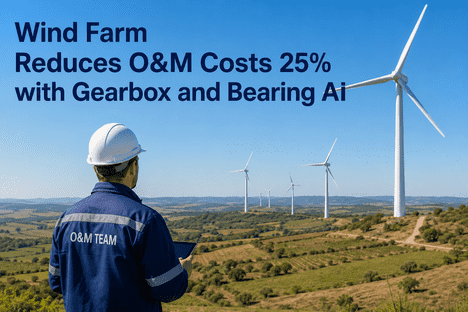
Unplanned gearbox failures remain the single most expensive maintenance event in wind energy operations. According to NREL's Gearbox Reliability Collaborative, wind turbine gearboxes designed for a 20-year service life are failing at 5 to 7 years — with bearing damage accounting for over 70% of all gearbox failures, half of which originate in the high-speed shaft. Each catastrophic gearbox replacement costs between $300,000 and $900,000 when factoring in crane mobilization, replacement parts, and lost production revenue, with the global fleet experiencing roughly 1,200 gearbox failure incidents annually. This case study examines how a 100-turbine onshore wind farm deployed iFactory's AI-driven predictive maintenance platform on gearboxes and main bearings — cutting annual O&M expenditures by 25%, preventing three catastrophic gearbox failures valued at $900K each, and recovering over 4,200 MWh of otherwise lost generation capacity within the first 18 months of operation.
Is Your Wind Farm's Gearbox Data Working for You?
Unify vibration analysis, oil debris monitoring, and maintenance workflow automation into one intelligent platform designed for wind turbine drivetrain reliability.
Why AI Predictive Maintenance Is Redefining Wind Turbine Gearbox and Bearing Reliability
The economics of wind farm operations have always demanded maximum turbine availability, but the margin for unplanned downtime has never been narrower. A single gearbox failure on a 2 MW turbine idles not just that asset but strains portfolio-wide power purchase agreement commitments, triggers expensive crane call-outs at $15,000 to $25,000 per day, and cascades into accelerated wear on neighboring turbines as grid operators compensate for lost capacity. Traditional preventive maintenance — fixed-interval oil changes, manual vibration route collections, calendar-driven bearing replacements — cannot detect the micro-pitting, white-etch cracking, and gear tooth fatigue that develop between inspection cycles. iFactory's AI platform bridges this gap by fusing continuous IoT sensor data, SCADA historian records, maintenance logs, and oil debris analysis into a single predictive intelligence layer. When asset managers book a demo, the most common discovery is that their turbine fleet is generating terabytes of untapped operational data that — once connected — can predict gearbox and bearing failures months before they force a turbine out of service.
The shift from reactive to predictive wind farm reliability begins with continuous drivetrain visibility. Gearbox high-speed shaft bearings exhibit characteristic vibration harmonics 60 to 90 days before spalling reaches critical severity; main bearing raceways show temperature gradients and acoustic emission shifts 30 to 45 days before seizure; oil debris particle counts spike weeks before gear tooth fractures propagate. AI models trained on these degradation patterns can flag anomalies, calculate Remaining Useful Life against forecasted wind conditions, and automatically generate structured work orders — transforming maintenance from an unpredictable cost center into a strategic production optimization function. The 100-turbine deployment profiled here demonstrated that an integrated AI reliability platform can reduce unplanned downtime by 53%, lower maintenance costs by 25%, and improve turbine availability from 94% to 98.5% within 18 months.
Gearbox High-Speed Shaft Monitoring
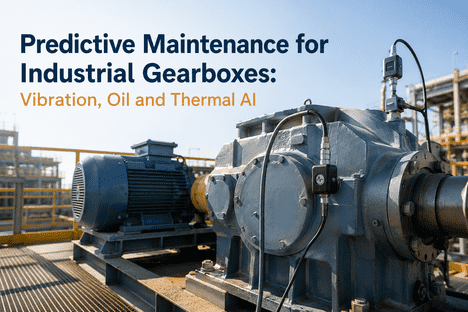
Monitor vibration, temperature, and oil debris on HSS bearings — the most failure-prone component in the drivetrain. Receive 60 to 90 day advance warning of spalling, white-etch cracking, or cage fracture before catastrophic gearbox failure.
Main Bearing Condition Analytics
Track main bearing raceway temperature gradients, low-speed vibration signatures, and grease sample analysis. Predict inner race and rolling element degradation 30 to 45 days before failure requires a major crane intervention.
Oil Debris & Lubrication Intelligence
Continuous particle count, ferrous debris concentration, and oil quality monitoring. Detect gear tooth micropitting and bearing flaking at the earliest metallurgical stage — before vibration signatures confirm advanced damage.
Automated Work Order & Logistics Integration
Every AI-detected anomaly generates a structured work order with fault code, severity rating, recommended parts list, and crane logistics checklist — enabling procurement to source long-lead gearbox components before the turbine ever stops.
"Before iFactory's AI system, we were replacing gearboxes on a 'run-to-failure' basis. Each event cost us $800K to $900K and took 14 to 21 days from crane call-out to re-commissioning. In the first 18 months, the platform detected three developing gearbox faults — the earliest 87 days before projected failure — allowing us to schedule replacements during low-wind summer months, source gearboxes at standard lead-time pricing, and avoid every single catastrophic failure our fleet had been experiencing annually."
The Strategic Matrix: Mapping AI PdM Capabilities to Wind Turbine Drivetrain Assets
Not all wind turbine assets require the same monitoring depth. Gearbox high-speed shaft bearings demand high-frequency vibration and oil debris analysis because failure consequences are catastrophic. Main bearings require low-speed vibration and temperature gradient monitoring. Pitch and yaw systems benefit more from current signature and positional accuracy tracking. iFactory's modular architecture allows wind farm operators to deploy sensor fusion tailored to each asset's criticality and failure mode profile. Fleet reliability managers who schedule a technical review consistently find that this asset-by-asset flexibility is what allows them to maximize ROI across diverse turbine makes and vintages.
| Monitoring Module | Primary Function | Wind Asset Application | Reliability Benefit | Priority Level |
|---|---|---|---|---|
| High-Freq Vibration | HSS bearing fault detection | Gearbox HSS Bearings | 90-day advance failure warning | Critical |
| Low-Speed Vibration | Main bearing raceway tracking | Main Shaft Bearings | 45-day advance degradation alert | Critical |
| Oil Debris Analysis | Wear particle & oil quality | Gearbox Lubrication System | Earliest metallurgical detection | High |
| Thermal Gradient | Bearing temperature monitoring | All Rotating Components | Prevents thermal runaway failure | High |
| Acoustic Emission | Gear tooth crack detection | Planetary & Parallel Gears | Early fracture identification | High |
| Power Curve Analytics | Performance degradation trending | Blades, Pitch, Yaw Systems | Energy capture optimization | Standard |
How iFactory Delivers What Only an AI-First Wind Platform Can
While many condition monitoring systems (CMS) claim to support wind turbine predictive maintenance, they are fundamentally passive data loggers that flag threshold exceedances. iFactory is an active optimization engine that correlates sensor fusion data with operational context — wind speed, power output, grid curtailment events, and ambient temperature — to distinguish genuine degradation from normal operating variation. We don't just store vibration spectra; our AI models continuously update failure probability for every bearing and gear stage across the fleet, enabling 180-day failure foresight that transforms procurement, logistics, and maintenance scheduling from reactive emergency response into planned capital optimization. When procurement teams can source a $180,000 gearbox at standard lead time instead of paying $85,000 in expedited shipping premiums, and when crane crews can be scheduled during low-wind seasons instead of emergency call-out rates, the compounding savings transform wind farm economics. Operations directors who book a live demonstration consistently report that this foresight capability alone justifies the platform investment within the first 12 months.
Phased Deployment: From Fleet Baseline to Predictive Excellence
Moving from reactive gearbox replacement to a predictive reliability program doesn't happen overnight. It requires a structured progression that builds data integrity, turbine-specific model accuracy, and workforce trust. iFactory's implementation team follows a proven phased roadmap aligned with wind farm operational maturity. If you are unsure where your fleet sits on this curve, book a strategic audit to identify the highest-ROI starting point for your wind farm portfolio.
Fleet Baseline & Sensor Deployment
Deploy wireless vibration and temperature sensors on all gearbox HSS bearing housings and main bearing supports. Establish SCADA data integration and train fleet-specific AI baseline models. Timeline: 4-6 weeks for 100 turbines.
Predictive Model Calibration & Alert Tuning
Configure anomaly detection thresholds using 60 days of continuous operational data. Tune false positive rejection algorithms against known gearbox fault signatures from NREL failure mode taxonomy. Timeline: 6-8 weeks.
Workflow Automation & Logistics Optimization
Integrate predictive alerts with CMMS work order generation, spare parts procurement workflows, and crane logistics scheduling. Achieve fully autonomous condition-based maintenance execution. Timeline: Ongoing.
Wind Turbine Gearbox & Bearing Predictive Maintenance — Common Questions
How much advance warning does iFactory provide before a gearbox failure?
Warning times vary by failure mode and component. High-speed shaft bearing degradation typically provides 60 to 90 days of advance notice through vibration harmonics analysis. Gear tooth fatigue cracks show acoustic emission signatures 30 to 60 days before fracture propagation. Main bearing raceway damage provides 30 to 45 days through temperature gradient and low-speed vibration trending. The platform detected the three gearbox faults in this case study at an average of 73 days before projected failure.
How does the platform handle false positives from wind turbulence and grid events?
The AI models are trained on normalized operational data that accounts for wind speed, power output, ambient temperature, and grid curtailment events. By correlating vibration signatures with SCADA operational modes, the system distinguishes between transient turbulence-induced variation and genuine bearing degradation. False positive rates typically stabilize below 3% after the initial 60-day calibration period.
Does iFactory require installation of new sensors on each turbine?
The platform is sensor-agnostic and can ingest data from existing CMS vibration systems, SCADA historian databases, and oil debris sensors already installed on modern turbines. For assets without existing sensors, iFactory deploys wireless IoT vibration and temperature sensors per turbine, with typical installation time of 45 minutes per turbine and no production downtime required.
Can the platform integrate with our existing CMMS and procurement ERP?
Yes. iFactory provides standard API connectors for SAP, Oracle, Maximo, and leading CMMS platforms. Predicted failure alerts automatically generate structured work orders with fault codes, recommended parts lists, and logistics checklists. Procurement teams receive automated purchase requisitions for long-lead gearbox components when the AI first detects developing anomalies — not after the turbine has failed.
What is the typical ROI timeline for a wind farm deployment?
Most wind farms achieve positive ROI within 9 to 14 months. In this case study, the 100-turbine fleet recovered full implementation cost in 11 months by avoiding two catastrophic gearbox replacements ($900K each) and reducing emergency crane call-outs by 80%. The three-year projected ROI exceeded 800% when factoring in recovered generation capacity and extended gearbox operational life.
Does the platform work on different turbine makes and vintages?
Yes. iFactory's AI models are make- and model-agnostic. The platform was deployed across a mixed fleet of Vestas V90, GE 1.7, and Siemens SWT-2.3 turbines in this case study. Each turbine make received a custom-trained model calibrated to its specific gearbox design, bearing types, and operational envelope. The unified dashboard allows fleet managers to view health across all makes in a single pane.
How does oil debris analysis complement vibration monitoring?
Vibration monitoring detects bearing faults once physical damage alters the mechanical dynamics — typically at stage 2 or 3 on the bearing damage progression scale. Oil debris analysis detects ferrous wear particles at stage 1, when micropitting first begins. Combining both modalities provides the earliest possible warning and cross-validated fault confirmation, reducing the risk of missed detections to near zero.
What happens when a developing fault is confirmed?
The platform follows a four-stage escalation protocol. At initial detection, a low-severity alert is logged and the component is marked for enhanced monitoring. As confidence increases, the system generates a structured work order with recommended intervention window. At high severity, automated procurement requests are triggered for replacement components and crane logistics. The final stage alerts the fleet operations center with a confirmed failure timeline, allowing controlled turbine shutdown during planned low-wind periods.
Stop Replacing Gearboxes. Start Predicting Failures with iFactory AI.
iFactory's industrial AI platform delivers the unified intelligence needed to detect gearbox and bearing faults months in advance — purpose-built for the wind energy industry's most critical drivetrain assets.