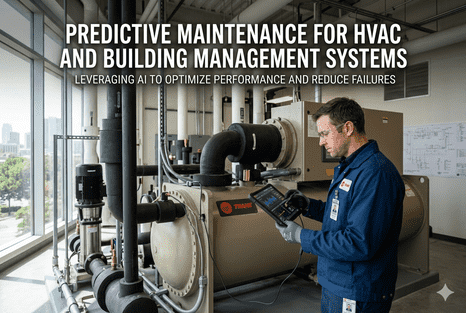
Predictive Maintenance for HVAC and Building Management Systems
By Daniel Carter on June 6, 2026
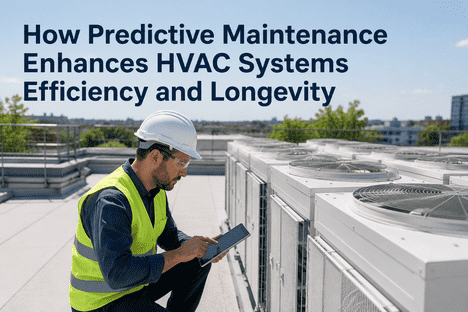
HVAC systems in commercial buildings, data centers, and industrial facilities account for 40-60% of total building energy consumption — yet unplanned chiller, AHU, and compressor failures remain the dominant cause of occupant comfort complaints, data center thermal excursions, and production environment deviations that cost $8,400–$22,000 per occurrence. Traditional time-based preventive maintenance schedules cannot detect refrigerant circuit degradation, bearing wear progression, or compressor valve leakage developing between quarterly inspection intervals. iFactory's predictive maintenance platform ingests Building Management System (BMS) telemetry, chiller controller data, AHU vibration signatures, compressor motor current draw, cooling tower approach temperature, and VAV box airflow trends into machine learning models that forecast chiller condenser fouling, AHU belt failure, compressor valve degradation, and pump cavitation 14–28 days before failure — enabling facility engineers to shift from reactive repair to condition-based HVAC asset intervention. Book a Demo to see how iFactory connects your BMS telemetry to predictive intelligence for every critical HVAC asset.
Predictive Maintenance · Building Management 2026
Predictive Maintenance for HVAC & Building Management Systems
Chiller condenser fouling detection · AHU bearing & belt failure forecasting · Compressor valve degradation · Cooling tower approach temp monitoring · VAV box airflow degradation · All flowing into iFactory CMMS & Shift Logbook.
Airflow degradation · damper position · reheat valve
Why Time-Based HVAC Maintenance Falls Short in Modern Facilities
Commercial and industrial HVAC systems in 2026 operate under dynamic load profiles driven by variable occupancy patterns, weather-responsive zone scheduling, and data center heat density fluctuations that fixed-interval maintenance schedules were never designed to accommodate. Quarterly filter changes, semi-annual bearing greasing, and annual chiller teardowns assume steady-state degradation curves that bear no resemblance to the accelerated wear patterns from variable-speed compressor cycling, AHU economizer operation in extreme ambient conditions, and part-load chiller operation that drives condenser fouling faster than full-load operation. iFactory replaces calendar-based schedules with continuous condition monitoring — ingesting data from BMS controllers, chiller plant managers, VFD drives, and smart building sensors to detect refrigerant circuit degradation, bearing wear progression, and thermal efficiency decay before they escalate into comfort complaints or production interruptions.
LIMITATIONS OF SCHEDULED HVAC MAINTENANCE
1
Load-blind intervals — same PM schedule regardless of actual chiller loading, ambient temperature, or compressor cycling frequency
2
Incipient fault invisibility — refrigerant leaks, bearing wear, and valve degradation develop between quarterly inspection cycles undetected
3
No energy efficiency correlation — rising kW/ton trends and approach temperature drift invisible until annual chiller performance test
4
Fleet-wide pattern blindness — cross-chiller and cross-AHU degradation patterns invisible when each asset is inspected in isolation
Three HVAC Asset Categories iFactory Predicts and Prevents
01
Chiller Condenser Fouling, Refrigerant Charge Loss & Compressor Degradation
Chiller failures rank among the highest-cost HVAC events in commercial and data center facilities — each catastrophic chiller breakdown can exceed $150,000 in emergency repair costs plus lost cooling capacity during peak load hours. iFactory integrates chiller plant controller telemetry (supply/return temps, refrigerant pressures, oil temperature, condenser approach, evaporator approach, kW/ton), compressor vibration signatures, and condenser water loop data into ensemble ML models. The platform classifies chiller health into four states — healthy, moderately stressed, highly stressed, critical — enabling facility engineers to prioritise interventions before condenser fouling drives approach temperature above threshold or compressor valve degradation causes capacity loss. Sites using similar AI-driven chiller monitoring report 32% fewer unplanned chiller outages and 24% lower HVAC maintenance costs. Book a Demo to see iFactory's chiller prediction models in production.
4-state healthkW/ton trend32% outage reduction
02
AHU Bearing Wear, Belt Degradation & Coil Fouling Forecasting
Air Handling Units in commercial buildings and data centers operate under variable airflow demands driven by occupancy schedules and server heat loads. iFactory monitors AHU supply fan vibration (velocity envelope for bearing wear, acceleration for belt degradation), motor current draw, mixed air temperature trends, cooling coil delta-T degradation, and damper position feedback against expected airflow. The Shift Logbook captures filter change records, coil cleaning dates, and technician inspection notes alongside sensor data — creating a unified asset health record that feeds remaining useful life (RUL) estimates for each AHU. Predicted bearing or belt failures trigger work order generation in iFactory with recommended intervention windows aligned to scheduled building occupancy downtime.
Cooling towers, boilers, and VAV boxes form the thermal delivery infrastructure that connects central plant capacity to occupied zones. iFactory ingests cooling tower approach temperature, fan vibration, basin water conductivity, and condenser water loop delta-P alongside boiler heat exchanger tube wall temperature, burner modulation frequency, flue gas O₂/CO₂, and VAV box airflow trends from the BMS. The platform identifies assets operating in degraded states — flagging cooling towers requiring condenser cleaning, boilers needing combustion tuning, and VAV boxes with damper drift or reheat valve leakage before occupant comfort is affected. Every alert is logged in iFactory with full traceability to the BMS point and sensor data that triggered the prediction.
How iFactory Transforms Building Telemetry Into Predictive Intelligence
iFactory is the AI software intelligence layer — not a sensor manufacturer or hardware vendor. The platform integrates with existing building management systems (Siemens Desigo, Johnson Controls Metasys, Honeywell Enterprise Buildings Integrator, Schneider EcoStruxure, Tridium Niagara), chiller plant controllers (Carrier, Trane, York, Daikin, Mitsubishi), VFD drives, smart meters, submetering systems, and ERP (SAP, Oracle). The Shift Logbook captures facility operator shift reports, tenant comfort complaint logs, work order histories, and field inspection notes alongside the sensor stream — creating a unified data fabric for predictive model training across your entire HVAC asset fleet.
Asset Class
Telemetry Sources
iFactory Prediction Output
Business Impact
Chillers
Controller telemetry · vibration · refrigerant pressures · approach temps
Health score · RUL · critical alert
32% fewer unplanned outages
AHUs
Fan vibration · motor current · coil delta-T · damper position
Bearing RUL · belt wear alert · coil fouling score
Reduced emergency fan motor replacement
Compressors
Motor current · vibration · oil level · discharge temp · valve signature
Valve degradation score · RUL estimate
Prioritised valve & motor maintenance
Cooling Towers & Boilers
Approach temp · fan vibration · tube wall temp · flue gas · burner modulation
Thermal efficiency score · degradation alert
Fewer thermal performance failures
Predictive Maintenance Use Cases in HVAC & Building Management
iFactory fuses chiller plant controller telemetry — supply and return temperatures, refrigerant suction and discharge pressures, oil pressure and temperature, condenser approach, evaporator approach, kW/ton — with compressor vibration envelope data and condenser water loop sensors into a single chiller health model. The stacked ensemble classifier assigns a health score — healthy, moderately stressed, highly stressed, or critical — based on multi-dimensional feature fusion. Chillers flagged as critical trigger automated alerts in the Shift Logbook with recommended actions, RUL estimates, and links to historical maintenance records. Facility engineers schedule condenser cleaning and compressor interventions based on actual condition rather than calendar intervals.
Air Handling Units in commercial buildings face variable airflow demands that accelerate bearing and belt wear beyond calendar-based replacement assumptions. iFactory monitors supply fan velocity envelope vibration (bearing wear detection), acceleration envelope vibration (belt degradation), motor current draw deviation from expected fan curve, cooling coil delta-P as an indicator of coil fouling, and mixed air damper position compared to setpoint. The ensemble ML model predicts remaining useful life for each AHU fan bearing, belt drive, and coil assembly. Predicted end-of-life triggers work order generation in iFactory with intervention window recommendations aligned to building occupancy schedules and seasonal load transitions.
Cooling towers and boilers form the thermal rejection and generation infrastructure for central HVAC plants. iFactory ingests cooling tower approach temperature (actual vs. design wet-bulb), fan vibration, basin conductivity and water level, bleed rate, and condenser water delta-P into thermal performance models. For boilers, the platform tracks tube wall temperature trends, burner modulation frequency, flue gas O₂ and CO₂, stack temperature, and heat exchanger delta-T. The platform generates a per-asset thermal efficiency score — flagging towers approaching condenser cleaning thresholds and boilers requiring combustion tuning. Every forecast event is logged in iFactory with full traceability to the BMS sensor data that triggered the prediction.
A 30-Minute Demo Built for Facility & Building Engineers
iFactory will walk through every prediction capability against your facility's specifications — HVAC asset fleet, BMS provider, current breakdown trends, existing CMMS stack. You leave with a deployment plan, an ROI projection, and clarity on which HVAC asset category earns predictive maintenance first.
What iFactory Delivers for HVAC & Building Management Reliability
32%
Fewer unplanned chiller outages
AI-driven chiller & compressor prediction
24%
Lower HVAC maintenance costs
Condition-based vs calendar-based scheduling
4 States
Health classification per HVAC asset
Healthy · stressed · high · critical
RUL
Remaining useful life for chillers & AHUs
Occupancy-aligned replacement scheduling
FAQ
iFactory is the AI software intelligence layer — not a sensor manufacturer or hardware vendor. The platform integrates with existing Building Management Systems (Siemens, Johnson Controls, Honeywell, Schneider, Tridium), chiller plant controllers (Carrier, Trane, York, Daikin), VFD drives, smart meters, and submetering systems already deployed across your facility. Your building engineering team selects the monitoring hardware; iFactory turns the data into predictive intelligence, health scores, RUL estimates, and maintenance work orders.
iFactory integrates with BACnet/IP and BACnet MSTP (the dominant building automation protocol), Modbus RTU/TCP (chiller plant controllers and VFDs), LonWorks (legacy building controllers), OPC UA (industrial interoperability), MQTT (IoT sensor bridges), and REST APIs (modern BMS platforms). The platform normalises data from multi-vendor BMS controllers, chiller plants, and smart sensors into a unified asset health model — eliminating the integration overhead of managing disparate building monitoring systems.
Yes. iFactory connects to SAP, Oracle, IBM Maximo, and major facility management CMMS platforms. The Shift Logbook captures facility operator shift reports, tenant comfort complaint logs, work order histories, and field inspection notes alongside sensor-generated predictions. Every prediction event, sensor reading, and maintenance action is recorded with full traceability for audit, compliance, and continuous model improvement across the HVAC asset fleet.
Deploy iFactory for HVAC Predictive Maintenance
AI-powered predictive maintenance platform connecting chiller, AHU, compressor, cooling tower, boiler, and VAV box telemetry into one unified intelligence layer — with ML-based failure prediction, Shift Logbook integration, CMMS workflow automation, and fleet-wide HVAC reliability analytics.