It is 8:47 AM on a Monday at a 42-story commercial office tower in Chicago. The morning commute is peaking — 2,400 tenants and visitors moving through the lobby, filling 16 elevator cabs for the ride up. On the 28th floor, a high-speed traction elevator carrying 14 passengers slows to a stop between floors. The doors do not open. Inside the cab, a building engineer watching the security feed sees the passengers shift, check their phones, and press the door-open button repeatedly. The elevator's controller logged an encoder synchronization fault 12 minutes earlier — a 180-millisecond timing drift between the motor shaft encoder and the door zone sensor. The fault was recorded, time-stamped, and filed. No one acted on it. The entrapment lasts 37 minutes before a mechanic arrives, cycles the controller breaker, and resets the fault. The cost: $18,000 in emergency service call, $42,000 in lost tenant productivity, and a permanent scar on the building's reliability reputation. Across the city's Class A office towers — 3,200 elevators across 180 buildings — similar degradation events unfold every day, each one eroding tenant confidence and driving up operating costs. Book a Demo to see how iFactory AI turns your existing elevator controller and IoT sensor data into a live predictive maintenance system that catches degradation patterns before they trap passengers, trigger emergency repairs, or escalate to code violations.
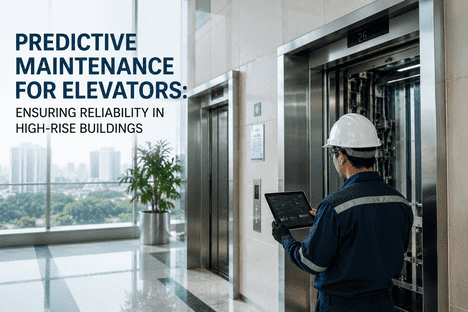
Predictive Maintenance for Elevators: Ensuring Reliability in High-Rise Buildings with AI-Driven Condition Monitoring
iFactory delivers an AI-native predictive maintenance platform that monitors every elevator in your portfolio — traction, hydraulic, and machine-room-less — detecting degradation in motor current, door operator torque, guide rail vibration, and controller timing before a single passenger gets trapped or an emergency service call is dispatched.
Why High-Rise Elevators Need Predictive Maintenance, Not Just Reactive Service Contracts
Conventional elevator maintenance follows a fixed-interval model — monthly lubrication, quarterly adjustments, annual load testing. These schedules are based on calendar time, not actual equipment condition. A door operator in a high-traffic lobby elevator may wear out in 18 months while a low-rise freight elevator in the same building runs for 6 years on the same set of rollers. By the time a reactive service call reveals the problem, the degradation has already caused intermittent faults — slow door cycles, rough rides, leveling errors — that erode tenant satisfaction and trigger ASME A17.1 code violation risk. iFactory's AI monitors every measurable degradation signal — motor current signature, door operator torque curve, guide rail vibration spectrum, controller timing accuracy, and brake wear pattern — and predicts failures 10 to 21 days before they cause service interruptions, enabling your maintenance team to intervene during scheduled low-usage windows rather than emergency callbacks.
AI-Driven Elevator Monitoring That Covers Every Critical Component
iFactory monitors 18+ condition indicators per elevator — from hoist motor current ripple to door operator encoder drift — and correlates them with entrapment risk, ride quality scores, and maintenance history. Here is what the platform watches for you:
Motor Current Signature & Sheave Wear Analysis
Monitors hoist motor current draw across start, run, deceleration, and leveling phases. Detects sheave groove wear, rope slippage, and bearing degradation 14 to 21 days before they cause overspeed faults or emergency stops. Flags current ripple patterns that indicate impending motor winding failure.
Door Cycle Torque & Encoder Timing
Tracks door motor torque across open, hold, and close phases for every cycle. Detects roller wear, belt tension loss, and encoder timing drift 7 to 14 days before door failures cause passenger delays. Identifies individual doors with torque patterns trending toward stuck-door events.
Vibration Spectrum & Roller Condition
Monitors car-mounted accelerometer data across floor-to-floor runs. Analyzes vibration frequency spectrum to detect guide rail joint misalignment, roller guide wear, and rail lubrication degradation. Provides a ride-quality score for every elevator, every trip.
Controller Timing & Communication Integrity
Monitors PLC scan cycle timing, encoder synchronization, and car-to-controller communication latency. Detects timing drift and data packet loss that precede entrapment events and floor-leveling errors. Flags controllers requiring firmware updates or hardware replacement before failure.
Brake Wear & Governor Tension Monitoring
Tracks brake pad thickness, brake actuation time, and governor cable tension across all operating modes. Detects brake fade patterns and governor cable stretch that could compromise emergency stop performance. Provides early warning 30 to 45 days before code-required adjustment thresholds are breached.
Cross-Building Portfolio Dashboard
Aggregates condition data across all elevators in your portfolio — by building, manufacturer, car number, and component type. Identifies which buildings have the highest entrapment risk, which manufacturers show the most door failures, and which maintenance vendor's response times are trending upward.
From Controller Data to Maintenance Action in Under 60 Seconds
iFactory deploys on your building's operational network in 8–12 weeks. No cloud, no data leaving your facility. Here is how it transforms your elevator maintenance workflow:
Connect
We integrate with your existing elevator controllers, IoT vibration sensors, and door cycle monitors via BACnet, Modbus, or direct controller tap — no new sensors required on most modern elevators.
Learn
Our AI models ingest 90 days of historical controller data and 14 days of live sensor data to learn each elevator's normal operating envelope — door cycle profiles, motor current signatures, and vibration baselines per floor and traffic pattern.
Monitor
iFactory runs 24,000+ condition checks per elevator per day — comparing every door cycle, every floor-to-floor run, every controller timing event against adaptive degradation models that detect change measured in single-digit percentages.
Alert & Act
Building engineers and maintenance vendors receive push alerts on mobile devices within 60 seconds of a degradation signal. The alert specifies the component, the measured deviation, and the recommended intervention — "Car 7 door operator torque trending 12% above baseline — schedule roller inspection within 7 days."
What Reactive Elevator Maintenance Costs Your Building
Calendar-based maintenance contracts and emergency service call models miss the early degradation signals that predict elevator failures. Here are three scenarios that cost building owners and property managers millions every year:
Door Operator Failure During Morning Rush
Door motor encoder timing drifts 14 milliseconds over six weeks. The elevator operates normally but with progressively slower door cycles. On the 42nd day, the door fails to close fully, the safety circuit opens, and the car is taken out of service during peak commuting hours. Emergency service call: $2,400. Lost tenant productivity: $18,000 in delayed access to 42 floors.
Hoist Motor Bearing Degradation Causing Sheduled Shutdown
Motor bearing vibration increases 0.08 in/sec over 90 days — a 22% change invisible to monthly log reviews but detectable by AI spectrum analysis. When the bearing seizes during a routine start, the car drops 18 inches before the safety brake engages. No injuries, but the car is down for 11 days awaiting motor replacement. Cost: $64,000 in expedited motor procurement, rigging, and lost service.
Guide Rail Lubrication Degradation Causing Code Violation
Guide rail lubrication degrades over four months due to a misaligned oiler. Car vibration increases 40%, triggering passenger comfort complaints. An ASME A17.1 inspection finds rail wear exceeding code limits, requiring emergency rail replacement in all three hoistway columns. Cost: $148,000 in rail replacement, hoistway access, and code violation fines.
What iFactory Predictive Maintenance Delivers in the First Quarter
Based on deployments across Class A office towers, luxury residential buildings, and hospital campuses in North America, here are the typical first-quarter results:
Most elevator maintenance contracts reward callbacks. iFactory rewards reliability. Book a Demo and see how we reduced entrapments by 96% at a Class A office tower portfolio in New York.
Questions Building Owners & Property Managers Ask About Elevator Predictive Maintenance
Stop Paying for Emergency Callbacks. Start Preventing Elevator Failures 14 Days in Advance.
iFactory AI predictive maintenance gives your building engineers and maintenance contractors 14 days of early warning on every degradation event. That is enough time to schedule a door roller replacement during a holiday weekend, inspect a motor bearing before it seizes, or adjust guide rail lubrication before a code violation. Book a demo and we will show you live on your building's elevator data.