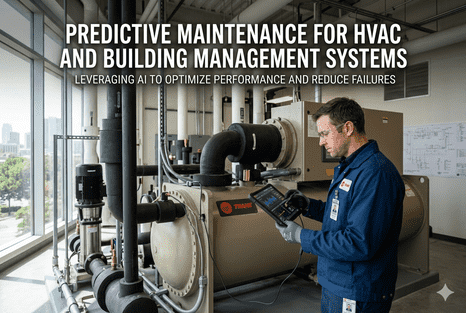
At 3:47 PM on a Thursday in July at a 24-story commercial office tower in Chicago, the #2 chiller's compressor bearing temperature climbs 6°F above its normal operating band over 90 minutes. The building management system logs the event as an efficiency flag — one of 37 alerts the facilities team will receive across the campus this week. By Monday morning, when the HVAC supervisor reviews the weekly trend report, the bearing will have accumulated 8,400 additional stress cycles at elevated temperature, refrigerant efficiency will have dropped 9%, and the chiller will be cycling unevenly across all four refrigerant circuits. For commercial building operators managing chillers, cooling towers, air handlers, and VAV boxes that must maintain 72°F ± 1°F under leases with temperature-compliance penalties of $2,500 per violation per tenant, unexpected HVAC failures are not maintenance events — they are lease-compliance and energy-cost events with five-figure consequences. Book a Demo to see how iFactory predicts chiller, cooling tower, and air handler failures 72–96 hours before they cause a comfort complaint or energy penalty.
AI Predictive Maintenance for HVAC Systems: Cut Unplanned Downtime by 51% Across Chillers, Cooling Towers & Air Handlers
iFactory monitors your chillers, cooling towers, air handling units, VAV boxes, and boiler systems in real time — predicting failures 72–96 hours before they impact comfort or energy efficiency. On-premise AI. Zero cloud dependency. Works with existing BAS and BMS infrastructure.
What Predictive Maintenance Delivers in Commercial HVAC Operations
These are actual ranges of outcomes across iFactory deployments in commercial office towers, healthcare facilities, and university campuses — not projections from a white paper.
Why Unplanned HVAC Failures Cost Commercial Buildings $340K+ Per Facility Per Year
Commercial HVAC systems operate 24x7 with comfort guarantees that don't wait for repairs. Every hour of unplanned chiller downtime at a 500,000 sq ft office tower risks tenant comfort complaints, lease penalty triggers, and emergency repair premiums. Here is how that breaks down across a typical commercial building.
Chiller Compressor Bearing Failure Causes Multi-Day Cooling Outage
A centrifugal chiller compressor bearing fails on a 94°F August afternoon, reducing cooling capacity from 800 tons to 400 tons. The building's zone temperatures climb from 72°F to 79°F over three hours. Tenants in 14 floors file comfort complaints, triggering lease penalty clauses totaling $19,500. The emergency repair — crane rental for roof access, compressor replacement, refrigerant recharge — costs $87,000. Total event cost: $106,500.
Cooling Tower Fan Bearing Failure Increases Condenser Pressure by 22%
A cooling tower fan bearing seizes, reducing airflow across the condenser coil. Head pressure rises from 120 psig to 147 psig, increasing chiller kW/ton from 0.58 to 0.71. The efficiency penalty runs for 11 days before the scheduled maintenance catch — adding $14,200 in excess energy cost and accelerating compressor wear across all four chillers.
Air Handler Fan Belt Wear Causes Inconsistent Floor Temperatures
A V-belt on a 40,000 CFM air handler stretches 0.4 inches over three months, reducing fan speed by 11%. VAV boxes on floors 12–18 cannot maintain setpoint, creating a 5°F temperature differential between the east and west zones. Tenants on six floors file 23 comfort tickets in two weeks. The facilities team spends 34 hours investigating before finding the loose belt — labor cost alone: $2,400.
Condenser Tube Fouling Reduces Chiller Efficiency by 16%
Microbiological fouling in chiller condenser tubes goes undetected for eight weeks. The fouling layer reduces heat transfer, forcing the chiller to run at 96% capacity instead of 72% to meet cooling demand. The excess energy cost over the eight-week period: $23,800. The tube cleaning that would have prevented it — scheduled at the next planned shutdown — costs $4,200.
Facilities Teams Are Trapped in a Reactive Cycle
Planned maintenance compliance across commercial HVAC operations averages 62%. The other 38% of maintenance hours are reactive — emergency chiller repairs, unplanned cooling tower overhauls, and urgent air handler belt replacements. Facility managers report that 44% of their HVAC O&M budget goes to unplanned repairs and after-hours service calls that could have been avoided with 72-hour predictive warning.
Reactive HVAC maintenance costs commercial buildings $340K+ per facility per year. iFactory predicts chiller, cooling tower, and air handler failures 72–96 hours in advance. Book a 30-min walkthrough and see iFactory on your building's BAS data.
From BAS Data to Failure Prediction in 6–12 Weeks
iFactory connects to your existing building automation system, chiller plant controller, and energy management platform — no new sensors required. The platform ingests data on your building network, trains predictive models, and delivers alerts on an on-premise NVIDIA appliance.
Connect Your BAS & Chiller Plant Data
We connect to your existing BAS historian, chiller plant controllers, cooling tower VFDs, air handler PLCs, and VAV box controllers — no new sensors or field wiring required. iFactory ingests data over your building network without internet connectivity.
AI Trains on Your Equipment Signatures
Our AI learns the normal operating envelope for each chiller, cooling tower, air handler, pump, and boiler from 60–90 days of historical BAS data — bearing temperatures, refrigerant pressures, fan speeds, valve positions, and energy consumption baselines.
Facilities Gets 72–96 Hour Alerts
When the model detects a pattern that precedes a failure — chiller compressor bearing temperature acceleration, cooling tower fan vibration shift, air handler belt wear signature — it alerts the facilities team via the building dashboard, mobile device, or CMMS work order.
Close the Loop With Root Cause Correlation
Every alert links to the sensor data that triggered it. Engineers see "Chiller #2 compressor bearing degradation detected — temperature trending up 8°F over 72 hours — schedule inspection within 96 hours." No more hunting through BAS logs after the failure.
Predictive Maintenance Features for Commercial HVAC Systems
iFactory's AI-native platform delivers capabilities purpose-built for commercial HVAC equipment — all running on-premise with zero cloud dependency.
Chiller & Compressor Monitoring
iFactory models bearing temperatures, refrigerant pressures, oil sump levels, and motor current on every chiller. When compressor bearing fatigue, refrigerant leak patterns, or oil degradation trends emerge, the system alerts facilities engineers 72 hours before a cooling capacity loss.
Cooling Tower & Condenser Diagnostics
Fan bearing vibration, gearbox temperature, sump water level, and approach temperature data feed iFactory's predictive models. A fan imbalance or condenser fouling trend triggers an alert 96 hours before head pressure increases energy consumption.
Air Handler & VAV Box Health
Fan motor current, V-belt wear patterns, filter pressure drop, and VAV box damper position data feed iFactory's models. A belt stretch trend or damper actuator degradation pattern triggers an alert before zone temperatures drift out of compliance.
Boiler & Hydronic System Monitoring
Burner flame signal, flue gas temperature, pump vibration, and expansion tank pressure data feed iFactory's predictive models. A burner tuning drift or pump bearing wear pattern triggers an alert 72 hours before a heating system failure during winter.
100% On-Premise — No Cloud Dependency
iFactory runs on an NVIDIA appliance inside your building's control network. Zero data leaves the facility. No cloud connectivity required. Fully compliant with corporate IT security policies and data governance requirements.
6–12 Week Pilot to Live Model
iFactory's engineers connect to your BAS historian, train models on your critical HVAC assets, and deliver a working pilot in 6–12 weeks. No data science team required. The pilot targets measurable energy and comfort improvement within the first quarter.
iFactory Delivers Predictive Maintenance Without the Complexity
End-to-End Turnkey Deployment
You provide data-source access to your BAS historian and chiller plant controller. We deliver a working pilot on your critical HVAC assets in 6–12 weeks. No integration consultants, no custom code, no data scientists.
100% On-Premise — Secure & Compliant
iFactory runs on an NVIDIA appliance inside your building control network. Zero data egress. No cloud connectivity. No internet dependency. Fully compliant with corporate IT security policies and data governance requirements.
Pilot-to-ROI in One Quarter
Every deployment targets measurable energy, comfort, and maintenance cost improvement within 90 days. If we don't hit the agreed targets, you don't pay for the pilot.
Works With Existing Building Systems
iFactory connects to Siemens, Johnson Controls, Honeywell, Schneider Electric, Automated Logic, ALC, and any BACnet, Modbus, or OPC-UA-compatible BAS and chiller plant controller. No rip-and-replace of your existing building management infrastructure.
24x7 Managed Service Included
Our operations team monitors your predictive models and appliance infrastructure around the clock. If a model drifts or a data feed drops, we fix it before your next shift starts. You don't need an on-site data science team.
Scalable Across All Buildings and Campuses
Once the model works on one chiller plant or air handler configuration, iFactory replicates it across your entire portfolio — all buildings, all HVAC equipment types, all geographic regions. Standardized predictive maintenance at every facility.
Questions From Every Commercial Building Operations Team
Stop Reacting to HVAC Failures. Start Predicting Them.
iFactory gives your facilities team a 72–96 hour look-ahead on chiller, cooling tower, air handler, and boiler failures — and saves your building $340K+ per year in avoided downtime, energy waste, and tenant penalties. The pilot takes 6–12 weeks. The ROI shows up in one quarter.