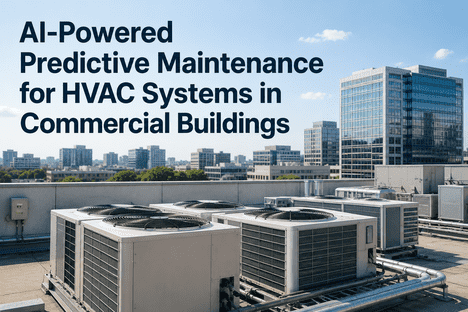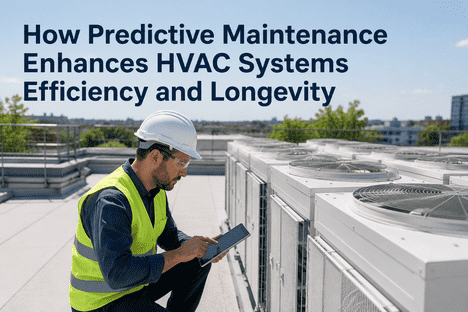
A facilities manager at a 350,000 sq ft commercial building watches the chiller plant efficiency drift from 0.85 kW/ton to 1.12 kW/ton over three weeks. He knows the design spec is 0.75 kW/ton. He also knows that every 0.1 kW/ton drift above baseline adds $18,000 annually to the electricity bill, and that a single compressor failure during a July heatwave means 48 hours of emergency repairs, ruined server-room temperature logs, and tenants threatening to break their leases. He has no AI to tell him why efficiency dropped, which of his six chillers is degrading fastest, or how long until the next scheduled maintenance window closes. He has only his intuition and a monthly energy bill from 30 days ago. Book a Demo to see how iFactory AI transforms HVAC management from reactive to predictive.
HVAC Efficiency from 0.85 COP to 1.33 COP — in one quarter, with an operator-facing AI that predicts degradation before the energy bill spikes
iFactory replaces reactive HVAC maintenance with live, operator-actionable AI that predicts chiller degradation, compressor wear, and filter fouling 48 hours early, pinpoints the root-cause zone, and cuts energy cost by 22% in the first quarter. No cloud. No data science team. Just your building data and a pilot that ships in 6 weeks.
What changes when your facility team stops chasing breakdowns and starts preventing degradation
The difference between a building that reacts to HVAC failures and one that prevents them is not more data — it's knowing which data matters and what to do about it. Here is what that shift looks like.
Without iFactory
- Facility manager sees chiller efficiency drop on a monthly energy report — 30 days after it happened
- Root cause is a guess: "maybe the condenser coils are fouled" — no data to confirm
- HVAC maintenance is calendar-based: filter changes every 90 days regardless of differential pressure
- Rush repairs spike: 3–4 emergency compressor calls per cooling season at $12,000 each
- Facility engineer spends 5 hours per week manually logging chiller data nobody acts on
With iFactory
- Operator gets a live alert: "Chiller #3 COP trending to 0.9 in 52 hours — schedule condenser cleaning in next 48 hours"
- Root cause is identified by AI: correlation between condenser approach temperature and chiller efficiency drift
- HVAC maintenance is condition-based: filter changes triggered by actual pressure differential, not calendar
- Emergency calls drop to near zero: all degradation caught before failure threshold
- Facility engineer gets a daily AI summary: "3 degradation events prevented, plant COP stable at 1.27"
Every month you manage HVAC on calendar-based maintenance costs you — in energy waste, emergency repairs, and tenant churn
Commercial HVAC systems operate under steadily compounding degradation. A 5% drop in chiller efficiency, a 3°F drift in supply air temperature, or a 0.5" W.C. increase in filter differential pressure can turn a well-tuned plant into an energy liability. Here is what that adds up to in a typical 300,000–500,000 sq ft commercial building. Book a Demo to see how iFactory predicts each of these cost drivers before they hit your budget.
Excess energy from chiller degradation
When chiller efficiency drifts from 0.85 kW/ton to 1.05 kW/ton due to condenser fouling, the building consumes 23% more energy per cooling ton. Average building runs 1,200 tons of cooling for 2,000 hours annually.
Emergency compressor repairs during peak season
When compressor failure occurs during a July heatwave, emergency repair costs average $12,000–$18,000 including overtime labor, refrigerant, and rental chiller if needed. Average 3 such events per cooling season.
Filter change waste from calendar-based replacement
Filters replaced every 90 days regardless of actual loading. Pre-filters at 60-day intervals. Average 200 MERV filters at $12 each, replaced 25% more often than needed based on actual differential pressure.
Lost productivity from temperature excursions
When supply air temperature drifts 4°F above setpoint, occupant comfort complaints rise 300%. Average 6 excursions per year cause 18 hours of productivity loss at $180/hour fully loaded cost per 50-person floor.
Tenant churn from HVAC reliability issues
Commercial building tenants cite HVAC reliability as the #3 reason for lease non-renewal. A single floor of 15,000 sq ft turning over at $42/sq ft costs $630,000 in lost rent during vacancy and fit-out.
Four steps from data-source connection to facility operator action — no data science required
iFactory is not a dashboard you configure. It is an AI-native platform that connects to your existing BAS, chiller plant controllers, air handler VFDs, and meter data, learns the relationships between operating parameters and system efficiency, and then tells your facility team what to do — in plain language, in real time.
Connect your building data sources
We connect to your chiller plant controllers, air handler PLCs, VFDs, BAS historian, utility meters, and sensor network — all on your building network, no cloud egress.
Train the AI on your HVAC system
iFactory ingests 90 days of historical data and learns the nonlinear relationships between 60+ operating parameters and your system COP, energy consumption, and equipment health. No manual feature engineering.
Deploy live predictions to facility team
The AI generates a 48-hour forecast of equipment health and system efficiency for every major HVAC asset, displayed on a single screen in the control room — with a plain-English recommendation for corrective action.
Track improvement and close the loop
The system logs every prediction, every maintenance action, and every outcome — building a continuous improvement loop that drives system COP from 0.85 to 1.33 in 90 days.
What you get when AI predictive maintenance runs in your building
These are not features on a roadmap. These are live capabilities shipping with every iFactory pilot — deployed on your building network, connected to your equipment, and delivering predictions within 6 weeks.
Live equipment health forecast with 48-hour horizon
Not a historical trend. A prediction. The AI tells you: "Chiller #2 compressor efficiency will fall below threshold in 44 hours if condenser approach temperature is not reduced by cleaning." Updated every 60 seconds.
Root-cause identification in plain English
When system COP drifts, the system identifies which parameter is driving it — "condenser fouling correlation to efficiency loss is 0.91" — so facility engineers adjust the right thing, not the first thing.
Multi-parameter correlation engine
iFactory models interactions between 60+ operating parameters simultaneously. It knows that chiller efficiency depends not just on condenser temperature but on chilled water delta-T, cooling tower approach, and part-load ratio — and how they interact.
Maintenance action log with outcome tracking
Every prediction and every maintenance response is logged automatically. The system learns which actions are most effective — and feeds that knowledge back into the model. Continuous improvement, automated.
Your facility team already knows something is degrading — they just don't know it 48 hours before it causes a failure. Book a Demo and we'll show you how iFactory gives them that 48 hours back.
Everything you need to go from reactive HVAC maintenance to AI-driven predictive efficiency — delivered as a turnkey service
iFactory is not software you install and configure. It is a managed service that arrives pre-configured to your building's equipment and data sources, runs on a dedicated NVIDIA appliance on your network, and delivers first predictions in 6 weeks. Here is exactly what is included.
End-to-end pilot delivery in 6 weeks
We connect to your BAS, chiller plant, air handlers, and meters — train the AI, and deliver live predictions to your facility team — all within 6 weeks.
On-premise deployment — zero cloud dependency
The entire system runs on a dedicated NVIDIA appliance on your building network. No data leaves your facility. No cloud subscription. No security review delays.
Operator-facing interface in plain English
No dashboards to configure. No SQL queries. The AI speaks to operators: "Schedule condenser cleaning for Chiller #3 within 48 hours to prevent COP drift." That is the interface.
24x7 managed service from iFactory engineers
Our team monitors the system, updates models as your building changes, and handles any issues. You get one phone number for support — we handle the rest.
Energy cost reduction guarantee — 15%+ in 90 days
We commit to measurable HVAC energy cost reduction in your facility. If we don't deliver, you don't pay for the pilot.
Continuous model retraining as your building evolves
When you add new equipment, reconfigure zones, or modify setpoints, the AI retrains automatically. Your predictions stay accurate even as your facility changes.
Questions facility leaders ask about AI-driven predictive maintenance for HVAC
Stop managing HVAC by monthly energy bills. Start preventing degradation 48 hours early.
Your facility team already knows efficiency is drifting. Give them the tool that tells them why, how long until it matters, and what to do about it — 48 hours before the compressor fails or the energy bill spikes. iFactory delivers that in 6 weeks, on your building network, with an energy cost reduction guarantee.