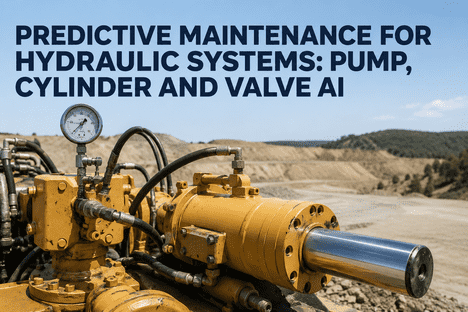
Hydraulic systems are the muscle of modern industrial machinery — powering presses, excavators, injection molders, cranes, and aircraft actuators through fluid power transmitted at pressures exceeding 4,000 psi. Yet the same fluid that transmits power also carries the seeds of system destruction: particulate contamination, water ingress, thermal degradation, and entrained air. Industry data consistently shows that 85% of hydraulic system failures trace back to fluid contamination, and 82% of component wear is particle-induced. A single variable-displacement piston pump operating on oil at ISO 4406 cleanliness code 20/18/15 — the typical cleanliness of new oil straight from the barrel — wears 4–6× faster than the same pump running at a target cleanliness of 16/14/11. Traditional maintenance approaches — fixed-interval filter changes, annual oil sampling, route-based pressure and temperature logging — operate on schedules that cannot adapt to real-world variables: ingression rate from a leaking cylinder rod wiper, water condensation from humid ambient air, oil oxidation accelerated by localized hot spots in the reservoir, or silt loading from a failing return-line filter. Predictive maintenance powered by AI and multi-sensor fusion is transforming how fluid-power operators manage hydraulic assets: continuous particle counting and viscometry feed AI models that predict pump swash-plate wear 4–8 weeks before efficiency drops below threshold; high-frequency pressure-transient analysis detects valve spool stiction 3–6 weeks before position error triggers a fault; cylinder seal degradation is forecast from rod-position drift and internal leakage trends; and oil-chemistry fusion models correlate TAN rise, viscosity shift, and wear-metal acceleration to predict remaining useful life across the entire hydraulic circuit. iFactory AI's industrial software platform, including its Shift Logbook and predictive maintenance engine, enables fluid-power operators to deploy AI-native predictive maintenance without replacing existing PLC, SCADA, CMMS, or BAS systems. Book a Demo to see how iFactory applies predictive maintenance for hydraulic systems. This guide covers failure-mode physics across pumps, cylinders, and valves, the role of ISO 4406 cleanliness control, sensor-fusion architecture, deployment paths, and the practical decision framework for operators evaluating modernization.
Fluid Power · Hydraulics · 2026
Predictive Maintenance for Hydraulic Systems
AI-driven fluid contamination prognostics · pump efficiency tracking · valve spool stiction detection · cylinder seal degradation forecasting — reducing unplanned downtime, extending component life, and optimizing fluid condition across hydraulic circuits.
Why Traditional Hydraulic Maintenance Is Hitting Its Ceiling
The conventional approach — quarterly oil sampling with lab-sent PDFs, calendar-based filter changes, route-based pressure and temperature logging — treats every system identically regardless of actual operating conditions. A hydraulic press in a foundry operating at 3,500 psi and 130°F oil temperature experiences oxidation and viscosity shear 3× faster than the same pump in a climate-controlled assembly machine. A mobile excavator working in a dusty quarry ingests particulate at 10× the rate of an indoor injection molder. A cylinder sealing a blast-furnace door sees thermal cycling and rod contamination that a packaging-line cylinder never encounters. Fixed-interval maintenance either over-serves healthy systems (wasting labor, filters, and oil) or under-serves systems approaching failure (risking catastrophic pump seizure, valve stiction, cylinder rod scoring, and production-stopping leaks). Four specific ceilings are visible across every mature hydraulic operation.
01
Fixed PM Schedules
Calendar-based filter and oil changes ignore actual contamination load. A system with a leaking cylinder rod wiper ingests particulate at 10× the rate of a sealed system. AI models use continuous particle count, viscosity, and water-content trends per machine.
Gap: Calendar-based vs Condition-based
02
Reactive Oil Management
Oil samples are sent to labs quarterly with results arriving weeks later. By then, a system that crossed an ISO 4406 alarm threshold has already accumulated wear. AI fusion models flag TAN rise, viscosity shear, and water ingress in real time from continuous sensors.
Gap: Lab-delayed vs Real-time
03
Siloed Component Monitoring
Pump pressure is logged in the PLC, cylinder position in the motion controller, valve current in the servo drive, and oil data in the lab system. No single view connects pump swash-plate drift to valve spool stiction to cylinder seal wear. AI fuses all streams.
Gap: Siloed vs Unified
04
No Degradation Trending
Pump case drain flow is rarely measured continuously. Valve response time is checked only during commissioning. Cylinder internal leakage is discovered only when position accuracy degrades. AI trends these parameters daily and predicts RUL from the degradation slope.
Gap: Point-check vs Trending
What Predictive Maintenance Actually Adds to Hydraulic Operations
The misconception some operators carry: predictive maintenance replaces existing PLC, SCADA, CMMS, or BAS systems. It doesn't. Your CMMS continues handling work orders, parts inventory, and maintenance schedules. Your PLC and SCADA continue controlling processes and monitoring alarms. What changes is the intelligence layer feeding those systems. Time-based filter and oil changes migrate to AI-driven condition-based predictions. Alarm thresholds gain predictive context — not just "pump case drain flow 8 L/min — alert" but "piston pump 2 shows case drain flow elevation from 3 L/min to 7 L/min correlating with ISO 4406 code shift from 16/14/11 to 19/17/14 at 96% confidence — estimated 21 days remaining useful life — root cause: swash-plate wear accelerated by elevated silt load — recommended action: inspect return filter, schedule pump overhaul within 14 days." iFactory AI's Shift Logbook provides hydraulic-system operators and technicians with a unified interface for shift handovers, equipment status, and AI-generated maintenance recommendations integrated with existing workflows.
Critical Failure Modes in Hydraulic Systems — What AI Catches That Manual Inspections Miss
Hydraulic component failure is not a sudden event — it is the endpoint of measurable degradation processes that leave identifiable signatures in fluid properties, pressure dynamics, vibration spectra, and position-tracking data long before visible damage occurs. AI models trained on these signatures detect degradation 3–8 weeks before failure — the window that separates a planned component swap from a catastrophic rupture, fire risk, and production-stopping spill.
P
Pumps
Piston pump swash-plate wear increases case drain flow — the leading indicator of internal leakage. Gear pump tip clearance erosion reduces volumetric efficiency. Vane pump cam-ring fatigue from contaminated oil generates characteristic vibration signatures. AI models fuse pressure ripple, case drain flow, and oil cleanliness to predict RUL.
Predictive lead time: 4–8 weeks
V
Valves
Servo and proportional valve spool stiction from silt and varnish degrades position control — step response slows, null bias drifts. Poppet and seat erosion from high-velocity particulate causes internal leakage. Relief valve pilot-stage contamination causes pressure instability. AI detects spool position vs command deviation and pressure transient anomalies.
Predictive lead time: 3–6 weeks
C
Cylinders
Piston seal wear allows internal bypass — rod creeps under load, position accuracy degrades. Rod wiper seal failure admits particulate that scores the rod surface and contaminates the entire system. End-cushion wear causes impact loading at stroke extremes. AI detects seal degradation from rod-position drift, internal leakage rate, and pressure decay.
Predictive lead time: 3–6 weeks
F
Fluid & Filtration
Return-filter element blinding increases differential pressure and eventually bypasses unfiltered oil. Water ingress from failed oil cooler or humid breather accelerates oxidation and reduces lubricity. Oil oxidation raises TAN and viscosity, accelerating varnish formation on valve spools. AI monitors filter DP, water content, TAN, and particle count to predict fluid health.
Predictive lead time: 4–6 weeks
The Keep / Retire / Transform / Replace Decision Matrix
Migration discipline starts here. Every asset management artifact in your current operation falls into one of four categories. Getting the categorization right in week one of the workshop saves quarters of debate later.
Core operations foundations
PLC / SCADA pressure and flow monitoring
CMMS work order engine
Oil lab analysis partnerships
BAS / environmental control
Service provider contracts
Established capabilities. No business case to replace. AI predictive maintenance writes recommendations and work orders to these systems.
Legacy inspection layers
Calendar-based filter change schedules
Annual lab-only oil analysis
Paper-based logbooks for pressure and temp
Standalone vibration data collection
Manual case drain flow measurement
Replaced by AI-driven condition-based predictions and unified interface. 70–90% reduction in manual monitoring effort.
Alert & notification layer
Legacy alarm notification gateways
Manual escalation workflows
Standalone pager / SMS systems
Paper-based fluid logs
Siloed lab report emails
Event-driven AI alert engine replaces manual notification. Critical alerts with automated work order creation.
Want this matrix applied to your specific hydraulic asset inventory in a working session? Walk through every pump, valve, and cylinder class and prioritize your predictive maintenance rollout.
Three Deployment Paths for Hydraulic Predictive Maintenance
Same starting point, three valid destinations. The right path depends on facility type (manufacturing, mobile, marine, aerospace), component criticality, and current sensor instrumentation. Operators that pick the wrong path spend 12 months in pilot purgatory. Operators that pick the right path deploy in 6–12 weeks.
Path A
Augment in Place
6–8 weeks
AI predictive monitoring runs alongside existing PM and oil-analysis programs. Shadow mode for 4 weeks. Alerts flow to CMMS for review. No legacy systems retired.
Best fit
Manufacturing plants · risk-averse operators · first AI deployment on fluid power systems
Wk 1–2 Sensor data federation
Wk 3–5 Shadow mode AI
Wk 6–8 CMMS integration live
Path B
Hybrid Migration
8–12 weeks
AI predictive layer replaces fixed PM schedules. Legacy oil-analysis PDF management retires for unified mobile UX. PLC, SCADA, CMMS preserved.
Best fit
Multi-machine operations · metal forming · injection molding · sponsorship for digital transformation
Wk 1–3 Discovery · matrix
Wk 4–8 Deploy AI prediction layer
Wk 9–12 Mobile UX migration · cutover
Path C
Full Modernization
10–14 weeks
Legacy fixed-interval programs retired. iFactory platform provides full predictive capability across pumps, valves, cylinders, and filtration. CMMS retained.
Best fit
Large multi-plant operators · hydraulic OEMs · strategic platform consolidation
Wk 1–4 Full asset inventory + matrix
Wk 5–10 Parallel build + test
Wk 11–14 Cutover + legacy sunset
Find the Right Path for Your Hydraulic Systems in a 90-Minute Workshop
iFactory AI's fluid power practice runs a focused workshop against your specific pump, valve, and cylinder inventory, sensor coverage, PLC configuration, and fluid analysis program. You leave with a defended path recommendation, a 12-week deployment plan, and a cost projection grounded in your maintenance history.
Vendor Evaluation Framework — Hydraulic System Specific Questions
Generic predictive maintenance vendors handle the AI math. Fluid-power-aware vendors handle the integration reality — pump type diversity (piston, gear, vane), valve dynamics (servo, proportional, cartridge), cylinder seal varieties, ISO 4406 cleanliness targets, and zero-disruption deployment to live production machinery. Eight criteria separate vendors who've done hydraulic modernizations from vendors selling a demo.
01
Fluid contamination fusion depth
Ask:
"Does your platform ingest online particle count, viscosity, water content, and TAN data and trend them against pump case drain flow and valve response metrics?"
Fluid contamination drives 85% of hydraulic failures. Platforms that monitor only vibration or temperature miss the root cause. Production-grade platforms fuse fluid chemistry with mechanical and hydraulic data per component.
02
Pump prognostics by type
Ask:
"Does your platform provide remaining useful life predictions for axial-piston, gear, and vane pumps using case drain flow, pressure ripple, and efficiency trends?"
Each pump type has distinct failure signatures. Axial-piston pumps fail through swash-plate wear (case drain flow rise). Gear pumps fail through tip clearance erosion (volumetric efficiency drop). AI models must be calibrated per pump type.
03
Valve stiction detection
Ask:
"Does your platform detect servo and proportional valve spool stiction from position error, step-response degradation, and pressure transient anomalies?"
Valve stiction from silt and varnish is the most common precision-control failure. Platforms without spool position vs command analytics miss 3–6 weeks of warning time. AI detects null-bias drift and response-time slowing invisible to operators.
04
Cylinder seal degradation
Ask:
"Can your platform detect cylinder internal bypass from rod-position drift, pressure decay rate, and leakage flow trends?"
Cylinder seal wear is the leading cause of position accuracy loss and external leakage. Platforms must trend internal leakage across full stroke cycles. AI detects seal degradation 3–6 weeks before visible external leakage appears.
05
ISO 4406 compliance monitoring
Ask:
"Does your platform track ISO 4406 cleanliness codes per system and trigger alarms when particle counts exceed component-specific target limits?"
ISO 4406 targets vary by component — servo valves require 16/14/11, piston pumps require 18/16/13, gear pumps require 20/18/15. Platforms without per-component target tracking cannot distinguish acceptable from actionable contamination levels.
06
PLC and SCADA integration
Ask:
"Does your platform integrate with existing PLC (Allen-Bradley, Siemens, Beckhoff) and SCADA platforms without custom development?"
Pre-built connectors for major PLC and SCADA platforms are the difference between 8-week and 8-month deployment. Custom integration projects fail at 3× the rate of template-based deployments.
07
Multi-pump coordination
Ask:
"Does your platform model hydraulic systems with multiple pumps, accumulators, and consumers — distinguishing pump-specific degradation from system-level anomalies?"
Multi-pump systems with common headers mask individual pump degradation. Systems with accumulators conceal leakage. Platforms that model system topology can isolate failing components that aggregate metrics miss.
08
Deployment timeline commitment
Ask:
"When does the first validated predictive alert reach our CMMS in production?"
8–12 weeks is the production-grade benchmark. Path A is 6–8 weeks. Path C is 10–14 weeks. Vendors quoting 6+ months are building custom development.
Want to score your shortlisted vendors against this 8-criterion framework? Run a vendor evaluation working session with our team.
The ROI Math — What Predictive Maintenance Delivers for Hydraulic Systems
The business case for AI-native predictive maintenance in hydraulic systems isn't about software cost — it's about cost avoidance on unplanned downtime, catastrophic component failure, fluid waste, energy inefficiency from worn pumps, and emergency repair premiums. Operators moving from preventive to AI-native predictive maintenance see measurable improvements across four metrics in the first quarter post-deployment.
−40–60%
Unplanned downtime reduction
AI identifies pump, valve, and cylinder degradation 3–8 weeks before failure. Emergency breakdowns shift to planned component swaps during scheduled maintenance windows.
−30–50%
Maintenance cost reduction
Condition-based oil and filter changes eliminate waste. Catastrophic pump seizures and valve replacements with hazmat cleanup costs are avoided entirely.
−5–15%
Energy cost reduction
AI-optimized pump sequencing and detection of efficiency drift from worn pumps directly reduces kWh per unit of hydraulic power delivered.
6–12 mo
Typical ROI payback
Full investment recovery through downtime avoidance, component life extension, fluid cost savings, and energy efficiency improvements.
Expert Perspective
"The single biggest mistake fluid-power operators make in predictive maintenance modernization is treating it as a rip-and-replace of their PLC or SCADA. It isn't. Your PLC pressure and flow monitoring, CMMS work order engine, and oil lab analysis program work as designed — there's no business case to replace them. What needs to change is the intelligence layer feeding those systems. Calendar-based filter changes and annual case drain flow tests need to migrate to AI model invocations running remaining useful life predictions across piston-pump swash plates, servo-valve spools, cylinder piston seals, and fluid-condition trends. ISO 4406 particle count data that currently sits in a quarterly PDF needs to stream continuously into fusion models that predict varnish formation 30 days before it compromises valve spool response. The architectural decision isn't PLC-or-AI — it's PLC-plus-AI-plus-fluid-lab-plus-vibration-plus-pressure-transients. Operators that frame it correctly deploy in 8–12 weeks. Operators that frame it as rip-and-replace spend 12 months in pilot purgatory or worse — they lose the production data history needed to train accurate degradation models."
— Fluid Power Asset Management Practice, 2026 industry insight
8–12 wk
hybrid deployment with pre-configured hydraulic templates
70–90%
reduction in custom deployment scope with templates
Zero rip
of existing PLC, SCADA, or CMMS required
Conclusion: The Modernization Decision Has Three Right Answers
Calendar-based maintenance programs aren't failing in hydraulic systems — they're hitting an architectural ceiling that fixed-interval analysis can't cross. AI-native predictive maintenance adds the condition-based intelligence layer that traditional programs were never designed to deliver: remaining useful life predictions across piston-pump swash plates and servo-valve spools, cylinder seal degradation forecasting before internal bypass affects position accuracy, fluid-contamination prognostics that flag ISO 4406 code shifts weeks before component damage, self-updating models from technician confirmations, and mobile-native operator interfaces grounded in real-time pressure, flow, and fluid-condition data. The modernization conversation has three valid answers depending on facility type and component criticality — augment in place (6–8 weeks), hybrid migration (8–12 weeks), or full modernization (10–14 weeks). All three keep existing PLC, SCADA, and CMMS intact and reuse current sensor infrastructure. All three deliver 40–60% reduction in unplanned downtime, 5–15% energy cost reduction, and measurable fluid and component cost savings within the first quarter. The decision worth making in 2026 isn't whether to adopt AI predictive maintenance for hydraulic systems — it's which of the three paths fits your specific equipment portfolio.
Run the Predictive Maintenance Workshop Built for Your Hydraulic Systems
iFactory AI's fluid power practice runs a 90-minute workshop against your real pump, valve, and cylinder inventory, sensor coverage, and PLC configuration. You leave with a defended path recommendation, the keep/retire/transform/replace matrix applied to your assets, and a cost reduction projection grounded in your maintenance history.
Frequently Asked Questions
Does predictive maintenance replace our existing PLC or SCADA system?
No. Your PLC continues handling machine control, pressure and flow regulation, and safety interlocks. Your SCADA continues providing visualization, alarming, and historical data. Your CMMS continues managing work orders and parts inventory. These are mature, mission-critical systems with no business case to replace. What changes is that sensor and fluid analysis data now feeds AI models that predict component failures 3–8 weeks in advance, in addition to the real-time monitoring your operators already perform. The predictive layer sits on top of existing systems through standard OPC-UA, Modbus TCP, and EtherNet/IP integration. Deployment does not require any changes to control logic or alarm thresholds.
What hydraulic system failure modes can AI actually predict?
Production-grade AI predictive maintenance covers pumps (axial-piston swash-plate wear via case drain flow rise, gear pump volumetric efficiency decay, vane pump cam-ring fatigue, cavitation erosion), valves (servo and proportional spool stiction from silt/varnish, poppet and seat erosion, relief valve pilot-stage instability, solenoid coil degradation), cylinders (piston seal wear causing internal bypass, rod wiper seal failure admitting contamination, end-cushion wear, rod scoring), and fluid systems (filter element blinding, water ingress, TAN rise, viscosity shear, varnish formation). Each failure mode has a characteristic multi-parameter signature detectable 3–8 weeks before functional failure.
Does deployment require new sensors on existing hydraulic systems?
No. Production-grade predictive maintenance platforms integrate with existing instrumentation already present on most hydraulic systems — PLC pressure transmitters, flow meters, temperature sensors, position transducers, and servo-valve LVDT feedback. iFactory's federation layer reuses current instrument data through existing OPC-UA, Modbus TCP, and EtherNet/IP infrastructure. For systems without continuous oil condition monitoring, retrofittable inline particle counters and viscometers are available as an option, but the platform is designed to extract maximum value from existing PLC instrumentation first. Many operators gain significant predictive capability from pressure, flow, and temperature data already collected by their PLC but never trended for degradation.
How does predictive maintenance improve hydraulic system reliability?
Reliability improvements come through four mechanisms. First, fluid contamination is tracked continuously against ISO 4406 targets — when particle counts approach component-specific limits for servo valves or piston pumps, the system generates a filter-change or oil-polishing work order before wear accelerates. Second, pump case drain flow is trended daily — a sustained rise triggers a predictive overhaul alert 4–8 weeks before efficiency loss affects production cycle time. Third, valve spool response is evaluated on every cycle — step-response slowing or null-bias drift generates a stiction alert 3–6 weeks before position error rejects parts. Fourth, the system automatically recommends rotating standby pumps online when an at-risk unit is flagged — eliminating the single-point failure scenario that stops production lines.
Which deployment path fits a multi-press metal forming plant best?
Path B (Hybrid Migration) is the right starting point for metal forming facilities with multiple hydraulic presses and a central CMMS. The platform replaces fixed-interval filter and oil changes with AI-driven condition-based scheduling. Legacy quarterly oil analysis continues in parallel for 8 weeks while the AI model builds a baseline, then transitions to continuous online monitoring augmented by targeted lab verification. No PLC or control system changes are required — the AI layer reads existing pressure, flow, and temperature data through the plant network. After 6–12 months, most operators find that oil consumption drops 30–50%, pump overhaul intervals extend 2–3×, and unplanned press stoppages from hydraulic failures are nearly eliminated.