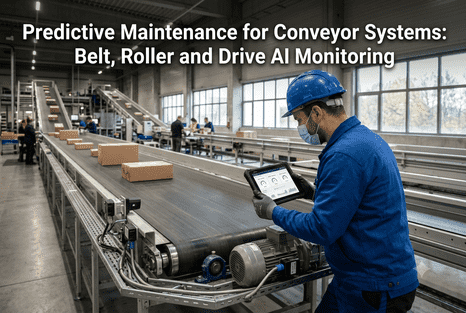
Predictive Maintenance for Conveyor Systems: Belt, Roller and Drive AI Monitoring
By Ethan Walker on June 7, 2026
Belt conveyor systems are the circulatory system of bulk material handling — transporting ore, coal, aggregates, grain, cement, and manufactured products across mining, power generation, ports, cement plants, and manufacturing facilities. A single conveyor failure can halt an entire production line within minutes, with belt tears, idler seizures, gearbox failures, and drive system breakdowns representing the dominant failure modes that cause unplanned stoppages costing $10,000–$250,000 per event depending on conveyor length, material criticality, and downstream production impact. Traditional conveyor maintenance relies on periodic visual inspections, manual roller temperature checks with infrared guns, scheduled lubrication rounds, and time-based belt replacement intervals — a regimen that leaves weeks or months of degradation undetected between inspection cycles. A conveyor system spanning 2 km with 10,000+ idlers produces millions of bearing operating hours per month; manual inspection of each idler is physically impossible at any practical frequency. AI-native predictive maintenance eliminates this coverage gap by ingesting continuous sensor data — belt alignment, roller vibration, motor current draw, bearing temperature, belt tension, and acoustic emissions — applying machine learning models to detect mistracking, idler bearing degradation, belt carcass damage, and drive system fatigue 14–30 days before functional failure. iFactory AI's industrial software platform, including its Shift Logbook and predictive maintenance engine, enables reliability teams to deploy AI-driven conveyor monitoring without replacing existing CMMS, SCADA, or PLC infrastructure. Book a Demo to see how iFactory applies AI predictive maintenance for conveyor systems across mining, cement, and bulk material handling operations. This guide covers conveyor failure mode physics, AI sensor fusion models, belt and roller degradation mechanisms, and the practical deployment path for reliability engineers evaluating modernization.
Conveyor Systems · Bulk Material Handling · 2026
Predictive Maintenance for Conveyor Systems: Belt, Roller and Drive AI Monitoring
Continuous belt tracking · roller bearing AI · drive system prognostics — preventing catastrophic belt tears, idler seizures, and gearbox failures across mining, cement, and bulk material handling conveyors.
Belt tear detection · chute block · fire risk prevention
Why Periodic Inspection Is Hitting Its Ceiling in Conveyor Reliability
The traditional approach — daily visual walk-downs, weekly roller temperature checks via infrared gun, monthly belt alignment inspections, quarterly lubrication rounds, and annual idler replacement campaigns — was designed for smaller conveyor systems with lower throughput. A modern overland conveyor in mining may span 15 km with 50,000+ idlers operating 24/7 at speeds over 6 m/s. A single maintenance technician walking 2 km per hour can inspect roughly 300 idlers per shift — meaning a complete inspection cycle for a 15 km system takes over 20 shifts, by which time idlers that initiated bearing degradation at the start of the route may have already seized. The four specific ceilings are well documented in conveyor reliability literature.
LIMITATIONS OF PERIODIC INSPECTION IN CONVEYORS
1
Idler inspection coverage impossible at scale — a technician inspects ~300 idlers per shift; a 15 km conveyor with 50,000 idlers cannot be fully inspected at any practical frequency
2
Belt tear detected after catastrophic failure — carcass damage and edge fraying develop over days but are invisible beneath the material load until the belt rips completely
3
Manual temperature checks miss transient events — an infrared gun reading once per week on an idler bearing captures 0.002% of the bearing's operating hours
4
No correlation between roller, belt, and drive health — an idler seizure that increases belt tension and motor current is missed when each component is monitored in isolation
What AI Predictive Maintenance Actually Adds to Conveyor Reliability Programs
The misconception some reliability engineers carry: AI conveyor monitoring replaces existing inspection programs, PLCs, or CMMS systems. It doesn't. Your existing inspection rounds, control systems, and work order engine remain. What changes is the continuous monitoring layer that fills the gaps between inspection intervals. Belt alignment sensors, roller vibration and temperature wireless nodes, motor current transducers, and acoustic belt rip detectors stream data into AI models that classify belt tracking condition, detect idler bearing degradation at incipient stage, identify belt carcass damage from acoustic signatures, and predict drive system remaining useful life. The existing CMMS receives higher-quality input — not just "conveyor tripped — unknown cause" but "idler at chainage 2,347 metres detected with bearing temperature 18°C above ambient — vibration velocity 14 mm/s RMS — bearing seizure predicted within 12 days at current degradation rate — recommended action: replace idler during next scheduled belt stop, part number CR-347-XL." iFactory AI's Shift Logbook provides operators and reliability engineers with a unified interface for conveyor status updates, shift handovers, and AI-generated maintenance recommendations integrated with existing CMMS workflows.
Capability
Periodic Conveyor Inspection
AI Continuous Conveyor Monitoring
Idler coverage
300 per shift per technician
50,000+ idlers monitored continuously
Belt tear detection
After catastrophic failure
Real-time acoustic carcass damage detection
Roller bearing monitoring
Weekly IR gun temperature
Continuous vibration + temp per idler node
Belt alignment
Monthly visual inspection
Continuous edge position sensor tracking
Drive health
Quarterly oil analysis + vibration
Continuous motor current + vibration + temp
Fire risk detection
Post-event investigation
Idler temp threshold + belt friction monitoring
Conveyor Failure Modes — What AI Catches Before Conventional Inspection Can
Conveyor systems fail through specific mechanical, structural, and material-related processes that leave identifiable signatures in sensor data before they become visible to inspectors or cause operational stoppages. AI models trained on these signatures detect degradation 14–30 days before failure — the window that separates planned replacement from catastrophic belt tear, idler fire, or drive system breakdown. Understanding the multi-modal fingerprint of each failure mode is essential for evaluating predictive maintenance vendors.
01
Belt Carcass Damage & Longitudinal Tear
Sharp material impact, trapped objects, or splice deterioration initiates carcass damage that propagates as the belt cycles. Acoustic emission sensors detect the characteristic sound of cord breakage and cover rubber tearing before the damage becomes visible. AI models classify tear severity from acoustic signature patterns and estimate remaining belt life. Longitudinal tears are the most expensive conveyor failure mode — each event causes 8–24 hours of downtime and $50,000–$250,000 in belt replacement and production loss.
$50-250K per eventAcoustic detection8-24 hr downtime
02
Idler Bearing Degradation & Seizure
Idler bearing failure progresses through four stages — incipient vibration at BPFI/BPFO frequencies, rising bearing housing temperature, shell wear from eccentric rotation, and complete seizure that generates friction heating capable of igniting coal dust or other combustible materials. AI models monitor vibration velocity and acceleration envelope spectra per idler node, detecting bearing degradation at Stage 1–2 before temperature rises above ambient. Seized idlers are the leading cause of conveyor belt fires in underground coal mining operations.
Fire risk preventionFour-stage detectionPer-idler tracking
03
Drive System & Gearbox Failure
Conveyor drive systems — motors, gearboxes, couplings, and pulleys — operate under high torque and variable load conditions. Gearbox failures are driven by gear tooth fatigue (gear mesh frequency sideband growth), bearing wear (envelope spectrum BPFO/BPFI), and oil degradation (particle count and viscosity loss). AI models fuse motor current draw, gearbox vibration, oil debris sensor data, and pulley bearing temperature to predict remaining useful life of drive components. Head pulley bearing failure alone accounts for 15% of unplanned conveyor stoppages in bulk material handling.
15% of stoppagesMotor current + vibrationRUL per component
The Keep / Retire / Transform / Replace Decision Matrix
Migration discipline starts here. Every conveyor maintenance artifact in your current operation falls into one of four categories. Getting the categorization right in week one of the workshop saves quarters of debate later.
Keep — CMMS work orders, PLC control logic, belt splice records, lubrication schedules. Established capabilities with no business case to replace.
R
Retire — Weekly IR gun temperature rounds, paper inspection checklists, manual idler tagging. Replaced by continuous wireless sensor monitoring and auto-alerting.
T
Transform — Idler replacement planning, belt life tracking, conveyor health reporting. Become AI model invocations grounded in continuous sensor data via iFactory Shift Logbook.
R
Replace — Legacy alarm notification, email-based breakdown alerts, paper shift logs. Event-driven AI alert engine with automated CMMS work order creation.
Want this matrix applied to your specific conveyor inventory in a working session? Book a Demo to walk through every conveyor system and prioritize your AI predictive maintenance rollout.
Three Deployment Paths for Conveyor AI Monitoring
Same starting point, three valid destinations. The right path depends on conveyor length, idler population, criticality, and current sensor infrastructure. Plants that pick the wrong path spend 12 months in pilot purgatory. Plants that pick the right path deploy in 8–14 weeks.
DEPLOYMENT PATH SELECTION
A
Augment in Place (8–10 weeks) — AI conveyor monitoring runs alongside existing inspection rounds. Shadow mode for 6 weeks. Alerts flow to CMMS for review. No legacy systems retired.
B
Hybrid Migration (10–14 weeks) — AI monitoring replaces manual inspection of idlers and belt tracking. PLC, CMMS, and ERP preserved. Wireless idler sensor network deployed. Shift logs digitised.
C
Full Modernization (12–16 weeks) — Manual inspection rounds retired entirely. iFactory platform provides full AI-native monitoring across belt, idlers, and drive systems with automated work order creation and sparing optimisation.
Pick the Right Path for Your Conveyor System in a 90-Minute Workshop
iFactory AI's conveyor reliability practice runs a focused workshop against your specific conveyor systems, idler population, current sensor coverage, and CMMS configuration. You leave with a defended path recommendation, a 12-week deployment plan, and a cost reduction projection grounded in your conveyor maintenance history.
Generic predictive maintenance vendors handle the AI math. Conveyor-aware vendors handle the integration reality — wireless idler sensor networks, belt acoustic monitoring, PLC data integration, motor current analysis, multi-kilometre communication infrastructure, and zero-disruption deployment. Eight criteria separate vendors who've done conveyor fleet modernizations from vendors selling a demo.
EIGHT CRITERIA FOR VENDOR EVALUATION
01
Idler sensor coverage at scale — Does the platform support wireless vibration and temperature sensor nodes on 10,000+ idlers with battery life exceeding 5 years and sub-GHz or LoRaWAN communication?
02
Belt acoustic monitoring — Does the platform integrate with acoustic fibre-optic or distributed acoustic sensing for real-time belt carcass damage detection and tear localisation?
03
Idler bearing degradation classification — Does the AI classify idler bearing condition across the four standard stages — healthy, incipient, moderate, and pre-seizure — from vibration envelope spectra?
04
Belt alignment and tracking — Does the platform continuously monitor belt edge position via sensors or vision systems and predict mistracking events before edge damage occurs?
05
Drive system RUL estimation — Does the platform combine motor current, gearbox vibration, oil debris, and pulley bearing temperature into remaining useful life estimates for all drive components?
06
Fire risk detection — Does the platform integrate idler temperature, belt friction, and material dust data into a conveyor fire risk score with automatic alerting?
07
Conveyor fleet dashboard — Does the platform provide a fleet-wide conveyor health view with per-idler temperature and vibration, belt degradation trend, and drive system RUL?
08
Deployment timeline commitment — When does the first AI-classified conveyor fault alert reach the CMMS in production? 8–14 weeks is the production-grade benchmark.
Want to score your shortlisted vendors against this 8-criterion framework? Run a vendor evaluation working session with our team and get a structured scorecard against your conveyor fleet requirements.
The ROI Math — What AI Conveyor Monitoring Delivers for Bulk Material Handling
The business case for AI-native conveyor monitoring isn't about software cost — it's about cost avoidance on catastrophic belt tears, idler fires, and drive system failures that stop production lines for extended periods. Plants moving from periodic inspection to AI continuous monitoring see measurable improvements across four metrics in the first quarter post-deployment.
−60–80%
Belt tear events reduction
Acoustic carcass damage detection enables intervention before catastrophic tear
−40–60%
Unplanned conveyor stoppages
Idler bearing and drive system failure prediction shifts emergency stops to planned service
Full investment recovery through belt tear prevention, stoppage reduction, and idler optimisation
Expert Perspective
INDUSTRY INSIGHT — 2026
“
"The single biggest mistake bulk material handling plants make in conveyor maintenance modernization is treating it as an idler replacement campaign project. It isn't. Your existing idler supply contract, belt splice records, and lubrication schedules work as designed — there's no business case to replace them wholesale. What needs to change is the monitoring density. Weekly IR gun checks on idler bearings and monthly belt alignment inspections need to migrate to continuous wireless sensor coverage across every idler, belt edge position tracking, and AI models that classify bearing degradation stages and belt carcass health. The architectural decision isn't inspection-or-AI — it's inspection-plus-AI-plus-wireless-idler-sensors-plus-acoustic-belt-monitoring. Plants that frame it correctly deploy in 10–14 weeks. Plants that frame it as rip-and-replace spend 12 months in pilot purgatory."
→
10–14 weeks hybrid deployment with pre-configured conveyor templates · 80–90% reduction in manual idler inspection effort · Zero rip of existing CMMS, PLC, or SCADA systems
Conclusion: The Modernization Decision Has Three Right Answers
Periodic visual inspection and manual temperature checks aren't failing in conveyor reliability programs — they're hitting a coverage ceiling that human-dependent methods can't cross. AI-native continuous conveyor monitoring adds the wireless idler sensor coverage, belt acoustic monitoring, drive system prognostics, and automated work order creation that traditional methods were never designed to deliver: 24/7 vibration and temperature telemetry from every idler, real-time belt carcass damage detection via acoustic sensing, continuous belt edge position tracking, motor current and gearbox fused RUL estimation, and mobile-native operator interfaces grounded in real-time conveyor health data. The modernization conversation has three valid answers depending on conveyor length, idler population, and criticality — augment in place (8–10 weeks), hybrid migration (10–14 weeks), or full modernization (12–16 weeks). All three keep existing CMMS and PLC infrastructure intact and reuse current control system investments. All three deliver 60–80% reduction in belt tear events and 40–60% reduction in unplanned stoppages within the first quarter. Walk through your specific conveyor systems and continuous monitoring requirements with our team.
Run the AI Conveyor Monitoring Workshop Built for Your Plant
iFactory AI's conveyor reliability practice runs a 90-minute workshop against your real conveyor systems, idler population, sensor coverage, and CMMS configuration. You leave with a defended path recommendation, the keep/retire/transform/replace matrix applied to your conveyors, and a cost reduction projection grounded in your conveyor maintenance history.
Belt Tear DetectionIdler Health AIDrive PrognosticsFire Risk PreventionShift Logbook
Frequently Asked Questions
No. Your PLC continues controlling conveyor start-stop sequences, speed control, and safety interlocks, and your SCADA continues providing operator interface and alarm management — these are mature, safety-critical systems with no business case to replace. What changes is the monitoring layer that fills the gaps between control system inputs. Wireless idler sensors, belt alignment sensors, and acoustic monitoring systems feed data into AI models that provide condition information the PLC was never designed to deliver — bearing degradation stage, belt carcass health, and drive system remaining useful life. The AI layer sits alongside existing control systems through standard OPC UA and Modbus TCP integration.
Production-grade AI conveyor monitoring covers belt longitudinal tear and carcass damage (acoustic emission signature of cord breakage and cover rubber tearing), idler bearing degradation (four-stage progression from incipient BPFO/BPFI vibration to complete seizure and fire risk), belt mistracking and edge fraying (continuous edge position sensor trending), drive system failure (motor current anomaly, gearbox vibration and oil debris, coupling misalignment, pulley bearing degradation), splice failure (acoustic and visual indicators of splice separation), and chute blockage and transfer point wear (flow rate and impact sensor correlation). Each failure mode has a characteristic multi-modal sensor signature detectable 14–30 days before functional failure.
Not necessarily on every idler. Production-grade AI conveyor platforms typically deploy wireless vibration and temperature sensor nodes on a representative sample of idlers — typically 5–10% of the total population — with sensor placement prioritised on high-wear zones such as loading areas, transfer points, and return side idlers. For belt monitoring, acoustic fibre-optic or distributed acoustic sensing cables can be retrofitted along the conveyor stringer to provide continuous carcass damage detection over the full belt length. iFactory's federation layer integrates sensor data at whatever density is deployed and scales sensor coverage as the program matures.
Each wireless idler sensor node measures triaxial vibration velocity and acceleration envelope spectra plus bearing housing temperature at 15–60 minute intervals. The AI model computes BPFO, BPFI, and BSF amplitudes from the envelope spectrum, classifies bearing condition across the four standard stages (healthy, incipient, moderate, pre-seizure), and tracks temperature trend relative to ambient baseline. When a bearing crosses the moderate stage threshold, the platform assigns a geo-located maintenance alert with the specific idler identifier, chainage position, severity classification, and recommended action window. The platform automatically groups idlers requiring replacement on the same belt stop to minimise conveyor downtime.
Path A (Augment in Place) is the right starting point for conveyors where unplanned stoppage carries severe production loss consequences. The platform runs alongside existing inspection programs for 6 weeks in shadow mode, generating idler condition classifications and belt health alerts logged for review but not triggering work orders. Reliability teams compare AI predictions against inspection findings and actual failure events before approving cutover. No legacy systems retire in Path A. After 6–12 months, most operations progress to Path B or C to capture additional efficiency benefits from automated work order creation and integrated conveyor fleet health dashboards.