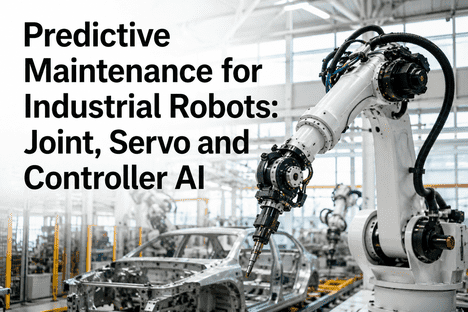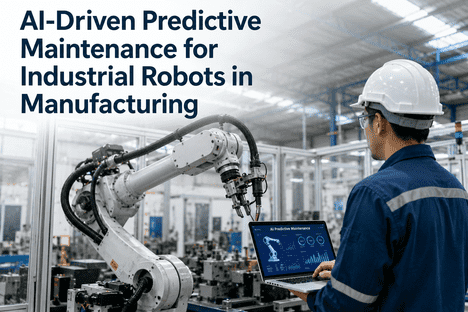
Manufacturers running industrial robot fleets operate under a steadily compounding burden — they're expected to deliver automotive-grade production consistency on consumer-product economics, with cycle-time tolerances and positioning accuracy requirements that leave no room for unplanned degradation. The legacy maintenance approach — scheduled robot servicing based on fixed hour counts, reactive repairs after drift detection, manual health assessments during changeovers, weekly OEE reviews — was built for a different automation era. Today's smart factory operators need something fundamentally different: predictive robot health that anticipates joint degradation, servo drift, and controller anomalies 48 hours before they affect production, self-learning condition models that continuously refine their understanding of what "normal" operation looks like for each robot model, application, and production cell, and maintenance intelligence reimagined around how manufacturing engineers actually work rather than how legacy CMMS platforms organize data. iFactory AI delivers this on a pre-configured NVIDIA appliance running on-premise inside the plant — replacing reactive robot maintenance with AI-native predictive health monitoring purpose-built for the demands of modern manufacturing, live in 6–12 weeks. Book a Demo to see how iFactory AI deploys across your robot fleet within weeks.
AI-Driven Predictive Maintenance for Industrial Robots
The smart factory operator's guide to predictive robot health and self-learning condition monitoring — anticipating joint wear and servo drift 48 hours ahead · adaptive baselines per robot model, application, and cell · live health dashboard with proactive maintenance recommendations. AI-native platform that keeps robot OEE at target without unscheduled downtime.
Robot Health in Manufacturing — Why the Three Failure Modes Behave Differently
Industrial robot reliability breaks into the same three categories across every manufacturing application — mechanical wear, servo drive degradation, and controller/software anomalies — but the underlying behavior of those failure modes differs significantly across robot models, applications, and operating environments. Joint backlash develops differently in spot welding versus material handling. Servo tuning drift accelerates in high-cycle pick-and-place versus slow-speed painting. Controller faults manifest differently in Fanuc versus KUKA versus ABB ecosystems. The breakdown below shows what's actually driving robot downtime — and which AI capability addresses each failure mode.
The combined robot OEE gain across all three failure modes typically lands in the +18–28% range within 12 months for manufacturing operations migrating from reactive robot maintenance to iFactory's AI-native predictive health platform. For a typical mid-size manufacturing plant running 30–80 robots with 78% baseline robot OEE, that translates to recovering 1,200–2,800 production hours annually — at typical cell line value rates, $3M–$8M in throughput recovery before counting reduced spare parts cost and eliminated emergency service calls.
Want a sized robot OEE projection for your specific manufacturing operation? Book a Demo — iFactory's robotics team will assess your current robot fleet health, failure mode breakdown, and projected gains across mechanical, servo, and controller categories.
Self-Learning Condition Monitoring — What "Predictive Robot Health" Actually Means
"Self-learning robot condition monitoring" sounds like a marketing phrase, and used carelessly it would be. In iFactory's platform it refers to a specific technical architecture — multivariate models that continuously refine their understanding of normal robot behavior using current operational data, without requiring manual threshold updates, limit recalibration, or engineering re-tuning by maintenance teams. The system gets better at distinguishing real drift from normal variation as it accumulates more operational experience across more robot models and applications.
Four feedback loops drive continuous improvement. Loop 1 compares each health prediction to the actual outcome — did the predicted joint degradation materialize, did the servo drift intervention work. Loop 2 captures domain expertise — when maintenance technicians override or correct AI recommendations, that judgment becomes training signal. Loop 3 is internal model retraining on accumulated operational data. Loop 4 transfers learnings across similar robot models in the fleet — when one robot exhibits a novel failure precursor, all comparable robots immediately benefit. Together they produce the "self-learning" property that legacy threshold-based CMMS fundamentally cannot replicate.
Want to see self-learning robot health monitoring running on representative manufacturing scenarios? Book a Demo — sessions include live demonstration of the four feedback loops in action on Fanuc, KUKA, ABB, or Yaskawa robot data.
Six Robot Applications Where Predictive Health Pays Back Fastest
Spot Welding
Predictive health on joint backlash accumulation, weld gun servo drift, and dressing spindle wear. AI models trained on hundreds of spot welding robot years of operational data.
Material Handling & Palleting
Predictive health on servo motor magnet degradation, encoder noise, and end-of-arm tooling fatigue. Self-learning models adapt to payload variation patterns.
Arc Welding
Predictive health on wrist axis bearing wear, wire feed servo drift, and torch position repeatability. AI detects seam tracking degradation before weld quality is affected.
Assembly
Predictive health on force/torque sensor drift, compliance actuator wear, and repeatability degradation. AI models detect sub-millimeter accuracy drift before it causes quality escapes.
Painting & Coating
Predictive health on bell applicator bearing wear, paint delivery pump degradation, and path repeatability drift. Self-learning models adapt to environmental and viscosity changes.
Machine Tending
Predictive health on gripper wear, axis backlash accumulation, and cycle time drift. AI predicts when robot performance will affect CNC spindle utilization and schedules intervention during tool changes.
Want application-specific robot OEE projections for your manufacturing operation? Send your robot fleet details to iFactory support — the robotics team will return a customised health projection with 12-month roadmap.
Live Predictive Robot Health Dashboard — What Manufacturing Engineers Actually See
The engineer's view after migration
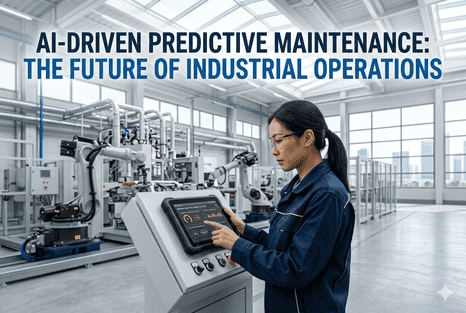
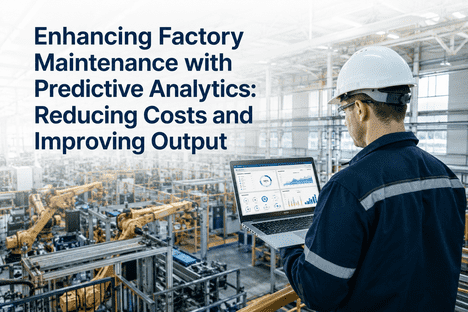
The operator workstation displays live robot health with predictive alerts, self-learning model status, and recommended maintenance actions for the upcoming shift. The interface is reimagined around how manufacturing engineers actually work — clear current state, focused predictions, actionable recommendations — rather than around how legacy CMMS platforms organize data.
Three Migration Paths from Reactive Robot Maintenance
Stay on Fixed-Interval Servicing
Continue with scheduled robot maintenance based on hour counts. No predictive health, no condition monitoring. Maintenance intervals unchanged from current state.
Cloud-Only CMMS Upgrade
Cloud migration with descriptive analytics improvement but no genuine self-learning predictive health or cross-robot intelligence. Cloud dependency for real-time robot monitoring.
iFactory AI On-Prem
Self-learning predictive robot health with condition monitoring. Adaptive baselines, cross-robot learning, autonomous RCA. No cloud lock-in. Sub-50ms edge inference.
iFactory's Robot Health Deployment — On-Premise or Cloud
Same AI-native platform on either deployment model. Same predictive robot health, self-learning condition monitoring, and autonomous RCA. For manufacturing operations specifically, on-prem is strongly recommended due to high-speed robot control loop latency requirements and production data sovereignty needs.
iFactory On-Premise Appliance Strong default for manufacturing plants · no cloud lock-in
- Pre-configured NVIDIA AI server — racked, software-loaded, ready to plug in.
- <50ms edge inference — keeps up with high-speed robot control loops.
- No cloud lock-in — robot health models, predictions, baselines stay in plant.
- Works during WAN outages — production continues uninterrupted.
iFactory Cloud For multi-plant operations with established cloud governance
- Fully managed — no rack, no facility requirements.
- Same self-learning stack — predictive robot health, cross-fleet intelligence.
- Cross-plant robot benchmarking across manufacturing operations.
- Fastest deployment — first plant live in 2–4 weeks.
Robot health intelligence reimagined isn't a slogan. It's a measurable operational difference.
Predictive robot health with self-learning condition monitoring running on a pre-configured NVIDIA appliance turns manufacturing robot fleets from reactive to proactive — 18–28% robot OEE improvement, 48-hour predictive warning windows, maintenance moving from emergency to scheduled. Book a Demo sizes the migration concretely for your specific robot fleet.
Frequently Asked Questions
How is "predictive robot health" different from standard robot condition monitoring?
Standard condition monitoring shows what already happened — yesterday's joint torque, this morning's position error, last shift's fault codes. Predictive robot health shows what's about to happen — model output for the next 48 hours including specific anticipated failure modes, projected impact on robot OEE, and recommended maintenance interventions. The shift from descriptive to predictive is the single most important capability difference between legacy CMMS robot monitoring and AI-native predictive health.
What exactly makes robot condition monitoring "self-learning"?
Four feedback paths working continuously — comparing predictions to actual outcomes (loop 1), capturing technician overrides and corrections as training signal (loop 2), internal model retraining on accumulated fleet data (loop 3), and cross-robot learning where insights from one robot's failure mode transfer to similar models (loop 4). The system improves accuracy over time without maintenance engineering tuning, threshold updates, or limit recalibration. After 8–14 weeks of operation, accuracy typically reaches steady state and continues incremental improvement thereafter.
Does iFactory support Fanuc, KUKA, ABB, Yaskawa, and other robot brands?
Yes — iFactory connects directly to robot controller data via the robot OEM's native telemetry interfaces including Fanuc iRProgrammer, KUKA.VisionTech, ABB Ability, and Yaskawa YRC. The platform supports all major industrial robot brands and controller generations. For mixed-fleet operations, a single iFactory appliance manages predictive health across all robot brands simultaneously with per-model baselines.
Can iFactory integrate with existing robot PLC and safety systems?
Yes — iFactory connects to robot cell PLCs (Rockwell, Siemens, Mitsubishi) and safety controllers for contextual data including cell mode, cycle count, and safety events. The platform correlates robot health data with cell operational data for richer predictive models. Existing PLC and safety architecture remain unchanged; iFactory provides read-only data access from historian or OPC-UA endpoints.
Does iFactory require additional sensors on each robot?
No — iFactory works with data already available from robot controllers, servos, and drives. For most robot models, joint torque, motor current, position error, and temperature data are accessible via the controller's standard telemetry interface. For enhanced vibration analysis on high-value robots, wireless vibration sensors can be added but are optional. The platform delivers value from controller-native data alone.
Can we deploy on one robot cell first before fleet-wide?
Yes — and it's the recommended approach. Start with the cell where robot downtime cost is highest or where failure frequency is most acute. Validate the predictive health accuracy and self-learning condition monitoring on a single cell. Then expand cell-by-cell in 2–4 week waves. Full fleet deployment for a typical 30–80 robot operation completes in 3–5 months end-to-end.
Robot OEE is the manufacturing engineer's daily metric. Predictive robot health makes it controllable.
Self-learning condition monitoring plus predictive robot health running on a pre-configured NVIDIA appliance — that's what "AI-driven predictive maintenance" actually means in operational terms. 18–28% robot OEE improvement typical within 12 months. No cloud lock-in. Live in 6–12 weeks. Book a Demo is the fastest way to size the migration for your specific robot fleet.