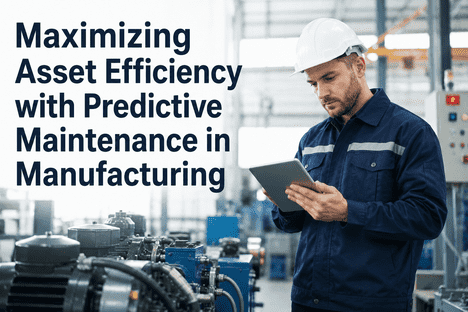
Industrial operations are undergoing the most significant transformation since the assembly line. The AI-driven predictive maintenance market is valued at $1.77 billion in 2025 and projected to reach $19.27 billion by 2032 — a 39.5% CAGR that reflects a fundamental shift in how facilities manage equipment health. Across manufacturing, energy, and processing plants, the old models of reactive repairs and fixed-interval preventive maintenance are giving way to a data-driven approach where AI analyzes every sensor reading in real time, learns the unique operating signature of each asset, and predicts failures days or weeks before they occur. Yet while 58% of maintenance teams are already using AI in their operations and 75% report measurable ROI in under six months, most facilities still lack the integrated platform to connect sensor data to maintenance action. iFactory AI's on-premise platform bridges this gap — connecting directly to existing PLCs, telematics, and control systems to deliver real-time failure predictions without cloud dependency. Book a Demo to see how AI-native predictive maintenance is transforming industrial operations from the factory floor up.
INDUSTRIAL OPERATIONS · PREDICTIVE MAINTENANCE · AI · 2026
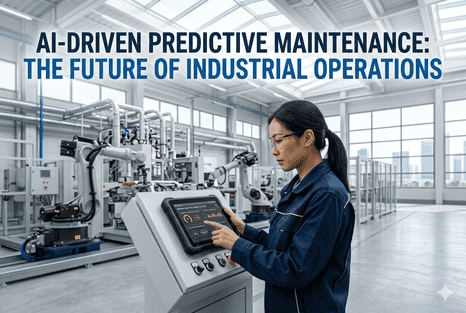
AI-Driven Predictive Maintenance: The Future of Industrial Operations
Move beyond reactive repairs and scheduled servicing. AI-native predictive maintenance analyzes every sensor data point from every asset in real time, predicts failures before they happen, and optimizes equipment life across your entire facility. No cloud dependency. No data egress. No unexpected downtime.
47%Average Unplanned Downtime Reduction
3–14 daysEarly Warning Before Failure
12xAverage ROI Over 3 Years
58%Teams Already Using AI in Maintenance (2026)
Why Traditional Maintenance Is No Longer Enough
The factories and plants that power the global economy generate millions of sensor data points per hour. Yet most facilities still manage equipment health the same way they did 20 years ago — waiting for failures or servicing assets on fixed calendar intervals regardless of actual condition. In an era of rising downtime costs and shrinking margins, this gap between data availability and maintenance strategy is where money leaks out.
Reactive Maintenance Costs More With Every Breakdown
Fortune 500 companies lose an estimated $233 billion annually in maintenance costs due to unplanned downtime. A single unexpected failure on a critical production line can cost $15,000–$50,000 per hour in lost output, depending on the industry. With 79% of teams reporting that unplanned downtime stayed the same or increased over the past year, reactive maintenance is not a strategy — it is a recurring expense that compounds with every aging asset.
Preventive Maintenance Wastes 30–50% of Useful Component Life
Fixed-interval maintenance replaces parts based on calendar days or operating hours, not actual condition. A bearing with 6 months of remaining useful life gets replaced because the schedule says so. Meanwhile, a hydraulic pump showing early signs of degradation goes unnoticed until it fails catastrophically. The result: operations spend money on unnecessary replacements while still getting surprised by failures that scheduled maintenance was supposed to prevent. Deloitte estimates that predictive maintenance can reduce these costs by up to 25% while increasing uptime by 10–20%.
Manual Inspections Miss 40% of Early Failure Signals
Visual inspections and manual data collection — still the primary methods in most facilities — fail to detect nearly half of early-stage equipment anomalies. By the time a technician hears an unusual bearing noise or feels elevated vibration, the damage has progressed to the point where repair costs are 3–5x higher than if caught at the onset. With experienced technicians retiring and skills gaps widening, the industry can no longer rely on human senses alone to catch problems early.
Siloed Data Hides the Interactions That Predict Failure
Industrial equipment fails in patterns, not isolation. A motor bearing failure is preceded by shifts across temperature, vibration, current draw, and acoustic emissions — not any single sensor. When each data stream lives in its own silo (SCADA, CMMS, vibration analysis, oil analysis), the multivariate signatures that signal impending failure are invisible. Univariate threshold alerts catch the obvious problems. They miss the subtle, cross-sensor patterns that precede the majority of equipment failures.
The AI Advantage: Six Capabilities That Change Everything
AI-native predictive maintenance is not a faster version of preventive maintenance. It is a fundamentally different approach — one that sees the full interaction space, learns from every data point, and acts before failure occurs. Here are the six capabilities that define this new paradigm.
1
Continuous Learning at Scale
Every new data point improves the model. Unlike static threshold systems that require manual recalibration, AI models become more accurate with each operating hour, each maintenance event, and each operator interaction. The system that goes live is the least capable version it will ever be. Over 3–6 months, false-alarm rates drop below 3% and the predictive window extends as the AI discovers increasingly subtle early indicators.
2
Multivariate Anomaly Detection
AI models capture the complex interactions between temperature, vibration, current, pressure, and acoustic data — detecting failure signatures that no single-sensor threshold could ever catch. A 0.3°F rise in motor winding temperature combined with a 1.5% increase in current draw variance may be normal individually, but together represents a 92% probability of bearing degradation within 72 hours. This is the signal that traditional systems miss.
3
Predictive Horizon: Days to Weeks
Traditional monitoring alerts you when something has already gone wrong. AI-driven predictive maintenance forecasts remaining useful life with 3–14 days of advance warning — enough time to order parts, schedule planned downtime, and avoid production interruptions entirely. Operators receive specific countdowns: "Bearing wear index predicted to exceed failure threshold in 6 days at current degradation rate."
4
Adaptive Baselines for Changing Conditions
When production lines change over between products, recipes, or seasonal operating modes, the normal parameters shift. AI models automatically detect these transitions and adapt their baselines within hours — not the weeks it takes a reliability engineer to re-validate thresholds. No blind spots during changeovers. No manual recalibration. The model stays accurate even as the process evolves.
5
Actionable, Plain-Language Alerts
Not "alarm: motor current high" but "Motor current trending +18% over 72 hours, bearing temperature rising, vibration increasing. Pattern match: 92% confidence in bearing degradation. Recommended action: inspect bearing within 7 days." Operators and technicians receive alerts that say what is wrong, why it matters, and what to do — without needing a data science degree to interpret them.
6
Closed-Loop Improvement
Every time a technician confirms or rejects a prediction, the model incorporates that feedback. Confirmed predictions reinforce the pattern. Rejected predictions teach the model what normal variation looks like at the edge of the envelope. Over time, the system becomes more precise, more trusted, and more valuable — a self-improving maintenance engine that gets better with every intervention.
Traditional vs. AI-Driven: A Day in the Life
The difference between traditional maintenance and AI-driven predictive maintenance is not theoretical. It shows up in every shift, every decision, and every P&L statement. Here is how the same day plays out in two facilities running identical equipment.
Traditional Maintenance Facility
6:00 AM
Night shift report: Compressor #2 shut down at 3:47 AM. Production line 3 was down for 47 minutes before backup compressed air was brought online. Root cause: unknown. Maintenance scheduled for 7 AM inspection.
7:30 AM
Technician inspects compressor. Bearing seized, motor damaged. No prior indications — no sensors on the compressor. Repair estimate: $14,000 and 3 days lead time for the motor. Production manager informed: reduced capacity for 3 days.
9:00 AM
Preventive maintenance on conveyor system. Schedule says replace all four drive bearings (completed at 3 months — 2 months early per schedule). Each bearing shows minimal wear. $2,600 in parts replaced prematurely. The schedule is followed regardless.
11:30 AM
Production supervisor asks about output. Plant manager: "We lost 47 minutes to the compressor failure. We're down one compressor for 3 days. If we have another failure this week, we miss the monthly target." Pressure is on.
2:00 PM
Root cause analysis for the compressor: "Bearing wear — unknown why. Recommend more frequent oil analysis." The data that could explain the failure was never collected. The investigation produces speculation, not answers.
AI-Driven Predictive Maintenance Facility
6:00 AM
Night shift handoff: All 42 monitored assets in green zone. AI dashboard shows zero predicted failures in the next 72 hours. Overnight production achieved 98.3% equipment availability. Day shift plan confirmed.
7:15 AM
AI alert: "Compressor #2: discharge temperature trending +14%, vibration amplitude increasing 8% week-over-week. Pattern match: 89% bearing wear. Predicted RUL: 12 days at current rate. Recommended action: schedule inspection within 5 days." Maintenance planner notes it, orders bearing kit, schedules for next Tuesday's planned downtime.
9:00 AM
Conveyor bearing analysis: AI reports all four drive bearings in healthy condition (average remaining useful life: 8.3 months). Preventive replacement deferred. Controller approves: "No need — AI says they are fine. We will monitor weekly." $2,600 in parts and 3 hours of labor saved.
11:00 AM
Monthly production review: 97.1% equipment availability YTD. Zero unplanned downtime incidents this month. All predicted failures were addressed during scheduled maintenance windows. Production on track for 104% of target output.
2:00 PM
AI generates monthly maintenance report automatically: 3 predicted failures this month, all confirmed by technicians, all resolved during planned downtime. $47,000 in avoided emergency repair costs, 22 hours of avoided unplanned downtime. Report shared with plant manager in 30 seconds.
The difference between reactive and predictive maintenance is not technology. It is time — time to act before the failure, time to plan instead of scramble, time to optimize instead of replace. AI-native predictive maintenance gives operations teams that time back.
The Real-World Impact: What Industry Leaders Are Achieving
These results are drawn from industrial facilities — manufacturing, energy, and processing plants — that have deployed AI-native predictive maintenance. The pattern is consistent across every deployment: less downtime, fewer emergency repairs, and a measurable shift from reactive firefighting to proactive management.
Before AI Predictive Maintenance
- Unplanned downtime: 180–250 hours/year per facility
- Emergency repairs consume 35% of maintenance budget
- Component replacement: schedule-driven (30–50% premature)
- Root cause analysis: manual, speculative, often incomplete
- Aging workforce: 40% of experienced technicians planning retirement within 5 years
- Equipment availability: 85–92% average
With AI-Driven Predictive Maintenance
- Unplanned downtime reduced by 47% (95–130 hours/year)
- Emergency repair costs cut by 35%
- Component replacement: condition-driven (full useful life extracted)
- Root cause analysis: AI-generated, data-backed, 92%+ accuracy
- Knowledge capture: tribal knowledge preserved in AI models and automated alerts
- Equipment availability: 96–98% average (3–6% increase)
START YOUR TRANSFORMATION
Ready to move from reactive to predictive?
65% of maintenance teams expect to adopt AI within the next 12 months. The question is not whether to adopt AI-driven predictive maintenance — it is whether you will lead or follow. Start with a single asset class and see ROI in the first quarter.
Your Implementation Journey: From Pilot to Enterprise
AI-native predictive maintenance is deployed incrementally, starting with the highest-impact assets and expanding as the ROI is proven. Most facilities move from pilot to full deployment within a single quarter.
Month 1: Discovery & ConnectioniFactory connects to your existing PLCs, SCADA systems, and sensor networks — typically in under two weeks. No custom integration work. No disruption to production. Your team continues operating normally while the platform begins ingesting data from your highest-priority assets.
Month 2: Baseline & TrainingThe AI builds a multivariate baseline for each monitored asset using 2–3 weeks of production data. During this period, the system operates in learning mode — ingesting data and building models without generating alerts. Operators and technicians are trained on the dashboard and alert system.
Month 3: Pilot & ValidationAI begins issuing failure predictions on the pilot asset group. Maintenance teams validate alerts against actual equipment condition. The first confirmed predictions build trust. False alarms are logged and used to refine the model. Within 30 days, the false-alarm rate typically drops below 5%.
Month 4+: Scale & OptimizeOnce the pilot delivers measurable ROI — usually within the first 60 days of live alerts — the platform is expanded to additional asset classes and production lines. The model learns continuously. False-alarm rates converge below 3%. The maintenance organization shifts from reactive to predictive operations permanently.
Frequently Asked Questions
Do I need new sensors or infrastructure to use AI-driven predictive maintenance?
Not necessarily. iFactory connects to your existing control infrastructure — PLCs, SCADA, historians, and telematics gateways — using standard industrial protocols. If your facility already has sensors and data collection systems in place, we can typically begin ingesting data within two weeks. For assets without sensors, we can recommend cost-effective retrofit options, but in most facilities, the data you already have is sufficient to start generating value.
How accurate are the failure predictions?
After the initial 2–3 week baseline period, prediction accuracy typically reaches 85–92% for the most common failure modes of the monitored assets. After 3 months of operator feedback and model refinement, accuracy exceeds 95% and false-alarm rates drop below 3%. Predictions include a confidence score, so maintenance teams can prioritize the highest-confidence alerts first.
How does AI handle different operating conditions — startups, shutdowns, changeovers?
AI-native predictive maintenance models are designed to handle transient conditions. The system learns the normal patterns of startups, shutdowns, product changeovers, and load variations. When equipment enters a transient state, the model switches to the appropriate baseline automatically — no manual intervention required. This ensures that operators receive alerts only for true anomalies, not for expected operational transitions.
What about cybersecurity? Does the data leave my facility?
iFactory runs on an NVIDIA appliance deployed inside your facility's network. All data is processed and stored locally. No internet connection is required for normal operation. No data egress occurs. The appliance is configured to your IT security standards — VLAN segmentation, AD integration, port restrictions — and undergoes a full security review before deployment. For facilities that require vendor remote access for support, we provide a secure, audited VPN tunnel with role-based access control.
What is the typical ROI timeline?
Most customers see positive ROI within 90 days of going live with live alerts. The savings from avoided emergency repairs and reduced unplanned downtime alone typically cover the full cost of the pilot in the first 60 days. Over 3 years, the average ROI across all deployments is 12x, driven by reduced maintenance costs, extended component life, lower inventory carrying costs, and improved production throughput.
How do I start? What does the first conversation look like?
We start with a 30-minute discovery call to understand your facility, your critical assets, and your maintenance challenges. Then we deliver a pilot proposal within one week — including the specific assets we recommend starting with, the expected timeline, and the projected ROI. Most facilities go from initial conversation to live alerts on the first asset class within 8–12 weeks. To begin the conversation,
Book a Demo and we will show you live AI-driven predictive maintenance on industrial equipment just like yours.
PREDICTIVE MAINTENANCE · AI-NATIVE · INDUSTRY 4.0
Stop reacting to breakdowns. Start predicting them with AI.
AI-native predictive maintenance analyzes every sensor data point in real time, predicts failures days before they occur, and optimizes asset life across your entire facility. 47% less downtime. 12x ROI. Zero cloud dependency.