Predictive Maintenance for Industrial Robots: Joint, Servo and Controller AI
By Ethan Walker on June 9, 2026
In automotive and discrete manufacturing, industrial robot failures on welding, painting, assembly, and material-handling lines represent one of the largest sources of production downtime — a single robot arm failure can halt an entire vehicle assembly line, costing $20,000–$50,000 per hour in lost throughput, with multi-billion-dollar plants forced into unplanned stoppages. Traditional reactive and time-based maintenance schedules cannot address the complex electromechanical interactions, variable cycle loads, and precision degradation that accelerate wear in robot joints, servo drives, and controllers. iFactory's predictive maintenance platform fuses joint torque signatures, servo motor current, harmonic drive vibration, controller telemetry, and equipment history into machine learning models that forecast joint harmonic reducer wear, servo bearing degradation, controller electronics drift, and brake failure 4-8 weeks in advance, enabling maintenance teams to act before the robot faults. Book a Demo to see how iFactory connects your industrial robot fleet data to predictive intelligence.
Predictive Maintenance · Robotics 2026
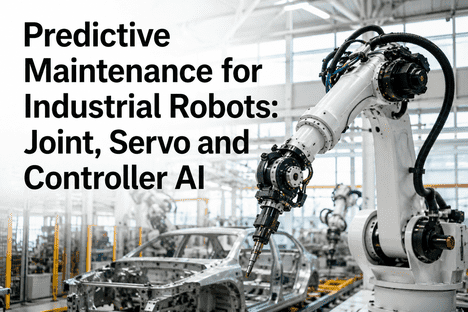
Predictive Maintenance for Industrial Robots: Joint, Servo & Controller AI
Joint harmonic reducer & gear wear prediction · Servo motor bearing & winding fault detection · Controller electronics & drive drift monitoring · Brake & safety system degradation forecasting · All flowing into iFactory CMMS & Shift Logbook.
Why Reactive Robot Maintenance Fails in Discrete Manufacturing
Industrial robots operate under extreme cycle demands — a single welding robot on an automotive body line executes 300,000+ weld cycles per year, accumulating harmonic reducer wear, servo bearing fatigue, and controller electronics drift that degrade positioning accuracy and repeatability. Harmonic reducers, the precision gearboxes in each robot joint, experience gear tooth wear, grease breakdown, and bearing race spalling that manifest as path deviation and velocity oscillation. Servo motor bearings fail from continuous reversing loads, while controller power supplies and drive IGBT modules degrade from thermal cycling and electrical stress. Brake systems — critical for safety in collaborative and high-speed applications — lose holding torque as friction surfaces wear. Fixed-interval maintenance replaces grease, bearings, and brakes based on calendar time or cycle count rather than actual condition — meaning joints are serviced either too early (wasting consumables and reducing OEE) or too late (causing path accuracy excursions that scrap body panels and damage tooling). iFactory's condition-based approach replaces the calendar with sensor-driven prediction.
LIMITATIONS OF TIME-BASED MAINTENANCE IN ROBOTIC WORKCELLS
1
Variable cycle loads ignored — same PM interval regardless of weld count, payload, speed, or path complexity
2
Sensor-blind to early-stage faults — torque ripple, current harmonics, joint backlash, and encoder drift not continuously monitored between PMs
3
Path accuracy degradation catastrophic — a single drifting joint can scrap painted bodies, damage welding tips, or crash tooling costing $100K+
4
No fleet-wide predictive visibility — maintenance decisions based on last robot alarm, not population-wide degradation across tool center point data
Joint failures — harmonic reducer wear, gear backlash increase, and bearing fatigue — represent the highest-frequency mechanical failure in multi-axis industrial robots. Each robot has 4-6 joints with precision reducers that transmit high torque while maintaining positional accuracy within hundredths of a degree. iFactory ingests joint torque signatures, servo current ripple, vibration spectra, and cycle position error data to train ML models that predict harmonic reducer wear, gear backlash increase, and joint bearing fatigue 4-8 weeks in advance with 70-80% accuracy. Automotive plants running these systems report 20-25% reductions in robot-related path accuracy excursions and unscheduled joint replacement events. Maintenance planners schedule reducer rebuilds and bearing swaps during planned line changeovers rather than responding to positioning faults that scrap work-in-process and damage downstream tooling. Book a Demo to see iFactory's robot joint prediction models in production.
4-8 week lead time70-80% accuracy20-25% excursion reduction
02
Servo Motor Bearing, Encoder & Winding Health Forecasting
Servo motors drive every robot axis with precise speed and torque control — bearing faults account for 40% of all servo motor failures, while encoder drift and winding insulation degradation cause position accuracy loss and unexpected drive faults. iFactory monitors motor current signature harmonics, voltage ripple, encoder position error, and winding temperature to detect early-stage bearing race spalling, encoder scale contamination, and winding insulation breakdown before they trigger drive faults. One automotive OEM using iFactory's servo monitoring reported a 30% reduction in servo-related unplanned downtime through early bearing replacement scheduling. The platform correlates current signature anomalies with cycle position data, pinpointing the specific joint axis and failure mode requiring maintenance attention before production quality degrades.
40% of motor failures addressed30% downtime reductionCurrent signature analysis
03
Controller Drive, Brake System & Safety Circuit Condition Surveillance
Robot controllers — servo drive IGBT modules, power supplies, safety relays, and brake systems — face variable electrical loads, thermal cycling, and safety demand patterns that produce complex, noisy data challenging fixed-threshold monitoring approaches. iFactory applies ensemble ML models that separate signal from noise in drive DC bus voltage, IGBT junction temperature, safety circuit response timing, and brake holding current trends. While prediction accuracy in this category is lower (50-60%), the platform's continuous learning loop improves model precision over time as more operating data accumulates across different programs, speeds, and payload configurations. The Shift Logbook captures maintenance technician-reported anomalies — brake adjustment notes, drive error codes, and controller fault logs — alongside sensor data, creating a richer training corpus for the prediction models. Book a Demo to see iFactory's complete robot predictive maintenance platform.
Ensemble ML modelsContinuous learning loopShift Logbook correlation
How iFactory Transforms Robot Fleet Telemetry Into Predictive Intelligence
iFactory is the AI software intelligence layer — not a robot manufacturer or hardware vendor. The platform integrates with existing robot controller telemetry from PLCs, servo drives (Siemens, Rockwell, Fanuc, KUKA, ABB, Yaskawa), vibration sensors, current sensors, and CMMS systems already deployed across your production lines. The Shift Logbook captures maintenance technician shift reports, robot alarm summaries, teach pendant logs, and repair actions alongside the sensor stream, creating a unified data fabric for predictive model training.
Asset Class
Telemetry Sources
iFactory Prediction Output
Business Impact
Robot Joints
Torque signature · servo current · vibration · position error · cycle count
iFactory ingests joint torque signature, servo current ripple, vibration, and position error data from each robot joint on welding, painting, and assembly lines. ML models trained on historical failure patterns predict harmonic reducer wear, gear backlash increase, and bearing fatigue 4-8 weeks in advance. Predicted failures are assigned a confidence score and recommended intervention window. Maintenance planners schedule joint rebuilds during planned line changeovers and model year tooling upgrades, avoiding unplanned robot swaps that halt production for hours. Every prediction event is logged in iFactory's Shift Logbook with full traceability to the joint telemetry that triggered the alert.
Servo motors execute the precise speed and torque control that determines robot path accuracy and cycle time consistency. Bearing wear, encoder scale contamination, and winding insulation degradation develop gradually, producing characteristic signatures in motor current harmonics and position tracking error. iFactory monitors current signature, temperature, and encoder error to detect early-stage degradation, pinpointing the specific axis and failure mode before path accuracy drifts out of specification. Alerts route directly to the maintenance shift in the Shift Logbook with robot metadata, severity score, and recommended action timeline.
Robot controllers and brake systems face variable electrical loads, thermal cycling, and safety test schedules that produce complex data — making failure prediction more challenging than for mechanical joint components. iFactory applies ensemble ML models with a continuous learning loop that improves prediction precision as more operating data accumulates across different production programs and cycle conditions. The Shift Logbook captures maintenance technician-reported anomalies — drive fault codes, brake adjustment records, safety relay test results — alongside sensor data, creating a richer training corpus. The result is steadily improving prediction accuracy for IGBT failure, power supply degradation, brake holding torque decay, and safety circuit timing drift.
What iFactory Delivers for Robot Fleet Reliability
70-80%
Robot joint & servo failure prediction accuracy
4-8 week advance warning vs line-side robot swap
$20-50K
Prevented loss per hour of robot downtime avoided
Scrapped parts + line stoppage + tooling damage
30%
Fewer servo motor-related unplanned failures
Bearing · encoder · winding insulation
20-25%
Reduction in path accuracy-related production excursions
Planned joint rebuild vs emergency replacement
FAQ
iFactory is the AI software intelligence layer — not a sensor or hardware vendor. The platform integrates with robot controller telemetry, servo drives (Siemens, Rockwell, Fanuc, KUKA, ABB, Yaskawa), PLCs, vibration sensors, current sensors, and CMMS platforms already deployed across your production lines. Your facility selects the sensor and telemetry hardware; iFactory turns the data into predictive intelligence, maintenance alerts, and shift-ready work orders.
Model tuning typically requires 6-12 months of operation on a specific robot fleet to eliminate false positives, tune threshold parameters, and build maintenance team confidence. The platform's continuous learning loop improves precision over time as more failure and operating data accumulates. iFactory recommends starting with one robot type and one failure mode — such as joint harmonic reducer wear or servo bearing degradation — proving value before expanding fleet-wide.
Yes. iFactory connects to SAP, Oracle, JDE, Microsoft Dynamics, and major CMMS platforms. The Shift Logbook captures maintenance technician shift reports, robot alarm summaries, teach pendant logs, and repair actions alongside sensor-generated predictions. Every prediction event, sensor reading, and maintenance action is recorded with full traceability for audit, compliance, and continuous model improvement.
Deploy iFactory for Robot Predictive Maintenance
AI-powered predictive maintenance platform connecting industrial robot joint, servo motor, controller drive, and brake system telemetry into one unified intelligence layer — with ML-based failure prediction, Shift Logbook integration, CMMS workflow automation, and fleet-wide reliability analytics for automotive and discrete manufacturing.