NVIDIA AI for Industrial Predictive Maintenance with GPU-Accelerated Analytics
By Daniel Carter on June 18, 2026
A modern industrial plant produces more sensor data in 24 hours than a 1990s factory produced in a year. A single high-frequency vibration sensor on a critical pump streams 25,600 samples per second — 2.2 billion data points per day per sensor. Multiply by 50 sensors across 200 critical assets and the math becomes uncomfortable: 22 terabytes of raw telemetry per day. CPUs process these streams sequentially — one FFT at a time, one sensor channel after another — introducing queuing delay that pushes inference latency past 40 seconds per asset. By the time a CPU-based predictive maintenance system flags a bearing spall, the fault has already propagated through two severity stages. NVIDIA GPUs change this equation entirely. CUDA cores execute thousands of parallel matrix operations simultaneously, processing FFT analysis across all bearing and gear-mesh frequency bands at once, running LSTM and Transformer models at 5x the speed of CPU inference through TensorRT optimization, and delivering sub-15-millisecond fault detection from raw sensor input to classified alert — fast enough to catch transient fault signatures that occur in millisecond windows. iFactory AI deploys NVIDIA GPU-accelerated predictive maintenance on on-premise edge servers inside your facility, connecting to existing PLCs, SCADA, and sensor infrastructure through read-only OPC-UA, with zero data egress and zero cloud dependency. Book a Demo to see NVIDIA GPU-accelerated predictive maintenance running on a live industrial environment.
NVIDIA GPU-Accelerated Analytics · Industrial AI · 2026
NVIDIA AI for Industrial Predictive Maintenance with GPU-Accelerated Analytics
Parallel FFT processing across all frequency bands · TensorRT-optimized deep learning inference · sub-15ms fault detection — running on on-premise NVIDIA edge servers with zero cloud dependency.
Why CPU-Based Predictive Maintenance Is Hitting Its Performance Ceiling
Traditional predictive maintenance platforms run on CPU-based servers that analyze sensor data sequentially — one data stream at a time, one FFT calculation after another. A plant with 200 monitored assets generating vibration, temperature, current, and pressure telemetry creates millions of data points per minute. CPUs queue this data, introduce latency, and miss the microsecond-level vibration harmonics that precede bearing failure. The four specific ceilings are well documented in industrial AI research and benchmarked across CPU versus GPU inference performance studies.
01
Sequential Processing Bottleneck
CPUs process one sensor stream at a time. A 50-sensor array with 25.6 kHz sampling generates 1.28 million data points per second. CPUs queue and serialize FFT analysis, creating 40–60 second per-asset inference latency — too slow for real-time fault detection.
Gap: Serial vs Parallel
02
Shallow Model Limit
CPU memory bandwidth and compute architecture restrict models to shallow ML with narrow feature sets — logistic regression, decision trees, basic thresholding. Deep CNNs, LSTMs, and Transformer architectures require GPU tensor core compute for feasible inference.
Gap: Shallow vs Deep Learning
03
Sampling Rate Constraint
CPU-based systems practically support sensor sampling rates up to 1 kHz before data ingestion becomes a bottleneck. Modern accelerometers sample at 25.6–50 kHz. High-frequency fault signatures — ultrasonic emissions, transient harmonics — are aliased or lost entirely.
Gap: Low rate vs High fidelity
04
Cloud Round-Trip Latency
Cloud-only AI maintenance platforms add 200–800ms round-trip latency for data egress, cloud inference, and response. A bearing at 15,000 RPM completes 25–100 revolutions in that window — enough time for a spall to propagate and damage the shaft journal.
Gap: Cloud vs Edge Inference
What NVIDIA GPU Acceleration Actually Delivers for Predictive Maintenance
The performance difference between CPU and GPU-accelerated predictive maintenance is not incremental — it is architectural. NVIDIA CUDA cores execute Fast Fourier Transform across all bearing and gear-mesh frequency bands simultaneously, work that would serialize on a CPU runs in parallel on a GPU. NVIDIA TensorRT compiles trained AI models into GPU-optimized execution graphs that exploit the parallel structure of CUDA cores, kernel fusion, and reduced-precision arithmetic. The practical result is up to 5x faster inference compared to standard CPU-based frameworks while maintaining 90%+ prediction accuracy on industrial datasets. An LSTM model that takes 75 milliseconds on a CPU runs in under 15 milliseconds on a TensorRT-optimized Jetson or IGX node — fast enough to detect transient fault signatures like a bearing harmonic shift or a sudden cavitation event in a pump. iFactory AI deploys these GPU-accelerated models on on-premise NVIDIA edge servers — Jetson Orin for single-asset inference, IGX Thor for plant-wide deployment, and DGX Station for full model training and retraining — all inside your facility, all connected to existing PLCs and SCADA via read-only OPC-UA, all with zero data egress.
Capability
CPU-Based Predictive Maintenance
NVIDIA GPU-Accelerated PdM
Per-asset inference latency
40–60 seconds
20–200 milliseconds
Sensor sampling rate supported
Up to 1 kHz practically
Up to 50 kHz with edge GPU
Daily data throughput per node
200–500 GB
20–40 TB
Model architecture feasible
Shallow ML, narrow features
Deep CNN / LSTM / Transformer
Edge deployment capability
Limited — slow inference
Native — IGX Thor & Jetson
Training time on 1 year of data
2–3 weeks
4–8 hours on DGX cluster
Real-time anomaly response
No — daily batch reports
Sub-second sensor to work order
Cost per inference at scale
High compute + cloud spend
Sub-cent per inference
NVIDIA Hardware Platforms for Industrial Predictive Maintenance
NVIDIA offers three hardware tiers purpose-built for industrial AI inference. Each maps to a specific deployment context — from a single critical pump to a plant-wide predictive maintenance fleet covering hundreds of assets. iFactory deploys all three as part of the turnkey on-premise package, with pre-loaded models, pre-configured OT cybersecurity zoning, and on-site engineering support included.
J
NVIDIA Jetson Orin — Edge Inference
Compact edge AI module delivering 100–275 TOPS for single-asset inference. Runs TensorRT-optimized bearing fault, gearbox wear, and pump cavitation models. Sub-15ms inference latency. -40°C to 85°C operation. Deployed directly on or near the monitored asset. Ideal for 1–10 critical assets per node.
100–275 TOPS · sub-15ms latency
I
NVIDIA IGX Thor — Plant-Wide Inference
Industrial-grade enterprise edge platform with NVIDIA Blackwell GPU. Up to 5,581 FP4 TFLOPS AI compute. Processes 500+ sensor streams simultaneously with 200GbE connectivity. IEC 62443 cybersecurity hardened. 10-year lifecycle support. 24/7 continuous inference across the entire rotating equipment fleet.
5,581 TFLOPS · 500+ sensor streams
D
NVIDIA DGX Station — Model Training & Inference
Data-center-class AI compute in a tower form factor. Grace CPU + Blackwell GPU architecture. Trains LSTM, CNN, and Transformer models on 12+ months of multivariate sensor data in 4–8 hours. Supports full model retraining as new failure modes are discovered. Runs the complete iFactory PdM model portfolio.
4–8 hour training · full model portfolio
H
NVIDIA H200 HGX — Fleet-Scale Training
141 GB HBM3e memory with 4.8 TB/s bandwidth. Designed for plants with 500+ monitored assets requiring continuous model retraining across multiple equipment classes. Supports the full iFactory 9-model portfolio at plant scale. No liquid cooling required. Lower power footprint than B200-class systems.
141 GB HBM3e · 500+ asset fleet
Run GPU-Accelerated Predictive Maintenance on Your Plant Floor
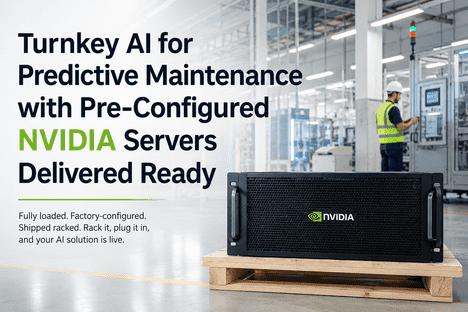
iFactory ships a pre-configured NVIDIA edge server — Jetson Orin, IGX Thor, or DGX Station — with pre-loaded LSTM and CNN models, pre-built PLC/SCADA connectors, and on-site engineering support. Power and internet are the only things you provide. From PO to production AI running on your plant data: 6–12 weeks. One fixed price. Zero recurring license fees.
TensorRT Optimization — What Makes GPU Inference 5x Faster
NVIDIA TensorRT is the software layer that transforms a standard AI model into a GPU-optimized inference engine. Without TensorRT, even a powerful GPU underperforms because the model is not structured to exploit the parallel architecture of CUDA cores. TensorRT compiles trained models — PyTorch, TensorFlow, ONNX — into execution graphs optimized for the target GPU. Three specific optimizations drive the measured 5x inference speedup on industrial PdM models. iFactory pre-compiles all LSTM, CNN, and ensemble models with TensorRT for each target NVIDIA platform before shipment, so plants get production-ready inference performance from day one.
01
Kernel Fusion
TensorRT fuses adjacent layers in the neural network — convolution, batch normalization, activation — into single kernel launches. A model with 50 layers that launches 50 sequential kernels on CPU becomes 8–12 fused kernel launches on GPU, eliminating memory bandwidth bottlenecks between layers.
50 layers → 8–12 fused kernels
02
Reduced-Precision Arithmetic
TensorRT automatically selects the optimal precision for each layer — FP32 for sensitive operations, FP16 or INT8 for computationally intensive layers, FP4 on Blackwell hardware. Reduced precision doubles or quadruples throughput while maintaining 90%+ prediction accuracy on industrial fault classification datasets.
FP32 → FP16/INT8/FP4 precision
03
Dynamic Batching & Memory Management
TensorRT dynamically batches inference requests from multiple sensor streams, processing 8–32 simultaneous FFT windows in a single GPU pass. CUDA memory pooling reuses GPU memory across inference cycles, eliminating allocation overhead that adds 5–15ms per inference on CPU-based frameworks.
8–32 simultaneous FFT batches
04
Layer-Specific Kernel Autotuning
TensorRT benchmarks hundreds of kernel implementations for each layer during compilation — different tiling strategies, thread block configurations, and memory access patterns — and selects the fastest configuration for the specific GPU model. The autotuning runs once at compile time; the plant runs the optimized graph permanently.
Autotuned per GPU architecture
The iFactory Deployment Architecture — NVIDIA Hardware + AI Software + Zero Data Egress
iFactory does not sell GPU hardware as a separate line item. The complete NVIDIA edge server — pre-racked, pre-cabled, burn-in tested, with IEC 62443 SL-3 OT cybersecurity zoning — ships as part of a single fixed-price turnkey package. The AI models are pre-loaded. The PLC/SCADA connectors are pre-built and tested. The Shift Logbook and CMMS integration are configured during on-site deployment. Power and internet are the only things your plant provides. All sensor data, all model inference, and all prediction records stay inside your facility network. The architecture is designed around five layers that map directly to the physical deployment.
Layer 1
Sensor & PLC Data Ingestion
Existing accelerometers, RTDs, current transducers
PLC data streams via OPC-UA / Modbus / MQTT
SCADA historian read-only integration
50 kHz sampling rate support via GPU ingest pipeline
No new sensors required. iFactory reads from existing instrumentation through standard industrial protocols. Read-only connections preserve OT network security.
Layer 2
NVIDIA Edge Inference Server
Jetson Orin / IGX Thor / DGX Station hardware
IEC 62443 SL-3 cybersecurity hardened
TensorRT-optimized models pre-loaded
Racked, cabled, burn-in tested before shipment
GPU-accelerated inference runs entirely on-premise. Sub-15ms latency. Zero cloud round-trip. Full data sovereignty by architecture, not by configuration workaround.
Layer 3
AI Model Inference Pipeline
Parallel FFT across all frequency bands
LSTM / CNN fault classification
Four-stage severity scoring
Trajectory-based RUL estimation
TensorRT-optimized models classify bearing, gearbox, pump, and fan faults simultaneously across all monitored assets. Every sensor stream processed in parallel on GPU cores.
Layer 4
Shift Logbook & CMMS Integration
Auto-generated work orders with fault classification
Operator dashboard with health scores
AI-generated shift summaries
Immutable audit trail for compliance
Every classified fault, severity score, and RUL estimate flows to the iFactory Shift Logbook with full traceability. Work orders auto-create in existing CMMS systems with recommended corrective actions and spare part numbers.
Want to see the GPU-accelerated inference pipeline running on your asset types? Book a Demo and our deployment team will configure a live demonstration environment with your sensor data streams and asset profiles.
What GPU-Accelerated Predictive Maintenance Delivers for Rotating Equipment Reliability
The business case for NVIDIA GPU-accelerated predictive maintenance is not about hardware performance benchmarks — it is about catching fault signatures that CPU-based systems miss entirely. Plants migrating from CPU-based periodic analysis or cloud-dependent AI platforms to on-premise GPU-accelerated continuous monitoring see measurable improvements across four metrics in the first quarter post-deployment.
<15 ms
Fault detection latency
GPU-accelerated TensorRT inference detects bearing harmonic shifts, gear tooth cracks, and pump cavitation events in under 15 milliseconds from raw sensor input — fast enough to catch transient signatures that occur in millisecond windows.
50–200×
Speedup over CPU inference
What takes 40–60 seconds per asset on a CPU completes in 20–200 milliseconds on a TensorRT-optimized NVIDIA GPU. The same LSTM model that runs in 75ms on CPU runs in under 15ms on Jetson.
90%+
Prediction accuracy maintained
TensorRT reduced-precision optimization (FP16, INT8) delivers 5x faster inference while maintaining 90%+ classification accuracy on industrial bearing, gearbox, and pump fault datasets.
20–40 TB
Daily throughput per GPU node
A single NVIDIA IGX Thor or Jetson cluster processes 20–40 terabytes of high-frequency sensor data per day — compared to 200–500 GB ceiling on CPU-based edge nodes operating at the same sampling rates.
Expert Perspective
"The single biggest mistake industrial AI teams make in predictive maintenance infrastructure is treating GPU acceleration as an optional performance upgrade. It isn't. The physics of bearing fault detection require sampling rates of 25–50 kHz to catch incipient spall signatures. CPU-based edge nodes physically cannot sustain those sampling rates across more than 10–15 assets simultaneously. The data queues, the inference latency climbs past 40 seconds per asset, and the transient harmonics that precede spall initiation by 14–28 days are aliased out of the captured signal entirely. NVIDIA GPUs process every sensor stream in parallel — 200 assets, 50 kHz sampling, FFT across all frequency bands simultaneously, all completing in under 15 milliseconds. The architectural decision is not whether to use GPU acceleration. It is whether your predictive maintenance system will detect faults at Stage 1 or miss them until Stage 3."
— Industrial AI Infrastructure Practice, 2026 industry insight
<15 ms
GPU inference from sensor to classified fault alert
Zero cloud
data egress · on-premise inference with air-gap option
6–12 wk
turnkey deployment with pre-loaded NVIDIA stack
Frequently Asked Questions
Do we need to replace our existing vibration sensors and PLC infrastructure to use NVIDIA GPU-accelerated predictive maintenance?
No. iFactory's platform integrates with existing accelerometers, RTD temperature probes, current transducers, and PLC data streams through standard industrial protocols — OPC-UA, Modbus, MQTT, and REST APIs. The NVIDIA edge server reads from your existing instrumentation through read-only connections that preserve OT network security. No sensor replacement, no PLC reprogramming, no data migration required. The GPU acceleration layer sits between your existing sensor infrastructure and your CMMS — it does not require changes to either.
What inference latency improvement can we expect moving from CPU-based to GPU-accelerated anomaly detection?
Production benchmarks on identical LSTM models show 50–200x latency improvement. A CPU-based edge node processing 50 sensor streams at 25.6 kHz sampling rates exhibits 40–60 seconds per-asset inference latency due to sequential FFT queuing. The same model on a TensorRT-optimized NVIDIA Jetson or IGX Thor completes inference in 20–200 milliseconds — with all 50 sensor streams processed in parallel on CUDA cores. The practical result: transient fault signatures that occur in millisecond windows — bearing harmonic shifts, cavitation events, gear tooth crack propagation — become detectable at Stage 1 instead of being aliased out of the captured signal.
Which NVIDIA hardware platform is right for our plant's scale and asset count?
iFactory matches hardware to workload during the scoping session. For 1–10 critical assets, Jetson Orin (100–275 TOPS) delivers sub-15ms inference at the edge. For plant-wide deployment across 50–500 assets, IGX Thor (5,581 FP4 TFLOPS) processes all sensor streams simultaneously with 200GbE connectivity. For plants requiring on-premise model training alongside inference, DGX Station or H200 HGX provide data-center-class compute in a tower form factor with no liquid cooling requirement. iFactory does not default to the largest GPU — we size to your actual asset count, sampling rates, and model complexity.
How does TensorRT optimization affect model accuracy for industrial fault classification?
TensorRT reduced-precision optimization (FP16, INT8, FP4 on Blackwell hardware) selectively applies lower precision to computationally intensive layers while preserving FP32 precision for sensitive operations. Independent benchmarks on industrial bearing fault, gearbox wear, and pump cavitation datasets demonstrate 90%+ classification accuracy maintained after TensorRT optimization — compared to 92% baseline accuracy on the same models at full FP32 precision. The 5x inference speedup is achieved without statistically significant accuracy degradation for industrial PdM use cases. iFactory pre-compiles and validates all models with TensorRT before shipment.
What is the deployment timeline and what does iFactory provide versus what our plant team needs to supply?
iFactory delivers the complete NVIDIA edge server — pre-racked, pre-cabled, burn-in tested, with IEC 62443 SL-3 cybersecurity zoning — as part of a single fixed-price turnkey package. AI models are pre-loaded and TensorRT-optimized for your asset classes. PLC/SCADA connectors are pre-built and tested. On-site engineering handles cabling, network configuration, model baseline collection, and operator training. Power and internet access credentials are the only things your plant provides. Total elapsed time from PO to production GPU-accelerated predictive maintenance: 6–12 weeks. Year-one remote monitoring and model retraining included. No recurring license fees.
Deploy NVIDIA GPU-Accelerated Predictive Maintenance in Your Plant
iFactory ships a pre-configured NVIDIA edge server — Jetson Orin, IGX Thor, or DGX Station — with pre-loaded TensorRT-optimized models, pre-built PLC/SCADA connectors, and on-site engineering support. Power and internet only. One fixed price. Zero recurring license fees. From PO to production: 6–12 weeks.